
TL;DR — Kibbe clothing at a glance
- Kibbe clothing is guided by line flow, silhouette, and fabric weight — not by clothing size or body measurements. A size 8 and a size 18 can share the exact same Kibbe type and follow identical cut rules.
- Three levels must align: silhouette (the outer line of the outfit), line (the internal seams, patterns, and details), and material (weight, texture, drape). If even one of these is off, the entire outfit looks unbalanced — even if the other two are right.
- Dramatic types need long, clear, unbroken lines. Romantic types need fluid, curve-enhancing cuts. Natural types need relaxed shapes with organic texture. Classic types need symmetry and moderation. Gamine types need compact, high-contrast details.
- The most common mistake: dressing the body you wish you had — instead of the one you do. Kibbe clothing amplifies your natural line rather than correcting it.
- If you don't yet know your type, the Kibbe quiz on this site or the professional Kibbe analysis will help.
Kibbe clothing: Kibbe clothing refers to cuts, silhouettes, and materials that suit the natural Yin-Yang balance of a specific Kibbe type. The system defines concrete recommendations for each of the 13 types regarding line flow (straight vs. curved), fabric weight (structured vs. fluid), cut length, neckline shape, and pattern scale. The goal is not camouflage — but coherence: clothing and body should read as a harmonious whole, not as two separate elements.
Contents
- The core principle: why clothing size has nothing to do with Kibbe clothing
- The three clothing levels — silhouette, line, and material
- Dramatic family: clothing for Dramatic and Soft Dramatic
- Natural family: clothing for Flamboyant Natural, Natural, and Soft Natural
- Classic family: clothing for Dramatic Classic, Classic, and Soft Classic
- Gamine family: clothing for Flamboyant Gamine, Gamine, and Soft Gamine
- Romantic family: clothing for Theatrical Romantic and Romantic
- The 3 most common Kibbe clothing mistakes
- Building a capsule wardrobe for your Kibbe type
- FAQ — Frequently asked questions about Kibbe clothing
The core principle: why clothing size has nothing to do with Kibbe clothing
Conventional fashion thinking sorts women by measurements: hourglass, apple, pear, rectangle. Then come blanket recommendations like "accentuate the waist" or "minimise the hips". Kibbe does the opposite.
David Kibbe was not interested in how tall someone is or how much they weigh. He was interested in the visual line of the body — the way bones, flesh, and proportions work together to create a specific, objectively recognisable presence. Two women of the same height and the same clothing size can be completely different Kibbe types, because their bone structure, body line, and distribution of Yin and Yang are fundamentally different.
That is the core idea: Kibbe clothing suits the natural line of the body — not a tape measure. A Dramatic type needs long, straight, sharp lines, whether that's a size 4 or a size 22. A Romantic type needs soft, curve-enhancing, fluid cuts — in exactly the same size range.
"Your body is not the problem. It is the solution. Clothing must follow its natural language — not work against it." — David Kibbe, Metamorphosis (1987)
What this means in practice: if you are a Soft Natural type wearing stiff, fitted blazers, you are "correcting" your natural line. The result is not a better outfit — it is an outfit that fights your body. This is exactly why so many women have the vague feeling that "something isn't right", even though the piece of clothing is objectively beautiful.
The three clothing levels — silhouette, line, and material
Before we get to the individual types: every outfit is assessed on three levels in the Kibbe system. If even one of them doesn't suit the type, the overall picture suffers.
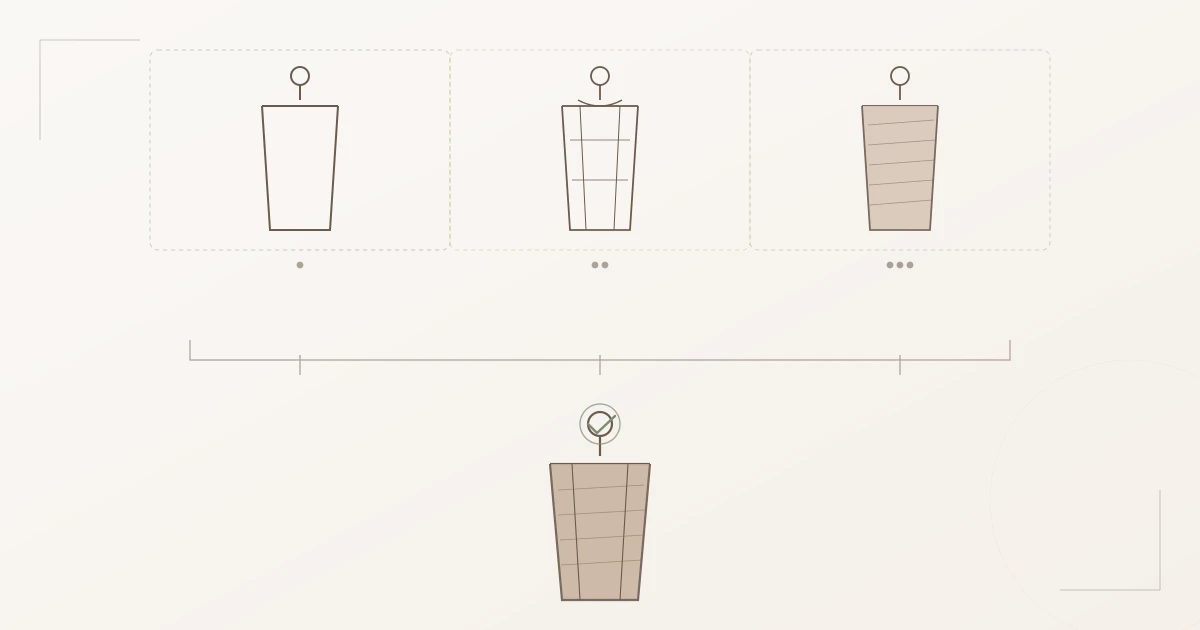
Level 1: Silhouette
The silhouette is the outer line of the outfit — the shape created when you look at someone from 5 metres away. Is it straight and vertical? Soft and A-shaped? Structured and symmetrical? The silhouette is the most important level. No detail can save a wrong silhouette.
Level 2: Line
The line encompasses the internal structures of the outfit: seams, cut direction, pattern direction, embroidery, ruffles, collar, neckline. Horizontal lines interrupt verticality (bad for Dramatics). Round details create softness (good for Romantics, too much for Gamines). Straight, parallel lines give structure (good for Classics, too stiff for Naturals).
Level 3: Material
The fabric weight and texture must match the body line. A Flamboyant Natural in stiff, structured tweed looks armoured — not stylish. The same type in soft, relaxed knitwear or linen reads as immediately balanced. A Dramatic in fluid, soft chiffon loses their sharp lines in the fabric — the silhouette collapses.
| Kibbe family | Silhouette | Line | Material |
|---|---|---|---|
| Dramatic | Long, narrow, vertical | Straight, sharp, geometric | Heavy, structured, smooth |
| Natural | Relaxed, slightly asymmetric | Loose, flowing, organic | Soft, textured, loosely woven |
| Classic | Symmetrical, moderate, balanced | Even, controlled, calm | Medium weight, refined, smooth |
| Gamine | Compact, sharply defined, high-contrast | Broken, staccato, playful | Light to medium, crisp or soft |
| Romantic | Soft, curvy, body-hugging | Curved, round, flowing | Light, fluid, lustrous |
Dramatic family: clothing for Dramatic and Soft Dramatic
The Dramatic family is the most Yang-dominant of all Kibbe families. Dramatics have sharp, vertically emphasised bones — often tall or at least with a large presence. Their natural line is straight, sharp, and powerful. Clothing must pick up and amplify this energy — not "feminise" it.
Dramatic (D)
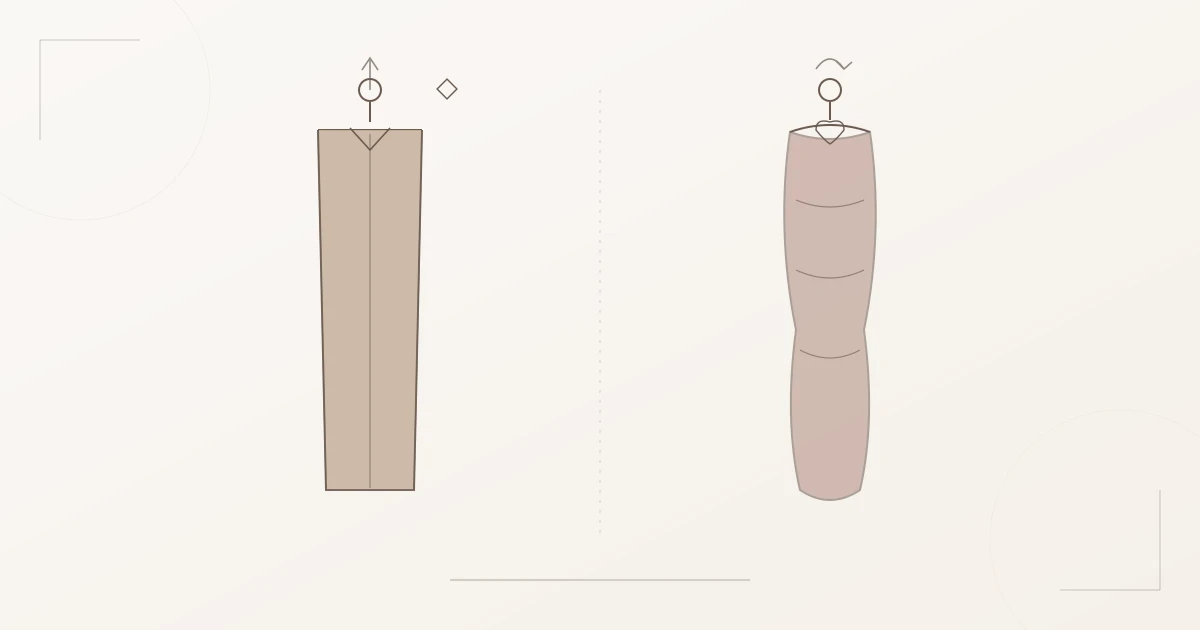
The Dramatic type is pure Yang. Bones are sharp and angular, the body line is slender and vertical, facial features are chiselled and expressive. The clothing principle: long, clear, unbroken vertical lines. Any interruption of this verticality — a cropped top, a wide belt, a ruffled detail — weakens the effect.
- Silhouettes: Long, straight coat; slim-cut full-length trousers; midi and maxi dresses with a sharp A-line or straight silhouette
- Cuts: Sharp shoulder lines, deep V-necklines, geometric collars; asymmetric details are allowed — as long as they emphasise verticality
- Fabrics: Heavy crepe, structured satin, leather, wool blends with body; no soft, fluid chiffons that soften the sharp line
- Patterns: Large-scale and abstract; geometric; no florals, no paisley, no small-scale patterns
- Accessories: Statement jewellery, sculptural pieces; no delicate chains or feminine details
Soft Dramatic (SD)
The Soft Dramatic carries the Yang foundation of the Dramatic — but with a significant Yin overlay. Typically: the bones are sharp and long, but the body has curves, often a pronounced hip and bust line. Clothing must serve both: dramatic length and sharpness combined with curve emphasis. An SD in straight, shapeless cuts loses their Yin energy. An SD in small, romantic prints loses their Yang structure.
- Silhouettes: Fishtail dresses; wrap dresses in maxi length; body-hugging long skirts; V-shaped necklines with fluid drape
- Cuts: Open backs; draping at the waist; soft, constructed shoulders (no epaulette look)
- Fabrics: Heavy silk, chiffon with substance, jersey with drape; fabrics must flow AND fall — no stiff structural weaves
- Patterns: Large-scale and lush; florals in large scale are allowed; tropical prints; no small patterns
| Dramatic — What works | Dramatic — What doesn't work |
|---|---|
| Long, straight wool coat | Short blazer with ruffle details |
| High-necked, straight midi dress in black | Babydoll dress or empire line |
| Geometric large earrings | Delicate pearl necklace or floral hair accessory |
| Full-length trousers with a sharp crease | Cropped trousers or Bermuda shorts |
| Monochrome, elongated looks | Many small patterns or colourful combinations |
Natural family: clothing for Flamboyant Natural, Natural, and Soft Natural
The Natural family stands for moderate Yang — broad, grounded, relaxed. Naturals often have broad shoulders, an athletic or slightly irregular body structure, and a naturally "relaxed" appearance. Their clothing must reflect this organic energy: neither too stiff nor too soft, neither too structured nor too undefined.
Flamboyant Natural (FN)
Tall, broad, athletic with pronounced bones. The Flamboyant Natural is the most imposing of all Natural types. They need clothing with relaxed width, layering, and organic lines. Tight, body-hugging cuts suppress their energy. Small feminine details look out of place.
- Silhouettes: Wide, fluid trousers; oversized shirts and blazers (not stiff, but draped); maxi dresses with movement; layering
- Fabrics: Linen, knitwear, denim, soft leather; natural fibres with texture; no smooth, synthetic fabrics without character
- Prints: Large-scale, irregular, nature-inspired — wood grain, abstract batik, wide stripes; no small florals or geometric patterns
Natural (True Natural, N)
Broader than Classic, but less tall than FN. The True Natural has a relaxed, slightly asymmetric line. Clothing should fall loosely without being too wide. They can carry slight waist definition, but not a sharp tailored silhouette.
- Silhouettes: Jeans in relaxed or straight cut; casual blazers; unstructured jackets; dresses with an easy fall
- Fabrics: Cotton, jersey, soft denim, linen — natural and breathable
Soft Natural (SN)
The Soft Natural is the Yin representative of the Natural family. Broad bones, but a softer, rounder body line — often with a pronounced waist and hips. The most common mix-up: Romantic. The difference is bone width — SNs have broad shoulders, Rs do not. Clothing must be loosely soft while still hinting at the waist.
- Silhouettes: Wrap dresses in fluid fabric; lightly waist-defined blouses over wide trousers; blouse skirts with volume; no tight pencil skirts
- Fabrics: Chiffon, lightweight silk, cotton blends with drape; no stiff fabrics, no tweed
- What to avoid: Structured suits; tight body-hugging dresses; anything that "imprisons" the natural width
Classic family: clothing for Dramatic Classic, Classic, and Soft Classic
Classic types are the most balanced of all Kibbe families — perfect or near-perfect Yin-Yang balance. Their clothing reflects this: symmetry, moderation, and controlled elegance. Extremes in any direction make a Classic look overdressed or underdressed — too much drama, too much volume, too much romance.
Dramatic Classic (DC)
Classic foundation with Yang emphasis. The Dramatic Classic has exactly balanced proportions, but the overall impression tilts slightly towards the severe and sharp. They can carry sharper tailoring details than a True Classic, but not the full Dramatic spectrum.
- Silhouettes: Tailored trouser suit; trench coat with clean lines; A-line pencil skirt; midi dresses with a defined shoulder
- Fabrics: Heavy crepe, tweed, wool blends; smooth, high-quality fabrics without texture
- Details: Asymmetry in small doses allowed; sharp collars; no ruffles or excessive draping
Classic (True Classic, C)
Perfect 50/50 balance between Yin and Yang. Everything must be symmetrical, moderate, and calm. This sounds restrictive — it isn't. Classic types can wear all the classic fashion archetypes: trench, blazer, A-line, ball gown in midi length. The keyword is "moderate": no extreme cuts, no extreme materials, no extreme colours.
- Silhouettes: A-line skirts in knee-to-midi length; fitted jackets; dresses with defined but not exaggerated proportions
- Fabrics: High-quality medium-weight materials — gabardine, crepe, silk, satin; no extreme textures
- Accessories: Classic, timeless, moderate — no statement pieces and no jewellery minimalism; the golden mean
Soft Classic (SC)
Classic foundation with Yin emphasis. The Soft Classic has balanced proportions, but a softer body line and softer facial features. They can carry feminine details that would be too soft on a True Classic — but not the full Romantic spectrum.
- Silhouettes: Wrap dresses with a defined but gentle waist; blouses with soft folds; skirts with slight volume
- Fabrics: High-quality silk, lightweight crepe, chiffon with substance; nothing too stiff, nothing too fluid
- Details: Small buttons, soft ruffles as accents, floral patterns in small to medium scale — everything in moderation
| Type | Clothing motto | The one thing that doesn't work |
|---|---|---|
| Dramatic Classic | Tailored power dressing | Maximal draping or ruffle overload |
| True Classic | Timeless elegance without extremes | Too much of everything — pattern, volume, sharpness |
| Soft Classic | Elegant feminine refinement | Completely shapeless or too stiff a look |
Gamine family: clothing for Flamboyant Gamine, Gamine, and Soft Gamine
Gamine types are the most compact and highest-contrast segment in the Kibbe system. They have a petite or moderate stature, but their bones and facial features create a strong Yin-Yang contrast — sharp bones beside soft roundness, sharpness beside playfulness. Clothing must pick up on this contrast and play with it — not smooth it out.
Flamboyant Gamine (FG)
Yang-dominant with a compact body. The Flamboyant Gamine has sharp, angular facial features and a straight, compact figure. They can carry bold, geometric cuts and menswear elements. Too feminine and fluid reads as lost on the compact body.
- Silhouettes: Knee-to-thigh length; compact jackets and blazers; shirt dresses; overalls with a sharp line
- Cuts: Geometric collars; button-front details; sharp shoulders; short, defined layers
- Patterns: Geometric, stripes, large-scale checks, abstract print; no florals, no paisley
- Accessories: Statement earrings, clear geometric pieces; no romantic jewellery
Gamine (True Gamine, G)
Perfect Yin-Yang contrast in a compact body. The True Gamine recipe: contrast on all three levels. Not continuously Yang, not continuously Yin — but a mix that coexists in the same outfit. A structured top over a soft skirt. A fitted jacket over a playful blouse.
- Silhouettes: Short to knee-length; mix of tailoring and softness; defined waist
- Fabrics: Mix of crisp and soft — stiff collar, fluid skirt; structured blazer, lightweight blouse
Soft Gamine (SG)
Yin-dominant with a compact body. The Soft Gamine has softer body lines than FG and G, but still the characteristic contrast of the Gamine family — just expressed more softly. Not the full Romantic spectrum, not the full Gamine spectrum: sweet, compact, with a defined waist and soft details.
- Silhouettes: Fitted and flared; defined waist with full skirt; short A-line; baby doll — but with structure
- Fabrics: Lightweight cotton, poplin, delicate chiffon with structure; no heavy fabrics, no pure fluid
- Details: Small buttons, puff sleeves (moderate), Peter Pan collar, delicate embroidery; no large statement elements
- What to avoid: Oversize; extremely long silhouettes; anything that buries the compact figure
Romantic family: clothing for Theatrical Romantic and Romantic
The Romantic family is the counterpart to the Dramatic family — pure Yin. Soft, round, curvy, lush. This does not necessarily mean full figures: Yin describes the quality of the lines — their softness and roundness — not body mass. A slender woman can be a Romantic type if her bones and body line are soft and curvy.
Theatrical Romantic (TR)
Yin-dominant — but with a Yang accent, typically through sharp, expressive facial features. The Theatrical Romantic needs soft, curve-enhancing clothing with one sharp detail. A purely romantic, rounded outfit feels incomplete; a sharp, dramatic detail provides the necessary energy.
- Silhouettes: Body-hugging dresses in midi length; wrap dresses; deep V-necklines with draping
- The Yang detail: Sharp collar; a structured corset element; clearly defined neckline; statement jewellery with an edge
- Fabrics: Heavy silk, satin, velvet — luxurious materials with drape and weight
- Patterns: Large-scale florals; leopard; rich ornamentation — always lush, never small-scale
Romantic (R)
This is pure Yin — the softest, roundest, most lush energy in the entire Kibbe system. Every line must be fluid, curved, and body-close. Straight lines, angular cuts, or structured silhouettes suppress the natural romance. The most common misconception: Romantics think they need to look "slimmer" — and reach for straight, camouflaging cuts. The opposite works.
- Silhouettes: Body-hugging, curve-enhancing dresses; mermaid and fishtail cuts; fitted waist with flare; short to knee length (longer lengths only with drape)
- Cuts: Round necklines; sweetheart necklines; ruffled necklines; soft puff sleeves; any form of draping
- Fabrics: Silk, chiffon, satin, lace, lightweight draping fabrics; nothing with body or stiffness
- Patterns: Small to medium florals; paisley; soft, organic patterns; no geometry, no abstract print
- What to avoid: Oversized, shapeless looks; straight pencil silhouette without curve emphasis; heavily structured materials
| Type | Core principle | Key fabric | To avoid |
|---|---|---|---|
| Theatrical Romantic | Soft + sharp accent detail | Heavy silk, satin, velvet | Straight, shapeless cuts; no Yang element |
| Romantic | Soft, curvy, lush — consistently | Chiffon, lightweight silk, lace | Any straight, structured line |
The 3 most common Kibbe clothing mistakes
These three mistakes are the ones I encounter most frequently in my consulting work. They cut across all types — Dramatics make them just as much as Romantics.
Mistake 1: Dressing the body you wish you had instead of your own type
It is the most common and most painful clothing trap: you dress the version of your body you wish you had — not the one you actually have. As a Natural type you wear sharp, structured tailored looks because you want to appear "stricter" or "more defined". As a Romantic type you wear straight, slimming cuts because you want to look "smaller".
The result is always the same: the outfit fights your body. You invest energy in an image that doesn't feel real — and still don't look the way you want to. Kibbe reverses the principle: your natural body is not the problem to be solved. It is the starting point you work with.
Mistake 2: Judging individual pieces instead of the overall picture
A pair of trousers is never beautiful or wrong in isolation. It is part of a system. A sharp, fitted wool trouser can be stunning on a Dramatic Classic — and the same style looks stiff and wrong on a Soft Natural. If you shop on the principle of "I like it — it suits me", you will keep falling into the same trap: a good piece of clothing, the wrong overall picture.
The solution is systems thinking: don't evaluate the individual item — evaluate how it interacts with your body, your other pieces, and your natural line. That is the core of any good style consultation — and the reason why Kibbe knowledge alone sometimes isn't enough when the implementation is missing.
Mistake 3: Prioritising colour and pattern over silhouette
Colour is the most appealing element in an outfit — it catches the eye, evokes emotions, brings joy. That is why it is tempting to choose clothing by colour. But colour is the third-ranking variable in the Kibbe system. Silhouette and line come first. A beautiful burgundy blazer in the wrong cut is a wrong blazer — no matter how well the colour sits.
This does not mean colour is unimportant. Colour analysis and Kibbe complement each other beautifully — but they have clear hierarchies. If you are unsure which consultation makes more sense for you, the colour analysis vs. style consulting comparison provides a detailed decision guide.
Building a capsule wardrobe for your Kibbe type
A capsule wardrobe is a small, fully combinable wardrobe made up of pieces you actually wear. The Kibbe approach makes capsule wardrobes significantly more precise — instead of generic Pinterest lists, you get type-specific rules that filter every purchasing decision.
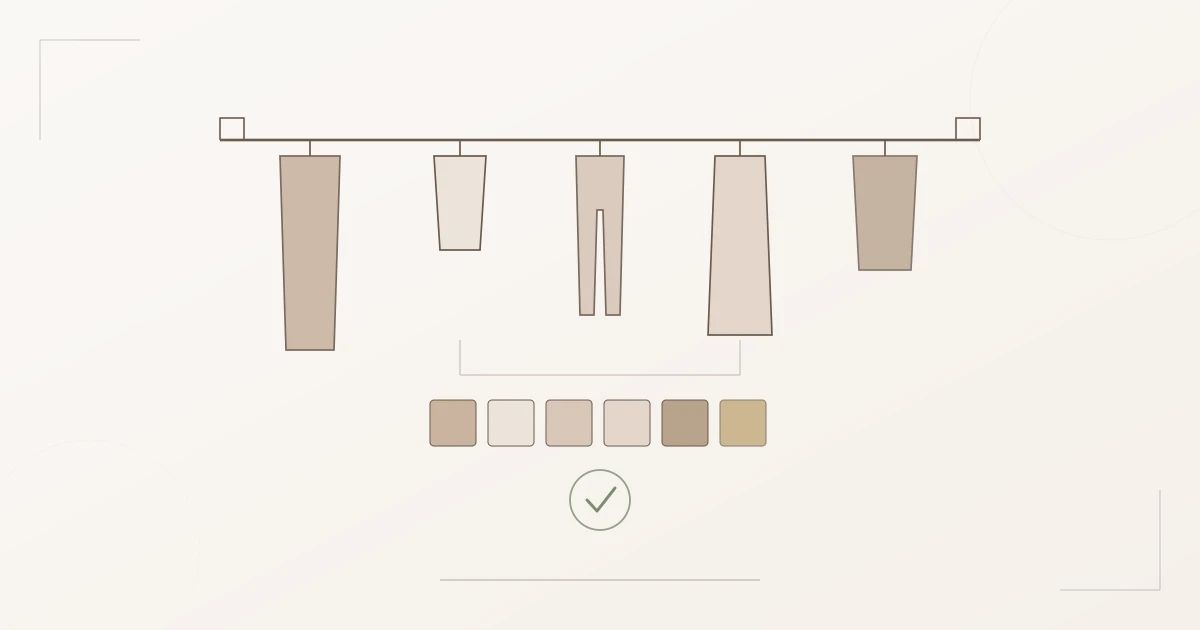
Step 1: Define your type rules
Before you shop, write down the three core rules of your type for each of the three clothing levels (silhouette, line, material). These become your shopping filter. If a piece of clothing violates one of these rules, it does not belong in your wardrobe — regardless of how affordable it is or how much you like it in the shop.
Step 2: Start with 3 base silhouettes
Every type has two or three silhouettes that work universally. For Dramatic: long coat, straight trousers, midi dress. For Romantic: wrap dress, A-line with waist emphasis, body-hugging trousers. For Soft Natural: wide jumper over a fluid skirt, wrap blouse over straight trousers, loose dress with waist tie. Invest first in these base silhouettes in neutral colours.
Step 3: Restrict your fabrics
Only buy fabrics that suit your type. This is the most important and simultaneously the most frequently ignored rule. A Dramatic type replacing structured crepe with cheap synthetic loses the body that holds the silhouette up. A Romantic type replacing chiffon with stiff cotton loses the drape that emphasises the curves. Fabrics are not a luxury — they are a function.
Step 4: Choose accessories according to type proportions
Accessories follow the same rules as clothing. A Dramatic needs statement jewellery in large proportions. A Romantic needs delicate, lush pieces — small pearls, floral brooches. A Gamine needs contrasting combinations — a structured belt over a soft dress, or geometric earrings over a playful blouse. The most common accessory mistake: pieces that are too small for Dramatics and too large for Romantics.
Step 5: Let your type decide — not the trend
This is the real freedom that Kibbe gives you: you no longer need to follow seasonal trends. If a trend doesn't suit your type, you don't buy it. If it fits, you integrate it. Instead of chasing every trend and feeling like you're starting from scratch each season, you build a wardrobe that feels better year after year — because every addition is deliberate and type-compatible.
Professional Kibbe wardrobe consulting
A Kibbe analysis gives you the exact rule set for your type. A wardrobe consultation goes one step further: we analyse together what is already working in your wardrobe — and what can go. The result is a wardrobe you actually wear.
The complete package (analysis + wardrobe + shopping) is available from €450. Free initial call via WhatsApp — 30 minutes, no obligation.
How the balanced middle dresses in practice — with symmetry, moderation, and tailored, timeless polish — is covered in the detailed Classic guide.
And if you're petite and compact but never feel right in long, smooth silhouettes? Then it's worth looking at the Gamine Kibbe type — the only type that needs not the unbroken but the deliberately broken line.
The soft branch of the Gamine family has its own deep-dive: the Soft Gamine Kibbe type — compact and high-contrast like every Gamine, but with rounded edges instead of hard ones and sweet details instead of geometric.
The sharp branch of the Gamine family has its own deep-dive: the Flamboyant Gamine Kibbe type — compact and high-contrast like every Gamine, but with hard edges instead of soft rounded ones and geometric precision instead of sweet details.
The soft branch of the Classic family has its own deep-dive: the Soft Classic Kibbe type — harmoniously symmetric like every Classic, but with softer cheeks, a subtly visible feminine curve, and soft flowing details instead of neutral hardness.
FAQ — Frequently asked questions about Kibbe clothing
Can I wear clothing that doesn't suit my Kibbe type?
Yes — Kibbe is not a fashion police. You can wear whatever you want. The system gives you tools, not rules. The difference: when you wear type-compatible clothing, the outfit needs no additional explanation. It simply looks right. When you consciously choose otherwise, that is a valid aesthetic choice — but not an expression of your natural type.
What is the difference between Kibbe clothing and classic figure styling?
Classic figure styling tries to optimise the body — accentuate the waist, minimise the hips. Kibbe clothing tries to amplify the natural body line — not correct it. There are no "problem areas" in the Kibbe system. There are only lines that are coherent or not.
I don't know my Kibbe type — how do I find it?
There are two paths: the Kibbe quiz on this site for an initial assessment, or the professional Kibbe analysis for a confirmed result with a personal PDF. Online self-tests are wrong 60–70% of the time — especially if you are torn between two types.
Does height make a difference with Kibbe clothing?
Yes, but not in the way you might think. Height primarily affects the scaling principle: a Flamboyant Natural in small patterns loses visual presence. A Soft Gamine in large-scale prints looks overwhelmed. The basic rules remain constant by type — but the proportioning of details scales with height.
Do I have to buy expensive clothing to dress my Kibbe type correctly?
No. Kibbe clothing is not a price segment — it is a question of cut and material. A well-cut, Kibbe-compatible piece from a budget retailer works better than a wrong cut from a designer label. Knowledge of your type makes you a better shopper — not a more expensive one.
What if I fall between two Kibbe types?
This is more common than you might think — especially with types that are close to each other (Soft Natural / Romantic, Soft Dramatic / Theatrical Romantic, Dramatic Classic / True Classic). In this case the step-by-step guides in the Kibbe Test Guide help you clarify the most common mix-ups. When uncertainty persists, a professional analysis is the fastest route.
Can a Natural type wear feminine dresses?
Yes — but the femininity must be expressed in harmony with the Natural line. For a Soft Natural this means: a wrap dress in fluid fabric is feminine and type-compatible. A tight pencil dress in stiff fabric is feminine and type-incompatible. The question is not whether a piece of clothing is feminine — but whether the femininity is expressed in the right way.
Can my Kibbe type change with age?
No. The Kibbe type is based on bone structure — which does not change. What changes: body flesh, weight, posture. These can temporarily shift the appearance, but they do not change the type itself. A well-analysed Kibbe diagnosis is valid for life. This is one of the greatest advantages of the system over trend-based style consulting.
What is the difference between a Romantic and a Soft Gamine?
Both are Yin-dominant — but the bone structure is fundamentally different. Romantic types have soft, fine bones without pronounced contrast. Soft Gamine types have sharp, angular bones (often on a small scale) that create contrast against the soft flesh areas. In clothing terms: Romantics need no interruptions, no contrasts. Soft Gamines always need at least one contrasting detail accent.
Can I determine my Kibbe type from photos by myself?
Partially — but with considerable risk of error. The most common problems with self-assessment: self-perception is distorted by social beauty ideals; photos overemphasise 2D measurements rather than 3D body lines; facial assessment is very error-prone without a trained eye. The complete guide to all 13 types gives you a solid foundation — but for a reliable result, a trained second pair of eyes is decisive.
Which Kibbe types most often wear the wrong clothing?
In my consulting practice the most frequent are: Romantic types wearing camouflaging straight cuts; Dramatic types choosing soft, feminine cuts because they want to appear "more feminine"; and Soft Natural types wearing fitted business attire because they perceive it as more professional. In all three cases the clothing fights the natural line — and the result is an outfit that looks neither slim, nor professional, nor feminine.
Are there Kibbe-compatible ways to incorporate current fashion trends?
Yes — and this is one of the most practical aspects of the system. When a trend (e.g. barrel-leg trousers or corset tops) suits your type, you integrate it. When it doesn't, you simply leave it. This eliminates the impulse-buy trap: you don't buy something because it is everywhere right now — only when it fits your type rule set. That saves money, space, and the energy that would otherwise go into returning wrong purchases.
Ready for your personal clothing guide?
Find out what really suits you
This article gives you the rule set. A professional Kibbe analysis gives you your personal result — with concrete cut recommendations, fabric suggestions, and an individual result PDF. Free initial call always included.