
TL;DR — Kibbe Test in Brief
- A Kibbe test assigns you to one of 13 style types — Dramatic, Natural, Classic, Gamine, Romantic and their subtypes — based on bone structure, body proportions and facial features.
- Online self-tests are wrong in roughly 60–70% of cases because self-perception is systematically distorted — especially regarding Yin/Yang balance and bone structure.
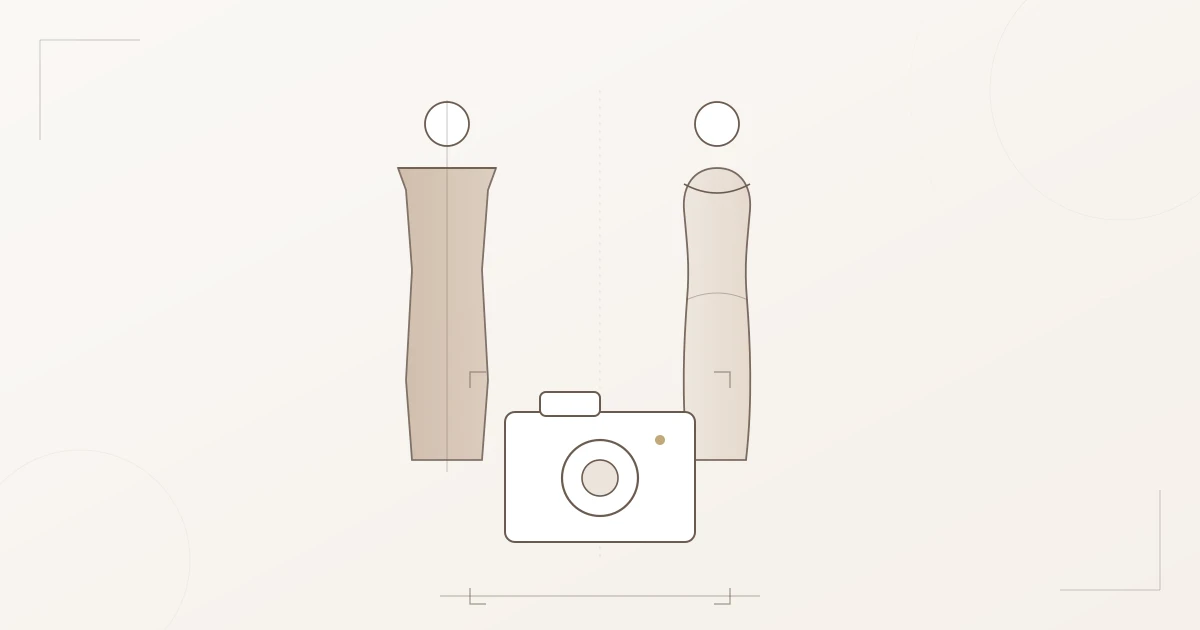
- The most honest self-test requires four full-body photos in fitted clothing, a neutral facial photo and a maximum of 15 minutes without a mirror.
- If your result fluctuates between two or three types, you are almost always a mixed type — not one of the "pure" family types.
- A professional analysis by a certified style consultant is the only method that reliably identifies the correct type when results are ambiguous.
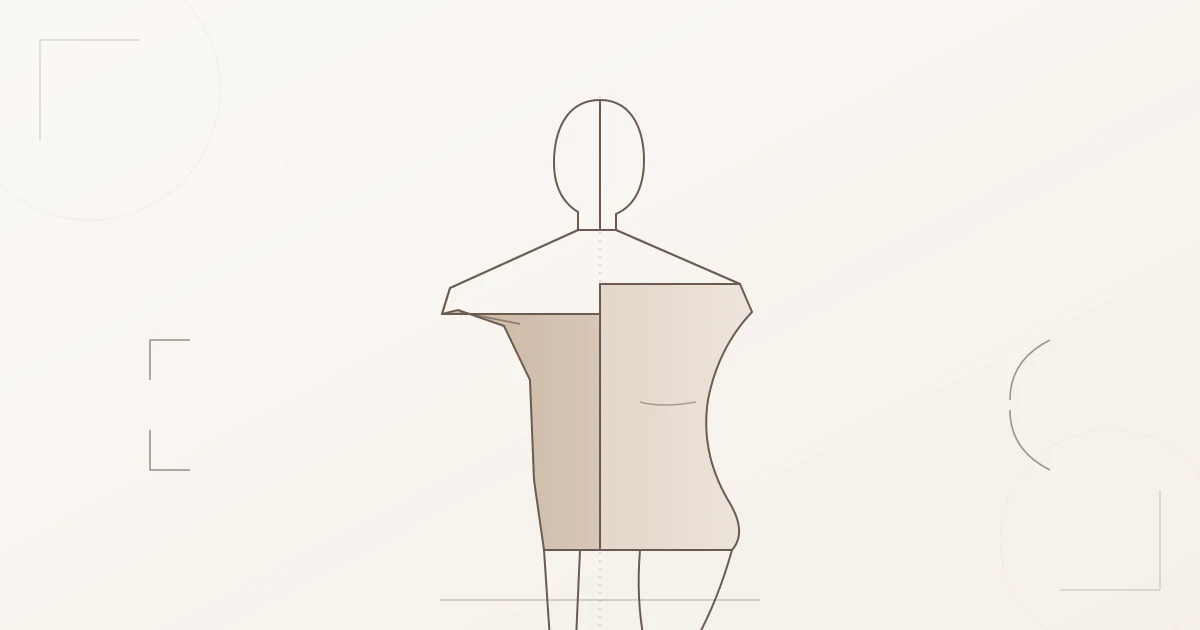
Kibbe Test: A Kibbe test is the structured self-assessment of your body and face according to the 13-type system developed by David Kibbe. The test consists of 15 to 20 questions about bone structure, body flesh, facial bones and facial flesh. Each answer belongs to one of three categories: Yin (soft, rounded), Yang (angular, straight) or Balance. The evaluation assigns you to one of 13 Kibbe types, showing which clothing, cuts and materials truly suit your natural appearance.
Prefer fast & interactive?
This page is the detailed manual method for doing it yourself. If you would rather go fast and skip the reading, click through the interactive image quiz in 5 minutes.
Contents
- What is a Kibbe test — and what isn't it?
- How the Kibbe system works
- Kibbe self-test: step-by-step guide
- The 13 Kibbe types compared directly
- The 5 most common mistakes in a Kibbe test
- Which Kibbe type am I? — Interpreting your result correctly
- Online test vs. professional analysis
- What to do with your result
- FAQ — Frequently asked questions about the Kibbe test
What is a Kibbe test — and what isn't it?
A Kibbe test is not a personality quiz. It does not capture preferences, style direction or "Soft Girl" or "Old Money" aesthetics. Instead, it analyses your objective physical presence: How are your bones structured? How is your body flesh distributed? Which lines dominate in your face?
David Kibbe developed his system in the 1980s in New York. His book "Metamorphosis" (1987) is the foundation for all credible tests today. The system distinguishes 13 types along a Yin-Yang scale:
- Yang means angular, straight, sharp, vertical — typically: Dramatic
- Yin means soft, rounded, curvy — typically: Romantic
- Balance is the symmetrical centre — typically: Classic
Every person has an individual mix of Yin and Yang. The test determines which side predominates and in what form it manifests.
"Kibbe does not analyse body shape, but how the overall body image affects the viewer — angular, soft, mixed." — David Kibbe, Metamorphosis
How the Kibbe system works
The system evaluates four areas, each on a 5-point Yin-Yang scale:
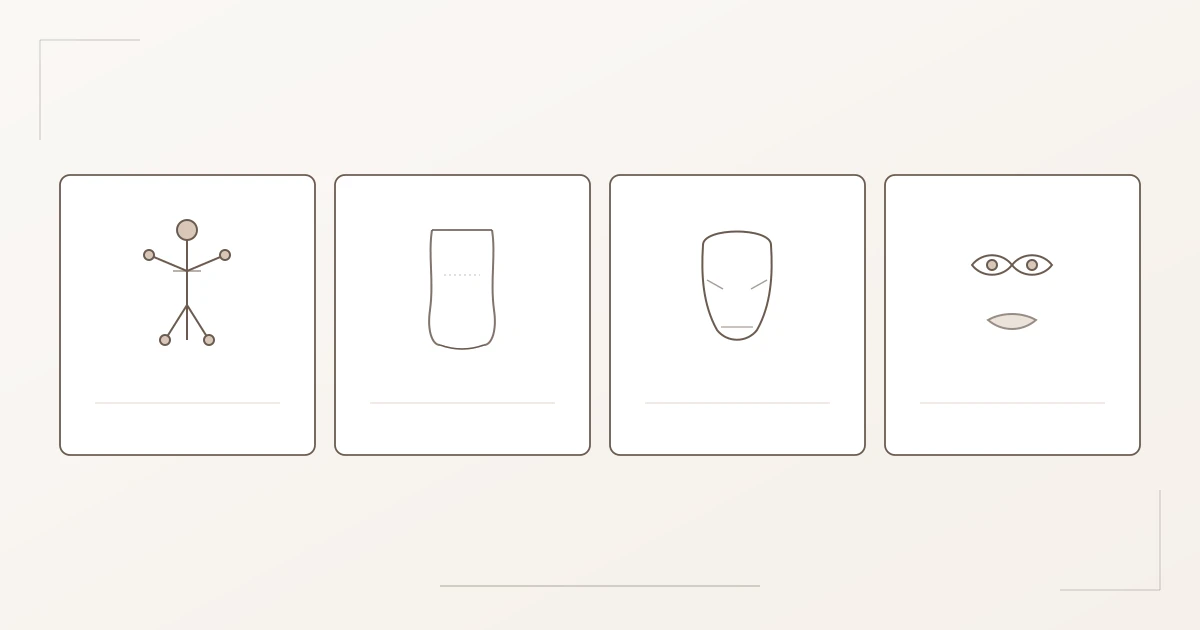
1. Bone structure (vertical line, shoulders, limbs)
Long, narrow bones with sharp angles indicate Yang. Short, rounded bones with soft transitions indicate Yin. Medium length and symmetrical is Balance.
2. Body flesh (distribution at upper body, hips, arms)
Lean, taut flesh without visible curves is Yang. Lush, rounded flesh with pronounced curves is Yin. Moderate distribution without a dominant impression is Balance.
3. Facial bones (jaw, cheekbones, nose)
Sharp, angular jawline and prominent cheekbones are Yang. Soft, rounded lines are Yin. Symmetrical, moderate contours are Balance.
4. Facial flesh (eyes, lips, cheeks)
Narrow lips and small eyes read as Yang. Full lips and large, rounded eyes read as Yin. Moderate size and shape is Balance.
The relationship between these four areas determines your type. Those who show pure Yang in all four areas are Dramatic. Those who combine Yang bones with Yin flesh are Soft Dramatic. Those who show Balance throughout are Classic.
Kibbe self-test: step-by-step guide
Here is how an honest self-test works. Allow about 30 minutes — and do it alone, without a mirror.
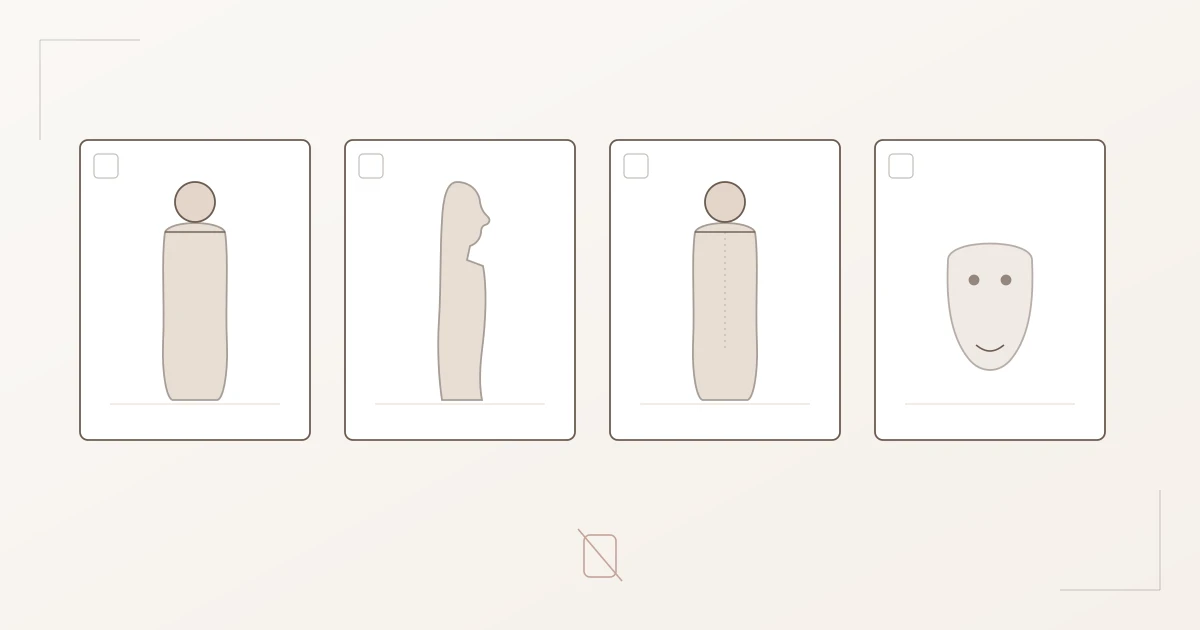
- Photograph yourself correctly. Stand in fitted clothing (sports top and leggings) in front of a white wall. Natural daylight from the front, no shadows. You need: one full-body photo from the front, one in profile, one from behind and a facial photo in a neutral position.
- Put your phone down. Look at the photos as though looking at a stranger. Mirror images distort perception — photos are more honest.
- Assess your bone structure. Are your shoulders broader than your hips (Yang), narrower (Yin) or equal (Balance)? Are your hands long and narrow (Yang) or small and rounded (Yin)?
- Assess your body flesh. Do you have a defined waist with a curvy hip-to-bust ratio (Yin)? Or a rather straight, athletic build (Yang)?
- Assess your facial bones. Is your jawline and are your cheekbones clearly defined (Yang) or soft and rounded (Yin)?
- Assess your facial flesh. Do you have full lips and large, almond-shaped or round eyes (Yin)? Narrow lips and smaller eyes (Yang)?
- Count the tendencies. More Yang than Yin → Dramatic family. More Yin → Romantic. Balanced → Classic. Combinations result in the subtypes.
- Write down your result — and let it rest for 48 hours. Read it again after that. Does it still match what you see in the photos?
The 13 Kibbe types compared directly
Here you can see all 13 types with their Yin-Yang balance and dominant characteristic — sorted from extreme Yang to extreme Yin:
| Kibbe type | Family | Yin/Yang | Dominant |
|---|---|---|---|
| Dramatic | Dramatic | Pure Yang | Vertical line, sharp edges |
| Soft Dramatic | Dramatic | Yang + lush Yin | Tall and curvy |
| Flamboyant Natural | Natural | Yang + Natural | Broad, athletic lines |
| Natural | Natural | Soft Yang | Broad shoulders, relaxed |
| Soft Natural | Natural | Natural + slight Yin | Broad shoulders, soft curves |
| Dramatic Classic | Classic | Balance + Yang accent | Symmetrical, slightly angular |
| Classic | Classic | Pure Balance | Perfectly symmetrical |
| Soft Classic | Classic | Balance + Yin accent | Symmetrical, slightly soft |
| Flamboyant Gamine | Gamine | Contrasting Yin/Yang | Small, angular, playful |
| Gamine | Gamine | High contrast | Petite, energetic |
| Soft Gamine | Gamine | Gamine + lush Yin | Small, curvy, youthful |
| Theatrical Romantic | Romantic | Romantic + Yang accent | Petite, curvy, defined |
| Romantic | Romantic | Pure Yin | Full curves, soft |
Each type has its own style logic. A detailed description of all types can be found in our complete guide to the 13 Kibbe types or on the Kibbe overview pages.
The 5 most common mistakes in a Kibbe test
After over 100 analyses I have recognised patterns that almost every woman shows when doing the self-test. If you find yourself in one of these points, your current result is probably wrong.
Mistake 1: You judge yourself by your current clothing size
The Kibbe system is weight-independent. A Romantic stays a Romantic whether she weighs 110 or 200 pounds — because bone structure and Yin-Yang balance do not change. Many women suddenly identify as Dramatic after weight loss, even though they are a Soft Natural. This is the most common mistake.
Mistake 2: You confuse height with Yang
Yang does not mean "tall." Yang means "angular, vertical, sharp." A 6-foot woman with rounded shoulders and soft curves is not a Dramatic — she is probably Soft Natural or Soft Dramatic. Height is just one of many factors.
Mistake 3: You orientate yourself by "reference points" from social media
TikTok and Pinterest are full of mistypings. If an influencer claims to be Soft Gamine, that says nothing about your type. Most mistypings online come from women just starting with the system — not from certified analysts.
Mistake 4: You fixate on facial features
The face is only one of four assessment areas. Having large, round eyes does not automatically make you a Romantic — if your bone structure is Yang, your type remains Dramatic or Soft Dramatic. The overall balance decides, not the individual feature.
Mistake 5: You choose the type you like
Many women wish they were Romantic or Soft Gamine because these types are considered "beautifully feminine." That is a wishful-thinking bias. Your Kibbe type is not better or worse — it is simply who you are. The honest answer is always more useful than the flattering one.
And if you suspect your previous result is wrong: the guide Mistyped Your Kibbe Type? covers the 7 warning signs of a mistype, the most common mix-up pairs, and a 5-step correction process.
Which Kibbe type am I? — Interpreting your result correctly
You have done the self-test and have a result. Now comes the harder part: Is it really right?
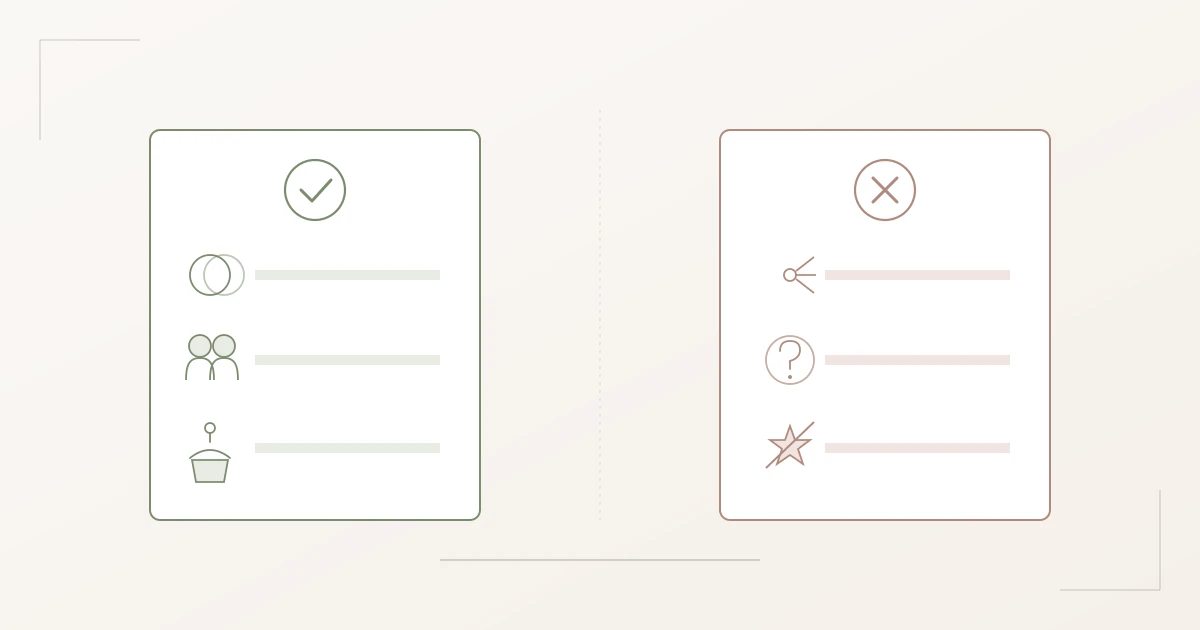
You can recognise a reliable result by three criteria:
- Consistency. When you do the test again after a week, you get the same result.
- Recognition. Your sister, your mother or your best friend confirms the result intuitively.
- Practice. You try on typical clothing for your type — and it actually suits you better than what you usually wear.
If even one of these criteria does not apply, your result is probably wrong. That is normal — self-assessment is methodologically difficult. It is not a failure.
When you are probably right
- You have been able to clearly assign yourself to a family (e.g. "clearly Romantic family").
- You can recognise the typical features in your photos.
- You actually feel more comfortable in the recommended fabrics and silhouettes.
When you are probably wrong
- You are wavering between three or more types.
- You get a different result every time you do the test.
- The recommended clothing looks odd on you.
- You are orientating yourself in the self-test by celebrity examples — almost all are incorrectly typed online.
Online test vs. professional analysis — when is which worth it?
Both routes have their place. Here is an honest comparison:
| Criterion | Online self-test | Professional analysis |
|---|---|---|
| Accuracy | 30–40 % | 90–95 % |
| Time required | 15–30 min. | 3–5 working days |
| Cost | €0 | €150 |
| For mixed types | Regularly fails | Identifies clearly |
| Style dossier | Generic or none | Individual, ~6 page PDF |
| Follow-up questions possible | No | Yes, 1:1 consultation |
| Self-perception bias | Fully active | Counterbalanced |
A self-test is a good starting point if you want to get to know the system. For real clarity — especially when you are investing money in your wardrobe — a professional analysis is more reliable. More information can be found on my packages overview.
What to do with your result
A Kibbe type without application is just a label. The real goal is a wardrobe that works for you. Here are the next steps:
1. Learn the lines of your type
Each type has characteristic silhouettes, cuts and lengths. A Dramatic wears sharp, clean lines — a Romantic wears soft, rounded ones. Learn not just the rules, but why they work.
2. Analyse your current wardrobe
Which pieces align with your type? Which are mistakes? A wardrobe analysis brings structured clarity here — you go through every piece with a professional eye.
3. Only buy according to your type from now on
Before buying anything, ask: "Does this suit my lines?" If not — leave it, even if it's on sale. This one question saves hundreds of euros in mistaken purchases over time.
4. Understand materials and structures
Fabric makes half the look. A Romantic needs soft, flowing materials like silk and velvet. A Natural needs rough, structured fabrics like linen and tweed. This too is part of your type.
5. Stay with your type — for years
Trends come and go. Your Kibbe type stays. Once you know your type and shop consistently according to it, you will build a wardrobe within 12 to 24 months where no doubt arises in the morning.
"You don't need to start fresh every season. You only need to understand who you are once." — Jola Deja, certified style consultant
FAQ — Frequently asked questions about the Kibbe test
How reliable is an online Kibbe test?
Online self-tests are wrong in 60 to 70 percent of cases — especially for mixed types and for women who already have a distorted self-image through social media. They are a good introduction to the system, but not a reliable basis for expensive purchasing decisions. For real clarity, a professional photo analysis by a certified style consultant is the more reliable route.
What photos do I need for a Kibbe test?
You need four full-body photos in fitted clothing (sports top and leggings) in front of a white wall in natural daylight: from the front, in profile, from behind and a neutral facial photo. No mirror selfies. No poses. Hands relaxed, face neutral. The photos are the most important basis for any honest analysis.
What does a professional Kibbe analysis cost?
A professional Kibbe analysis with a personal style dossier costs €150 at JO-Style. This includes the photo analysis, a detailed questionnaire, your personal style dossier as a PDF with cuts, materials and outfit guidance, and a 30-minute 1:1 results consultation. The initial consultation is free and non-binding.
Can I find out my Kibbe type on my own?
Yes, with discipline and honesty it is possible. You need good photos, a solid guide, at least 30 minutes of uninterrupted time and ideally a second person who is detached from you. Self-assessment is methodologically challenging but not impossible. Plan for several attempts and allow waiting time between tries.
What is the difference between Kibbe and body shape types like apple or hourglass?
Classical body shape systems only evaluate hip-waist-bust ratio. The Kibbe system instead analyses bone structure, body flesh, facial bones and facial flesh and places them in a Yin-Yang relationship. The result is significantly more precise and provides recommendations for materials, patterns, accessories and even hairstyles — not just cuts. More on this in our comparison on the Kibbe overview.
Which Kibbe type is most common?
Statistically the Natural family (Natural, Soft Natural, Flamboyant Natural) is the most widespread — approximately 35 to 40 percent of women fall into this group. Pure Dramatic and pure Romantic are the rarest types, each under 5 percent. This is also why many self-tests incorrectly return Romantic or Dramatic — both are overrepresented in pop culture.
Does my Kibbe type change with age?
No. Your Kibbe type is based on bone structure and natural proportions, which do not change after puberty. What changes is weight and skin elasticity. A 25-year-old Soft Natural is still Soft Natural at 65 — the lines remain the same, even if the skin is no longer as firm.
Does Kibbe work for plus-size or very slim women?
Yes, the system is weight-independent. A plus-size Romantic stays Romantic, a very slim Dramatic stays Dramatic. What counts is the Yin-Yang balance of your bone structure — and that does not change with clothing size. This is one of the most important advantages of Kibbe over classical body shape systems.
What is my Kibbe type if I am wavering between two results?
If you are clearly wavering between two neighbouring types — say Natural and Soft Natural — you are probably actually the softer subtype. If you are wavering between two types from different families (say Dramatic and Romantic), there is almost always a self-test error involved. In this case a professional analysis is worthwhile, because the Yin-Yang balance is often misjudged here.
Conclusion: Your next step
A Kibbe test is the entry point into a system that can simplify your clothing choices for years. But it is only as good as your self-assessment — and that is methodologically difficult.
If you really want to know which Kibbe type you are, there are two routes:
- Self-test with patience: Do the test multiple times, look at photos instead of mirror images, take your time. Accept that in 60 to 70 percent of cases you won't get it perfectly right.
- Professional analysis: A certified style consultant delivers a clear result in 3 to 5 working days with an individual style dossier and a personal consultation.
If you would like to take the professional analysis route: my free 30-minute initial consultation is non-binding. We clarify whether the consultation suits you — without pressure.
Ready for clarity?
Book a free initial consultation
30 minutes, non-binding, online or in person in the Märkisches Sauerland and Dortmund area.
Schedule a consultationSources: David Kibbe, "Metamorphosis" (1987) · The Concept Wardrobe — Kibbe Body Types · Kibbe Body — Photo Analysis · Own consulting experience JO-Style