
Table of Contents
The Quick Answer
Quick Answer
If your Kibbe result is wrong, you’ll notice it as a recurring pattern: the cuts recommended “for your type” still look wrong on you, different tests deliver different results, and your result violates the system’s hard rules — first and foremost the height rule (above roughly 168 cm, Romantic and Gamine types are ruled out; below roughly 160 cm, the pure Dramatic is). The most common causes: self-perception instead of an outside eye, fixation on a single feature (“I have curves, so I must be a Romantic”), distorted photos, and wishful thinking. This guide shows you the 7 warning signs, the 5 most commonly confused pairs — and how to correct your typing cleanly in 5 steps.
Three tests, three results: Soft Natural one time, Romantic the next, “something Classic-ish” the third. If that sounds familiar, you are not the problem — you are the normal case. Even in the big international Kibbe communities, where strangers type one another from photos, only a fraction of requests ever reach anything resembling agreement. In the Kibbe system, mistyping is not the exception — it is the most likely outcome of a do-it-yourself attempt. The good news: it follows predictable patterns — and once you know the patterns, you can correct them.
Why Self-Tests Get It Wrong So Often
The Kibbe Body Type System determines your type from bone structure, body flesh, and facial features — traits that objectively exist. And yet self-tests fail in droves. That is rarely the system’s fault and almost always comes down to five sources of error in how it is applied:
1. Self-perception is not analysis
The heart of the problem: you have seen yourself in the mirror your whole life — along with every story you tell yourself about your body. If you have always felt “too broad,” you tick “broad shoulders” even when your shoulders are objectively narrow. If you feel curvy, you see curves where the underlying lines are straight. This is exactly why self-assessment and professional outside analysis notoriously diverge when it comes to typing — not because women don’t know themselves, but because nobody can see their own bone structure neutrally.
2. Crowd-typing is guessing with an audience
In online forums where strangers type one another from photos, the same woman is routinely assigned three or four different types depending on the photo and whoever happens to show up that day — a large share of “type me” requests never reach a consensus. No wonder: reading lines is a trained eye, not a majority vote. And even David Kibbe himself stresses that photos can deceive — uncontrolled snapshots with wide-angle distortion, filters, and posed stances are simply not analysis material.
3. Fixating on a single feature
The classic: “I have a large bust, so I’m a Romantic.” Or: “I’m slim, so Dramatic.” But Kibbe doesn’t work additively over single features — it works through the overall picture of vertical line, bones, flesh, and face. One single Yin feature on an otherwise clearly structured Yang body does not make a Romantic — at most, it makes a Soft subtype. If you type backwards from your most striking feature, you will almost inevitably land in the wrong place.
4. Vague test questions produce “Classic as the fallback answer”
Many self-tests work with wording like “rather long,” “slightly pronounced,” “average” — and whoever is unsure picks the middle. The result: a systematic drift toward the Classic family that has nothing to do with your actual line and everything to do with how the questions are built. (This is exactly why our redesigned Kibbe test works with image options instead of word scales and makes height a required field — more on that in a moment.)
5. Wishful thinking
The quietest but most stubborn error: having a favorite result before the test even begins. Certain types are considered more desirable in the communities — and the answers unconsciously bend in that direction. An honest typing starts with the willingness to accept an unexpected result. The system knows no “better” or “worse” anyway — only different line logic. Whatever type comes out: it is the key to clothes that finally work, not a verdict.
7 Warning Signs Your Type Is Wrong

How do you tell that your current typing is off? By these signals — the more of them apply, the more certain the mistyping:
- The recommendations don’t work. You follow the cuts recommended “for your type” — and still look like you’re wearing a costume, swallowed up by the clothes, or older than you are. The single most important signal of all: the right type shows up in the mirror immediately.
- Different tests, different results. Two or more differing results from different sources mean: at least one of them is wrong — probably several.
- Your result breaks the height rule. You’re 172 cm and got “Romantic”? Impossible — more on that below. Hard rule violations are the fastest proof of a wrong result.
- Your type “changed” with your weight. After gaining or losing weight, a different result came out. The Kibbe type is based on bone structure — it cannot change with your weight. If it “does,” at least one of the typings was wrong.
- You had to agonize over many of the questions. If you waver between two answers on half the questions, you produce a random result. Clarity in the inputs is the prerequisite for clarity in the result.
- Your result rests on a single feature. If your placement essentially boils down to one sentence (“because I have curves,” “because I’m tall”), it is standing on one leg.
- The description fits, the clothes don’t. Type descriptions are like horoscopes — there is something that rings true in almost every one. The real test is not the description but the silhouette on your body: if the recommended lines don’t harmonize, even the most flattering type description won’t help.
The Height Rule: The Hardest Filter in the System
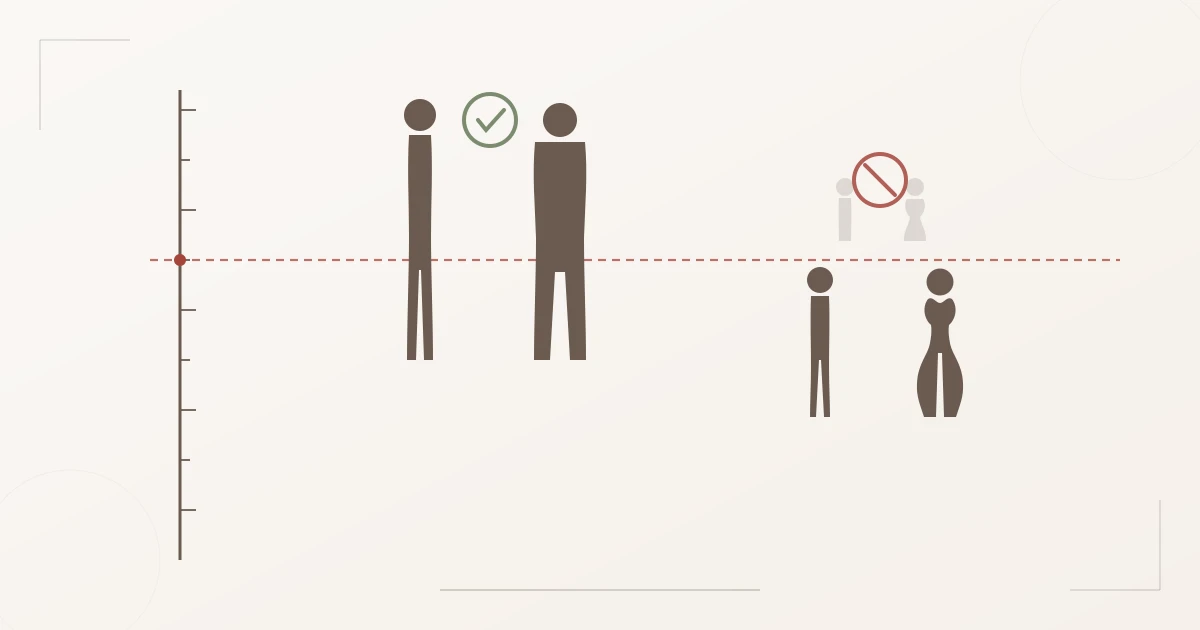
If you take only one rule away from this article, make it this one: In the Kibbe system, height is not a soft trait — it is a hard filter. The vertical line comes first in every typing, and it categorically rules out entire families:
| Your Height | Ruled Out | Why |
|---|---|---|
| Above approx. 168 cm | Romantic, Theatrical Romantic, all Gamine types | These types are defined by a short vertical line — genuine height contradicts their foundational line |
| Below approx. 160 cm | Pure Dramatic, Flamboyant Natural | Both live on visible length — on a petite frame, the same sharp features lead to different types (e.g. Flamboyant Gamine) |
| In between | Nothing categorically | Here, bones, flesh, and face decide — height acts as a tendency, not an exclusion |
This rule is why a 1.74 m woman with soft curves is not a Romantic but almost certainly a Soft Dramatic — the same softness, but on a long line. And why a 1.55 m woman with sharp features is not a Dramatic but more likely a Flamboyant Gamine: the same sharpness, but as contrast rather than length. The features stay — the family changes with the vertical line. That is exactly why our Kibbe test has made height a required question since its last revision and applies these exclusions automatically.
The 5 Most Commonly Confused Pairs
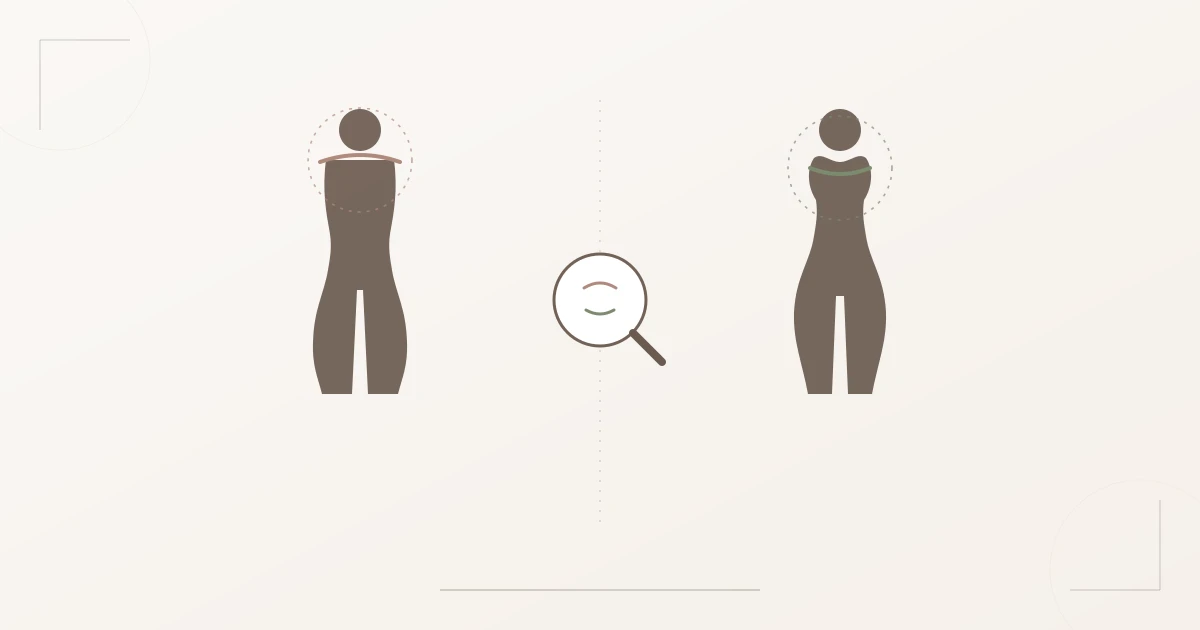
Mistypings are not randomly distributed — they almost always happen between the same neighboring types. The five most common pairs, and the distinguishing feature that settles each one:
Soft Natural ↔ Romantic
Both have soft body flesh and curves — the difference lies underneath: Soft Natural has a broad, blunt Yang bone structure (visible in shoulder width and sturdier joints), while Romantic has consistently delicate, rounded Yin bones. The practical check: do your shoulders look present and fairly straight even without padding? Then Soft Natural. Do they disappear into a soft slope? Then Romantic. The complete deep dive on the Soft Natural covers exactly this distinction in detail — it is no coincidence that it is the most frequently mistyped type of all.
Theatrical Romantic ↔ Soft Dramatic
The community classic, often wrongly explained as “SD is just tall TR.” In reality, the two are structurally different: Theatrical Romantic is Yin-dominant (delicate bones, curves) with a small sharp undertone; Soft Dramatic is Yang-dominant (long, sharp bone structure) with soft flesh on top. The first filter, once again, is height: TR stays petite, SD needs length. The second filter: are the bones delicate or prominent?
Soft Classic ↔ Soft Gamine
Both petite to medium in height, both blends with Yin — yet fundamentally different in principle: Soft Classic is balance (everything even, harmonious, nothing stands out), Soft Gamine is contrast (a delicate frame with strikingly lively, opposing details — large eyes, angular accents in a soft face). The practical check: do strangers describe you as “elegant and harmonious” or as “bubbly and full of life”?
Flamboyant Natural ↔ Natural (and Soft Natural)
All three share the broad, blunt bone structure. The dividing line is the vertical: Flamboyant Natural needs clear length (usually from ~168 cm upward) plus additional sharpness in the bones; the moderate Natural middle and the softer Soft Natural stay more compact. If you are a 1.63 m woman whose test said “Flamboyant Natural,” you should question that result.
“Something Classic-ish” ↔ your actual type
The most common test artifact: Classic as the catch-all for the undecided. True Classic is rare — it demands consistent symmetry and evenness in bones, flesh, and face. If you always ticked the middle whenever you weren’t sure, repeat the test and this time compare honestly on every feature instead of dodging. The full walkthrough of what a clean test run looks like is in the guide Kibbe Test: Which Type Are You Really?
For the Yin side of these mix-ups, there is a complete deep-dive: Romantic Kibbe Type — the complete analysis, including a self-check and the full wardrobe logic.
Weight Doesn’t Change Your Type — Ever
Direct Answer
The Kibbe type is based on bone length, joint size, and facial structure — traits that do not change in adulthood. When your weight changes, only the fullness over the same structure changes, never the structure itself. If you get a different test result after a diet, you tested wrong at least once — very likely because fullness traits (“soft,” “curvy”) were confused with structural ones.
This misconception is so stubborn because classic body shape systems (apple, pear, hourglass) really do tip over with weight — they measure circumferences, after all. Kibbe measures something else, and that is exactly what makes the system valuable long-term: a correct typing is valid for life. Why the two systems get mixed up so often, and what each of them actually measures, is explained in the comparison Kibbe vs. Body Shape Type.
For self-typing, that means concretely: answer flesh questions (“soft or taut?”) for your usual weight — not for an exceptional state after a crash diet or an unusually indulgent phase. And if you are comparing two test runs that straddle a weight change: don’t trust either of them blindly.
How to Correct Your Typing in 5 Steps
If several warning signs apply, redo the assessment — but this time methodically instead of by feel:
- Apply the hard filters first. Measure your height (don’t guess!) and apply the exclusion table above. That immediately eliminates several candidates — before a single soft trait is assessed.
- Replace the mirror with standardized photos. Full body, front and side, straight posture, close-fitting clothes, neutral daylight, camera at chest height — no wide-angle, no filter, no pose. Photos reveal proportions that years of mirror-gazing have “normalized away.”
- Assess structure before fullness. Bones first (shoulder line, wrists, facial bones in the photos), then flesh, then face — in that order. If you start with your most striking feature, you are typing backwards and will land right back in the old mistake.
- Do the fabric test. The most practical cross-check: actually try on the two suspected neighboring types — e.g. a sharply cut, straight piece against a softly flowing one. Your body answers the question faster than any questionnaire: one line feels right, the other feels borrowed. (The 4-question self-check from our comparison guide helps with the shortlist.)
- If doubt remains, bring in an outside eye. A cleanly executed self-test — such as our free Kibbe test with required height input and image options — gives you a reliable initial read. If two types are still in the running after that, this is the point where a professional analysis makes the difference: a trained eye, standardized photo assessment, a reasoned placement. The guide to online style consultation shows how that works in practice.
The effort pays off for one simple reason: every style decision built on a wrong type passes the error down — into your closet, onto your shopping list, into expensive bad buys. A corrected type, on the other hand, is a one-time investment of an hour or two of care that makes every single purchase decision sharper from then on.
A classic example of this fine distinction is the Romantic / Theatrical Romantic pair: the same petite curvy base — but a fine sharp undertone in the cheekbones and chin decides between two different styling lines.
The Dramatic / Flamboyant Natural pair is another classic fine distinction: both tall and straight — but narrow, sharp bones on one and broad, blunt bones on the other, and two completely different wardrobes follow from that.
The most prominent example of a default misdiagnosis is the Classic type: "no extremes, so I must be Classic" is the most common fallacy in the whole system — yet true Classic balance is an active, moderate symmetry, not an absence of features.
The most frequently overlooked case is the Gamine: someone who reads as "sharp one moment, soft the next" and seems to fit no category is often unknowingly describing exactly its contrast signature — here the contradiction is the trait.
The most frequently overlooked Gamine variant is the Soft Gamine: compact, soft, and with visible sharp contrast points. Those who mistake themselves for a too-soft Romantic or a too-compact Theatrical Romantic often end up here.
The most frequently underestimated Gamine variant is the Flamboyant Gamine: compact, angular, and wiry — the sharp geometric Yang variant of the Gamine family. Those who mistake themselves for a too-short Dramatic or a too-angular Soft Gamine often end up here.
The Kibbe type most frequently dismissed as "I just don't know" is the Soft Classic: medium-height, harmonious, subtly soft without dominant extremes. Those who find no sharp Yang edges and no lush Yin abundance but still see a gently feminine note often end up here — the refined-soft Classic variant is frequently overlooked because it displays no extremes.
Frequently Asked Questions (FAQ)
How can I tell that my Kibbe type was determined incorrectly?
Most reliably by three signals: the recommendations for your type still look wrong on you, different tests deliver different results, and your result violates hard rules — such as Romantic or Gamine despite a height above roughly 168 cm. The more of these signals apply, the more likely you have been mistyped.
Why do I get a different result on every Kibbe test?
Because self-tests hinge on self-perception, vague questions, and inconsistent methodology. Different results mean: at least one of them is wrong. Redo the assessment methodically — hard filters first (height), standardized photos instead of the mirror, and assess structure before fullness.
Can I be a Romantic at 170 cm?
No. Romantic and Theatrical Romantic are defined by a short vertical line — above roughly 165–168 cm they are ruled out. A tall woman with soft curves is almost certainly a Soft Dramatic: the same softness, but on a long Yang structure.
Can I be a Dramatic at 155 cm?
Practically speaking, no. The pure Dramatic lives on visible length. On a petite frame, the same sharp, angular features lead to Flamboyant Gamine (sharpness as contrast) or — with a Yin component — to Theatrical Romantic.
Does my Kibbe type change if I gain or lose weight?
No, never. The type is based on bone length, joint size, and facial structure, which remain stable in adulthood. Weight change only alters the fullness over the same structure. A “changed” test result after a diet means that at least one of the two typings was wrong.
Which Kibbe types get confused most often?
The most common pairs: Soft Natural ↔ Romantic (difference: the bone structure beneath the curves), Theatrical Romantic ↔ Soft Dramatic (difference: height and bone dominance), Soft Classic ↔ Soft Gamine (balance vs. contrast), Flamboyant Natural ↔ Natural (vertical line) — and Classic as the fallback answer when test responses are unclear.
Is Soft Natural really the most frequently mistyped type?
It is reliably among the most common cases — because soft body flesh is quickly read as “Romantic” while the broad Yang bone structure underneath gets overlooked. The practical check is the shoulder line: present and fairly straight points to Soft Natural, softly sloping to Romantic.
Why does almost every test say I’m a Classic type?
Usually a test artifact: picking the middle option whenever you are unsure automatically drifts the result toward Classic. True Classic demands consistent symmetry in bones, flesh, and face — it is far rarer than test results suggest. Repeat the test and make an active call on every feature instead of dodging.
How do I take photos for a reliable self-typing?
Full body from the front and the side, straight relaxed posture, close-fitting single-color clothing, neutral daylight, camera at chest height and at a distance (no selfie wide-angle), no filters, no posing. The goal is proportions you can assess, not pretty pictures.
Can I fall between two Kibbe types?
You can waver between two types — but the system assigns each person exactly one type; many of the 13 types are themselves already defined blends (e.g. Soft Dramatic as Yang with a Yin undertone). Persistent indecision between two neighboring types is the classic signal that a trained outside eye should make the call.
Why bother correcting my type if my clothes look “okay”?
“Okay” is exactly what a half-right type produces: nothing is wrong, nothing truly fits. The difference between neighboring types decides shoulder cut, drape, lengths, and details — precisely the factors that turn “it’ll do” into “this actually suits me.” And every purchase based on the wrong type repeats the mistake.
When is a professional analysis worth it instead of more self-tests?
At the latest, when two types are still in the running after a methodically clean self-test — or before you make bigger investments based on your type (anchor pieces, a wardrobe overhaul). A professional analysis works with standardized photos and a trained eye, and delivers a reasoned placement complete with a style dossier instead of yet another guess.
Enough guesswork.
Take the redesigned Kibbe test with required height input and image options — or have your type professionally determined once and for all, with a reasoned placement and a personal style dossier.