
Table of contents
- The short answer
- Why decluttering is so hard: the psychology
- The blind spot of every decluttering guide
- Step 0: Know your line before you sort
- The three-pile method with line check
- Methods compared: KonMari, hanger trick & co.
- After decluttering: gaps, not emptiness
- Where should the discarded pieces go?
- Frequently asked questions (FAQ)
The short answer
Short answer
Decluttering your wardrobe works in four steps: (1) Determine your body line — it is the objective sorting criterion. (2) Check every piece individually: Does it match the line? Does it fit? Was it worn in 12 months? (3) Form three piles: stays, goes, undecided — undecided goes after the second round. (4) Note gaps instead of buying immediately. Whoever declutters without a criterion sorts by feeling — and the wardrobe refills with the same mistakes.
Saturday morning. You open the wardrobe firmly resolved to finally declutter. Two hours later you sit on the bed surrounded by mountains, with exactly four pieces in the "out" bag — two of which you will retrieve tomorrow. Sound familiar? Then it is not your discipline. It is that nobody gave you the most important tool: a criterion.
A study by researchers Elizabeth Bye and Ellen McKinney reached a remarkable conclusion: 85% of women have clothes in their wardrobe that do not fit or no longer belong to their life. The full closet is not your personal weakness — it is the norm. This guide shows you why the usual decluttering methods stay on the surface, what psychology knows about letting go, and how one additional step turns decluttering into a real wardrobe analysis.
Why decluttering is so hard: the psychology
If letting go were merely a question of space, every closet would be half empty. In reality, four psychological mechanisms work against you:
| Mechanism | The thought | The counter-strategy |
|---|---|---|
| Emotional attachment | "The dress from that summer, the jumper from back then…" | Keepsakes go into a memory box — they belong to your biography, not your wardrobe. |
| Sunk-cost fallacy | "It was so expensive, I cannot give it away." | The money is spent — whether the piece hangs there or not. From now on it only costs space and guilt. |
| The future self | "When I fit into size 8 again…" | It is your clothes' job to fit you today. A closet full of "someday" demoralises you every single morning. |
| Overwhelm | "It is so much, I will not even start." | Work in category stages (tops first, then trousers…), 30–60 minutes per stage, fixed end date. |
All four mechanisms share one thing: they win whenever the decision is a gut decision. As soon as an objective criterion exists, they lose their power. And this is exactly where the usual guides fail.
The blind spot of every decluttering guide
KonMari asks: "Does it spark joy?" The hanger trick asks: "Was it worn?" The maybe box asks: "Do you miss it?" All three methods share the same blind spot: they do not explain why a piece never worked.
Yet that is the crucial information. Most unworn pieces are not random casualties — they are system errors: bought for someone else's body line. The stiff boxy jacket on the soft figure. The ruffled dress on the long, clean line. The oversized trend on the petite yin body. These pieces sparked joy in the shop and were still never worn — because in the mirror they looked "somehow wrong" without you being able to name why.
Whoever declutters without recognising this pattern empties the closet — and refills it with the same mistakes within twelve months. That is why proper decluttering does not start at the wardrobe. It starts with your body line. We analysed the five causes behind "looks somehow wrong" in detail: Why Do My Outfits Look Bad on Me?
Step 0: Know your line before you sort
Direct answer
Before decluttering, determine your body line (e.g. with a Kibbe test): it is the objective criterion that turns "I like it / I do not like it" into a clear "matches me / does not match me". With a known type you instantly see while sorting why pieces stayed unworn — and make decisions in seconds instead of minutes.
Your body line — the combination of vertical line, bone structure and flesh distribution — determines which cuts, fabrics and silhouettes look harmonious on you. The Kibbe Body Type System describes 13 types for this. For decluttering, the basic direction is enough at first: are you long and clean (yang), soft and curved (yin), or a blend?
The effect while sorting is dramatic: "Hm, actually pretty, maybe I will keep it after all…" becomes "Stiff shoulder line, I am soft — that is why it hung unworn for three years. Out." The decision takes seconds, without guilt — because now there is a reason.
Free tool
Step 0 in 5 minutes: your body line
Before you sort: our free Kibbe quiz determines your body line in 8 questions — so you declutter with an objective criterion instead of gut feeling. No account, no email.
Start the Kibbe quiz →The three-pile method with line check
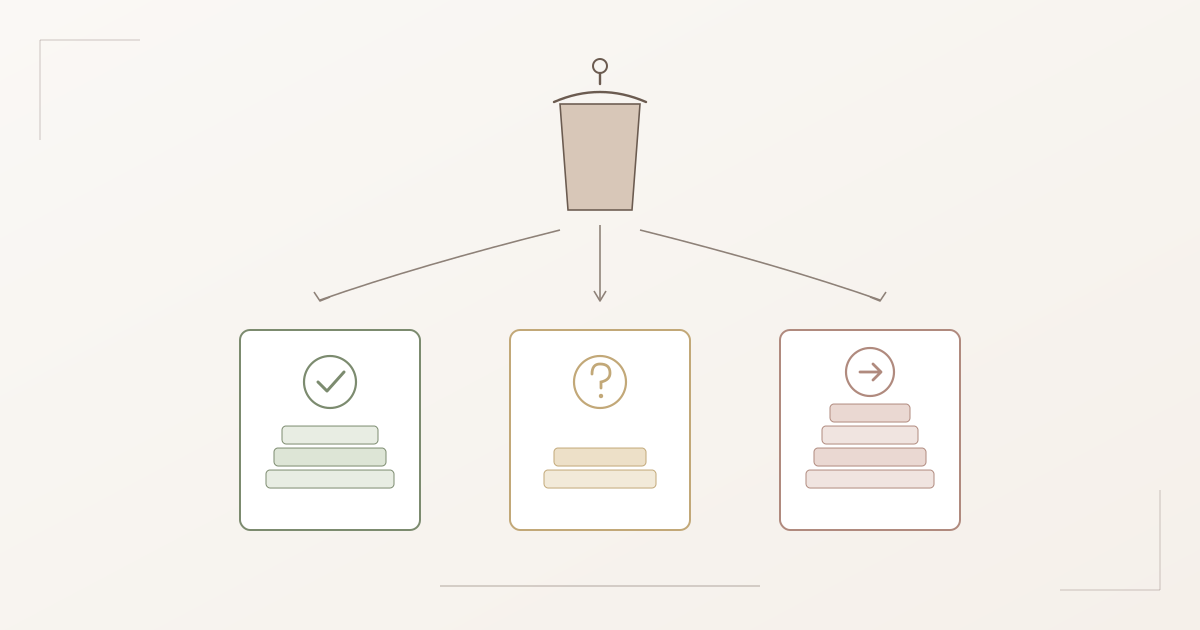
Now to the sorting — category by category (all tops first, then all trousers, then dresses, then jackets), never the whole closet at once. Take every piece in hand individually and ask three questions:
- The line question: Does this piece repeat the lines of my body — fabric, cut, silhouette?
- The fit question: Does it fit today — not after five kilos, not after the alteration I have been planning for two years?
- The reality question: Have I worn it in the last 12 months?
Scoring:
- Three yeses → "stays" pile. That is your working core.
- Two nos, or a no on the line question → "goes" pile. No discussion — the piece had its chance.
- Everything else → "undecided" pile. Second round at the end of the category. Whatever is still undecided then, goes. (Exception: one maybe box for a maximum of 5 pieces, lid on, date on — not missed after 6 months = out.)
Special cases: Occasion wear (the one evening gown, funeral clothes) is exempt from the 12-month check — provided it fits and matches your line. Keepsakes (wedding dress, the concert shirt) move into a memory box outside the wardrobe: they belong to your story, but not to your wardrobe.
Wardrobe Check tool
The guided version of this method
Our free Wardrobe Check walks you through exactly this analysis piece by piece — with three-pile logic, automatic progress saving and a gap evaluation at the end. 10 minutes, right in your browser.
Start the Wardrobe Check →Methods compared: how good are KonMari, the hanger trick & co.?
| Method | Principle | Strength | Weakness |
|---|---|---|---|
| KonMari | "Does it spark joy?" | Emotional entry point, radically simple | Joy is not a style criterion — bad buys sparked joy in the shop too |
| Hanger trick | Reverse hangers, check after 12 months | Objective wearing data, zero effort | Takes a year and does not explain the why |
| Maybe box | Pack away uncertain items, check after 6–12 months | Removes the fear of finality | Postpones decisions instead of making them |
| Three piles + line check | Objective criterion: body line + fit + reality | Explains the why, prevents repetition, instantly applicable | Requires knowing your line (5-minute quiz) |
The methods do not exclude each other: the hanger trick delivers data over the year, the maybe box defuses the last hard cases. But the foundation — the criterion that explains decisions instead of merely forcing them — only the line check provides.
After decluttering: gaps, not emptiness
The most common mistake after decluttering: treating the free space as a shopping order. The opposite is right. First comes the analysis of the "stays" pile:
- What is your working core? These pieces reveal your style pattern: cuts, fabrics, colours that demonstrably work.
- Which connecting pieces are missing? It is almost never tops. It is almost always: the right trousers, the transitional jacket, shoes that carry several outfits.
- The gap list is your only shopping list. You only buy what closes a gap and passes the line question — following the three-outfit law: every new piece must instantly yield three combinations with what you own.
How to build a complete wardrobe with a system from here is shown in our 5-stage guide "How Do I Dress Well?" — decluttering is stage 2 of 5 there.
For business wardrobes specifically, our guide Business Dressing by Kibbe Type shows which blazer cut, fabrics, and capsule wardrobe match your line — and for everyday life beyond the office, the guide Capsule Wardrobe by Kibbe Type walks through piece counts, the build process, and the core pieces for every style family.
Where should the discarded pieces go?
- Sell: Well-preserved brand and quality pieces via Vinted, Sellpy or Vestiaire Collective. Price realistically — the goal is letting go, not profit maximisation.
- Donate: Wearable items to social department stores, clothing banks or local organisations — where they demonstrably arrive, unlike some anonymous containers.
- Recycle: Broken and worn-out items go to textile recycling.
- Not allowed: keeping "for cleaning" in wardrobe quantities, and the way back into the closet "just for the transition".
What comes after decluttering is a step of its own: what you keep needs a system, or there will be a pile on the chair again in three weeks. How to put it back by zones and outfit blocks is in the guide to organising a wardrobe.
Frequently asked questions about decluttering your wardrobe
What is the best way to declutter my wardrobe?
With the three-pile method plus line check: take every piece in hand individually and ask three questions — Does it match my body line? Does it fit right? Have I worn it in the last 12 months? Two nos = "goes" pile. Important: determine your body line first, otherwise you sort by feeling instead of by criterion.
Why is it so hard for me to let go of clothes?
Four psychological reasons: emotional attachment (clothes are tied to identity and memories), the sunk-cost fallacy ("it was expensive"), the future self ("when I fit into it again") and overwhelm (the brain avoids oversized tasks). All four can be bypassed with clear criteria and small stages.
How many clothes should I keep?
There is no magic number — but as orientation: 30 to 50 actively worn pieces per season are enough for a fully functional wardrobe. What matters is not the count, but that every remaining piece matches your body line and yields at least three outfits.
What is the 12-month rule?
Whatever you have not worn in the last 12 months (i.e. across all seasons) you will most likely never wear again. Exceptions: occasion wear (evening gown, funeral clothes) and keepsakes — the latter belong in a memory box, not in the wardrobe.
Should I declutter using the KonMari method?
KonMari ("Does it spark joy?") is a good entry point but has one weakness: joy is not a style criterion. A piece can spark joy and still never get worn because it does not match your body line. Better: combine the joy question with the line question.
What do I do with expensive bad buys?
The money is spent — whether the piece hangs in your closet or not (sunk-cost principle). From now on it only costs space and guilt. Sell it (Vinted, Vestiaire, Sellpy), donate it or give it away. Keep the lesson, not the piece.
How do I prevent my wardrobe from filling up again?
With two rules: 1) One in, one out — for every new piece an old one goes. 2) Only buy by your body line — then no new bad buys occur. A wardrobe only overflows when shopping happens without a system.
What is the difference between decluttering and a wardrobe check?
Decluttering only reduces quantity. A wardrobe check analyses: what works and why (not)? Which gaps does the wardrobe really have? The result is not an empty rail but a shopping list with a system. Our free online tool guides you through both parts step by step.
Where should discarded clothes go?
In this order: sell well-preserved brand pieces (Vinted, Vestiaire, Sellpy). Donate wearable items to social department stores and clothing banks — more reliable than anonymous containers. Damaged items go to textile recycling. None of it goes back in the closet "for the transition".
How long does proper decluttering take?
As a single session: 3–5 hours for an average wardrobe. More realistic and sustainable: stages of 30–60 minutes per category (tops first, then trousers, then dresses…). A fixed end date matters — otherwise the "undecided" pile becomes permanent.
Why is my wardrobe full but I have nothing to wear?
Because quantity is not the problem — the missing system is: pieces from different style phases that do not combine, and purchases made for someone else's body line. The solution is not more clothes but analysis: what line does my body have, and which pieces respect it?
Should I determine my Kibbe type before or after decluttering?
Before — definitely. The body line is the objective sorting criterion that turns gut decisions into clear decisions. If you know your type first, you instantly see while sorting why certain pieces never worked — and you stop keeping them "for someday".
From full closet to clear wardrobe.
Decluttering is the beginning. If you then want to know how your wardrobe works as a system — with type determination, colour and cut roadmap — we accompany you professionally.