
Table of contents
- The short answer
- The ground rule: harmonious, not fashionable
- Stage 1: Determine your body line
- Stage 2: Declutter before you buy
- Stage 3: Buy by system
- Stage 4: Volume balance when combining
- Stage 5: Develop your Image Identity
- The 7 most common mistakes (and their fixes)
- Well dressed for every occasion
- Frequently asked questions (FAQ)
The short answer
Short answer
Dressing well means: wearing clothes whose lines repeat the lines of your body — in the right fit, the right fabric, with balanced volume. The path there has five stages: (1) determine your body line, (2) analyse your wardrobe, (3) buy by system, (4) balance volume, (5) develop your Image Identity. Trends are optional. Harmony is not.
"How do I dress well?" — thousands of women google this question every month. Most answers are lists: 10 basics, 5 trends, 3 rules. And yet the same women stand in front of the mirror a year later feeling wrongly dressed. Why? Because dressing well is not a list. It is a system. This one.
This guide gives you no trend forecasts and no shopping list. It gives you the method to judge every purchase and every outfit yourself — in 2026 and ten years from now. It comes from professional style consulting based on the Kibbe Body Type System and from hundreds of wardrobe analyses with real clients — not from Pinterest boards.
The ground rule: well dressed means harmonious, not fashionable
A woman looks "well dressed" when three things align: the lines of her body, the lines of her clothes, and the occasion. That is the whole magic. Trends, colours, brands — all secondary. That is why some women look more elegant in jeans and a white shirt than others in designer dresses: for them the harmony is right; for the designer dress, often only the price is.
What "lines" means in practice:
| Feature | Yang (sharp/long) | Yin (soft/round) |
|---|---|---|
| Silhouette | Straight, elongated, angular | Curved, compact, rounded |
| Best fabrics | Firm, structured, with body | Flowing, soft, with drape |
| Best cuts | Clean vertical lines, sharp lapels, long hems | Waist emphasis, curves, soft necklines |
| Prints | Geometric, large-scale, graphic | Floral, small-scale, watercolour |
| Looks wrong in | Ruffles, fussy details, tight curved cuts | Stiff blazers, hard lines, oversized boxy shapes |
Most bodies are blends — and exactly that blend determines which rules apply to you. The bad news: this harmony does not come from chance or taste. The good news: it can be learned — in five stages.
Stage 1: Determine your body line (not your "figure")
Direct answer
Your body line results from three factors: vertical line (do you appear longer or more compact than your measurements?), bone structure (sharp/angular or soft/rounded?) and flesh distribution (taut on the bone or soft curves?). The combination determines your Kibbe type — and with it all the cut, fabric and print rules that apply to you.
Forget pear, apple and hourglass. Those categories only describe where you are wide — not how your body reads. Three questions matter:
- Vertical line: Do you appear longer or more compact than you are? (Not height — optical elongation.)
- Bone structure: Are shoulders, wrists, facial features sharp and angular (yang) or soft and rounded (yin)?
- Flesh: Does it sit taut on the bone or form soft curves — independent of weight?
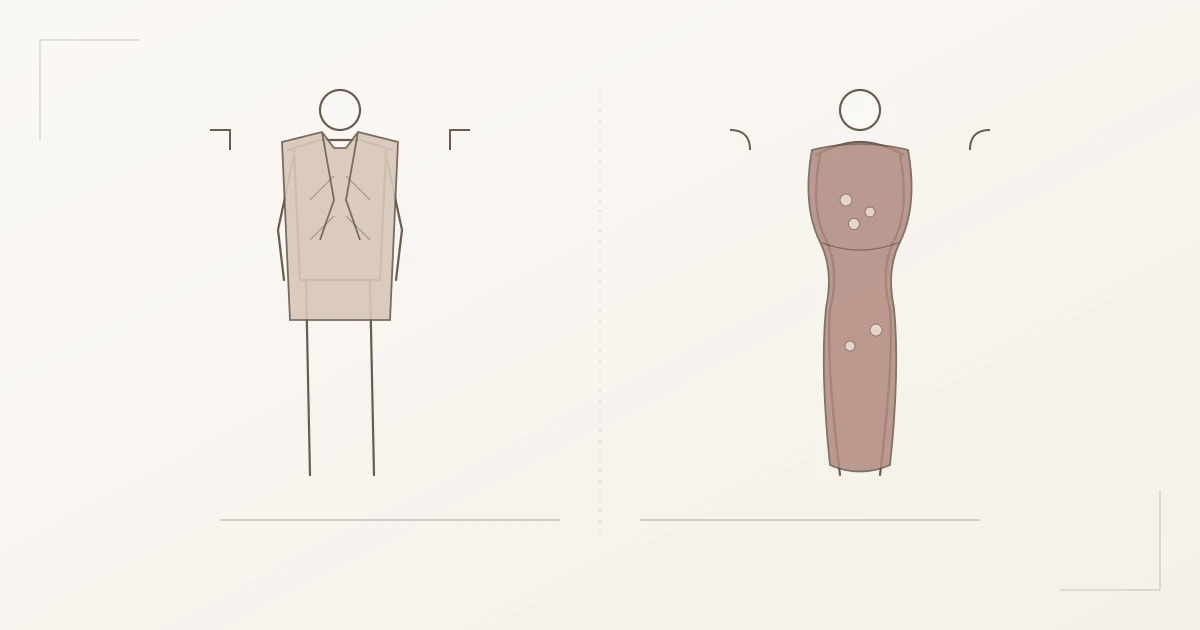
These three answers give you your body line — and from it, everything else: which cuts, fabrics, necklines, prints and even accessories look "made for you". The Kibbe system defines 13 types in five families: Dramatic (pure yang), Natural (broad, relaxed yang), Classic (perfect balance), Gamine (high-contrast blend) and Romantic (pure yin). Why this beats the fruit logic: two women can share the same "pear" outline and still have completely different lines — one needs flowing fabrics with waist emphasis, the other clean long cuts. The outline looks the same. The right clothes are not.
Free tool
Stage 1 in 5 minutes: your Kibbe type
Our free quiz determines your body line in 8 questions — with a full type explanation and concrete styling tips for your type. No account, no email.
Start the Kibbe quiz →Stage 2: Declutter before you buy
The second-biggest mistake after the unknown body line: hanging new clothes into a wardrobe that already does not work. A closet full of bad buys turns every new piece into another bad buy, because nothing goes together.
The proven method is the three-pile analysis — piece by piece, no exceptions:
- Stays: matches your line, fits right, actually gets worn. These pieces define your working core.
- Goes: wrong line, wrong size, wrong life. Even if it was expensive — the price is paid; now the piece only costs you space and decision energy.
- Undecided: third pile, second round. Rule: whatever is still undecided after two rounds, goes.
What almost always becomes visible: you have no gap in tops — you have a gap in what connects outfits: the right trousers, the right transitional jacket, shoes that carry more than one outfit. Those gaps are your shopping list — not the next pretty top. Why letting go is psychologically so hard, and how the three-pile method works in detail, is covered in our complete decluttering guide.
Wardrobe Check tool
Stage 2 as a guided analysis
The free Wardrobe Check guides you through your closet in a structured 10-minute session — including the three-pile method and a gap analysis at the end. Your progress is saved automatically.
Start the Wardrobe Check →Stage 3: Buy by system, not by feeling
With a known line and an analysed wardrobe, shopping changes fundamentally. Three rules that settle any purchase decision in under a minute:
Rule 1: The line question first
Before you even try a piece on: does it repeat the lines of your body? A Soft Natural reaches for flowing fabric with a waist suggestion, a Dramatic for the clean, long line, a Romantic for soft, waisted cuts. Wrong line = back on the rack, however beautiful the piece is in itself.
Rule 2: Fit before size
Buy for your widest point and have the rest altered. A tailor is the most underrated style hack there is: 15–30 euros turn off-the-rack into made-to-measure feeling. Concretely: the blazer is bought for the shoulders (shoulders are barely alterable), waist and sleeves get adjusted. Trousers are bought for hips/thighs, the waistband gets taken in.
Rule 3: The three-outfit law
A new piece only comes home if you can instantly name three outfits with things you already own. If you cannot, you are buying an orphan — and orphans are the building blocks of the "full wardrobe, nothing to wear" feeling.
Fitting-room checklist:
- ☐ Does the piece repeat my body lines?
- ☐ Does the shoulder seam end exactly at the shoulder bone?
- ☐ No pull or compression wrinkles when standing?
- ☐ Can I sit, raise my arms, breathe — without anything shifting?
- ☐ Can I instantly think of three combinations with pieces I own?
- ☐ Would I buy it at full price? (If not: it is the discount you like — not the piece.)
Stage 4: Build outfits by volume balance
Direct answer
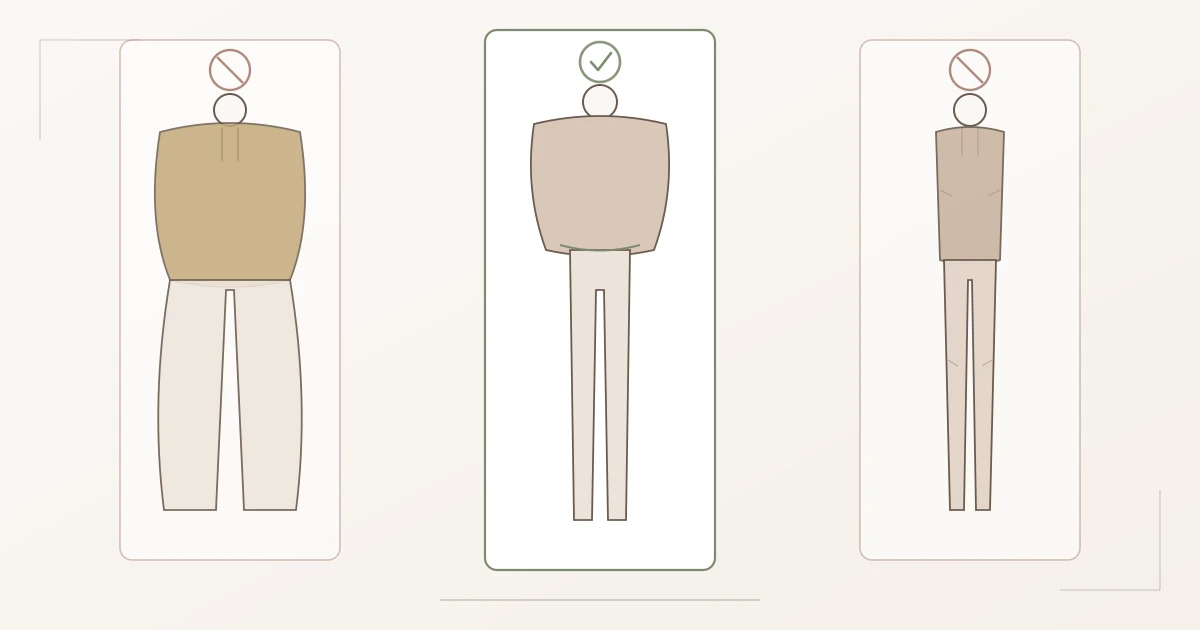
The most important combination rule: one volume per outfit. Loose top with narrow trousers, wide trousers with a fitted top. Two wide pieces swallow the figure, two tight ones leave nothing breathing. Whether and how the waist is marked is decided by your body line — not by a blanket rule.
Combining well is simpler than fashion magazines make it look. Beyond the volume formula, three more balances matter:
| Balance | Principle | Typical mistake |
|---|---|---|
| Volume | One wide + one narrow piece | Oversized jumper with wide trousers ("swallowed") |
| Proportion | Thirds instead of halves (e.g. short top + long trousers) | Hip-length top with mid-length skirt (1:1 compresses) |
| Structure | Match fabric weights to each other | Delicate blouse under a stiff boxy blazer |
| Attention | One focal point per outfit (neckline or waist or leg) | Emphasising everything at once — nothing registers |
If an outfit still looks "off" and you do not know why, you will find the five most common causes in our guide "Why Do My Outfits Look Bad on Me?" — the diagnostic companion to this article.
Stage 5: Develop your Image Identity
The final stage separates "well dressed" from "unmistakable". Your Image Identity answers the question: what should my appearance say about me — before I have said a word? It connects your body line with your personality and your life: career, everyday reality, goals.
Two women with the same Kibbe type can develop completely different Image Identities — one underlines authority (cleaner lines, deeper colours, less jewellery), the other warmth (softer fabrics, lighter tones, more texture). Both are right if they belong to the wearer. This is the stage where many women bring in professional guidance: seeing your own effect from the outside is nearly impossible — which is exactly what style consulting is for.
The 7 most common mistakes — and their fixes
- Buying for the wished-for body instead of the real one. Fix: buy clothes for today. Altering is cheaper than keeping things unworn.
- Black as a safety net. Black is a colour like any other — it suits high-contrast appearances and makes soft, warm types look tired. Fix: test dark alternatives (navy, espresso, forest green).
- Trends as a shopping list. Fix: run every trend through the line filter. If it passes, it is an update. If not, it is a costume.
- The size label as an ego question. Fix: nobody sees the number — everybody sees the wrinkles. Always the size that fits, never the one that flatters.
- Wanting to emphasise everything. Fix: one focal point per outfit. The rest stays calm.
- Ignoring accessories. Shoes, bag, jewellery follow the same line rules as clothes — dainty jewellery looks lost on a tall, angular appearance; chunky chains crush delicate yin types.
- Shopping without a system. Fix: never enter a shop without a gap list. Whoever goes "just to look" comes back with the fifth white top.
Well dressed for every occasion: the formula
Same body line, different contexts — how to translate your system into daily life:
| Occasion | Formula | Line-true execution |
|---|---|---|
| Office / business | Structure + one soft element | Blazer in your line shape + blouse in your fabric weight |
| Everyday / casual | Volume balance + one deliberate detail | Good jeans in your silhouette + knit in your texture |
| Evening / event | Your line, amplified | The same silhouette principle in a finer fabric — never a foreign line "because it is festive" |
| Video call | Focus on the top third | Neckline shape by your facial line, colour by your contrast level |
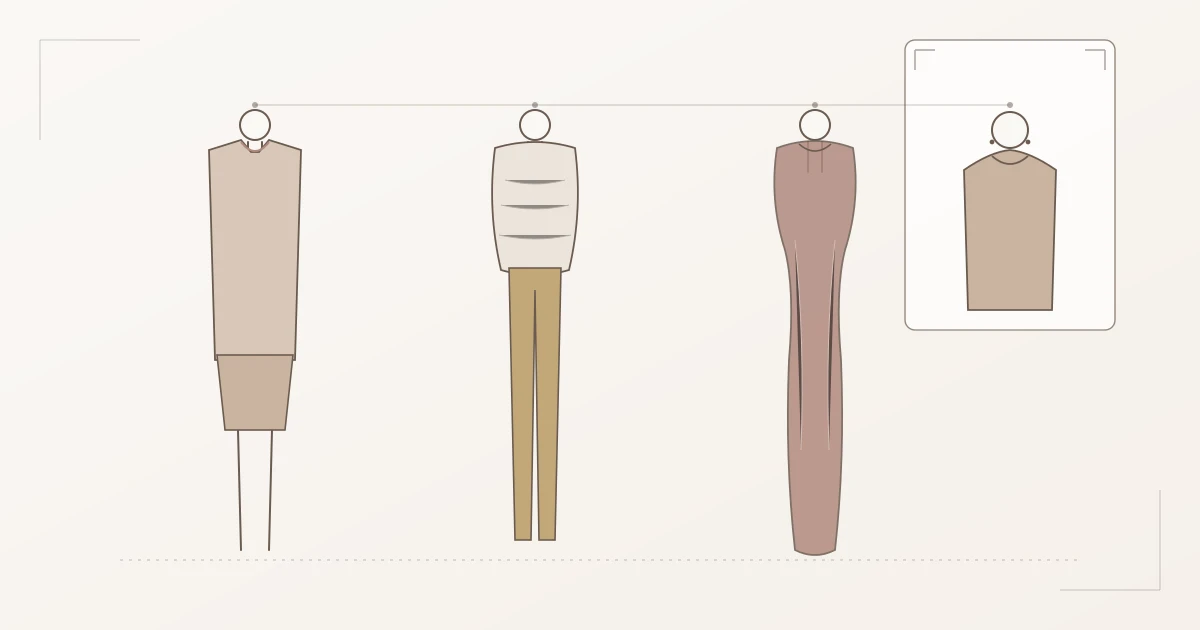
The most common occasion mistake: leaving your own line for "festive". The evening gown that looks dramatic on the rack does not turn a soft Natural into a Dramatic — it makes her invisible. Festive means: the same line, better materials.
Frequently asked questions about dressing well
How do I dress well if I do not know my body type?
The first step is always determining your body line: vertical line, bone structure and flesh distribution. A Kibbe test (free, 8 questions, about 5 minutes) gives you the basic classification. Only then do buying rules, combination rules and trends make any sense — before that, every rule is guesswork.
What is the biggest mistake when getting dressed?
Buying clothes for someone else's body line. Most women orient themselves by models, friends or trends — that is, by bodies with different lines. The result: pieces that are objectively beautiful but look like a costume on their own figure.
How many pieces does a working wardrobe need?
Fewer than most people own: 30 to 50 well-chosen pieces per season are enough for a fully functional wardrobe. What matters is not quantity but combinability — every piece should yield at least three outfits with things you already own.
Is expensive clothing automatically better?
No. A 40-euro piece in your line, properly altered, always beats a 400-euro piece in the wrong line. Price correlates with material and workmanship, not with harmony. The best investment is not the expensive piece but the tailor.
Which colours suit me?
Colour effect depends on skin undertone, hair and eye colour — a separate field of analysis next to the body line. Ground rule: colours near the face must match your contrast level. A high-contrast appearance can carry strong contrasts; a soft appearance looks more harmonious in muted tones.
How do I dress well after gaining weight?
Do not camouflage — respect the current fit: buy clothes for the body of today, not yesterday's or tomorrow's. Your body line remains constant through weight changes — a Soft Natural stays a Soft Natural. What changes is only the size, never the line principle.
What do yin and yang mean in the Kibbe system?
Yang stands for sharp, long, angular features (defined shoulders, long vertical, striking features). Yin stands for soft, round, compact features (soft curves, rounded features, shorter vertical). Every body is an individual blend — the 13 Kibbe types describe the most common balances.
Can I dress well on a small budget?
Yes — the system is budget-independent. Order of operations on a small budget: determine your body line (free), analyse your wardrobe (free), then close gaps deliberately — second-hand and basics lines work perfectly when the line is right. Avoiding bad buys saves more than any discount ever will.
How do I know if a garment truly fits?
Three checkpoints: 1) The shoulder seam ends exactly at the shoulder bone. 2) The piece shows no pull or compression wrinkles when standing. 3) You can sit, raise your arms and breathe without anything shifting. If one fails, it is the wrong size or the wrong cut — whatever the label says.
What is the difference between style consulting and colour analysis?
Colour analysis determines your palette (undertones, contrasts, best colours). Style consulting determines lines, cuts, silhouettes and the whole wardrobe architecture. The combination is ideal — but if you choose only one: the line has a bigger impact on overall effect than colour.
How long does it take to find your own style?
With a system: weeks instead of years. Determine your body line (1 day), analyse your wardrobe (1 afternoon), first deliberate purchases (1–2 months). Without a system it often takes decades — because every bad buy repeats a guessing game instead of building knowledge.
Does the Kibbe system work for petite and tall women?
Yes — height is actually a core factor of the system. From about 5'7" pure yin types (Romantic, Gamine) are rare; under 5'3" pure yang types (Dramatic, Flamboyant Natural) are rare. The quiz automatically accounts for your height in the evaluation.
From method to presence.
You can walk the five stages alone — or with certainty: a professional Kibbe analysis determines your type definitively and develops your personal Image Identity from it.