
Table of Contents
- The Quick Answer
- What Defines the Romantic Type?
- The Characteristics in Detail
- Are You Really a Romantic? Drawing the Line
- The Styling Logic: Soft, Flowing, Waist-Defined
- The Romantic Wardrobe: Cuts & Pieces
- Fabrics, Patterns & Colors
- Jewelry & Accessories
- The 5 Biggest Styling Mistakes
- Romantic at Work & in Everyday Life
- Famous Romantic Examples
- The Romantic Self-Check: 5 Questions
- Frequently Asked Questions (FAQ)
The Quick Answer
Quick Answer
The Romantic is the type with the highest proportion of Yin in the Kibbe Body Type System: petite to medium stature (up to about 165 cm), a delicate, rounded bone structure, soft body flesh with a pronounced hourglass shape, and soft, full facial features. Its styling logic follows a single rule: soft, flowing fabrics in waist-defined cuts — the curved line is framed, never hidden and never forced into stiff construction. The most common mistakes: boxy blazers, hard minimalist basics and oversized cuts that “armor” the soft line rather than emphasize it. This guide explains every characteristic, how to draw the line to Soft Natural and Theatrical Romantic, and the complete wardrobe logic.
Hardly any Kibbe type is misunderstood as often as the Romantic. Some take every curvy woman for a Romantic (wrong — curves alone don't make the type). Others confuse its styling logic with “ruffles and rosebuds” (also wrong — it's about the line, not about looking cute). And still others spend years squeezing this type into severe blazers because “that's just what professional looks like” — then wonder why every business outfit feels like armor. This deep dive sets the record straight: what truly defines the Romantic, how to identify it with confidence — and what its wardrobe looks like when it works.
What Defines the Romantic Type?
In the Kibbe Body Type System, each of the 13 types describes a particular balance of Yang (sharp, straight, long) and Yin (soft, round, short). The Romantic marks the Yin end of the spectrum: in no other type is the soft, rounded line so consistent — from the bone structure through the body flesh right into the facial features.
“Consistent” is the decisive word here. A single soft feature — full lips, a curvy hip — does not make a Romantic. The type only emerges when all three levels speak the same language:
- Bone structure: delicate, small, finishing in rounded rather than angular edges — no visible sharp corners at the shoulders, joints or jaw
- Body flesh: soft and lush, with a natural hourglass distribution — defined waist, full bust and hips
- Face: soft, full features — round cheeks, large eyes, full lips, a gently rounded jaw
Add to that the fourth dimension, which acts as a hard filter in the Kibbe system: the short vertical line. The Romantic never appears long or stretched — height typically tops out at about 165 cm. A 1.74 m woman with soft curves is not a Romantic but almost certainly a Soft Dramatic: the same softness, carried on a long Yang structure. Why this height rule is so uncompromising is explained in detail in our guide to mistyping.
The Characteristics in Detail
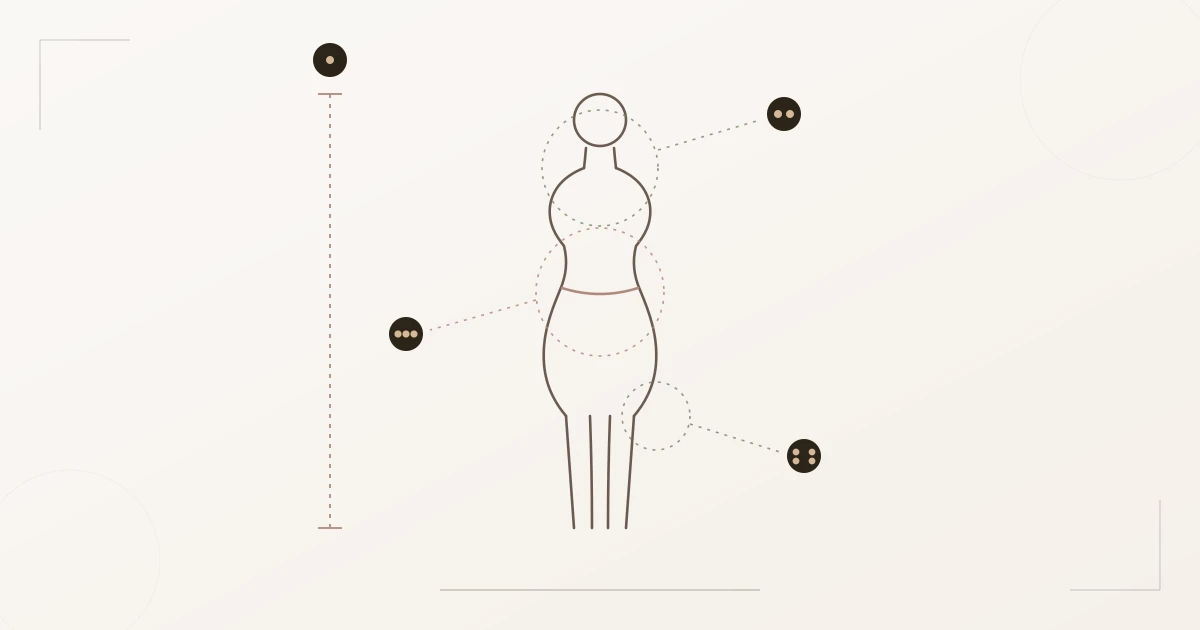
| Feature | In the Romantic | For Comparison (Yang End) |
|---|---|---|
| Vertical Line / Height | Short — up to about 165 cm, never looks stretched | Dramatic: long, well above average |
| Shoulders | Softly sloping, rounded, narrow | Sharp, angular or broad and straight |
| Bones & Joints | Delicate, fine, barely visible beneath soft skin | Prominently protruding or broad and strong |
| Body Flesh | Soft, lush, pronounced hourglass — waist markedly narrower than bust/hips | Taut, straight, columnar |
| Face | Round cheeks, large eyes, full lips, soft jaw | Sharp cheekbones, angular jaw |
Important for self-assessment: these characteristics refer to structure, not weight. A Romantic remains a Romantic at size 36 just as at size 48 — the hourglass distribution and the delicate bones stay the same at every weight. Conversely, a straight, taut body does not become a Romantic through weight gain. In the Kibbe system, body weight is never a typing criterion.
Are You Really a Romantic? Telling the Neighbouring Types Apart
Romantic is one of the most frequently wrongly chosen types — because curves are the most eye-catching feature and quickly outshine the overall picture. The three most important distinctions:
Romantic vs. Soft Natural
The most commonly confused pair of all. Both have soft flesh and curves — but the Soft Natural carries a broad, blunt Yang bone structure underneath: present, fairly straight shoulders and stronger joints. The Romantic is soft even in the skeleton — narrow, sloping shoulders, fine wrists. The practical check in front of the mirror: look at your bare shoulder line. Present, broad and fairly straight → Soft Natural. Narrow, softly sloping → Romantic. The complete Soft Natural deep dive examines the same boundary from the other side.
Romantic vs. Theatrical Romantic
The Theatrical Romantic is the direct neighbour: equally petite, equally curvy — but with a subtle Yang undertone in the structure. It shows in a slight sharpness the pure Romantic does not have: somewhat more defined cheekbones, a narrower, slightly tapered jawline, finer “chiselled” details. The TR can therefore handle a touch more structure and drama in clothing (more pointed necklines, sharper heels), while on the pure Romantic every hard edge looks foreign. The most prominent example of how fine this boundary is: Selena Gomez was pegged as a Soft Natural by the community for years — until David Kibbe officially typed her as a Theatrical Romantic.
Romantic vs. Soft Gamine
Both petite, both with Yin — the difference is the principle: the Romantic is continuous softness, the Soft Gamine is contrast — soft elements meet angular accents and a palpably “bright-eyed” energy. If strangers describe you as “cute and bubbly” rather than “sensual and soft”, it is worth looking towards Soft Gamine.
If uncertainty persists, follow the sequence from the mistyping guide: first the hard filters (measure your height!), then standardized photos, then assess structure before flesh. The free Kibbe test gives you a first reliable indication — and you will find the complete type profile with all the do's & don'ts on the Romantic type page.
The Styling Logic: Soft, Flowing, Waist-Defined
The entire Romantic wardrobe can be derived from a single principle: clothing repeats the body's curved line instead of working against it. Three rules follow from this:
- Soft fabrics instead of hard construction. Fabric should fall and cling, not stand. Anything stiff, board-like or heavily reinforced creates a visible conflict between the garment's line and the body's line.
- Waist definition is mandatory, not optional. The narrow waist is the center of the Romantic silhouette. Cuts without any waist shaping (boxy, oversized, straight columns) erase the type's most important feature — underneath them the body looks shapeless rather than slim.
- Round lines in the details. Round and sweetheart necklines, rounded lapels, soft draping, flowing hems — every line on a garment may follow the curve; none needs to set an edge.
The misunderstanding you hear most often: “Romantic styling = playful and girlish.” No. The line logic says nothing about playfulness — it says soft, flowing, waist-defined. A simple, deep dark-green wrap dress in heavy crêpe is perfect Romantic styling, and at the same time as grown-up and self-assured as a look can possibly be.
The Romantic Wardrobe: Cuts & Pieces
Dresses — The Crowning Discipline
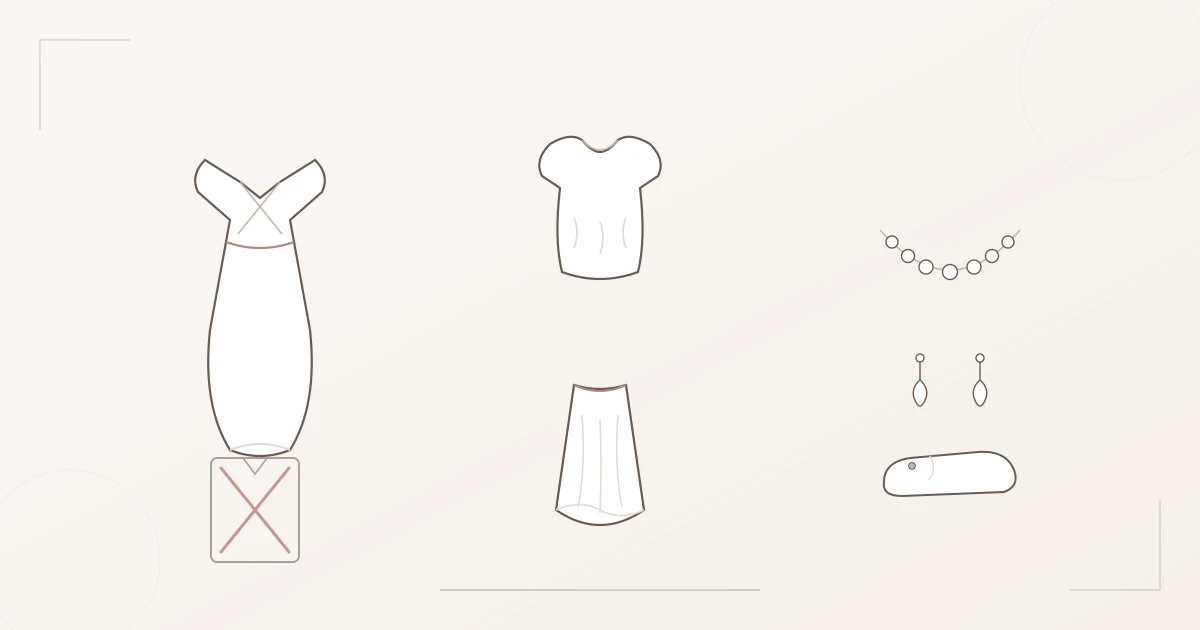
No type wears dresses as effortlessly as the Romantic. The wrap dress is the signature piece: it defines the waist, follows the curve and falls softly — the entire line logic in a single garment. Just as strong: soft sheath shapes that trace the curve, fit-and-flare cuts, dresses with gathering or draping at the waist. Lengths ideally end at the knee or in a soft midi fall — floor-length straight columns work against the short vertical line.
Tops & Blouses
Softly falling blouses with a round, sweetheart or subtly gathered neckline; the wrap look is strong here too. Sleeves may be softly set in — never with a sharp shoulder-pad edge. Fine knits that follow the waist beat boxy chunky-knit blocks.
Skirts & Trousers
Skirts: flared, trumpet or godet shapes, soft bias cuts — with a defined waist and a flowing hem. Trousers are possible but need the same logic: a high, soft waistband, a flowing leg (softly straight or subtly tapered), no hard creases, no stiff menswear-trouser construction.
Jackets — The Honest Answer
The classic stiff blazer is the most difficult garment for this type — and the honest recommendation is: you can usually do without it. Where a jacket is needed, it works waist-defined, in soft fabric, with rounded lapels or as a wrap jacket. Often a soft knit jacket, a draped cardigan or the dark wrap dress mentioned above replaces the blazer with more authority than any “toned-down” blazer variant ever could — credibility is a question of quality, not hardness.
Fabrics, Patterns & Colors
| Category | Ideal | Avoid |
|---|---|---|
| Fabrics | Silk, chiffon, soft crêpe, fine jersey, satin, soft cashmere, lace | Stiff linen, heavy board-like wool, thick rigid denim, gabardine |
| Patterns | Soft florals, watercolor gradients, round dots — at a moderate scale | Hard geometry, wide block stripes, large-scale angular prints |
| Surfaces | Gentle shimmer, fine texture, subtle embellishment — the Romantic wears ornament effortlessly | Hard patent finishes, technical matte surfaces, rough utility looks |
Two notes on this. First: the Romantic is the only type for whom fine embellishment — lace, mother-of-pearl buttons, delicate embroidery — is structurally right rather than “too much”: it repeats the fine, soft detailing of the type's own features. Second: which colors you wear is not a Kibbe question but a color-type question — the Kibbe line determines cut and fabric, color analysis determines the palette. The difference is explained in Color Analysis or Style Consultation.
Jewelry & Accessories
- Jewelry: delicate, round, feminine — pearls in every form, fine necklaces with a round pendant, drop earrings, round stones. Fine embellishment is welcome; the scale stays small to moderate, in keeping with the delicate bone structure.
- Avoid: heavy geometric statement pieces, angular metal “hardware”, pointedly minimalist hard shapes — they put edges on a body that has none.
- Bags: soft, rounded shapes in moderate sizes — no oversized stiff briefcase silhouettes.
- Shoes: feminine, rounded shapes — soft ballet flats, pumps with a round or almond toe, dainty straps. Clunky, heavy boots fight the fine line of the foot.
- Belts: yes, absolutely — soft, narrow to medium-width, at the natural waist. For the Romantic, a belt is not an accessory but a silhouette tool.
The 5 Biggest Styling Mistakes for the Romantic
1. The Boxy Blazer as “Proof of Seriousness”
The classic, especially in professional life: stiff, straight blazers, because “professional”. On the soft curved line, however, hard construction doesn't look commanding — it looks like armor, and the look ends up armored rather than polished. For this type, authority is built on fabric quality and precise waist shaping, not stiffness.
2. Oversize as a Camouflage Strategy
Those who feel unsure about their curves often reach for wide, straight cuts — and achieve the opposite: without waist definition, the soft silhouette does not look slimmer, it looks shapeless. The curve needs framing, not concealment.
3. Hard Minimalist Basics
The sober capsule programme of the standard style guides — stiff white shirt, straight black trousers, angular coat — is structurally wrong for this type. Minimalism only works for the Romantic in its soft translation: a clean wrap dress instead of a shirt-and-trousers combination.
4. Accessories That Are Too Big and Too Hard
Oversized bags, clunky boots, heavy geometric chains: anything that brings mass and edge makes the delicate bone structure beside it look even daintier — and the look less coherent.
5. Dressing Up as “Cute”
The opposite mistake: confusing Romantic with a childlike aesthetic — little bows everywhere, candy-floss pastels, ruffle overload. The mature version of this type is sensual and elegant; ornament is a seasoning, not the main course.
Romantic at Work & in Everyday Life
Direct Answer
The Romantic becomes business-ready not through harder cuts but through darker colors, higher-quality fabrics and pared-back details with the same line logic: a deep dark wrap dress, a softly waist-defined jacket with rounded lapels, flowing trousers with a high waistband. The formula is “soft authority” — presence through quality and fit rather than stiffness.
For the complete office context — including the blazer alternatives and video-call pointers — it is worth reading Business Look by Kibbe Type. And if you want to rebuild your wardrobe as a whole: the Capsule Wardrobe by Kibbe Type contains the Romantic capsule with its defining core pieces — from the wrap dress to flowing trousers.
Famous Romantic Examples
The classic examples of the Romantic, documented by David Kibbe himself, are Marilyn Monroe and Elizabeth Taylor — both petite, both with consistently soft lines, a pronounced hourglass and full, round facial features. Both also show why the shorthand “Romantic = cute” is wrong: their iconic looks — flowing, waist-defined silhouettes in softly falling fabrics — are the opposite of playful. They demonstrate the grown-up, self-assured version of the Yin line.
The counter-example is just as revealing: Selena Gomez, long pegged as a Soft Natural, was officially typed by Kibbe as a Theatrical Romantic — the neighbouring variant with a subtle Yang undertone. The boundary between the Yin types is so fine that even practised community eyes miss it regularly. Which is exactly why, when doubt remains, the trained outside eye decides — not gut feeling. How a professional analysis works is shown in our guide to online style consultation.
The Romantic Self-Check: 5 Questions
Before you commit, answer these five questions honestly — each one tests a different level of the type:
- The height question: Are you (measured, not estimated) 165 cm or shorter? If not, the pure Romantic is off the table — look at Soft Dramatic or Soft Classic instead.
- The shoulder question: Are your bare shoulders narrow and softly sloping — or present, broad and fairly straight? The latter points to Soft Natural, not Romantic.
- The joint question: Do your wrists and knuckles disappear beneath soft skin, looking fine and delicate? Visibly prominent or strong joints contradict the type.
- The waist question: Is your waist markedly narrower than your bust and hips even without shaping clothes — at every weight? For the Romantic, the hourglass is structure, not a styling effect.
- The fabric question (the practical test): Try on a softly falling wrap dress, then a stiff straight blazer. If the dress instantly looks right and the blazer looks borrowed, your body confirms the Yin line faster than any questionnaire.
Four to five yes answers are a strong Romantic signal. At two to three, the structured route through the Kibbe test guide is worth taking — and if two types remain deadlocked, a professional photo analysis settles it.
And if you want to meet the exact opposite: the Dramatic Kibbe type marks the Yang end of the same spectrum — long, sharp lines instead of soft curves, with the completely opposite styling logic.
Are you tall and curvy rather than petite and soft? Then your family isn't Romantic but the Soft Dramatic Kibbe type — the same softness, but built on a long, sharp Yang structure.
But if you find a fine, sharp edge in your soft face — defined cheekbones, a pointed chin? Then you may not be a pure Romantic but a Theatrical Romantic — the same petite curvy base, but with a fine Yang accent that visibly shifts the styling logic.
But if you find visible sharp points in the middle of your soft structure — a defined chin, prominent cheekbones, a small angular shoulder line — and your curve is more compact than lush? Then you're probably not a Romantic but a Soft Gamine — the same softness, but with a broken line instead of an unbroken curve.
But if you find the same softness in yourself, only in a more moderate expression — a subtly visible curve rather than a lush hourglass, harmoniously symmetric proportions rather than full-round abundance, medium height and a clearly contoured silhouette? Then you're probably not a Romantic but a Soft Classic — the same feminine softness, but in elegant Classic symmetry rather than lush Romantic fullness.
Frequently Asked Questions (FAQ)
What is the Romantic type in the Kibbe system?
The type with the highest proportion of Yin: petite to medium stature (up to about 165 cm), a delicate, rounded bone structure, soft body flesh with a pronounced hourglass shape and soft, full facial features. Its clothing follows one rule: soft, flowing fabrics in waist-defined cuts with round lines.
How tall can a Romantic be?
Up to about 165 cm. The short vertical line is a hard criterion — above roughly 165–168 cm the type is ruled out. Taller women with soft curves are usually Soft Dramatic: the same softness on a long Yang structure.
Am I automatically a Romantic if I have curves?
No. Curves alone are only a flesh characteristic. Romantic additionally requires a delicate, rounded bone structure (soft narrow shoulders, fine joints) and soft facial features — plus the short vertical line. Curves on a broad, blunt bone structure point to Soft Natural.
What is the difference between Romantic and Soft Natural?
The bone structure beneath the curves: Soft Natural has broad, blunt Yang bones (present, fairly straight shoulders); Romantic has consistently delicate Yin bones (narrow, softly sloping shoulders). The shoulder-line check in front of the mirror is the quickest practical test.
What is the difference between Romantic and Theatrical Romantic?
The Theatrical Romantic carries a subtle Yang undertone within its predominantly soft structure — somewhat more defined cheekbones, a slightly tapered jawline, “chiselled” details. It can therefore handle a touch more sharpness and drama in clothing than the pure Romantic.
What clothing suits the Romantic type?
Soft, flowing fabrics in waist-defined cuts: wrap dresses, fit-and-flare, draped blouses with round necklines, flared skirts, flowing high-waisted trousers. Round lines in every detail, waist definition always.
What fabrics should a Romantic wear?
Softly falling, supple qualities: silk, chiffon, soft crêpe, fine jersey, satin, soft cashmere, lace. Avoid: stiff linen, board-like heavy wool, thick rigid denim — anything that stands instead of falls.
Can a Romantic wear blazers?
Only in the soft translation: waist-defined, in flowing fabric, with rounded lapels or as a wrap jacket. On the soft curved line, the classic stiff blazer looks like armor. Often a knit jacket, a draped cardigan or a dark wrap dress is the more commanding choice.
How does a Romantic dress professionally at the office?
With “soft authority”: darker colors, high-quality flowing fabrics, pared-back details — with the line logic unchanged. A deep dark wrap dress or a softly waist-defined jacket replaces the stiff suit. Presence comes from quality and fit, not from hardness.
What jewelry suits the Romantic?
Delicate, round, feminine: pearls, fine necklaces, drop earrings, round stones, ideally with fine embellishment — at a small to moderate scale. Avoid: heavy geometric statement pieces and hard minimalist shapes.
Does my Romantic type change if I lose weight?
No. The type is based on bone structure and flesh distribution, not on absolute weight. The hourglass proportion and the delicate bones remain at every weight — a Romantic is the same type with the same styling logic at size 36 and at size 48.
Which celebrities are Romantic types?
The classic documented examples are Marilyn Monroe and Elizabeth Taylor — both petite, with consistently soft lines and a pronounced hourglass. Selena Gomez is the best-known example of the neighbouring variant Theatrical Romantic, officially typed by David Kibbe.
Are you a Romantic — or Soft Natural after all?
The free Kibbe test gives you a structure-based assessment in just a few minutes — and the professional analysis delivers a well-founded answer, complete with your personal style dossier.