
TL;DR — Soft Autumn at a glance
Soft Autumn is the gentlest of the three autumn subtypes: warm undertone, medium depth and above all low contrast between skin, eyes and hair. The colours are warm but never saturated — sage, camel, muted rust, warm teal. Clear, vivid shades shout on you; muted ones make you look rested.
- Soft Autumn sits between autumn and summer. The muting is the leading trait, the warmth the second.
- Best colours: sage, olive, muted teal, camel, mustard gold, muted rust, mahogany, warm beige, cream, warm dusty rose.
- Avoid: pure white, true black, fuchsia, ice blue, bright yellow, royal blue — anything clear or cool.
- Most common mix-up: Soft Summer. Both are muted, but Soft Summer is cool and this type is warm. Gold against silver separates them.
- Gold suits you, but brushed gold more than high polish — a muted type cannot carry hard shine.

Contents
- What is a Soft Autumn?
- The traits: are you Soft Autumn?
- The self-test in five steps
- The Soft Autumn colour palette
- Which colours overwhelm you
- Soft Autumn or Soft Summer?
- Soft, Warm or Deep Autumn?
- Make-up, hair colour and jewellery
- Combining colours day to day
- Why celebrity lists mislead
- Colour meets line: your Kibbe type
- Frequently asked questions
What is a Soft Autumn?
Soft Autumn is one of twelve colour types in the extended seasonal system and the bridge between autumn and summer. The name states the order of its properties: soft for the muting, autumn for the warmth. That order matters. Here the low saturation dominates and the warmth comes second — unlike Warm Autumn, where warmth leads.
The four-season model sorts people by undertone and depth. That is enough for rough orientation but does not explain why two autumn types need completely different reds. Hence the twelve-type system: every season gets three subtypes, each tipping towards a neighbouring season. This one tips towards summer — it is the coolest and quietest of the three autumns.
In German it is called softer or gedämpfter Herbsttyp, yet almost everyone searches the English term. Both mean the same thing. If you already know the autumn type in general, this article is the deep dive into its gentlest variant.
A Soft Autumn rarely fails on colour temperature. It fails on too much clarity — a warm colour can still be wrong if it is too pure.
The traits: are you Soft Autumn?
This type is defined by low personal contrast. Skin, eyes and hair sit close together in value — there is no sharp jump from pale skin to dark hair. That small gap is exactly why high-contrast combinations look harsh here, even when the individual colours are warm.
Skin
Usually medium, with a golden or slightly peachy undertone. Rarely porcelain-pale, rarely deep. It tans evenly and quickly but never goes very dark. Some have a faint olive cast that pushes them towards "cool" in self-tests — a frequent error.
Eyes
Hazel, muted green, greenish grey or soft brown. The telling detail is a blurred boundary between iris and white: the transition is soft, not sharply drawn. Clear, luminous eyes with a strong limbal ring argue against this type.
Hair
Ash blonde with a golden cast, dark blonde, light brown or mid brown with warm shimmer. A faint grey veil over the colour is typical — that veil is the muting the type is named for. Jet black or vivid red natural hair effectively rules it out.
The contrast
The most reliable clue: photograph yourself without make-up and convert the image to black and white. Here skin, eyes and hair fall into a narrow band of greys — nothing stands out. Sharp light-dark jumps point to Deep Autumn or a Winter instead.
The self-test in five steps
These five steps narrow it down reliably. Preparation decides the outcome: most mistypings come from the wrong light, not from poor judgement.
- Daylight and a bare face. Stand at a window in indirect daylight. Artificial light skews temperature in both directions. Remove make-up, tie your hair back and drape a white cloth over your shoulders.
- The vein test. Look at the veins on your inner wrist. Greenish suggests a warm undertone, bluish a cool one. For this type they often look ambiguous — greenish with a blue cast. That is typical and not a sign of error.
- Gold against silver. Hold both metals to your face in turn. Gold should make the skin look warmer and more even. Important: use brushed gold, not polished — high shine overpowers muted types and skews the result.
- Pure white against cream. Hold a pure white and a cream cloth under your chin. Pure white tends to make the skin look dull and the shadows under the eyes more obvious; cream smooths both.
- Draping: clear against muted. Place a clear, vivid colour next to a muted one from the same family — emerald beside sage, bright red beside muted rust. If the muted version lights you up and the clear one tires your face, that is Soft Autumn.
Only when four of five steps point the same way is the result dependable. If it stays ambiguous, a guided colour analysis with real fabric drapes helps — muting is the single property hardest to judge in your own mirror. For a faster start, our free colour type test takes you to the right season in seven questions.
The Soft Autumn colour palette
The palette consists of warm colours with a grey veil over them. None is loud, none is icy. The principle: warmth meets warmth, muting meets muting. A colour without that veil falls out of the palette — even when its temperature is right.
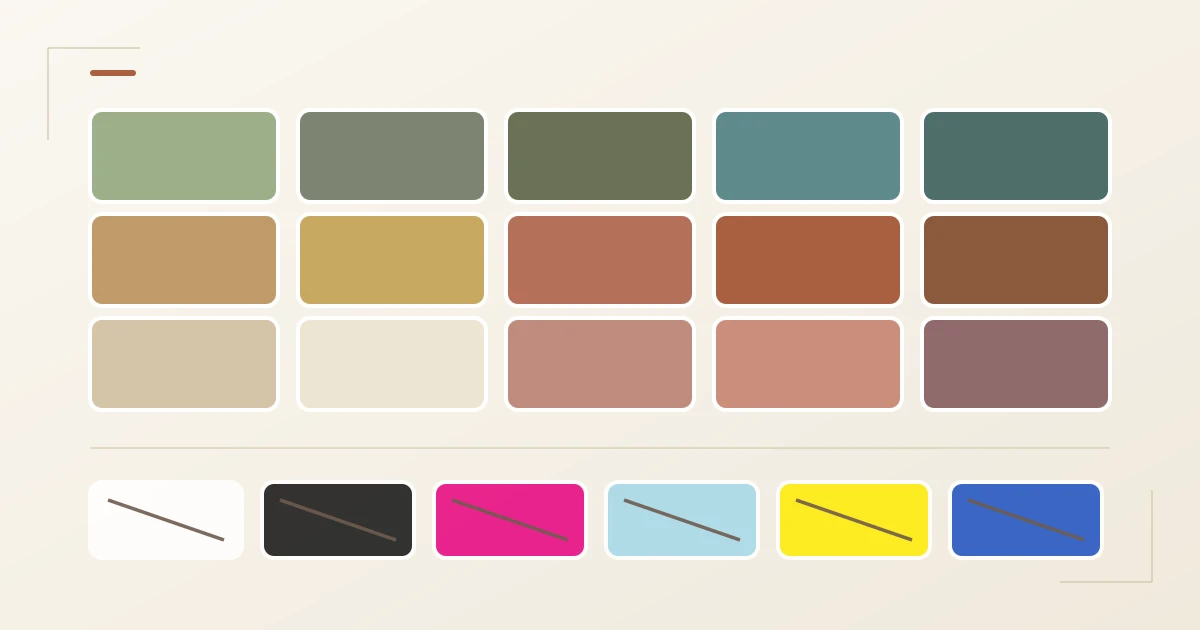
- Green and teal (the signature range): sage, olive, moss, muted teal, deep petrol. These carry further here than for a Warm Autumn because they bring the muting with them.
- Warm earth tones: camel, caramel, chocolate brown, mahogany, warm beige. The most reliable range for coats, trousers and bags.
- Muted red and orange: muted rust, terracotta, warm brick. Always with a grey component — never pumpkin orange in its pure form.
- Yellow: mustard gold, ochre, muted curry. No lemon, no neon.
- Rosé and plum: warm dusty rose, muted salmon, warm plum — borrowed from summer, but only in the warm variant.
- Neutrals: cream instead of pure white, warm taupe instead of grey, dark brown instead of black.
| Use | Soft Autumn | Instead of |
|---|---|---|
| White near the face | Cream, eggshell, warm ivory | Pure white |
| Dark base | Dark brown, deep olive, petrol | True black |
| Neutral mid tone | Taupe, warm greige, camel | Cool grey |
| Accent colour | Muted rust, mustard gold | Bright red, neon orange |
| Blue | Muted teal, denim with grey in it | Royal blue, ice blue |
| Metal | Brushed gold, brass, bronze | Polished silver, white gold |
Which colours overwhelm you
Two mistakes are possible, and the second is almost always overlooked. The first is the wrong temperature: cool shades such as ice blue, fuchsia or cool grey turn the golden undertone grey. The second is the right temperature at too much clarity — a vivid pumpkin orange is warm and still wrong, because it drowns out a muted presence.
Pure white and true black are the two most critical. Both carry maximum contrast, and that is precisely what a low-contrast person cannot hold. Black near the face drags shadows under the eyes and chin downward. If you do not want to give up black, wear it below the waist and put a camel or olive scarf in between.
Soft Autumn or Soft Summer?
This is the most common mix-up in the whole twelve-type system, for a simple reason: both share the muting. Both look poor in loud colours, both need muted shades. The difference lies in temperature alone.
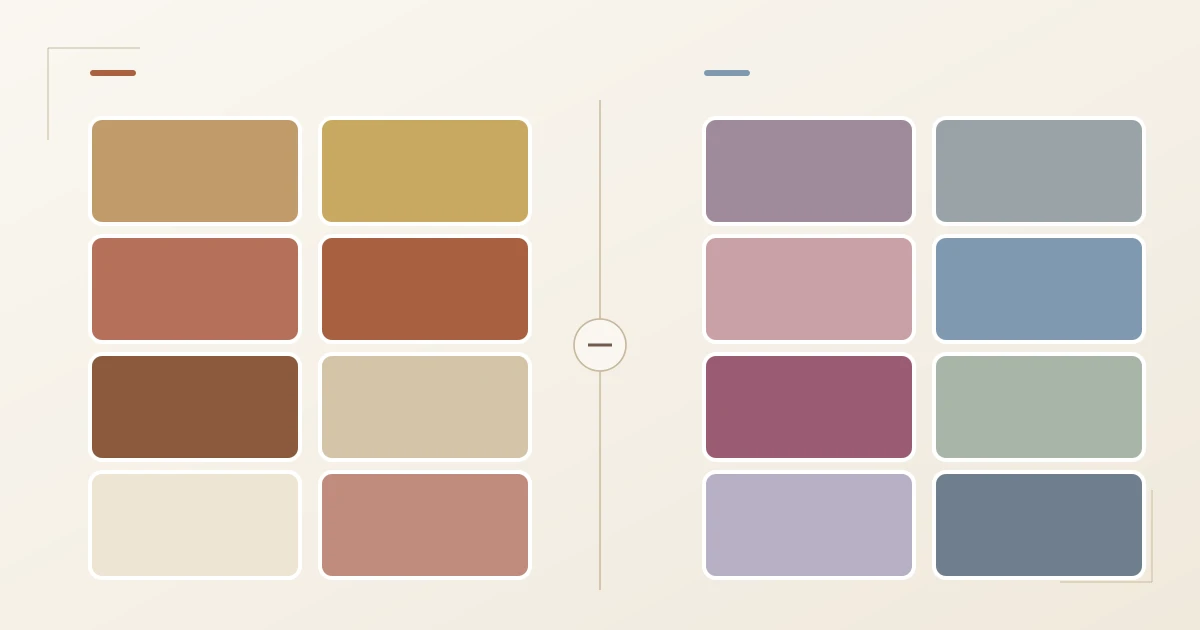
The one question that decides it: does brushed gold or brushed silver flatter you more? Take both metals in a brushed, not polished finish and hold them to your face in daylight. For a Soft Autumn the skin evens out under gold and looks dull under silver. For a Soft Summer it is the other way round.
A second check if the metal stays unclear: put camel next to dove grey. Camel is the signature shade here, dove grey the Soft Summer's. One of the two makes your face read clearer, the other flattens it — that difference is usually more obvious than the metal test.
Soft, Warm or Deep Autumn?
Within the autumn family the deciding factor is not temperature — all three are warm — but how much clarity and depth is added.
- Soft Autumn: muted, medium depth, low contrast. Sage and camel are the anchor colours.
- Warm Autumn: warmer and clearer, the colours may be richer. Pure rust and pumpkin orange work here but not for the soft variant.
- Deep Autumn: noticeably deeper and higher in contrast. Dark brown, forest green and aubergine carry, usually alongside dark hair and stronger personal contrast.
The practical check: hold muted rust next to saturated rust. If the saturated version makes you look stronger, you are Warm or Deep Autumn. If it overpowers you and your face disappears behind it, you are Soft Autumn.
Make-up, hair colour and jewellery
The same rule applies to make-up as to clothing: warm and muted. Blush in warm apricot or muted peach, lips in terracotta, warm nude or a muted berry. Eyeshadow in taupe, bronze, olive and warm brown. What does not work: cool pink, blue-based red and black kohl right at the lash line — dark brown does the same job without weighing the face down. More in our guide on make-up by colour type.
Hair colour is flexible as long as the golden cast survives. Caramel, warm hazelnut, bronde and muted copper all work. Ash tones without warmth and platinum blonde leave the skin looking dull; jet black creates a contrast the type cannot carry. The full picture is in hair colour by colour type.
For jewellery gold is right, but the finish matters as much: brushed gold, brass, bronze and antiqued settings read better than high polish. Stones in amber, carnelian, jade, smoky quartz and tiger's eye pick up the palette. Diamonds and cool white mother-of-pearl break it.
Combining colours day to day
The biggest practical advantage of this type: the palette is almost freely combinable with itself. Because every shade shares the same grey veil, very little clashes. You can wear olive with rust with camel without it turning noisy — for a high-contrast person that would be risky.
Three combinations that reliably hold:
- Tone on tone with one break: camel coat over cream knitwear, trousers in warm taupe, and a muted rust scarf as the single accent.
- Two muted colours at equal strength: olive and mahogany. It works because both carry the same muting. Metal in bronze.
- The swap for business: where an occasion expects black and white, use dark brown and cream instead. It reads just as formal and does not take the light off your face.
With denim, look at the wash: mid blue with a grey component, or a warm, slightly faded blue. Raw denim in deep indigo is too clear and too cool.
Why celebrity lists mislead
Almost every article on this type lists celebrities. It is convenient and mostly useless — for three reasons rarely mentioned.
First, the hair is nearly always dyed. Colour typing follows natural hair colour. For public figures that has often not been visible for decades. Assigning a type from a current look describes a colourist's decision, not the person.
Second, studio lighting skews temperature. The same face reads more golden under warm light and cooler under a cold flash. Reading colour types off press photos means reading the lighting setup too.
Third, make-up exists precisely to cover the undertone. Foundation evens out redness and yellow cast — exactly the signals a colour analysis depends on.
One bare-faced selfie at a window tells you more about your colour type than any celebrity list online.
There is a further point that affects self-testing in general: colour perception is not identical for everyone. According to the US National Eye Institute, around 8 per cent of men and 0.5 per cent of women of Northern European descent have red-green colour vision deficiency. Asking for a second opinion on reds and greens is not less certain — it is more careful.
One more confusion worth clearing: colour type is not the Fitzpatrick skin type. The Fitzpatrick scale describes how skin reacts to UV radiation. It is a dermatological classification and says nothing about which blue suits you. Two people with the same Fitzpatrick type can belong to different colour types.
Colour meets line: your Kibbe type
Colour analysis answers only half the question. It tells you which shades carry you — not which cuts do. That is the job of the Kibbe system, which sorts the body by the relationship between bone structure, flesh and facial features.
The two systems never contradict each other. You can have any of the 13 Kibbe types, and the combination is what matters in practice: with a soft Kibbe line, muted rust works best in fluid fabric; with a sharp line, the same colour reads better in structured wool. How to turn both results into one shopping plan is in combining colour type and Kibbe type.
If you do not know your colour type at all yet, start one level up: determining your colour type takes you to the right season in four steps before you look at subtypes.
Frequently asked questions
What is the difference between Soft Autumn and the autumn type?
Autumn is the parent category in the four-season system; Soft Autumn is one of its three subtypes in the twelve-type system. All autumn types are warm; this one is the most muted and lightest of them, tipping towards summer. If you have placed yourself as an autumn but still feel wrong in rich colours, this is usually why.
Which colours suit Soft Autumn best?
Sage, olive, muted teal, camel, mustard gold, muted rust, mahogany, warm beige, cream and warm dusty rose. All of them carry a warm undertone and a grey veil at the same time. Sage and camel are the signature shades because they hit temperature and muting together.
Which colours should a Soft Autumn avoid?
Pure white, true black, fuchsia, ice blue, royal blue, bright yellow and neon. Two groups are critical: everything cool, because it turns the golden undertone grey, and everything clear, because it drowns out a muted presence — even when the colour itself is warm.
Can a Soft Autumn wear black?
Directly at the face, true black rarely works, because it creates a contrast this type does not have. It drags shadows under the eyes and chin downward. Below the waist black is unproblematic. Near the face, dark brown, deep olive or petrol do the same job.
Gold or silver for Soft Autumn?
Gold, but in a brushed finish. Polished high-shine gold carries too much clarity and overpowers a muted complexion. Brass, bronze and brushed yellow gold are the most coherent options. Silver usually looks dull at the face; in mixed-metal jewellery it is no problem.
How do I tell Soft Autumn from Soft Summer?
By temperature, not by muting — both share that. Hold brushed gold and brushed silver to your face in daylight: if gold evens out your skin, it is the warm side. Second check: camel against dove grey. Whichever makes your face read clearer points the way.
Which hair colour suits Soft Autumn?
Caramel, warm hazelnut, bronde, muted copper and dark blonde with a golden shimmer. What matters is a warm undertone without too much luminosity. Ash tones without warmth, platinum blonde and jet black either dull the skin or create a contrast the type cannot carry.
Can my colour type change over a lifetime?
The undertone stays the same for life — it sits in the skin. What changes is depth and contrast: greying hair lowers personal contrast and shifts many people towards the muted subtypes. A Warm Autumn can effectively become a Soft Autumn over the years; the reverse does not happen.
Is a professional colour analysis worth it here?
For the muted types especially, yes. Muting is the property hardest to judge in your own mirror, because it has no clear tipping point the way warm against cool does. Draping with real fabric swatches makes the difference between muted and clear visible within seconds.