
TL;DR — Which color type am I?
- Your color type describes which colors make your natural complexion glow — defined by three properties of your skin, eyes, and hair: undertone (warm/cool), value (light/deep), and chroma (clear/muted).
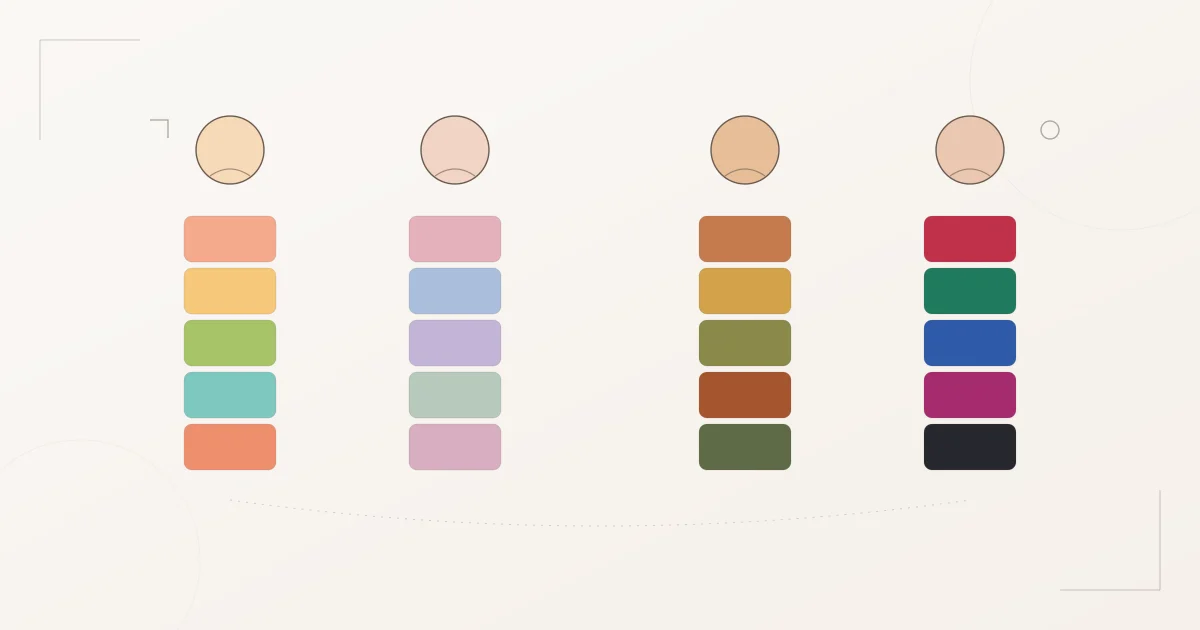
- The best-known model sorts people into four seasons: Spring (warm-light-clear), Summer (cool-light-muted), Autumn (warm-deep-muted), and Winter (cool-deep-clear).
- The most important first step is your undertone: warm (golden) or cool (rosy/bluish). It's the foundation — value and chroma refine the result from there.
- You can narrow down your color type yourself with a few simple tests: the vein test, the jewelry test (gold vs. silver), the white-vs-cream test, and fabric draping in daylight.
- Self-tests often miss the mark, because lighting, makeup, and dyed hair are deceiving. For a reliable result, a professional analysis is worth it. Color decides which shades suit you — the shape is determined by your Kibbe type.
Which color type am I? Your color type is the group of colors that live in harmony with your natural skin undertone, eye color, and hair color, making you look fresher, brighter, and healthier. It's defined by three properties: undertone (warm or cool), value (light or deep), and chroma (clear or muted). The classic model groups these into four color types — Spring, Summer, Autumn, and Winter.
Contents
- What a color type is — and what it isn't
- The three dimensions of every color analysis
- Warm or cool? Undertone as the foundation
- The 4-seasons system explained
- The four color types in detail
- From the 4-season to the 12-type system
- Determine your color type yourself: step by step
- The most common mistakes in DIY color analysis
- Color type, hair color & makeup
- Color meets shape: color type and Kibbe
- Self-test or professional color analysis?
- FAQ — Common questions about color type
What a color type is — and what it isn't
A color type is not a matter of taste. It doesn't describe which colors you like, but which colors bring you to life. That's a crucial distinction. Your favorite color might be cobalt blue — but if your natural complexion is warm and golden, a cool cobalt blue will leave your face looking sallow, no matter how much you love the color.
The idea traces back to the color theory of Bauhaus master Johannes Itten, who noticed that his students' color preferences strikingly matched their own complexions. In the 1980s, Carole Jackson made the principle a worldwide phenomenon with her bestseller Color Me Beautiful — and shaped the four-seasons model still known today.
The core idea is simple: everyone carries a natural color harmony within them — in the skin, the eyes, and the hair. Colors that share the same temperature, value, and chroma reinforce that harmony. Colors that work against it create discord: the complexion looks tired, shadows and redness come forward, and the face loses its presence.
The right color makes your face look younger and more rested — the wrong one exposes every shadow. That's why color analysis isn't a gimmick, but the cheapest anti-aging there is.
It's just as important to know what a color type is not: not a ban, and not a uniform. You're allowed to wear any color you like. Your color type simply tells you which shades let you glow effortlessly — and which ones to use deliberately (away from the face, on shoes or bags, for instance), because they work against your complexion right up close.
The three dimensions of every color analysis
The four seasons are only the surface. Beneath them lie three dimensions that make up every color type. Once you understand these three, you can pin down your type far more precisely than with a surface-level "warm or cool?"
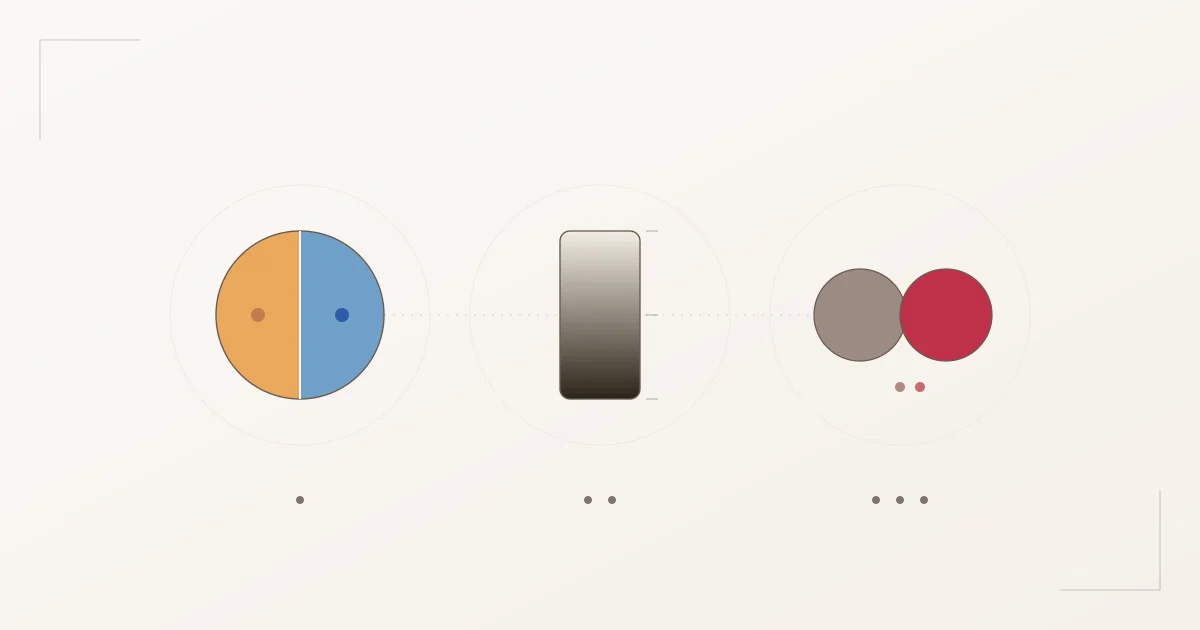
Dimension 1: Undertone (warm ↔ cool)
Undertone is the temperature of your skin. Warm undertones have a golden, peachy, or yellowish glow. Cool undertones have a rosy, bluish, or olive glow. Undertone is the most important of the three dimensions — it decides whether golden or silver tones, warm camel or cool grey carry your complexion.
Dimension 2: Value (light ↔ deep)
Value describes how light or deep your overall natural appearance is — the interplay of skin, eyes, and hair. A fair, blonde person with light eyes is light; a person with dark hair and dark eyes is deep. Value determines whether delicate, lightened colors or rich, dark tones suit you better.
Dimension 3: Chroma (clear ↔ muted)
Chroma — also called intensity or saturation — describes whether your coloring is clear and bright or soft and muted. People with high contrast between skin, eyes, and hair carry clear, bright colors. People with low, blended contrast carry muted, smoky tones. This third dimension is the one most often overlooked — and it's frequently the reason a "warm" person still gets swallowed up by pure orange.
Remember this
Undertone tells you which temperature. Value tells you how light or deep. Chroma tells you how clear or soft. Only all three together give you your true color type — not a single "warm" or "cool."
Warm or cool? Undertone as the foundation
If you learn only one thing about your color type, make it this: your undertone. It's the foundation everything else is built on. Undertone is the underlying base temperature that shows through your skin — independent of tan, redness, or how you're doing on a given day.
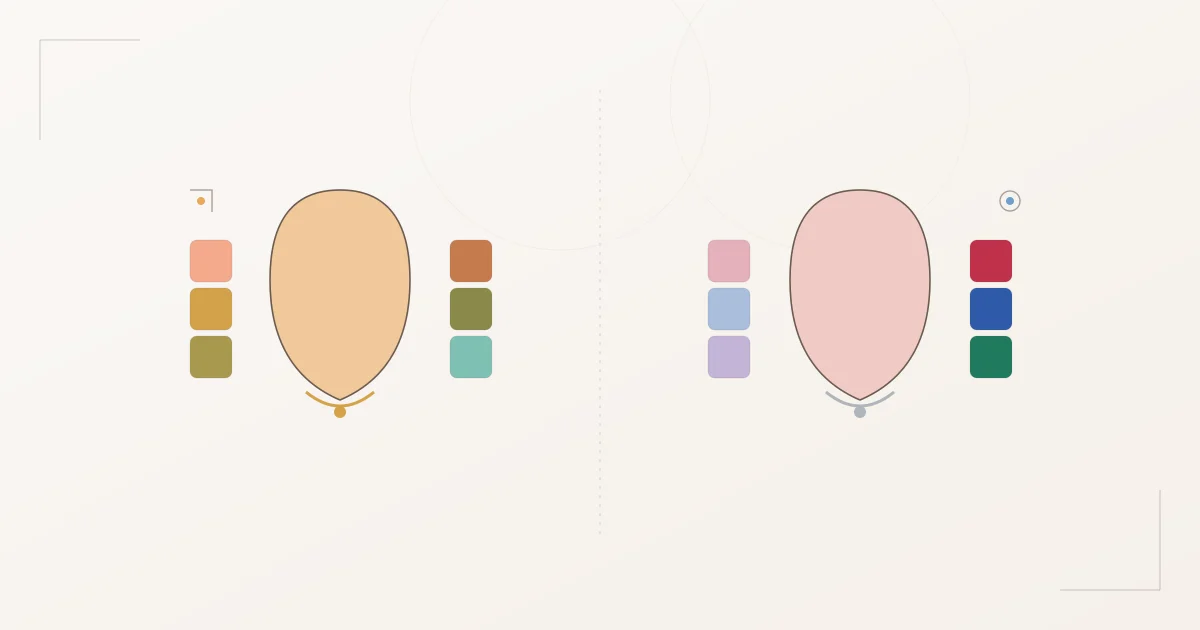
This table sums up the most reliable signals. Always judge them in daylight and without makeup — artificial light distorts the temperature.
| Signal | Warm undertone | Cool undertone |
|---|---|---|
| Veins at the wrist | Greenish | Bluish / purple |
| Jewelry that flatters | Gold | Silver / platinum |
| Skin's glow | Golden, peachy, yellowish | Rosy, bluish, olive |
| White vs. cream by the face | Cream looks fresher | Pure white looks fresher |
| Sun | Tans golden-brown | Burns quickly |
One important note: no single signal is conclusive on its own. The vein test, for example, is famous but unreliable when taken in isolation. Only when three or four signals point in the same direction do you have a result you can trust. People with a neutral or olive undertone often get mixed signals — for them, a professional analysis is especially helpful.
The 4-seasons system explained
The four-seasons system combines the three dimensions into four clear color types. Each season stands for a particular combination of undertone, value, and chroma — mirroring the colors nature shows in that season.
| Color type | Undertone | Value | Chroma |
|---|---|---|---|
| Spring | Warm | Light | Clear |
| Summer | Cool | Light | Muted |
| Autumn | Warm | Deep | Muted |
| Winter | Cool | Deep | Clear |
You can see the pattern: Spring and Autumn are warm, Summer and Winter are cool. Spring and Summer are light, Autumn and Winter are deep. Spring and Winter are clear, Summer and Autumn are muted. Each season is a unique combination of the three dimensions — which is why "warm or cool" alone is never enough.
The four color types in detail

Spring — warm, light, clear
The Spring type has a warm, golden complexion with high clarity — often golden-blonde to warm-brown hair and bright eyes. Spring is flattered by warm, fresh, luminous colors: coral, peach, warm turquoise, apple green, golden yellow, camel, and warm ivory. Best avoided are black, cool dark shades, and dusty, muted colors — they smother the type's natural lightness.
Summer — cool, light, muted
The Summer type has a cool, rosy undertone with soft, muted coloring — often ash-blonde to medium-brown hair and gentle eyes. Summer is flattered by cool, soft, smoky tones: dusty rose, smoke blue, lavender, mauve, sage, soft grey, and muted navy. Best avoided are orange, warm gold, and harsh black — they read as too garish for this delicate coloring.
Autumn — warm, deep, muted
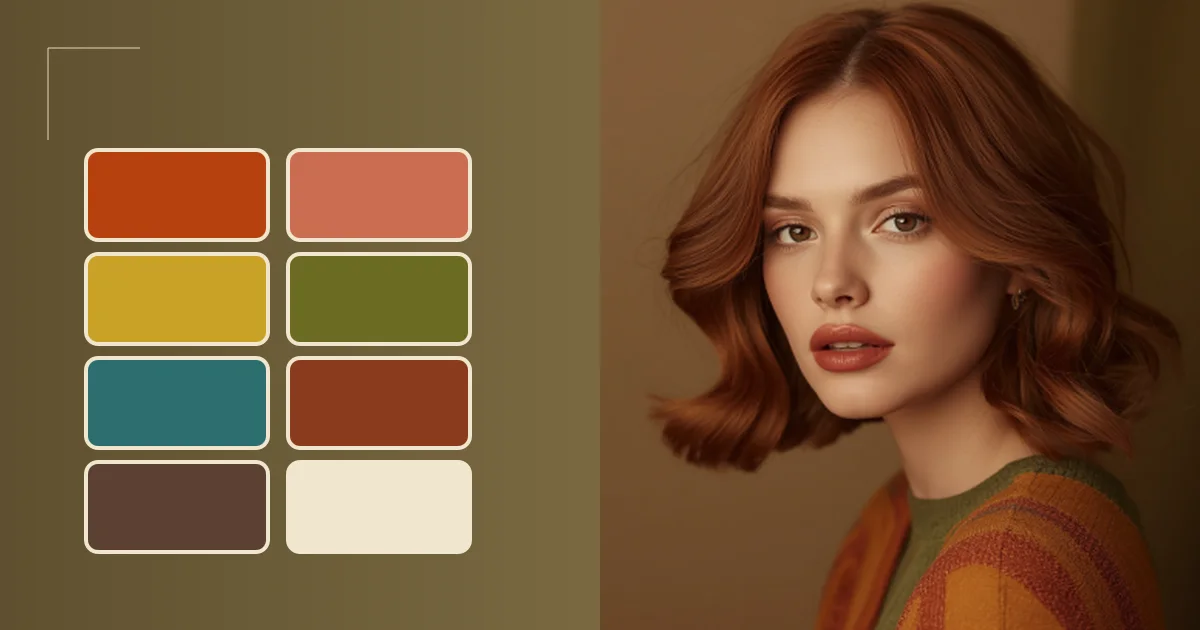
The Autumn type has a warm, golden undertone with deep, rich coloring — often copper to dark-brown hair and warm, deep eyes. Autumn is flattered by warm, earthy, rich colors: terracotta, rust, olive, mustard, forest green, camel, and warm brown. Best avoided are cool pastels, icy colors, and stark black-and-white — they leave the warm complexion looking sallow.
Winter — cool, deep, clear
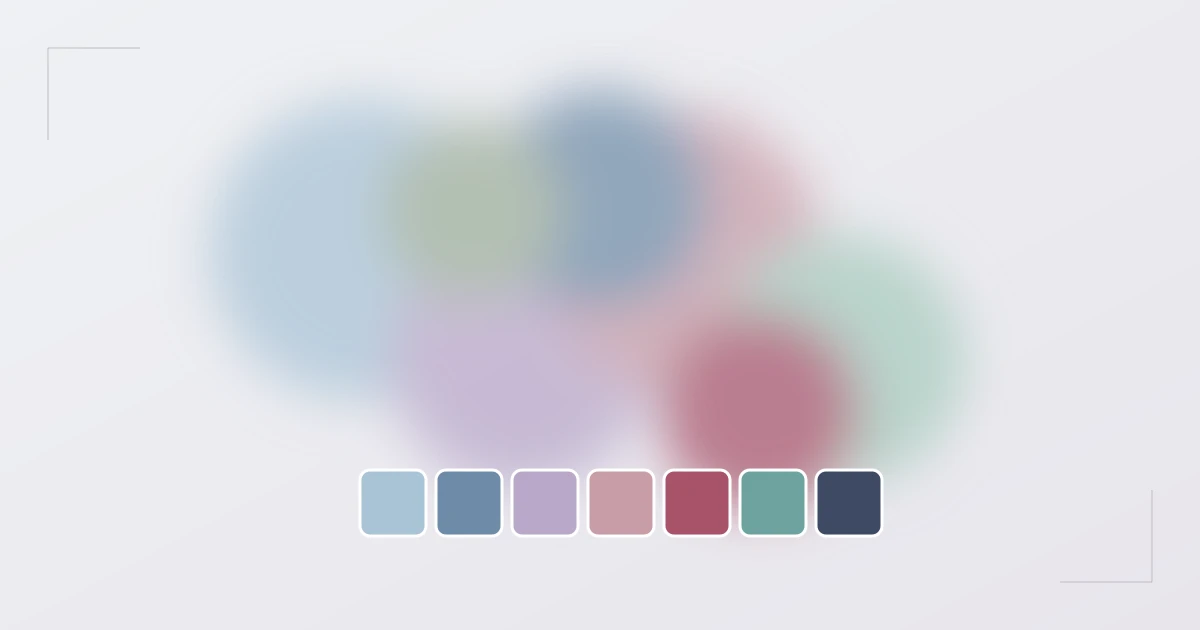
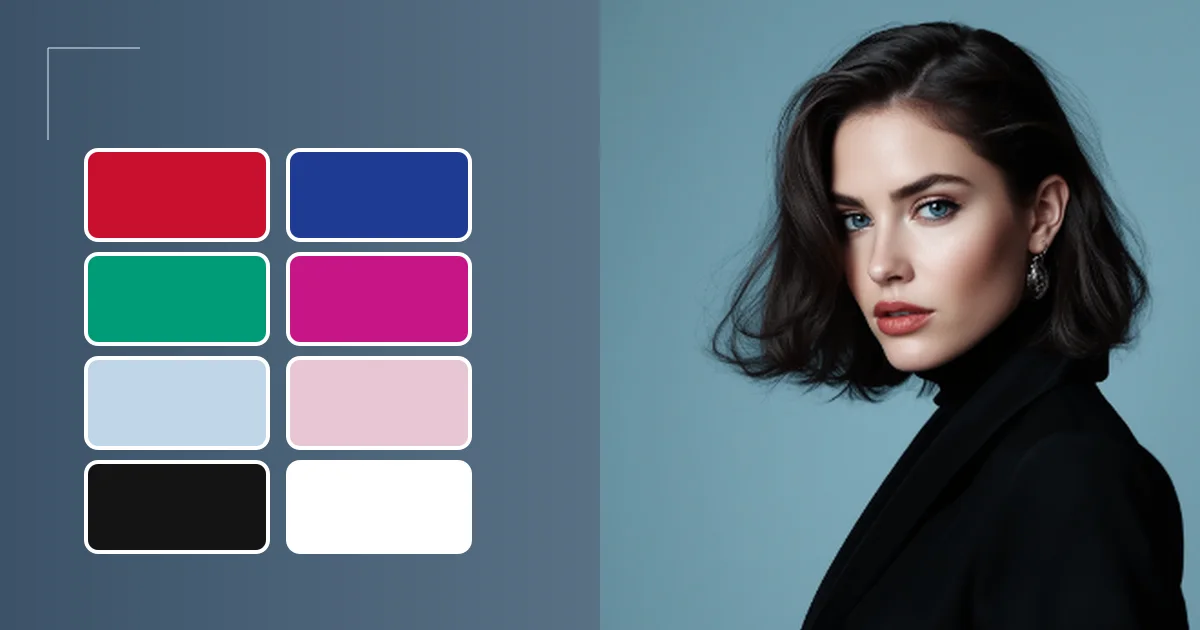
The Winter type has a cool undertone with high contrast and great clarity — often dark hair against lighter skin and bright eyes. Winter is flattered by cool, clear, high-contrast colors: true red, emerald, royal blue, magenta, pure white, black, and icy pastels. Best avoided are warm, earthy, muted tones — they cloud the clear, cool effect.
Practical tip
The two most common color types in Central Europe are Summer and Autumn — the muted types. When you're unsure between a clear and a muted type, the usual mistake is to reach for colors that are too clear. When in doubt: a color that feels "a bit too much" is usually too clear for you.
From the 4-season to the 12-type system
The four-seasons model is an excellent starting point, but it has one weakness: not everyone fits neatly into one of the four boxes. Many people fall between two seasons. That's why modern color consultants have refined the system into twelve color types — each season split into three variations.
Each season gets one pure variation and two that "flow" toward a neighboring season. The twelve types arrange themselves along the three dimensions:
| Season | The three variations |
|---|---|
| Spring | Light Spring · Warm Spring · Clear Spring |
| Summer | Light Summer · Cool Summer · Muted Summer |
| Autumn | Muted Autumn · Warm Autumn · Deep Autumn |
| Winter | Deep Winter · Cool Winter · Clear Winter |
For everyday purposes, the four-seasons classification is entirely enough. The twelve-type system pays off when you waver between two seasons or want to push your palette to its precise limits — and that's exactly the territory of a professional analysis, which matches your skin against real fabric swatches.
Determine your color type yourself: step by step
These six steps will narrow down your color type reliably. Preparation is key — most misreadings come from the wrong light or from makeup, not from faulty judgment.

- Daylight and a bare face. Stand by a window in indirect daylight — never under artificial light, which casts a yellow or blue distortion. Remove your makeup, tie your hair back, and drape a white cloth over your shoulders to block out clothing colors.
- Vein test. Look at the veins on the inside of your wrist in daylight. If they look greenish, that points to a warm undertone; if they look bluish or purple, to a cool one. Treat this signal as a clue, not a verdict.
- Jewelry test. Hold a gold and a silver piece up to your face in turn. Notice which one makes your complexion look fresher and more even. Gold flatters warm types, silver flatters cool ones.
- White-vs-cream test. Hold a pure-white and a cream-colored cloth under your chin one after the other. If pure white makes you look fresh, you lean cool; if cream looks more harmonious, you lean warm. This test is often more telling than the vein test.
- Assess contrast and depth. In the mirror, look at how strongly your natural hair, eye, and skin colors contrast. High contrast (dark hair, light skin) points to clear, deep types; low, blended contrast points to light or muted types.
- Draping and cross-checking. Hold warm and cool fabric colors up to your face in turn — terracotta against berry, mustard against smoke blue, say. The right temperature makes the skin look smooth and healthy; the wrong one emphasizes shadows, redness, and under-eye circles. This lands you on one of the four seasons.
Your color palette — professionally determined
A self-test gives you a tendency. A professional analysis gives you your exact palette — determined by draping with real fabric swatches and documented in a personal dossier you can carry with you when shopping and at the salon.
My Kibbe analysis with style dossier costs €150 — a colour analysis can be added (price on request). Free intro call via WhatsApp — 30 minutes, no obligation.
The most common mistakes in DIY color analysis
Most wrong color-type results don't come from a lack of instinct, but from avoidable mistakes in how the test is run. These five are the most common.
Mistake 1: The wrong light
Artificial light is the biggest enemy of color analysis. Incandescent bulbs throw a warm yellow cast; many LED and fluorescent tubes throw a cool blue one — both distort your undertone completely. Judge your color type only in indirect daylight by a window, never in the bathroom mirror under a ceiling lamp.
Mistake 2: Makeup, tan, or dyed hair
Foundation, self-tanner, and hair color overwrite the very signals you're trying to read. A warm dye job makes a cool type look warm. Always analyze your natural state: no makeup, no fresh tan, and looking at the roots rather than the dyed lengths.
Mistake 3: Confusing your favorite color with your color type
The color you love and the color that suits you are not the same thing. It's tempting to nudge your own result toward your favorite shades. So don't judge which color you like, but which one visibly freshens your complexion — that's an objective criterion, not a matter of taste.
Mistake 4: Running only one test
No single test is reliable — the famous vein test least of all. The result only becomes trustworthy when several tests point in the same direction. Always combine at least the vein, jewelry, and white-vs-cream tests before you commit.
Mistake 5: Ignoring chroma
Most self-tests stop at "warm or cool" and overlook chroma. That's exactly what leads to misfires: a muted warm type (Autumn) reaches for clear orange and wonders why it looks "like too much." Always check all three dimensions — undertone, value, and chroma.
Color type, hair color & makeup
Your color type is the best compass for two decisions many women make by feel for years: hair color and makeup. Both sit right at the face and therefore have an especially strong effect on the complexion.
With hair color, the rule is: stay within the temperature of your color type. A cool Summer type looks harmonious in ashy shades but quickly sallow in golden warm blonde. A warm Autumn type comes alive in coppery, golden-brown tones and looks tired in ashy cool blonde. You don't have to keep your natural color — but the right temperature always flatters more than the wrong one.
The same logic applies to makeup. Lipstick and blush are the most powerful levers: a cool type glows in berry, bluish-red tones, a warm type in coral, terracotta, and warm red. A clear Winter type carries a vivid blue-red effortlessly that would overwhelm a muted Summer type. The basic rule: foundation by undertone, colors by season.
The fastest visible effect of a color analysis shows up not in the wardrobe, but on the lips. The right shade makes your teeth look whiter and your complexion brighter — instantly, without changing anything else.
Color meets shape: color type and Kibbe
Color is one half of your style picture — the other is shape. Your color type determines which shades suit you. Your Kibbe type determines which cuts, silhouettes, and lines suit your body structure. Only together do they form a complete picture.
An example: two women are both "Autumn" and both wear the same warm terracotta. One is a Dramatic and wears it as a long, sleek, unbroken dress; the other is a Romantic and wears it as soft, curve-emphasizing drapery. The same color, two completely different silhouettes — both right, because color and shape are determined separately. For how this works in detail, see the Kibbe clothing guide; and which consultation you need first is answered by the comparison color analysis or style consultation.
The same separation applies to your hairstyle: your color type determines the hair color, your Kibbe type the cut. More on that in the guide hairstyles by Kibbe type. And if you don't yet know your Kibbe type, the guide to all 13 Kibbe types gives you the foundation.
Self-test or professional color analysis?
A self-test is a good start and costs nothing. For many people it's enough to find the broad direction — warm or cool, light or deep. Its limit is precision: with neutral or olive undertones, with people who fall between two seasons, or with hair that's already dyed, self-assessment quickly reaches its limits.
A professional color analysis works with draping: the consultant systematically holds dozens of real fabric colors up to the face and observes, under standardized light, which tones carry the complexion and which cloud it. The result is your exact palette — including the twelve-type fine-tuning that's nearly impossible to hit with a self-test. On jo-style.com, the color palette is part of the "Image Identity" style consultation, which brings color and Kibbe shape together in a personal dossier.
| Criterion | Self-test | Professional analysis |
|---|---|---|
| Cost | Free | Price on request |
| Precision | Broad tendency | Exact 12-type palette |
| Neutral/olive undertones | Often uncertain | Reliably resolved |
| Result | Your own estimate | Documented palette + dossier |
FAQ — Common questions about color type
What is a color type?
A color type is the group of colors that harmonize with your natural skin undertone, eye color, and hair color, making you look fresher as a result. It's defined by three properties: undertone, value, and chroma. The best-known model groups these into four color types — Spring, Summer, Autumn, and Winter.
How do I find out which color type I am?
Start with your undertone: in daylight and without makeup, check your veins (greenish = warm, bluish = cool), test gold against silver and pure white against cream by the face. Then determine the value and chroma of your overall appearance. Several matching signals lead you to one of the four seasons.
What's the difference between a warm and a cool undertone?
A warm undertone has a golden, peachy, or yellowish glow; a cool undertone looks rosy, bluish, or olive. Warm types look harmonious in gold and earthy tones, cool types in silver and clear, cool colors. Undertone is the single most important trait in any color analysis.
How reliable is the vein test?
The vein test is a useful first clue, but not reliable on its own. Lighting conditions and skin thickness distort the result, and many people see both greenish and bluish veins. Never rely on a single test — combine the vein, jewelry, and white-vs-cream tests.
Can my color type change over the course of my life?
Your undertone stays constant — it's genetically fixed and doesn't change. What can change is your value: greying hair or lighter skin in later years often shift the flattering palette within the same temperature, moving from a deep to a lighter type in the same direction. The base temperature, however, stays the same.
What if I fall between two color types?
This is common, and it's the main reason for the expanded twelve-type system. Someone who falls between two seasons is usually a transitional type that flows toward a neighboring season — a muted Summer leaning toward Autumn, for instance. In that case, a professional analysis with draping gives the clearest answer.
Which colors should I avoid once I know my type?
Above all, avoid colors of the wrong temperature right at the face. A warm type should avoid cool, icy tones; a cool type warm orange and gold. You don't have to give these colors up entirely — wear them away from the face, on trousers, shoes, or bags, where they don't affect the complexion.
Does my color type also determine my best hair color?
Yes, at least the temperature. When you color your hair, stay within the temperature of your color type: warm types look harmonious in golden and coppery shades, cool types in ashy ones. You can vary the exact value, but the wrong temperature quickly leaves the complexion looking sallow.
Can I wear black if I'm not a Winter type?
Pure black suits the Winter type above all, because it echoes that type's cool, clear contrast. Other types often look pale or harsh in black right at the face. The solution isn't going without, but swapping in a substitute: warm types reach for chocolate brown or navy, soft types for charcoal or muted grey.
What's the difference between color type and color analysis?
The color type is the result; the color analysis is the process that determines it. A professional color analysis identifies your type through systematic draping with real fabric colors and translates it into a concrete palette. The self-test is the free, less precise version of the same goal.
Do I need a color analysis or a style consultation first?
Each answers a different question: the color analysis tells you which shades suit you; the Kibbe style consultation tells you which cuts and silhouettes suit your body line. Ideally you combine both. Which one makes sense first for you is explained in detail by the comparison "color analysis or style consultation."
Can I determine my color type online or via an app?
Apps and online tests offer a first orientation but struggle with the same limits as any self-test: screen and camera colors aren't calibrated, and photo lighting distorts the undertone. As a supplement to your own assessment they're usable, as a sole source unreliable. Reliable results still come from matching against real fabric colors under standardized light.
Ready for your personal color palette?
Find the colors that make you glow
This guide gives you the tools for self-assessment. A professional analysis gives you your exact palette — determined by draping with real fabric colors and united with your Kibbe type in a personal dossier. A free intro call is always included.