
TL;DR — the key points at a glance
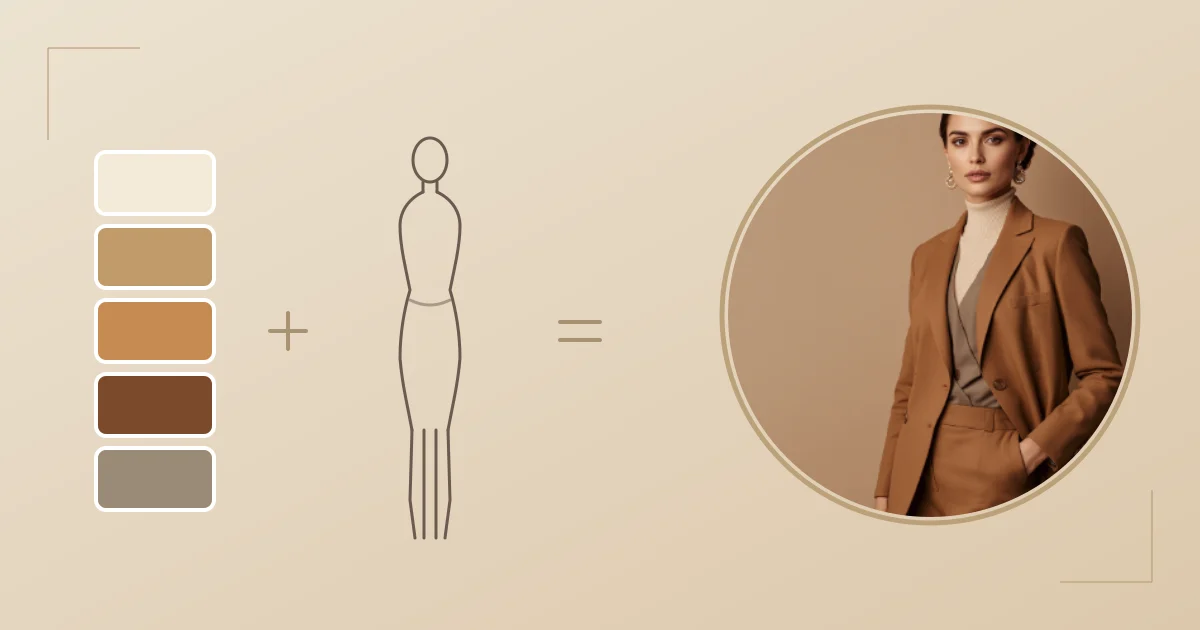
- Colour and form are two independent systems. Colour analysis tells you which tones suit you; the Kibbe system tells you which cuts and lines suit you.
- Your colour type (Spring, Summer, Autumn, Winter) changes nothing about your Kibbe type — and vice versa. Every combination is possible.
- Only both together give you the full picture: the right colour in the right cut.
- In practice: colour decides which colour, Kibbe decides where it sits and in which cut.
- In 5 steps you build a wardrobe from both in which every piece fits — no more wrong buys.
Table of contents
- The short answer
- Colour & form: two independent systems
- What colour analysis tells you
- What the Kibbe system tells you
- The 5 Kibbe families in brief
- Why you need both
- The combination matrix: colour season × Kibbe
- Your complete style type in 5 steps
- Colour placement: where the colour belongs
- The most common mistakes
- Example: the same tone, two types
- When professional help pays off
- Frequently asked questions (FAQ)
The short answer
Short answer
Colour type and Kibbe type are two independent systems that complement each other: colour analysis determines your colour palette (which tones make your face glow), while the Kibbe Body Type System determines your line (which cuts and silhouettes flatter you). To combine the two, you first choose the colour according to your season and then the cut according to your Kibbe type. That way you always wear the right colour in the right form — the most reliable foundation for a wardrobe without wrong buys.
Most style guides treat colour and cut separately — yet a truly cohesive look only emerges when the two come together. This guide brings together the two systems JO-Style has built up separately: the four-seasons colour analysis and the Kibbe Body Type System. By the end you will know how to turn your colour season and your Kibbe type into a single, working wardrobe.

Colour & form: two independent systems
Colour and form are two separate axes of your style. One tells you which colour tones suit your natural contrast and undertone. The other tells you which cuts, lines and proportions suit your body structure. Both matter — and both are independent of each other.
This is the central point many people miss: your colour season reveals nothing about your body line, and your Kibbe type reveals nothing about your colours. A Summer type can be a soft Romantic or an angular Dramatic. A Winter type can be a Gamine or a Natural. Each of the four colour seasons can meet any of the 13 Kibbe types.
This independence is not theory but everyday reality: two women with an identical colour season often need completely different cuts, and two women with the same Kibbe type often need completely different colours. Anyone who blends the two axes — for instance along the lines of "Winter means cool and severe, so severe cuts too" — draws a false conclusion about form from colour. Colour stays colour, form stays form; only when deliberately combined do they become a tool.
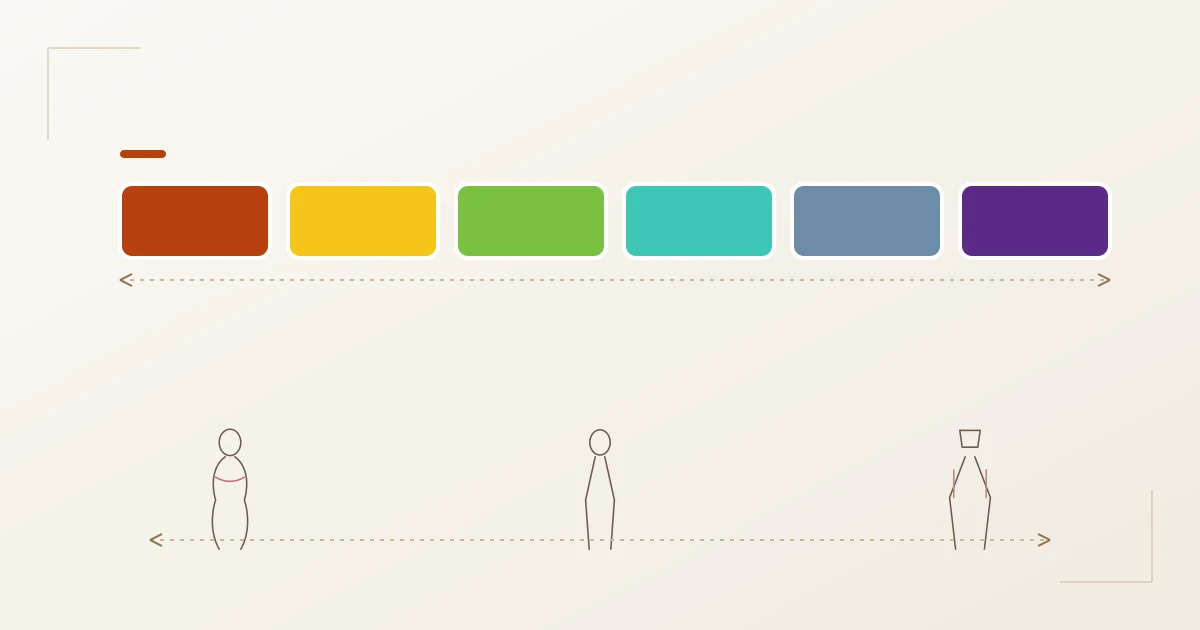
"Colour answers the question which one. Form answers the question which cut. Anyone who knows only one of the two is making half their decisions blind."
What colour analysis tells you
Colour analysis is the system that determines your personal colour palette. Using three properties — temperature (warm/cool), lightness (light/dark) and clarity (clear/muted) — it assigns you to one of the four seasons. The result is a palette of tones that make your face look fresh and awake.
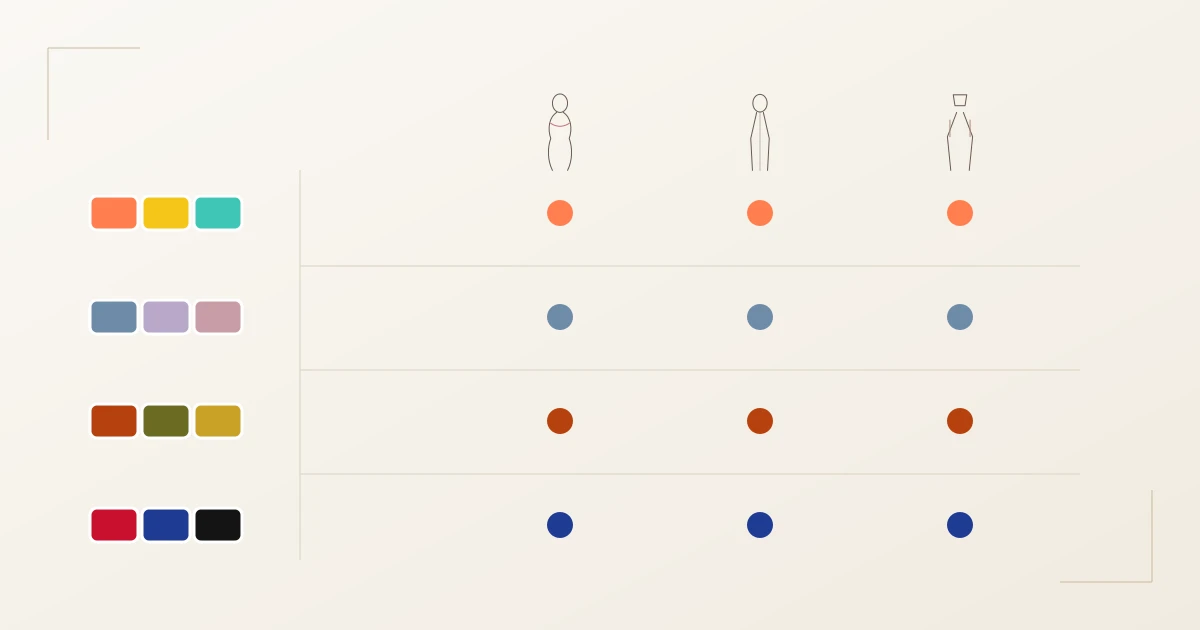
- Spring: warm, clear, light — coral, golden yellow, warm turquoise.
- Summer: cool, muted, light — dove blue, mauve, dusty rose.
- Autumn: warm, muted, deep — rust, olive, mustard gold.
- Winter: cool, clear, high-contrast — true red, royal blue, black and white.
What colour analysis does not answer: which cut, which length, which silhouette. A rust tone suits the Autumn type — but whether as a softly draping wrap dress or a sharply cut blazer is not something colour analysis decides. You will find your starting point in the overview Which colour type am I?
What the Kibbe system tells you
The Kibbe Body Type System is the system that determines your body line. Based on the ratio of Yin (soft, round) and Yang (sharp, straight), it assigns you to one of 13 types across five families — from Dramatic through Natural, Classic and Gamine to Romantic. The result is a logic for cuts, lengths, fabrics and silhouettes that take up your structure harmoniously.
Unlike the crude body-shape models (apple, pear, hourglass), Kibbe works with the overall line made up of bone structure, body flesh and proportions — not just the waist. More on this in the comparison Kibbe vs. body-shape type. What the Kibbe system does not answer: which colour. It tells you that a sharp shoulder line suits you — but not whether in navy or in rust. You will find out which Kibbe type you are in the do-it-yourself Kibbe test.
The 5 Kibbe families in brief
To make the combination tangible, a quick look at the five Kibbe families helps. They group the 13 types by their basic line — and each one takes up colour differently:
- Dramatic: long, sharp, straight lines (pure Yang). Wears large, clear, calm blocks of colour and severe cuts.
- Natural: broad, relaxed, blunt lines. Wears colour in flowing, unconstructed pieces and in texture.
- Classic: symmetrical, balanced lines. Wears colour in clear, harmonious ensembles without extremes.
- Gamine: compact, broken lines (a Yin-Yang mix). Wears colour in contrasts and divided blocks.
- Romantic: soft, round lines (pure Yin). Wears colour in flowing, waisted, feminine cuts.
Each family takes up the same colour differently — as a large block, as texture, as contrast or as a flowing drape. This is exactly why the combination of colour season and Kibbe family is so powerful: it tells you not only which colour, but also in which block and form it works best. You will find the full overview of all 13 types and the five families in the guide to the 13 Kibbe types.
Why you need both
A garment only looks truly cohesive when colour and cut fit. If one of the two axes is missing, a typical half-hit results: the right colour in the wrong cut (the tone flatters, but the silhouette does not sit) or the right cut in the wrong colour (the line is right, but the face looks washed out).
This is exactly where most wrong buys come from. A piece that fits on only one axis stays hanging in the wardrobe because "something isn't quite right". Anyone who knows both axes filters reliably right there in the shop: colour first (is the tone in my palette?), then form (is the cut in my line?). Only what passes both tests comes home.
A quick calculation makes the power of the combination clear: with four colour seasons and 13 Kibbe types there are 52 possible combinations — 52 different "instruction manuals" for colour and cut. No general trend list can hit any one of them, because it ignores both axes. Your personal two-axis system narrows thousands of garments down to exactly the few that work for you — and makes shopping faster, not more complicated.
The combination matrix: colour season × Kibbe type
The combination matrix shows the principle at a glance: each of the four colour seasons can be combined with any of the Kibbe lines. There are no "forbidden" pairings — only different executions of the same colour tone.
| System | Answers | Measures | Result |
|---|---|---|---|
| Colour analysis | Which colours? | Undertone, lightness, contrast | Your colour palette (1 of 4 seasons) |
| Kibbe system | Which cuts? | Yin/Yang, bone, flesh, proportion | Your line (1 of 13 types) |
| Both combined | Which colour in which cut? | Colour + form together | Your complete style type |
Your complete style type in 5 steps
Here is how you connect the two systems into a working wardrobe:
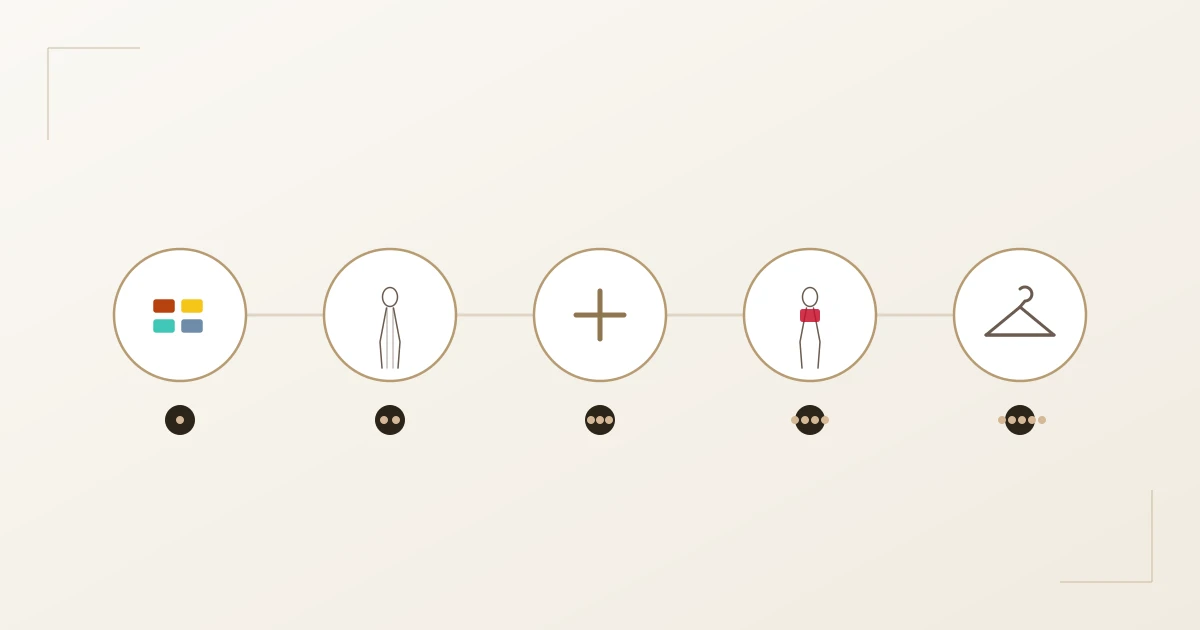
- Determine your colour palette: Find your colour season via the undertone, jewellery and contrast tests. Result: your yes-colours and your no-colours.
- Determine your Kibbe line: Find your Kibbe type via the Yin/Yang analysis of bone, flesh and proportions. Result: your cuts, lengths and silhouettes.
- Bring the two together: Translate each yes-colour into the cuts of your line. Example: your rust tone becomes a soft blouse for the Romantic, a clean blazer for the Dramatic.
- Place the colour: Decide where the strong colour sits — close to the face for maximum impact, as an accent following the 60-30-10 rule for balance (more on this below).
- Build the wardrobe: Build a capsule wardrobe on your neutrals and add accent colours deliberately — every piece passes both tests.
Colour placement: where the colour belongs
Colour placement is the art of putting the right colour in the right spot — and this is where colour and form mesh directly. Two principles help:
- Close to the face counts most: Tops, scarves and blouses decide the effect of your colours. Your best tones belong up top; difficult colours at most down below.
- The 60-30-10 rule: Build an outfit from roughly 60% base tone (your neutral), 30% secondary colour and 10% accent. The 10% is the place for your strongest palette colour.
- The line determines the block: Clear, straight lines (Dramatic, Classic) carry large, calm blocks of colour. Soft or broken lines (Romantic, Natural) take colour better in flowing pieces and patterns.
In practice this means: a Winter type with a Dramatic line uses a large field of royal blue as a clean coat — a calm block in a clear colour. A Summer type with a Romantic line spreads the same principle across a softly draping blouse in muted dove blue — the same logic, but in soft form and a cool-muted tone. The rule "best colour up top, strongest tone as an accent" stays the same; the block and the cut follow your line, the nuance follows your season.
The most common mistakes when combining
- Considering only one axis. Anyone who knows only colour or only cut keeps buying half off the mark. Both tests belong together.
- Confusing colour season with body type. "I'm Winter, so I wear severe cuts" is a fallacy — the season says nothing about the line.
- Wearing your best colour down below. A perfect tone on your trousers wastes its effect; close to the face it comes alive.
- Putting trends above your own system. A trend colour outside your palette stays outside your palette — even if it's everywhere right now.
Example: the same tone, two types
Two women are both Autumn types — the same warm olive suits both. One is a Romantic with soft curves, the other a Dramatic with long, straight lines. The colour is identical, the execution opposite:
The Romantic wears the olive as a softly draping wrap dress with roundness. The Dramatic wears the same olive as a sharply cut trench coat with a clean shoulder. Same colour, opposite form — and both look exactly right. That is the whole idea.
The same holds in the other direction: two women are both Dramatic — the sharp, clear line suits both. If one is a Winter type and the other an Autumn type, one wears her blazer in royal blue or black, the other in rust or deep olive. Same form, opposite colour. That is how the two systems mesh: the line stays constant, the colour shifts with the season.
This very effect makes clear why no app and no trend list can replace the combination: the colour is a constant, but form translates it into your silhouette — and the line is a constant that tints the colour with your season.
When professional help pays off
You can work out both systems for yourself — the tests in the linked guides take you a long way. A professional analysis pays off when you waver between two seasons or two Kibbe types, when the self-tests stay ambiguous, or when you want to translate both results directly into a concrete shopping and wardrobe plan. Whether you are missing the colour or the style analysis is clarified by the comparison colour consultation or style consultation.
The greatest value of a combined consultation lies in the translation: a professional takes your season and your line and derives from them concrete cuts, lengths, fabrics and colour combinations — including the pieces you can safely sort out. In the long run this usually saves more than the consultation costs, because the expensive wrong buys fall away and every new piece fits into your system.
Clarify colour and form in a single session — and translate both results straight into your wardrobe. A professional colour and style consultation takes the guesswork off your hands.
To the colour & style consultation →Frequently asked questions (FAQ)
Are colour type and Kibbe type the same thing?
No. The colour type (Spring, Summer, Autumn, Winter) determines your colour palette, the Kibbe type your body line and therefore your cuts. They are two completely independent systems. Only together do they give you the full picture of the right colour and the right form.
Does my colour type depend on my body type?
No, the two are independent of each other. Your colour season rests on the undertone, lightness and contrast of your natural colouring; your Kibbe type on bone structure, body flesh and proportions. Every colour season can meet any of the 13 Kibbe types.
Which system should I determine first?
The order is up to you, but in practice it is often easier to determine the colour season first, because the undertone tests are quick. Then you clarify your Kibbe type. When shopping you reverse the order: check the colour first, then the cut.
Can every colour season be combined with every Kibbe type?
Yes. There are no impossible combinations — a Winter type can be Romantic, an Autumn type Dramatic, a Summer type Gamine. The colour season determines the tones, the Kibbe type the cuts; they never contradict each other, they complement each other.
How do I combine colour and cut in practice?
First choose a colour from your palette, then the cut from your Kibbe line. The same rust becomes a soft blouse for the Romantic, a clean blazer for the Dramatic. That way you always wear each of your colours in the form that flatters your structure.
What is the 60-30-10 rule?
The 60-30-10 rule splits an outfit into roughly 60% base tone, 30% secondary colour and 10% accent. For colour types it is practical because the 10% is the place for the strongest palette colour, while the 60% stays a neutral base tone. That way colour works deliberately rather than looking overloaded.
Why isn't colour analysis alone enough?
Colour analysis tells you which tones suit you, but nothing about cut, length and silhouette. A perfect tone in the wrong cut still doesn't sit — the piece stays in the wardrobe. Only the body line (Kibbe) translates the colour into the right form.
Why isn't the Kibbe system alone enough?
The Kibbe system tells you which cuts suit you, but nothing about colour. A perfectly cut blazer in the wrong colour makes your face look washed out. Only colour analysis adds the missing axis and makes the face glow.
Does my Kibbe type change if I lose or gain weight?
The Kibbe type rests above all on bone structure and the basic proportions, which stay stable. Weight fluctuations change the body flesh, but rarely the basic line. The colour season stays stable for life anyway, because it hangs on the undertone.
Do I need a consultation for both systems?
No, both can be approximated well with the self-tests. A consultation pays off when the self-tests stay ambiguous, you waver between two types, or you want to translate both results directly into a concrete wardrobe plan. For many people, combining the two self-guides is enough.
Sources & further reading: Johannes Itten — colour theory · Color analysis (art).