
TL;DR — Soft Summer at a glance
Soft Summer is the most muted of the three summer subtypes: cool undertone, medium depth and very little personal contrast. The colours are cool but never clear — mauve, smoky blue, dove grey, cool dusty rose. Anything luminous shouts on you; anything dusty makes you look awake.
- This type sits between summer and autumn. The muting leads, the coolness follows.
- Best colours: mauve, lavender, smoky blue, sea blue, dove grey, slate, cool dusty rose, muted berry, sage and jade.
- Avoid: pure white, black, orange, golden yellow, tomato red and camel — everything clear and everything warm.
- Grey genuinely works here — the only colour type that carries it as a main colour near the face.
- Most common mix-up: Soft Autumn. Both are muted; temperature alone separates them.

Contents
- What is a Soft Summer?
- The traits: is this you?
- The self-test in five steps
- The Soft Summer colour palette
- The dark-colour problem
- Which colours overwhelm you
- Soft Summer or Soft Autumn?
- Soft, Cool or Light Summer?
- Make-up, hair colour and jewellery
- Combining colours day to day
- Why celebrity lists mislead
- Colour meets line: your Kibbe type
- Frequently asked questions
What is a Soft Summer?
Soft Summer is one of twelve colour types in the extended seasonal system and the bridge between summer and autumn. The name states the order of its properties: soft for the muting, summer for the coolness. That order decides everything. Here low saturation dominates and coolness comes second — unlike Cool Summer, where temperature leads.
The classic four-season model sorts by undertone and depth. That gives a rough direction but does not explain why two summer types look completely different in the same blue. Hence the twelve-type system: every season gets three subtypes, each leaning towards a neighbouring season. This one leans towards autumn — it is the warmest and quietest of the three summers.
It is striking how firmly the English term has taken hold in German-speaking markets: according to Ahrefs data, "soft summer" is searched around 2,000 times a month in Germany, while "sommertyp" — the German word for summer type — reaches only about 1,400. The English subtype name has overtaken the native seasonal label. If you have placed yourself as a summer type so far, this article is the deep dive into its most muted variant.
This type rarely fails on colours that are too warm. It fails on colours that are too clear — a cool royal blue is correct on temperature and still wrong.
The traits: is this you?
The hallmark is very low personal contrast combined with a cool undertone. Skin, eyes and hair sit close together in value, and none of the three is luminous. That is why sharp oppositions read harsh here, even when the individual colours are cool and therefore in principle correct.
Skin
Usually light to medium with a rosy, bluish or slightly olive undertone. Typically it neither glows nor reads deep — it looks matte. Many describe their complexion as "dull", and that is not a flaw but the trait itself: the muting already sits in the skin.
Eyes
Grey-blue, grey-green, muted hazel or soft brown with a cool cast. The telling detail is a blurred boundary between iris and white. Luminous blue or clearly green eyes with a distinct rim point towards Cool Summer or a Winter instead.
Hair
Ash blonde, mid brown with an ash cast, dark blonde without golden shimmer, or early grey. Red and golden reflections are absent from the natural colour. Anyone who was light blonde as a child and drifted into ash over the years lands here more often than average.
The contrast
The most reliable check: photograph yourself without make-up and convert the image to black and white. Skin, eyes and hair should fall into a narrow band of greys, and in the middle range — neither very light nor very dark. If the hair reads distinctly darker than the skin, you are closer to a Winter.
The self-test in five steps
These five steps narrow the result down reliably. Preparation decides the outcome: most mistypings come from the wrong light, not from poor judgement.
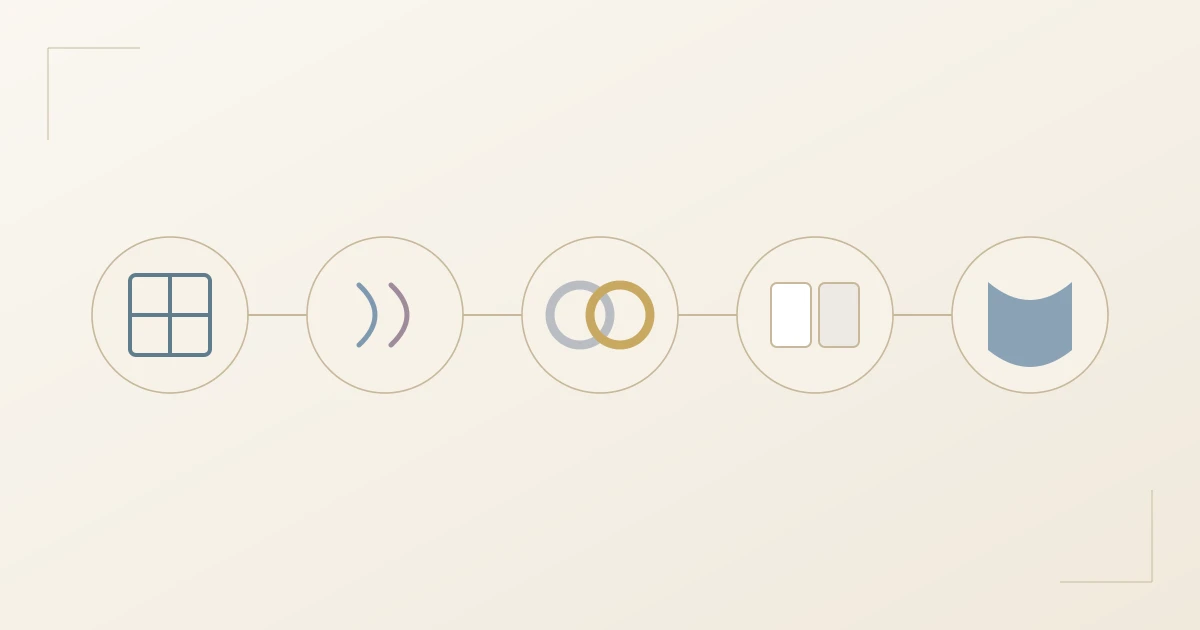
- Daylight and a bare face. Stand at a window in indirect daylight. Artificial light shifts temperature in both directions. Remove make-up, tie your hair back and drape a white cloth over your shoulders.
- The vein test. Look at the veins on your inner wrist. Bluish or violet suggests a cool undertone. Greenish argues against this type — though on olive skin the veins often look ambiguous, so treat this step as a hint rather than a verdict.
- Silver against gold. Hold both metals to your face in turn. Silver should make the skin read clearer and more even, gold should make it look sallow. Use brushed silver, not polished — high shine overpowers muted types and skews the result.
- Pure white against broken white. Hold a pure white and a cool, slightly greyed white under your chin. Pure white usually reads too sharp here and emphasises every patch of redness; the broken white calms the face.
- Draping: clear against muted. Place a clear, cool colour next to a muted one from the same family — royal blue beside smoky blue, magenta beside muted berry. If the muted version makes your face look calmer and fresher, that is your answer.
Only when four of five steps point the same way is the result dependable. If it stays ambiguous, a guided colour analysis with real fabric drapes helps. For a faster start, our free colour type test takes you to the right season in seven questions — the subtypes you then settle here.
The Soft Summer colour palette
This palette consists of cool colours under a grey veil. None of them glows, none is warm. The principle: coolness meets coolness, muting meets muting. A cool colour without that veil drops out — royal blue is the clearest example.
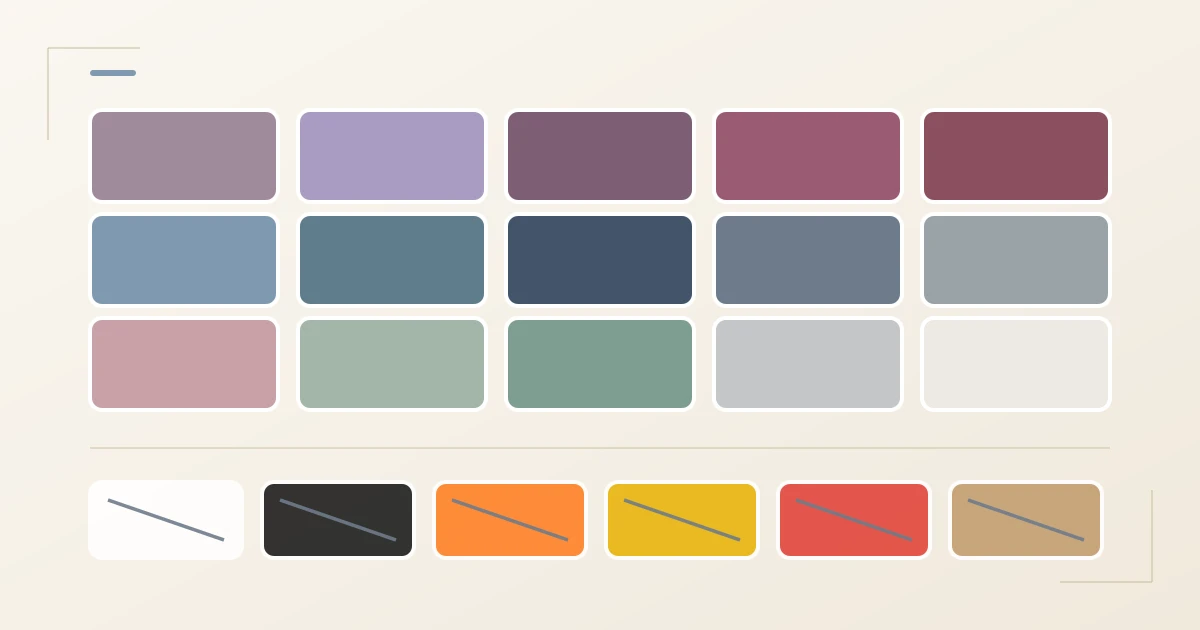
- Blue and petrol (the signature range): smoky blue, sea blue, muted navy, slate. The strongest and most wearable part of the palette.
- Grey in every gradation: dove grey, pearl grey, slate grey. The only colour type for which grey carries as a main colour near the face instead of draining it.
- Mauve and lilac: mauve, muted lavender, cool plum. The most characteristic group — if mauve makes you bloom, you usually have your answer.
- Muted pink and berry: cool dusty rose, muted berry, soft burgundy. Never fuchsia, never coral.
- Green: cool sage, jade, grey eucalyptus. Anything with yellow in it drops out.
- Neutrals: cool cream or broken white instead of pure white, dove grey instead of black, slate instead of charcoal.
| Use | Soft Summer | Instead of |
|---|---|---|
| White near the face | Broken white, cool cream | Pure white |
| Dark base | Muted navy, slate, plum | True black |
| Neutral mid tone | Dove grey, pearl grey | Camel, beige |
| Accent colour | Mauve, muted berry | Fuchsia, coral |
| Blue | Smoky blue, sea blue | Royal blue, turquoise |
| Metal | Brushed silver, white gold, platinum | Yellow gold, copper |
The dark-colour problem
Few colour types struggle with dark shades as much as this one — and few need them as badly in daily life. Coats, suits, office clothing: anything meant to give structure is usually dark. Yet neither black nor the usual navy serves here.
Black creates a contrast at the face that the complexion does not have. The result is emphasised shadows under the eyes and skin that reads grey rather than clear. Classic navy is cool enough but often too saturated — it takes the lead role and the face becomes a supporting part.
Three dark shades that genuinely work:
- Muted navy with grey in it. Not the strong ink blue but the washed-out version that almost tips into slate. Meets every formal expectation.
- Slate grey and blue-based charcoal. The honest alternative to black. Works in suits, coats and evening wear.
- Dark plum and deep burgundy. For anything where colour is allowed — they give depth without breaking the contrast.
Where black is unavoidable, for instance at a funeral: wear it below the waist, or put a dove-grey scarf between the fabric and your face. The difference shows up immediately in photographs.
Which colours overwhelm you
Two mistakes are possible, and the second is almost always overlooked. The first is the wrong temperature: warm shades such as orange, golden yellow, camel and rust turn the cool undertone yellowish. The second is the right temperature at too much clarity — royal blue, emerald and magenta are cool and still wrong, because they drown out a muted presence.
Pure white is the least obvious problem. It looks neutral but is maximally clear and maximally light — at the face it emphasises every patch of redness and every shadow. A broken white with a hint of grey does the same job and flatters.
Soft Summer or Soft Autumn?
This is the most common mix-up in the twelve-type system, for a simple reason: both share the muting. Both look poor in loud colours, both need muted shades, neither can take pure white. The difference lies in temperature alone.
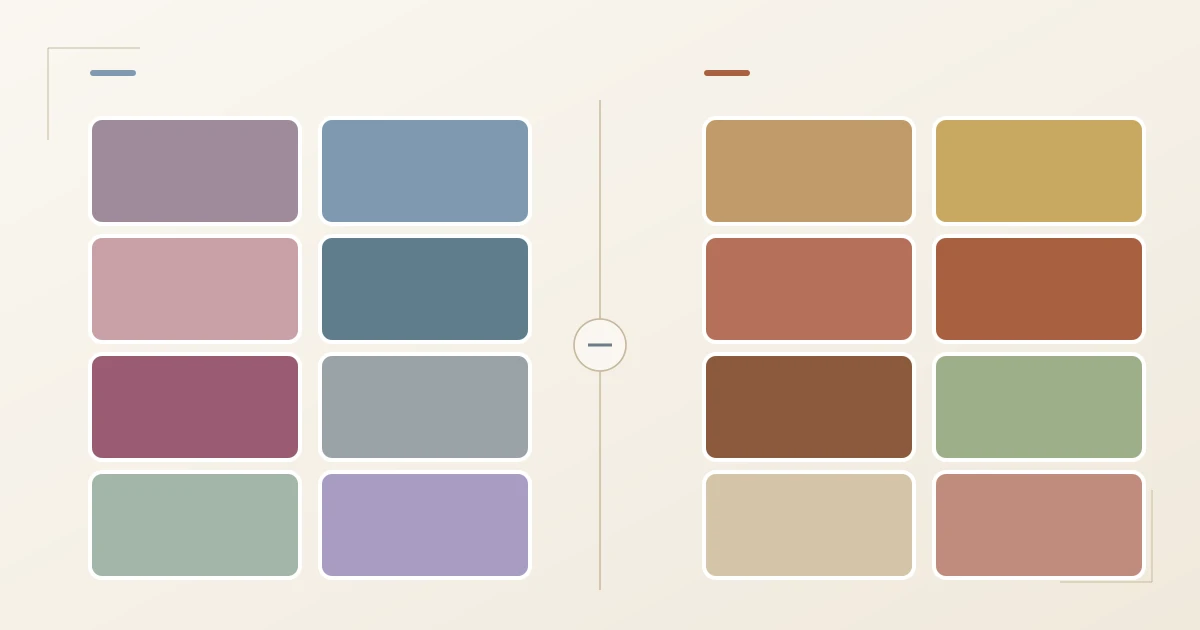
The one question that decides it: does brushed silver or brushed gold flatter you more? Take both metals in a matte finish and hold them to your face in daylight. Here the skin reads clearer under silver and sallow under gold. For a Soft Autumn it is the other way round.
A second check if the metal stays unclear: put dove grey next to camel. Dove grey is the signature shade of this type, camel that of its warm counterpart. One of the two makes your face read clearer, the other flattens it — that difference is usually more obvious than the metal test, because it shows the temperature across a large area.
Soft, Cool or Light Summer?
Within the summer family the deciding factor is not temperature — all three are cool — but how much clarity and lightness is added. This is where the second half of all mistypings sits, and it is discussed far less often than the boundary with autumn.
- Soft Summer: muted, medium depth, very low contrast. Mauve and dove grey are the anchor colours.
- Cool Summer: cooler and somewhat clearer. True navy and clear berry red work here; on the muted relative they overshoot.
- Light Summer: noticeably lighter and more delicate. Pastels carry, usually alongside light hair and an overall luminous appearance.
The practical check in two moves: first hold muted berry next to clear berry red. If the clear version makes you fresher, you are Cool Summer. Then hold dove grey next to powder pink. If the light pastel reads right and the grey feels heavy, you are Light Summer.
Make-up, hair colour and jewellery
The same rule applies to make-up as to clothing: cool and muted. Blush in cool dusty rose or muted berry, lips in mauve, soft berry or cool nude. Eyeshadow in grey-based taupe, slate, muted lilac and cool brown. What does not work: coral, peach, bronze and warm red. Black kohl right at the lash line is usually too hard — grey-brown or dark slate do the same job. The full picture is in make-up by colour type.
With hair colour, restraint is the better strategy. Ash blonde, cool mid brown, mocha and soft platinum with a grey undertone all work. Golden blonde, caramel, copper and warm mahogany tip the undertone warm and leave the complexion looking dull. Anyone greying early can wear the grey openly — it harmonises with the palette better than most dye jobs. More in hair colour by colour type.
For jewellery silver is right, along with white gold and platinum. The finish may be matte or lightly brushed; high polish quickly reads hard against a muted complexion. Stones in amethyst, moonstone, rose quartz, aquamarine and labradorite pick up the palette. Amber, carnelian and tiger's eye break it.
Combining colours day to day
The practical advantage of this palette: it combines with itself almost freely. Because every shade shares the same grey veil, very little turns noisy. Mauve with smoky blue with dove grey works — for a high-contrast person that would be risky.
Three combinations that reliably hold:
- Tone on tone with one break: dove-grey coat over broken white, slate trousers, and a mauve scarf as the single accent.
- Two muted colours at equal strength: smoky blue and muted berry. It works because both carry the same muting. Metal in brushed silver.
- The swap for formal occasions: where black and white are expected, use muted navy and broken white. It reads just as correct and does not take the light off your face.
With denim, look at the wash: mid and light blue with a grey component work, as does grey denim. Raw denim in deep indigo and any warm, brown-tinged fade drop out.
Why celebrity lists mislead
Almost every article on this subject lists celebrities — "soft summer celebrities" alone draws around 700 searches a month in Germany according to Ahrefs. Convenient, mostly useless, and for three reasons.
First, the hair is nearly always dyed. Colour typing follows natural hair colour. For public figures that has often not been visible for decades. Assigning a type from a current look describes a colourist's decision.
Second, studio lighting skews temperature. The same face reads more golden under warm light and cooler under a cold flash. Reading colour types off press photos means reading the lighting setup too — and for muted types that nuance is exactly what decides the outcome.
Third, make-up exists to cover the undertone. Foundation evens out redness and yellow cast, precisely the signals a colour analysis depends on.
One bare-faced selfie at a window tells you more about your colour type than any celebrity list online.
There is a further point affecting self-testing in general: colour perception is not identical for everyone. According to the US National Eye Institute, around 8 per cent of men and 0.5 per cent of women of Northern European descent have red-green colour vision deficiency. Asking for a second opinion on greens and berry shades is not less certain — it is more careful.
Colour type is also frequently confused with the Fitzpatrick skin type. The Fitzpatrick scale describes how skin reacts to UV radiation — a dermatological classification that says nothing about which blue suits you. Two people with the same Fitzpatrick type can belong to different colour types.
Colour meets line: your Kibbe type
Colour analysis answers only half the question. It tells you which shades carry you — not which cuts do. That is the job of the Kibbe system, which sorts the body by the relationship between bone structure, flesh and facial features.
The two systems never contradict each other. You can have any of the 13 Kibbe types, and only the combination becomes practical: with a soft Kibbe line, mauve works best in fluid fabric; with a sharp line, the same colour reads better in structured wool. How to turn both results into one shopping plan is in combining colour type and Kibbe type.
If you do not know your colour type at all yet, start one level up: determining your colour type takes you to the right season in four steps before you look at subtypes.
Frequently asked questions
What is the difference between Soft Summer and the summer type?
Summer is the parent category in the four-season system; Soft Summer is one of its three subtypes in the twelve-type system. All summer types are cool; this one is the most muted of them and leans towards autumn. If you have placed yourself as a summer but still feel wrong in delicate pastels, this is usually where you belong.
Which colours suit Soft Summer best?
Mauve, muted lavender, smoky blue, sea blue, dove grey, slate, cool dusty rose, muted berry, cool sage and jade. All of them carry a cool undertone and a grey veil at the same time. Mauve and dove grey are the signature shades because they hit temperature and muting together.
Can a Soft Summer wear grey?
Yes, and as the only colour type without restriction near the face. Dove grey, pearl grey and slate grey are main colours here, not fallbacks. On warm or clear types grey drains the complexion; here it picks up the person's own muting and lets the face read calmer.
Which dark colour replaces black?
Muted navy with grey in it, slate grey and dark plum. All three meet formal expectations without breaking the contrast this complexion cannot hold. True black at the face emphasises shadows under the eyes and chin; below the waist it is unproblematic.
Silver or gold for Soft Summer?
Silver, along with white gold and platinum. The finish may be matte or brushed — polished high-shine metal reads hard against a muted complexion. Yellow gold and copper make the skin look sallow. In mixed-metal jewellery with a silver majority, a little gold is no problem.
How do I tell Soft Summer from Soft Autumn?
By temperature, not by muting — both share that. Hold brushed silver and brushed gold to your face in daylight: if silver makes the skin read clearer, the cool side leads. Second check: dove grey against camel. Whichever makes your face read clearer points the way.
Which hair colour suits Soft Summer?
Ash blonde, cool mid brown, mocha and soft platinum with a grey undertone. What matters is the absence of warm reflections. Golden blonde, caramel, copper and warm mahogany shift the undertone warm and leave the complexion dull. Natural grey harmonises better here than most dye jobs.
Why does pure white look bad on me when it is neutral?
Because pure white is not neutral but maximally light and maximally clear. At low personal contrast it creates a jump at the face that the skin cannot mirror — redness and shadows stand out more. A broken white with a hint of grey does the same job and flatters.
Can my colour type change over a lifetime?
The undertone stays the same for life — it sits in the skin. What changes is depth and contrast: greying hair lowers personal contrast and shifts many people towards the muted subtypes. A Cool Summer can effectively become a Soft Summer over the years; the reverse does not happen.