
TL;DR — the essentials at a glance
- Make-up follows three zones: the base (foundation = your undertone), the colour (lips & blush = your colour palette) and the definition (eyes & brows = your contrast).
- The most common mistake is the foundation: it has to match your undertone, not just the lightness. The wrong undertone looks greyish or orange.
- Cool types (Summer, Winter) wear shades with a blue base — cool rosé, berry, plum. Warm types (Spring, Autumn) wear coral, peach, terracotta.
- Your contrast determines the intensity: Winter types wear bold colours, Summer types need soft ones.
- Make-up colour follows your colour type — not the make-up trend. Trend shades outside your palette stay outside your palette.
Table of contents
- The short answer
- The 3-zone system
- Zone 1: Foundation by undertone
- Zone 2: Lips & blush by colour type
- Zone 3: Eyes & brows by contrast
- Make-up by colour type at a glance
- Contrast determines the intensity
- Special cases: neutral & olive skin
- Your make-up in 5 steps
- The 6 most common mistakes
- Make-up colour vs. make-up style
- Frequently asked questions (FAQ)
The short answer
Short answer
The right make-up depends on your colour type: Summer types suit cool rosé and berry shades, Winter types clear, bold berry, plum and blue-red shades, Autumn types warm terracotta, brick and copper shades, Spring types warm coral, peach and apricot shades. The foundation always follows your skin undertone (cool, neutral or warm), not just the lightness. The intensity depends on your natural contrast: bold for Winter, soft for Summer.
Most make-up guides cover only one product — sometimes the lipstick, sometimes the foundation. Yet a harmonious face only comes together when base, colour and definition work together. This guide explains the whole system by colour type and thereby extends the hair colour by colour type to the face. You'll find the introduction to the colour type itself in the guide Which colour type am I?

The 3-zone system of make-up
Make-up by colour type follows three zones, each with its own logic. Separating them lets you make every product decision deliberately rather than by feel.
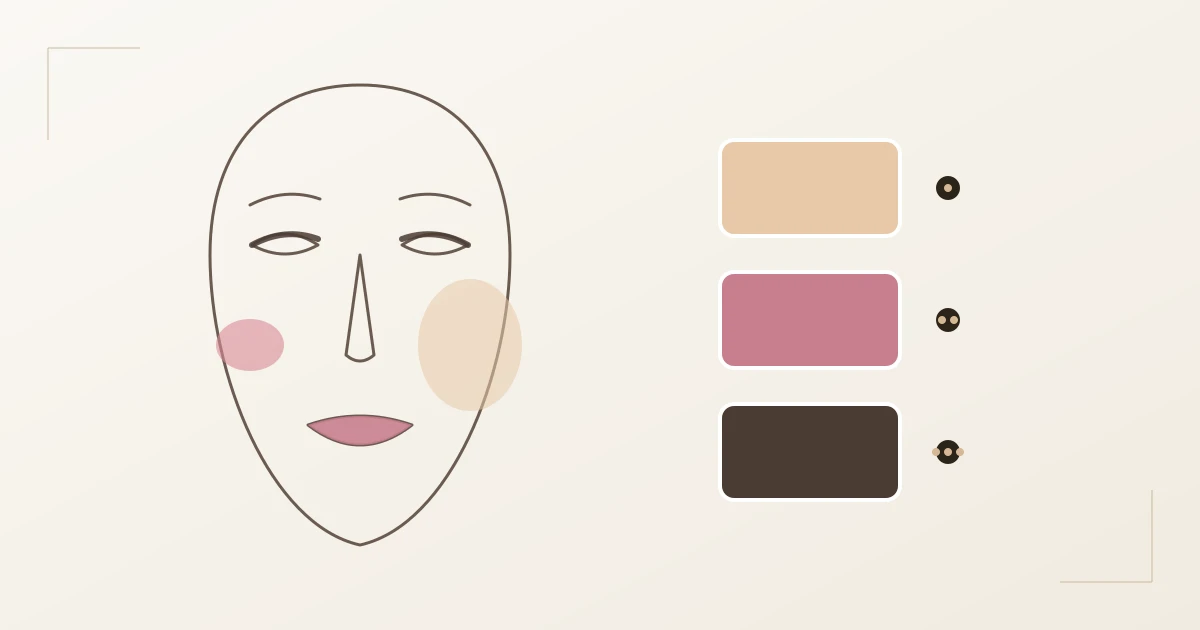
- Zone 1 — Base: foundation, concealer and powder. They should match your skin exactly, not discolour it. Here the undertone counts.
- Zone 2 — Colour: lipstick and blush. They bring the colour of your palette into your face. Here your colour season counts.
- Zone 3 — Definition: eyeshadow, eyeliner, mascara and brows. They set the contrast. Here your natural contrast level counts.
“The base should be invisible, the colour should flatter, the definition should frame. Choose all three by the same principle and you look ‘simply fresher' — not ‘made up'."
Zone 1: Foundation by undertone
Foundation is the most important and most often wrongly chosen make-up decision. The reason: most people choose the foundation by lightness, but what matters is the undertone. The right level of lightness with the wrong undertone makes the skin look greyish (too cool) or mask-like and orange (too warm).
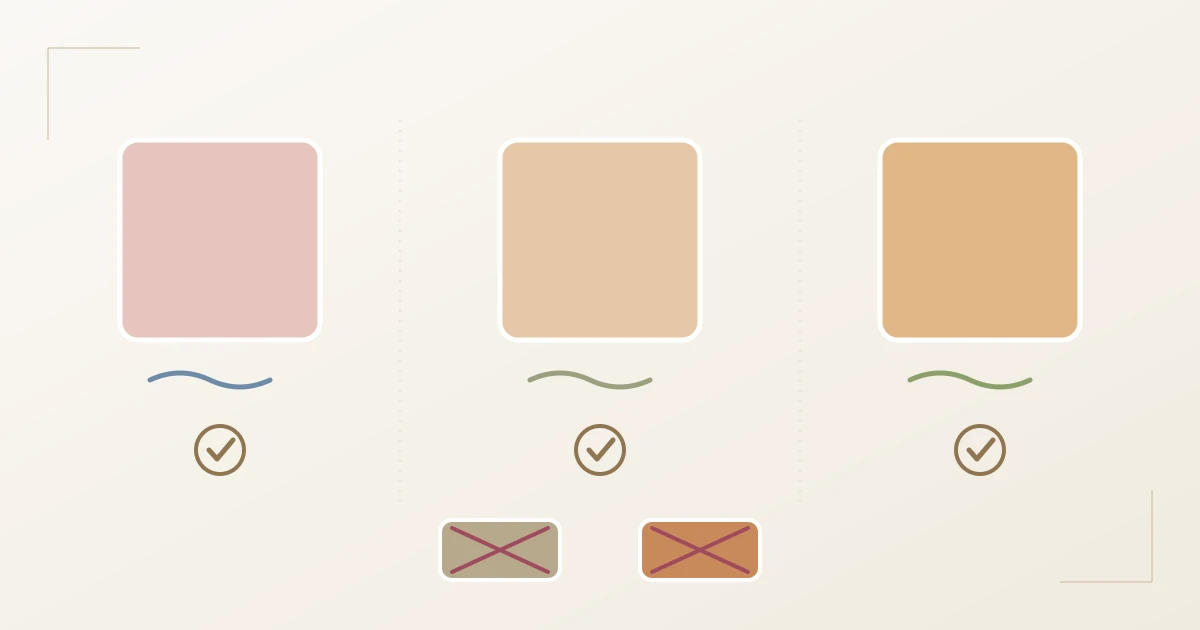
There are three undertones, and they take priority over the lightness:
- Cool: rosy or bluish undertone, veins look bluish-violet. Product names: “Rosé", “Cool", “C". Suits Summer and Winter types.
- Warm: golden or peachy undertone, veins look greenish. Product names: “Gold", “Warm", “W". Suits Spring and Autumn types.
- Neutral: a balanced mix, veins hard to classify. Product names: “Neutral", “N". A special case that adapts easily to either direction.
The quickest test is the jaw test: apply three shades along the jawline and look at them in daylight by a window. The right one almost disappears — the wrong one shows up as a line or a colour cast. Your colour type gives you the undertone in advance: Summer and Winter are cool, Spring and Autumn warm.
A second practical point: foundation oxidises. Many formulas turn a shade darker and warmer on the skin after 10 to 20 minutes. That's why, when in doubt, you choose one shade lighter and judge the result only after a quarter of an hour — not right after applying. Knowing this one effect avoids the most common reason why a foundation that looked good in the shop suddenly looks orange at home.
Zone 2: Lips & blush by colour type
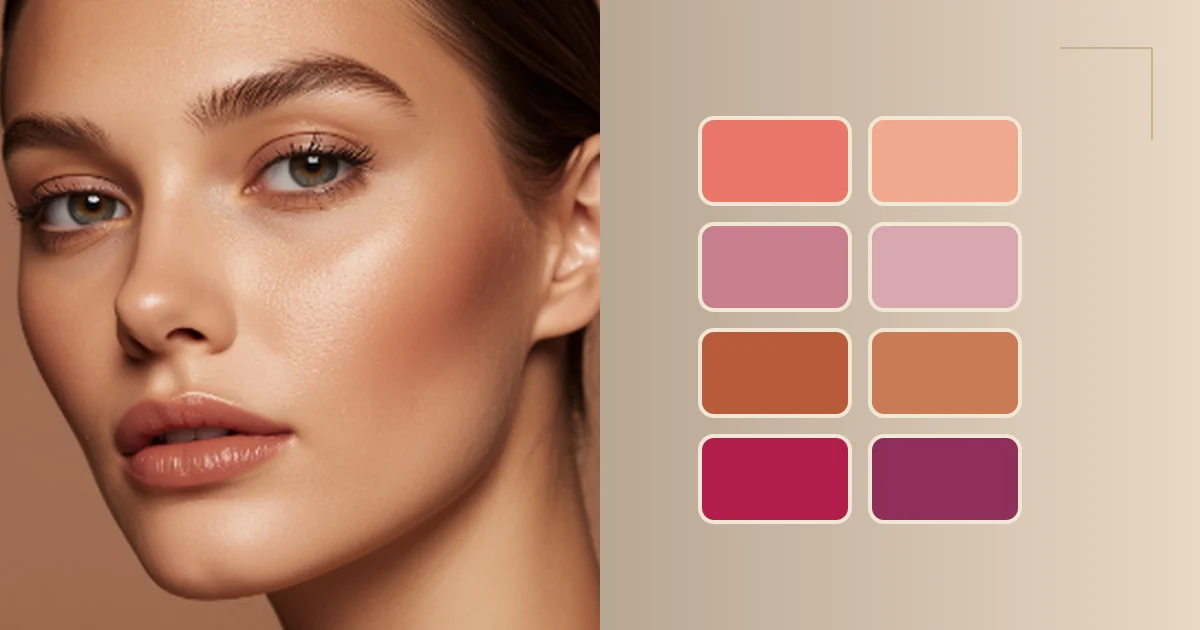
Lipstick and blush are the colour zone of the face — here you wear the same colour temperature as in your clothing. A cool type takes shades with a blue base, a warm type shades with a golden base. Blush and lips should come from the same family so the face looks harmonious.
Summer type: cool rosé and berry
The Summer type suits cool, muted shades: soft rosé, mauve, cool raspberry and muted berry. The blush stays a soft, cool pink. Coral, orange and warm brown should be avoided — they look out of place on the cool complexion.
Winter type: clear berry and blue-red
The Winter type suits clear, intense shades: blue-red, cherry red, cool berry, plum and fuchsia. It's the only type that a bold, clear lipstick really suits. The blush stays cool and subtle so the lips keep the stage.
Autumn type: terracotta and brick
The Autumn type suits warm, earthy shades: terracotta, brick red, warm nude, copper and burnt orange. The blush is a warm peach or terracotta. Cool blue-red shades look hard and out of place on this type.
Spring type: coral and peach
The Spring type suits warm, clear shades: coral, peach, warm apricot and clear salmon pink. The blush is a fresh, warm peach for a lively glow. Dark, muted berry shades look heavy on this type.
Zone 3: Eyes & brows by contrast
The definition zone — eyeshadow, eyeliner, mascara and brows — follows two rules: the colour temperature depends on your season, the intensity on your contrast. Warm types use brownish, golden and coppery neutrals; cool types taupe, grey and plum ones. Pure black as eyeliner only suits the high-contrast Winter type; everyone else looks more natural with soft brown or grey.
- Spring: warm champagne, golden brown, soft copper; mascara and brows in warm brown.
- Summer: taupe, cool grey, muted rosé; mascara and brows in ashy brown.
- Autumn: bronze, olive, warm copper, chocolate brown; mascara and brows in warm dark brown.
- Winter: cool grey, charcoal, plum, silver; the only type that can also wear black eyeliner.
A detail that's often forgotten is the eyebrows: they frame the whole face and should follow the hair colour, not the trend. A brow kept a shade lighter and in the right temperature looks more natural than a dark, hard line — especially on light and warm types. Which hair tone is your frame is settled by the hair colour by colour type; the brow ideally sits one to two shades below it.
Make-up by colour type at a glance
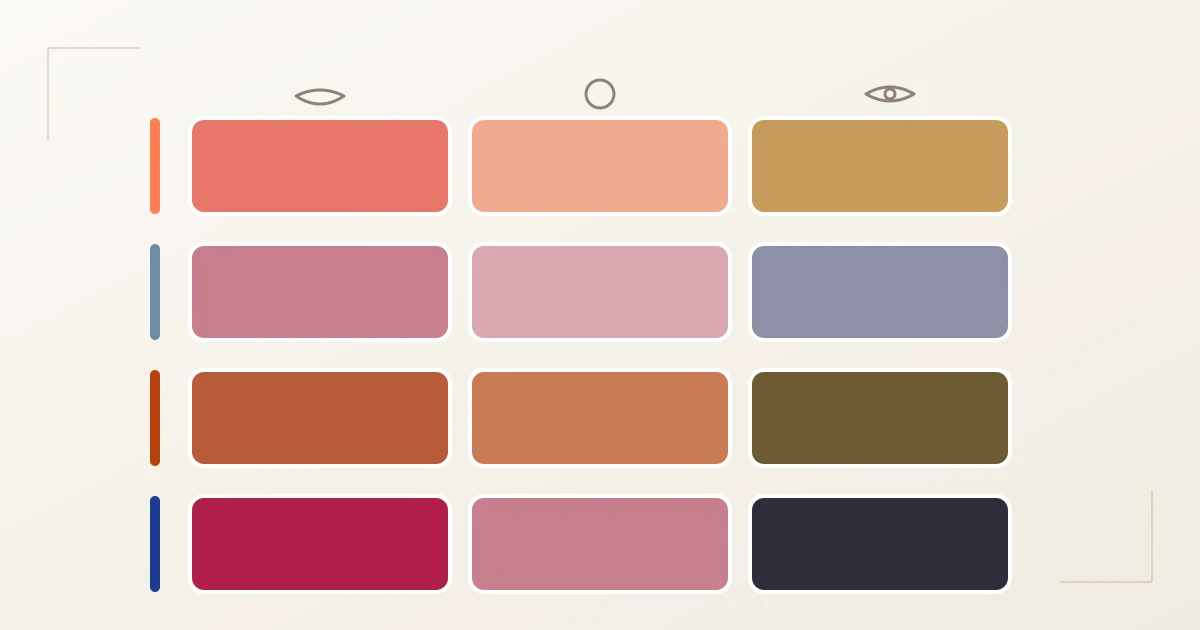
The image shows the three zones side by side for each colour type (left to right: lips, blush, eyes).
| Colour type | Foundation | Lips & blush | Eyes |
|---|---|---|---|
| Spring | Warm, light | Coral, peach, apricot | Champagne, golden brown, copper |
| Summer | Cool, rosé | Cool rosé, mauve, berry | Taupe, cool grey, rosé |
| Autumn | Warm, golden | Terracotta, brick, warm nude | Bronze, olive, chocolate brown |
| Winter | Cool, clear | Blue-red, berry, plum, fuchsia | Cool grey, charcoal, silver |
Contrast determines the intensity
Contrast is the difference between your skin, your hair and your eyes — and it decides how bold your make-up may be. A high-contrast Winter type wears the same berry shade as a clear statement, while it overwhelms a low-contrast Summer type.
- High contrast (Winter): wears bold lips and clear definition without looking overdone. A pale nude, by contrast, makes this type look sickly.
- Medium contrast (Autumn, Spring): wears medium intensity — a distinct but not garish shade, with soft gradation.
- Low contrast (Summer): needs soft, blurred transitions. Hard lines and loud colours look tacked on.
How to assess your contrast and what it reveals about your colours is set out in the overview Which colour type am I? — a black-and-white selfie shows it in seconds.
The rule of thumb for intensity: as bold as your natural contrast, no bolder. Make-up should reinforce your own colour distribution — not invent someone else's.
Special cases: neutral undertones and olive skin
Not every skin can be assigned to a clear warm or cool right away — and this is exactly where most guides give up. Three cases come up particularly often:
- Neutral undertone: the veins look partly blue, partly green, and both gold and silver flatter. Here you choose foundations marked “N" and keep lips and blush in muted, mid shades that are neither strongly warm nor strongly cool — rosé nude, soft berry, muted coral.
- Olive skin: olive has a greenish-neutral veil that makes many foundations look greyish or pinkish. A shade with a slightly golden, never pink, undertone looks most natural; a peach concealer neutralises shadows better than a rosy one.
- Deep skin tones: even with dark skin, the undertone decides, not the depth. Warm types glow in golden bronze and warm berry, cool types in plum and clear red — the four colour seasons apply regardless of skin colour.
So the colour season is not a question of skin depth, but of undertone and contrast. Two people with very different skin colours can have the same colour type — and wear the same make-up palette at different intensities. That's the same basic idea as in the interplay of colour and shape: the undertone is the constant, the execution adapts.
Your make-up in 5 steps
- Clarify the undertone: the vein and jewellery tests decide between cool and warm. This sets the foundation and colour family.
- Test the foundation at the jaw: three shades along the jawline, in daylight. The right one disappears.
- Choose the colour zone: lips and blush from the same family of your season — cool or warm, never mixed.
- Match the definition to the contrast: colour by season, intensity by contrast. Black only for Winter.
- Cross-check in daylight: check the finished face by the window, not in bathroom lighting — artificial light distorts every temperature.
Once you've worked through these five steps, you'll then need surprisingly few products: a foundation in the right undertone, one or two lip shades, a matching blush and two or three eyeshadows cover everyday life. That's the make-up version of a capsule wardrobe.
The 6 most common mistakes
- Choosing foundation by lightness instead of undertone. The right level in the wrong undertone looks greyish or orange.
- Mixing warm and cool shades. Cool blush with warm lipstick breaks the harmony of the face.
- Black for everyone. Pure black as eyeliner or mascara only works for the Winter type; otherwise it looks hard.
- Following the trend instead of the type. A trend shade outside your palette stays outside your palette.
- Ignoring the intensity. Bold colour on a low-contrast face looks tacked on, pale colour on a high-contrast face looks sickly.
- Applying make-up in artificial light. Only daylight shows undertone and colour temperature honestly.
Make-up colour vs. make-up style
Make-up has two levels that should be kept apart. The colour depends on your colour type — which shades make your face glow. The style and placement — emphasising soft or clear lines, round or defined shapes — follow your facial features and your overall line.
That's the same distinction as in the wardrobe: colour comes from colour analysis, shape from the Kibbe system. A soft type wears their palette in blurred, round transitions; a clear, angular type wears the same palette in defined lines. How the two systems generally work together is explained by combining colour type & Kibbe type. The colour theory behind it goes back to Johannes Itten and the four-seasons colour analysis developed from it, the four-seasons colour analysis.
Not sure which colour type you are — and which make-up shades really suit you? A professional colour and style consultation clarifies undertone, palette and contrast in a single session.
To the colour & style consultation →Frequently asked questions (FAQ)
Which make-up suits my colour type?
The Spring type suits warm coral and peach shades, the Summer type cool rosé and berry, the Autumn type terracotta and brick, the Winter type clear berry, plum and blue-red shades. The foundation always follows your skin undertone — cool for Summer and Winter, warm for Spring and Autumn. The intensity depends on your natural contrast.
How do I find the right foundation colour?
What matters is the undertone, not just the lightness. Check at your wrist whether your veins look bluish (cool) or greenish (warm), and choose the foundation accordingly as “Cool/Rosé" or “Warm/Gold". Test three shades along the jawline in daylight: the right one disappears, the wrong one shows up as a colour cast.
Which lipstick suits which colour type?
Summer types suit cool rosé, mauve and muted berry; Winter types clear blue-red, cherry red, berry and plum; Autumn types warm terracotta, brick and nude; Spring types coral, peach and apricot. The basic rule: cool types wear shades with a blue base, warm types shades with a golden base. Blush comes from the same family.
Does black eyeliner suit me?
Pure black as eyeliner or mascara mainly suits the high-contrast Winter type, whose natural contrast carries the black. On all other types, soft brown, grey or taupe looks more natural and less hard. As a rule of thumb: the lower your contrast, the softer the definition.
What is the difference between cool and warm make-up?
Cool make-up has a bluish or rosy undertone — cool rosé, berry, plum, taupe. Warm make-up has a golden or peachy undertone — coral, terracotta, bronze, copper. Cool shades suit Summer and Winter types, warm shades Spring and Autumn types. The jewellery test decides quickly: silver for cool, gold for warm.
Can a Summer type wear red lipstick?
Yes, but only in a cool red with a bluish undertone — such as raspberry or berry red, not orange or brick red. Because of the low Summer contrast, however, a very bold red quickly looks hard; a muted, cool berry is often the more flattering choice. The Summer type is better off leaving warm reds aside.
Which blush suits the Autumn type?
The Autumn type suits a warm, earthy blush: terracotta, warm peach or burnt coral. These shades emphasise the golden undertone and look like a natural sun glow. Cool, bluish pink shades, by contrast, look dull and tacked on against the warm Autumn complexion.
Does make-up change my colour type?
No. The colour type is based on the undertone of your skin, which stays stable. Make-up can make your complexion appear warmer or cooler for a while, but it doesn't change the underlying colour season. That's why make-up works best when it works with your undertone rather than against it.
Does the colour type also determine my make-up style?
No. The colour type determines the make-up colour, not the style. Whether soft, blurred transitions or clear, defined lines suit you depends on your facial features and your overall line — in the Kibbe system, on your type. Colour and style are two separate decisions.
How many make-up products do I really need?
For everyday life, a few well-coordinated products are enough: a foundation in the right undertone, one or two lip shades from your palette, a matching blush plus two or three eyeshadows and a mascara in the right temperature. That covers almost every occasion — more products rarely mean more effect.
Sources & further reading: Johannes Itten — colour theory · Color analysis (art).