
TL;DR — What should you wear to a funeral?
- At a funeral you wear dark, simple and matt clothing: black, navy, charcoal or dark brown, without loud patterns and without shine.
- Black is tradition, not a rule. Navy and grey are explicitly named as appropriate by funeral directors too.
- If black doesn't suit you, use the face-zone rule: black goes lower down, your dark colour-season alternative goes in the roughly 30 centimetres around your face.
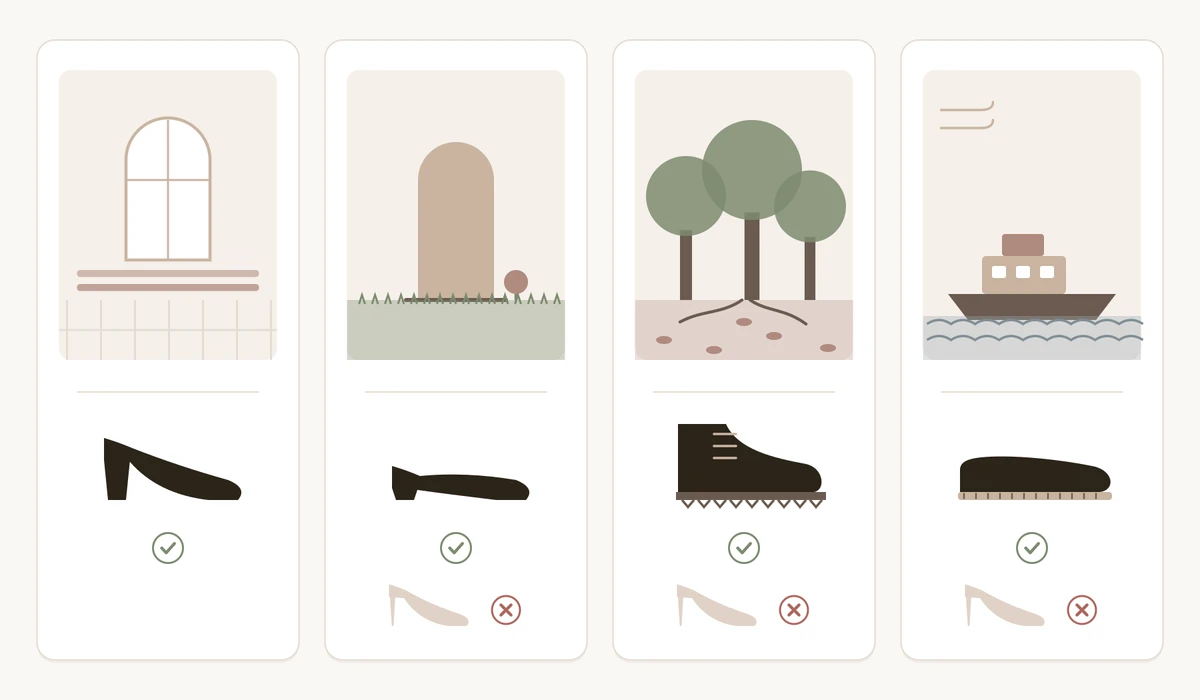
- The type of burial decides the shoes: a block heel in the chapel, flat soles with grip in a woodland burial ground or on a boat.
- If the notice says “no mourning clothes, please”, the family's wish applies. The outfit still stays muted and respectful.
The right clothing for a funeral is dark, simple, free of shine and free of loud patterns. As a woman you choose a dress that reaches at least the knee, a trouser suit, or a skirt with blouse and blazer in black, navy, charcoal or dark brown. Black is the tradition, but not an obligation. What matters is restraint, covered shoulders and shoes you can stand in safely at the graveside.
Most guides stop at this point. They tell you what is appropriate. They don't tell you which of those options looks dignified on you. Whether the black dress makes you look drained, whether the skirt rides up on the church pew, whether your heels sink into the woodland path: these are the questions nobody wants to carry on a day like this. This guide answers both sides.
Contents
- The basic rule: dark, simple, matt
- Does it have to be black?
- When black doesn't suit you: dark alternatives by colour season
- Funeral clothes for women: dress, trouser suit or skirt suit
- Which cut sits with dignity
- Chapel, urn, woodland, sea: clothing by type of burial
- Shoes, tights, jewellery and make-up
- Funerals in summer and in winter
- Muslim, Jewish and other funerals
- “No mourning clothes, please”: reading funeral notices
- Men and children: the essentials
- The emergency outfit from your own wardrobe
- What to avoid
- FAQ — Frequently asked questions
- Next steps
The basic rule: dark, simple, matt
Funeral attire is clothing that shows restraint. That applies to every funeral, whether it takes place in a church, at an urn grave or in a forest. It expresses respect for the person who has died and for their family, and it draws no attention to the wearer. Three criteria follow from that, and each one counts equally.
The colour is dark and muted. Black, navy, charcoal, dark grey or dark brown. Germany's Federal Association of Funeral Directors explicitly lists grey and navy as appropriate alongside black. Signal colours such as red, yellow or bright green are out.
The cut is simple. Shoulders and cleavage are covered, and a dress or skirt ends at the knee or below. No slits, no cut-outs, no cascading ruffles. The clothes should stay calm while you sit, stand and move.
The fabric is matt. This point is missing from almost every guide, yet it often decides more than the colour. Satin, patent leather, sequins, lurex and metallic threads read as festive, even in black. Wool, crêpe, matt jersey, cotton and linen blends read as serious.
A black satin dress is an evening dress. A navy wool dress is funeral attire. Whether an outfit is appropriate is often decided more by the fabric than by the colour.
The quickest test: hold the garment up to a window. If it throws reflections, it belongs in the evening wardrobe, not at the cemetery.
Does it have to be black?
Black is the traditional mourning colour in Germany and across Western culture, but it is not a rule. Widows used to wear black for months, sometimes for a full year of mourning. Today there are no fixed rules any more, neither for the colour nor for how long it is worn.
In practice there is a simple gradation. The closest relatives wear black more often, because it makes their role within the mourners visible. Guests, colleagues and acquaintances have more freedom: navy, charcoal and dark brown are equally appropriate for them. In rural areas and among older congregations black is expected more than in a big city.
If you are unsure, choose the darker option. Nobody will find a navy suit out of place. A mid-grey summer dress, on the other hand, can stand out in a traditional congregation.
And then there is a second question almost nobody asks: black is the safest choice for the mourners around you. For your face, it isn't necessarily.
When black doesn't suit you: dark alternatives by colour season
Whether black suits you depends on your colour season, more precisely on the contrast between skin, hair and eyes and on the temperature of your undertone. Only the Winter type really carries pure black, because it echoes her high, cool contrast. On other types, black right at the face makes skin look sallow and features look harsh. If you don't know your season yet, the guide Which colour season am I? helps.
On a day of mourning this effect grows stronger. Little sleep, eyes red from crying, hardly any make-up: black directly under the chin emphasises exactly the shadows that are already visible. That is no reason to give up black. It is a reason to put it in the right place.
The face-zone rule
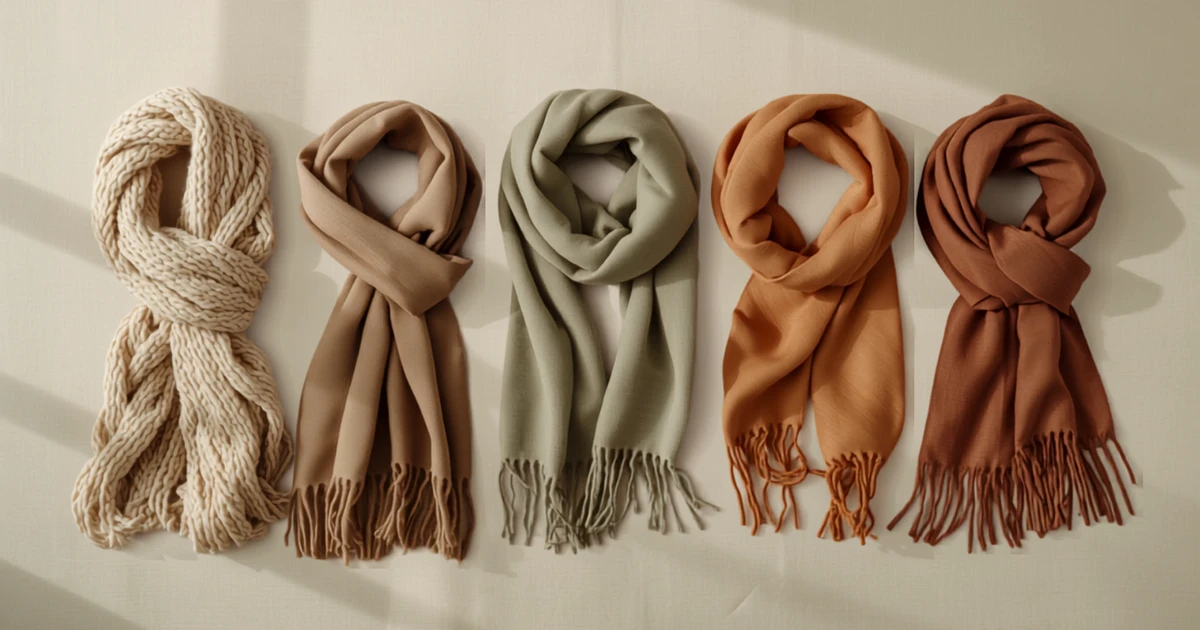
The colour in the roughly 30 centimetres around your face, meaning collar, top and scarf, decides how you look. Everything below that only decides how the outfit reads as a whole. So you can wear black trousers, a black skirt and black shoes and still look fresh, as long as your dark alternative sits at your face. Under a black coat, a scarf in navy or espresso is often enough.
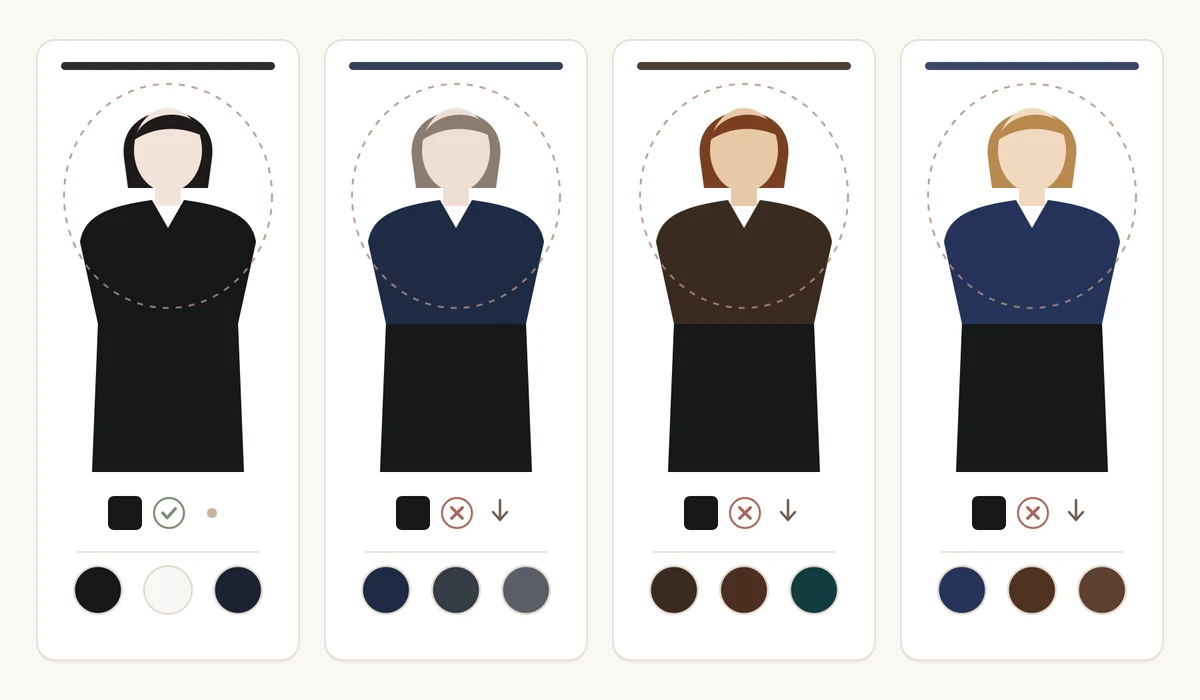
| Colour season | Black at the face? | Dark alternative for the funeral | How to combine black |
|---|---|---|---|
| Winter | Yes, it suits you | Pure black, with a clear white blouse | All black is possible |
| Summer | Usually too harsh | Cool navy, blue-tinged charcoal, deep dove grey | Black only below: trousers, skirt, shoes |
| Autumn | Usually too harsh (exception: Deep Autumn) | Espresso, chocolate brown, midnight teal | Black below, brown or teal at the face |
| Spring | Usually too harsh | Warm navy, chocolate brown | Black below, never right at the collar |
The alternatives come straight from the palettes of the four seasons, just in their darkest shade. If you want to go deeper, the full palettes are in the Summer, Autumn, Spring and Winter guides. One caveat for the Autumn type: deep olive does belong in her palette, but among mourners it reads less clearly. Espresso and midnight teal are the safer shades here.
If you don't know your colour season
Then navy is the most neutral choice. It is dark enough for any funeral and softer than black. Under a dark blazer, a blouse in white or ecru brightens the face. For warm types, ecru or ivory is the softer option, because pure white next to warm skin can look glaring.
Funeral clothes for women: dress, trouser suit or skirt suit
Clothing for a funeral has three equally valid basic forms for women: the dark dress, the trouser suit, and a skirt with blouse and blazer. None of them is more formal than the others. Choose the form in which you move most confidently, because you will stand, sit and perhaps shake hands for a long time.
The dark dress
A simple knee-length or longer dress is the classic choice. Sleeveless styles need a blazer or cardigan that you keep on inside the church or chapel. Deep necklines, high slits and tight stretch fabrics are out. Which dress shape suits your figure is covered in the guide Which dress suits my body shape?.
Trouser suit or trousers with blazer
The dark trouser suit is fully accepted today, and in cold weather, rain or an outdoor burial it is often the most practical solution. If you don't own a suit, pair dark tailored trousers with a matching dark blazer. What matters in the fit is explained in the guide Which blazer suits my body shape?.
Skirt with blouse and blazer
The skirt ends at the knee or below, including when you sit. That is where many skirts fail: knee-length when standing, a hand's width above it on the pew. Add opaque or fine dark tights, a simple blouse and a blazer.
Coat and jacket
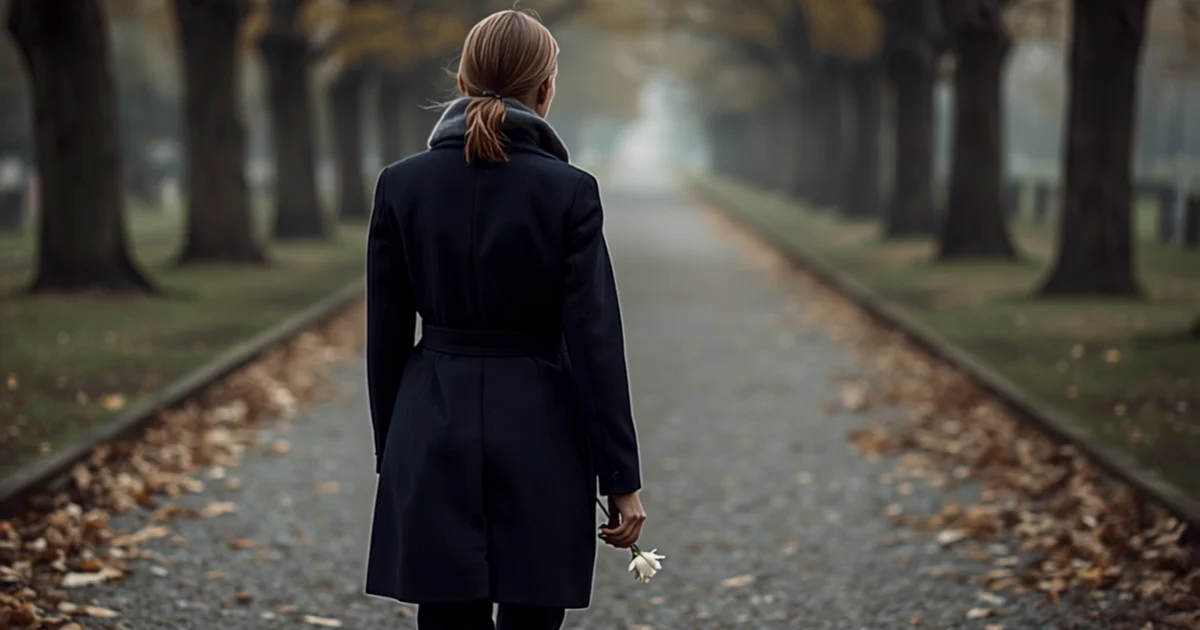
In cold weather, one thing is visible at the graveside above all: the coat. A light parka or a colourful outdoor jacket overrides the most careful outfit underneath. A dark wool coat is therefore the most important piece of the whole wardrobe in autumn and winter. Which coat shape suits you is covered in the guide Which coat suits me?.
Which cut sits with dignity
With funeral attire, dignified means the garment stays calm while you move. When you sit down, stand up, bend to place earth or a flower in the grave. A cut that doesn't match your body line pulls, rides up or strains, and you spend the day managing it instead of saying goodbye.
The Kibbe method sorts body lines into families. For a funeral this can be broken down into four practical directions. The detailed classification is in the overview of the 13 Kibbe types.
Long, straight line. A straight column, a trouser suit with a longer jacket, a coat with a clear shoulder. Playful details such as bows or ruffles quickly look like a costume on this line.
Balanced line. The fitted sheath dress or the classic skirt suit with a moderate waist. Symmetry and clean proportions do all the work here.
Curved, soft line. A wrap dress or a dress in matt, fluid jersey with a soft drape. Stiff, boxy tailoring looks borrowed on this line. With a wrap dress, secure the neckline with a hidden pin so it doesn't open when you bend.
Petite, graphic line. A shorter jacket, slim trousers, clean edges. A long, wide black coat swallows this line. Keep the proportion compact.
Funeral attire shouldn't stand out. On the wrong body line it stands out anyway, as a garment that doesn't belong to the woman wearing it.
Chapel, urn, woodland, sea: clothing by type of burial
When it comes to clothing for a funeral, the type of burial decides less about colour than about shoes, weather protection and skirt length. This is exactly the part most guides leave out, although it causes the most problems on the day itself.
| Type of burial | Where you stand | Clothing | Shoes |
|---|---|---|---|
| Service and burial | Church or chapel, then cemetery path and lawn | Classic dark, coat in cold weather | Block heel or flat, no stilettos |
| Urn interment | Often a small circle outdoors at the urn grave | As for a burial, often a little simpler | Flat or low block heel |
| Woodland burial | Uneven forest floor, roots, leaves | Weatherproof dark layers | Sturdy flat shoes with grip |
| Sea burial | Ship's deck, wind, movement | Windproof layer, no wide skirts | Flat, non-slip sole |
| Memorial service without burial | Indoors | As invited, otherwise classic dark | Free choice |
Urn interment
The same dress rules apply to an urn interment as to a burial. It often takes place weeks after the service, in the closest circle. Then the clothing can be a little simpler, for example dark trousers and fine knitwear instead of a suit. It stays dark all the same.
Woodland burial
At a woodland burial you stand on forest floor, not on a path. FriedWald, Germany's best-known woodland burial provider, itself recommends sturdy footwear and weatherproof clothing. Heels sink into soft ground, long skirts pick up wet leaves. A dark weatherproof jacket and flat boots or lace-ups in black or brown are more appropriate here than court shoes.
Sea burial
On a boat, wind and movement come into play. Wide skirts and hats are impractical, and a windproof dark layer matters more than the suit. Shoes need a flat, non-slip sole, because the deck may be wet.
Shoes, tights, jewellery and make-up
Accessories with funeral attire follow a single rule: they may be there, but they must not jingle, sparkle or glow.
Shoes
Closed, dark, smooth or in matt suede. A block heel of three to five centimetres is ideal for most funerals, because you stand securely on gravel and lawn. Patent leather looks festive, trainers look casual. Don't wear new shoes: you often stand for a long time, and blisters are the last thing you want to think about. Which shoe shape suits your figure is covered in the guide Which shoes suit my body shape?.
Tights
With a dress or skirt, traditional congregations expect tights in black or navy, opaque or fine. In high summer, bare legs with a knee-length dress are now accepted in many cities. If you don't know the congregation, fine tights are the safe side.
Jewellery
Subtle and minimal: wedding ring, small stud earrings, a fine chain. Pearls are the classic choice. Historically, mourning jewellery was made from jet, a deep black, matt stone. Large hoops, clinking bangles and eye-catching statement necklaces stay at home. Whether gold or silver suits you depends on your colour season, as described in the guide Jewellery by colour season. On this day, choose the matt or brushed version.
Make-up
Waterproof mascara isn't a style question on this day, it is practical. A light tinted base instead of full-coverage foundation, a touch of blush against pallor, and lips in a muted shade. Strong red and glitter are out. If you wear black close to your face, you need the blush in particular. Which shades suit you is in the guide Make-up by colour season.
Bag and perfume
A small, dark bag with room for tissues, a condolence card and an umbrella. As for perfume: very little or none at all. When offering condolences you come very close to other people, and strong scent becomes a burden.
Funerals in summer and in winter
The season changes the fabric of your funeral clothing, not the colour rule. Dark and simple stays the same at 30 degrees as it does in frost.
In summer, linen blends, viscose and light cotton in navy or charcoal are more comfortable than black wool. Short sleeves are possible if you bring a light blazer or thin cardigan for the church or chapel. Spaghetti straps, shorts and open-toe sandals are out. Simple dark sunglasses are accepted at the graveside; take them off inside the church.
In winter the coat becomes the most important garment. Add a dark scarf in your face-zone colour, dark gloves and smooth dark leather boots. And one detail almost nobody thinks of: the umbrella. A brightly branded umbrella over a careful dark outfit is the most conspicuous thing of all at the graveside.
Muslim, Jewish and other funerals
Funerals of other religions come with additional dress rules. They mostly concern covering the body, not colour. If you are unsure, ask the family or the funeral home. That isn't a mistake, it is a gesture of respect.
Muslim funeral
Simple, loose clothing that fully covers arms and legs is expected: long sleeves, long trousers or a long skirt. Women usually wear a headscarf at the cemetery and in the mosque, even if they are not Muslim. Shoes are taken off in the mosque. So plan shoes you can slip off easily, and clean, opaque socks or tights.
Jewish funeral
Men cover their heads at a Jewish cemetery, for example with a kippah. In Orthodox communities women also cover shoulders, knees and often their hair. Clothing is dark and conservative. Close relatives tear a cut into a garment as a sign of mourning, a practice known as Kria. As a guest, this does not apply to you.
Orthodox, Hindu and Buddhist ceremonies
At Orthodox Christian funerals the clothing is dark, and women sometimes cover shoulders and head in church. In Hindu and many East Asian Buddhist traditions, by contrast, white is the colour of mourning. There, black can be out of place. This is exactly where asking is most worthwhile.
“No mourning clothes, please”: reading funeral notices
Phrases such as “no mourning clothes, please” or “please wear colour” are a wish of the family or of the person who died. That makes them more binding than any convention. The most common phrases and what they mean:
- “No mourning clothes, please”: not black, but muted. Mid blue, green, burgundy, calm patterns. No party look.
- “Please wear colour” or “in her favourite colour”: colour is explicitly wanted. The favourite colour as a detail, such as a scarf or a flower, is a lovely gesture.
- “Casual dress”: dark jeans without fading or rips, with a jumper or blazer.
- “The burial will take place in the closest family circle”: not a dress code but a guest limit. You don't attend the burial unless you are explicitly asked.
- No mention: classic funeral attire.
If colour is wanted, reach for shades from your own palette. That way you wear colour without it becoming loud. How to combine colours calmly is shown in the guide Combining colours.
Men and children: the essentials
Men wear a dark suit in black, navy or charcoal, a white shirt, a dark tie and dark, polished leather shoes. Without a suit, dark tailored trousers with a dark jacket or a jumper over a shirt work. The face-zone rule applies here too: a navy shirt instead of a white one helps men who don't suit hard contrast.
Children don't need special funeral clothes. Neat everyday clothing in muted colours is enough, without cartoon prints and without neon colours. Comfortable shoes matter more than formal ones.
The emergency outfit from your own wardrobe
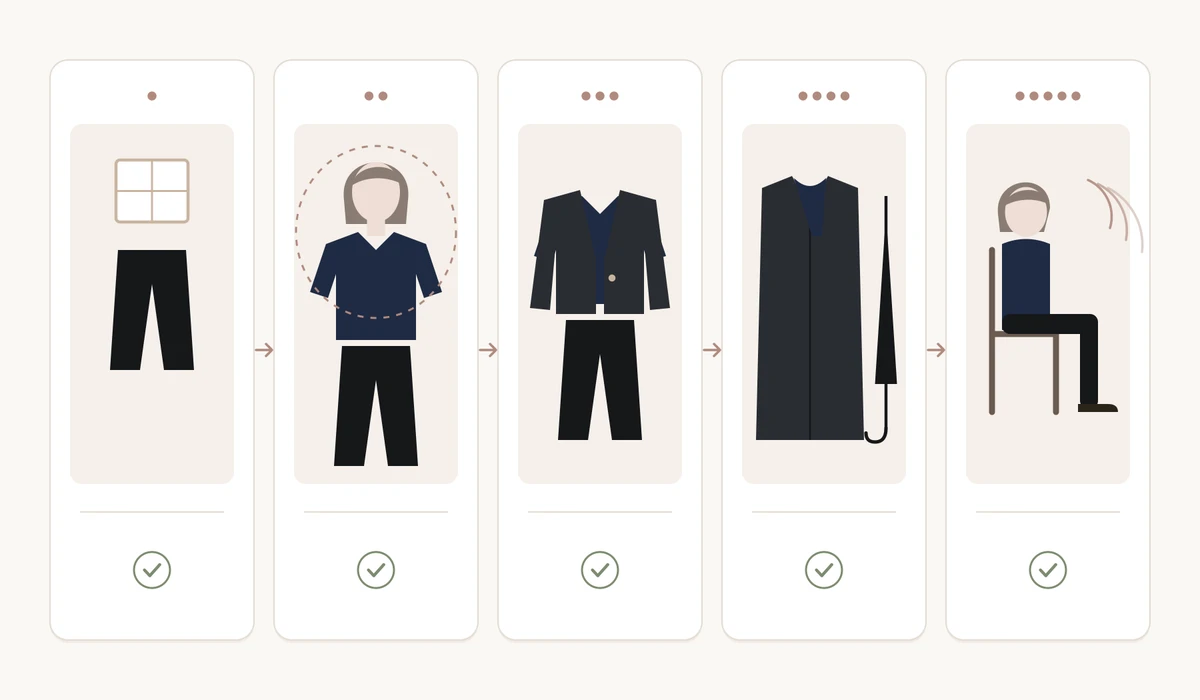
Between the news and the funeral there are often only a few days. A shopping trip is the last thing anyone needs in that time. The good news: most women already own the outfit. It is just spread across three pieces they never wear together.
- Choose the dark base. Trousers, skirt or dress in black, navy or charcoal. Shine test at the window: if the fabric reflects, take the next piece.
- Fill the face zone. A blouse, fine knit or simple top in your dark colour-season alternative. If you have none: white for cool types, ecru for warm types.
- Add the structure layer. A blazer or a dark cardigan that covers shoulders and arms. It turns everyday pieces into a funeral outfit.
- Do the outer check. Coat, scarf, umbrella, bag. This is what people see at the graveside. One light piece here overrides everything underneath.
- Do the movement test. Sit down, stand up, bend, walk twenty metres over lawn or gravel. If something rides up, pulls or clatters, swap it now, not on the morning of the funeral.
If a piece really is missing, buy just one and buy it with the time afterwards in mind: a matt dark blazer or dark tailored trousers that live on at the office. That way a sad occasion doesn't turn into a bad purchase. How such pieces fit into a small, coherent wardrobe is shown in the guide Capsule wardrobe by Kibbe type. And where funeral attire sits on the formality scale next to business and evening wear is explained in Dress codes for women.
What to avoid
Shine, sequins and patent. Even in black they read as evening wear.
Signal colours and large patterns. Red, neon, large floral or animal prints draw looks, unless the family has explicitly asked for colour.
Deep necklines, spaghetti straps, mini skirts. Even in high summer, shoulders stay covered in church.
Stilettos on lawn and forest floor. They sink in, and you are busy balancing instead of saying goodbye.
The casual jacket over the perfect outfit. At the graveside people see the coat, not the dress underneath.
Logos and visible brands. Large brand logos on a bag or belt look out of place and loud on this day.
New shoes that aren't worn in. Service, burial and the reception afterwards often last several hours.
FAQ — Frequently asked questions
Do you have to wear black to a funeral?
No. Black is the traditional mourning colour, but it isn't compulsory. Navy, charcoal, dark grey and dark brown are considered equally appropriate, especially for guests outside the closest family circle. More important than the exact colour are a simple cut and a matt fabric.
Can you wear navy to a funeral?
Yes, navy is one of the most appropriate alternatives to black and is explicitly named by funeral directors. For many colour seasons navy even suits better than black, because it looks softer at the face. In very traditional congregations the closest relatives usually still wear black.
Are black jeans acceptable at a funeral?
Only if the family asks for casual dress or the occasion is explicitly informal. Then dark jeans without fading, rips or contrast stitching work, paired with a blazer or fine knit. For a classic funeral service, dark tailored trousers are the better choice.
What shoes should a woman wear to a funeral?
Closed, dark shoes in smooth or matt leather, ideally with a block heel or flat. Stilettos sink into lawn and gravel, and patent leather looks festive. For a woodland or sea burial, flat shoes with grip or a non-slip sole are the right choice.
What do you wear to an urn interment?
The same rules apply to an urn interment as to any funeral: dark, simple clothing. Because it often takes place in a small circle and outdoors, the clothing can be slightly more relaxed, for example dark trousers with fine knitwear. Weatherproof shoes and a dark coat usually matter more than a suit.
What does “no mourning clothes, please” mean?
The family or the person who died would like guests not to come in black. What is usually meant is muted, respectful clothing in colour, such as mid blue, green or burgundy. It does not mean a bright party look.
What do you wear to a funeral in summer?
Light, breathable fabrics such as linen blends, viscose or cotton in navy or charcoal. Short sleeves are possible if you bring a light blazer or cardigan for indoors. Spaghetti straps, shorts and open sandals stay at home even in the heat.
Can you wear jewellery to a funeral?
Yes, but subtly. A wedding ring, small studs, a fine chain or pearls are appropriate. Large hoops, clinking bangles and sparkling statement pieces don't suit the occasion. Matt or brushed surfaces look calmer than high-polish ones.
What should I wear if black doesn't suit me?
Wear black lower down, as trousers, skirt or shoes, and put a dark colour from your palette in the zone around your face. For Summer types that is cool navy or charcoal, for Autumn types espresso or midnight teal, for Spring types warm navy or chocolate brown. A scarf in that colour under a black coat is already enough.
Next steps
If you are facing this question right now, take three things with you: dark, simple and matt as the basic rule, the face-zone rule for colour, and the movement test before the day itself. With that, your funeral clothing is appropriate at any service and you still look like yourself.
If you want to know, regardless of the occasion, which dark shades your face really carries, the guide Which colour season am I? gives a first orientation and a colour and style consultation gives a definite answer. And if it has to be quick, send me a photo of your outfit on WhatsApp. I reply personally, usually on the same day.