
TL;DR — the essentials at a glance
- Choosing glasses by face shape is only half the answer. The face shape determines the proportion (width, height, where the frame sits), the Kibbe line determines the character (angular or rounded, plain or ornate) and the colour type determines the colour.
- Six face shapes — oval, round, square, heart-shaped, oblong, diamond — follow the principle of balance: whatever the face has in abundance, the frame counterbalances. But that only explains the shape, not the effect.
- Frame size follows your body scale, not just the size of your face. A petite Gamine and a tall Dramatic can both have an oval face and still need completely different frame sizes.
- In a conflict, the Kibbe line wins on character (edges, curves, level of detail) and the face shape wins on width and height. Together they point to exactly one frame — not two opinions.
- Colour comes from your colour type, impact comes from contrast. Warm types wear tortoiseshell, honey and gold; cool types grey, blue, wine red and silver. How bold the frame may be is decided by your own contrast — a winter type carries heavy black, a summer type disappears behind it.
Table of contents
- The short answer
- Determining your face shape — the mirror and photo method
- The 6 face shapes and the right frame
- Why face shape alone isn't enough
- Kibbe line: the character of the frame
- Frame size by body scale
- When the two conflict — and the decision rule
- Frame colour by colour type
- Contrast level: how bold your glasses may be
- Material: acetate, metal, rimless
- The right glasses in 5 steps
- The most common mistakes
- Checklist for your optician appointment
- Frequently asked questions (FAQ)
The short answer
Short answer
The right pair of glasses comes out of three levels: the face shape sets the width and height of the frame, the Kibbe line sets the character — angular for Yang, rounded for Yin — and the body scale sets the size. The colour comes from your colour type: warm types wear tortoiseshell and gold, cool types grey, blue and silver. How bold the frame may be is decided by your contrast.
Almost every glasses guide online comes from an optician's shop and stops after a single sentence: round face, square frame. That explains why a pair of glasses fits — but not why two women with the same oval face look completely different in the same frame. The difference lies in the line and the scale. Those are exactly what we add here — just as the guides to hairstyles by Kibbe type and jewellery by colour type do for hair and accessories.

Determining your face shape — the mirror and photo method
The full determination — four measurements, the jaw angle test and every borderline case — has its own guide: what face shape do I have. The short version is enough here.
Your face shape is the outline of your face from hairline to chin — defined by three widths (forehead, cheekbones, jawline), the length of the face and the edge of the jaw. Working it out takes five minutes and needs no app.
- Hair back, daylight, front view. Tie all your hair away from your face, stand facing the window and look straight ahead into the mirror. No angle, no chin tilted down.
- Trace the outline. Using a washable marker or a piece of soap, trace the outline of your face on the mirror — hairline, temples, cheekbones, jaw, chin. Step back and look at the pure shape.
- Alternatively: a photo with a grid. Take a front-on selfie without smiling, hair back, phone at eye level. Draw three horizontal lines onto the photo: the forehead at half its height, the cheekbones at the level of the bridge of the nose, the jaw just below the earlobes.
- Compare the three widths. Which line is the longest? If the forehead is widest, you're heading towards heart-shaped. If the cheekbones are widest, towards diamond or round. If all three are nearly equal, towards square, oblong or oval.
- Set length against width. Measure from the hairline to the chin and compare it with the widest point. Length clearly greater than width means oblong or oval; length roughly equal to width means round or square.
- Check the jaw edge. Is the transition from jaw to chin a visible corner or a curve? Square and round differ almost solely at this edge — and it is precisely that edge which later decides between angles and curves in the frame.
Note down two things: the shape and the widest point in centimetres. You'll need the width in the next step, because the frame should be roughly as wide as your face at its widest point — not narrower, not noticeably wider.
The 6 face shapes and the right frame
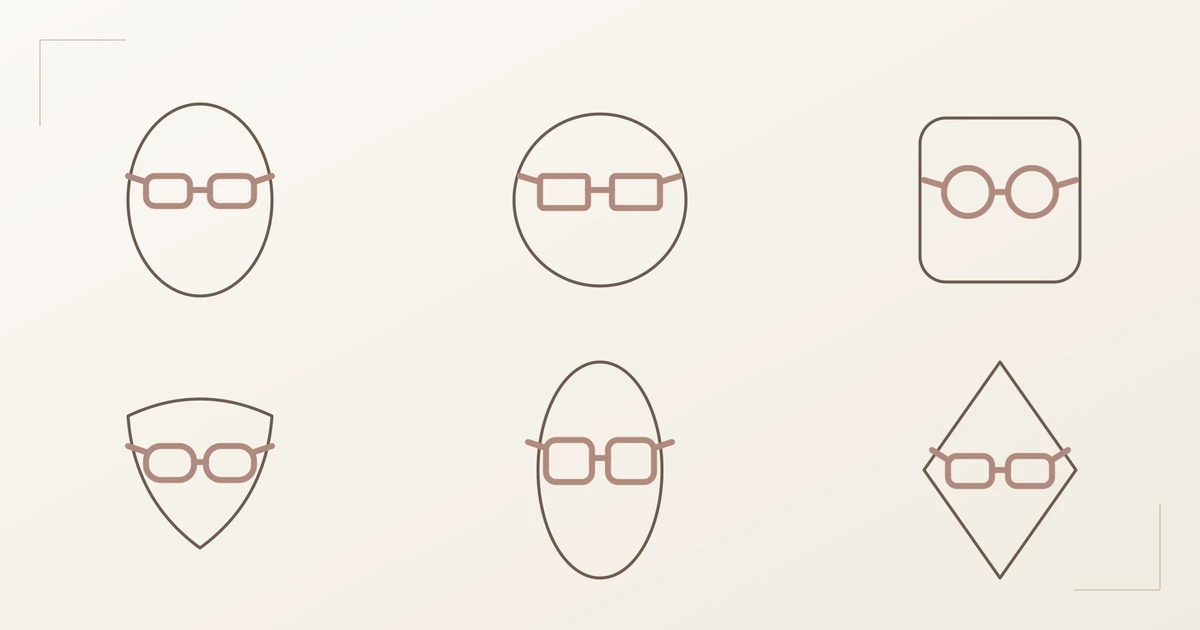
The principle of balance is the ground rule of choosing glasses: the frame gives the face what it lacks and takes back what it has in excess. A round face gains from angles, an angular one from soft lines, a long one from horizontal emphasis.
| Face shape | Characteristic | Recommended frame | Better avoided |
|---|---|---|---|
| Oval | Balanced widths, softly rounded chin | Almost anything; frame width = face width | Extremely oversized shapes that tip the balance |
| Round | Length ≈ width, full cheeks, soft jaw | Square, rectangular, cat-eye with lifted outer corners | Small round frames, low-set temples |
| Square | Wide forehead, pronounced jaw edge | Round, oval, panto, softly rounded edges | Hard, wide rectangles with sharp corners |
| Heart-shaped | Wide forehead, narrow chin | Shapes wider at the bottom, rimless below, panto, light metal frames | Heavy brow bars, wide cat-eyes, decoration at the temples |
| Oblong | Clearly longer than wide, straight cheeks | Tall lenses, strong brow bar, low temple joints, wide shapes | Narrow, shallow frames, very small lenses |
| Diamond | Narrow forehead, wide cheekbones, narrow chin | Oval, cat-eye, frames with an emphasised upper line | Frames wider than the cheekbones |
The two rules that always apply
Whatever the shape, there are two measurements every frame has to meet. First, the width: the frame ends at, or minimally beyond, the widest point of your face. Narrower than that and the face looks squeezed; noticeably wider and it slips and looks borrowed. Second, the top edge: the upper rim follows the brow line or sits just below it — it must not cut through the brows. The pupil sits roughly in the middle of the lens, slightly above centre.
Why face shape alone isn't enough
A face shape is an outline — it says nothing about bone structure, height, the softness of your features or the impression you give off. That is exactly why the one-sentence rule fails so often in the fitting room: two people with the same outline need different frames.
Three things fall by the wayside when you look only at the outline:
- Scale. An oval face at 5'2" with fine bones and an oval face at 5'11" with broad shoulders get the same recommendation — and the same frame looks stuck-on on one and lost on the other.
- The softness of the features. A square face with fleshy cheeks and full lips can't carry a hard, sharp frame, even though the outline says "square". A square face with sinewy, straight features carries it perfectly well.
- Contrast. The same black acetate frame is a statement on a high-contrast person and a mask on a low-contrast one, wiping out everything else in the face.
Your face shape answers how big and where the frame sits. It never answers how it should feel. That question is settled by the line.
Kibbe line: the character of the frame
The Kibbe line is the balance of Yin and Yang across your whole appearance — bone structure, body flesh and facial features together. Yang stands for length, edge, sharpness and geometry; Yin for curve, softness, fullness and delicacy. It is precisely this quality the frame has to echo, otherwise it sits on the face like a foreign object.
This is the decisive difference from any optician's guide: the face shape tells you rectangular or round. The Kibbe line tells you whether that rectangle has to be sharp-edged and narrow or blunt and wide — and whether that curve may be cleanly drawn or playful and full of detail. Two frames with an identical outline can have completely opposite characters.
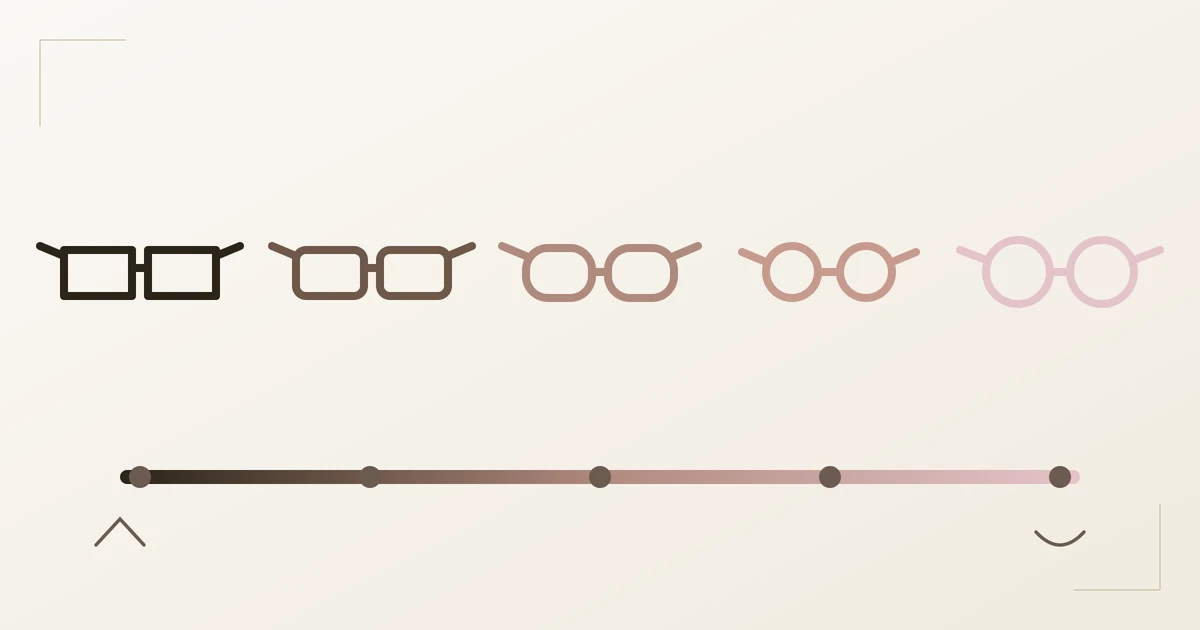
Dramatic (pure Yang): sharp, narrow, long
The Dramatic line is vertical, angular and very clear. Frames may be large, but they have to stay narrow and elongated rather than wide and round: sharply drawn rectangles, geometric shapes, pointed cat-eyes, clean edges with no playfulness. Matt black, clean metal, monochrome frames. Anything soft, curlicued or sweet looks like a costume on this line.
Natural (soft Yang): wide, relaxed, blunt
The Natural line is wide and slightly irregular. It carries frames with rounded-off edges instead of sharp corners, with visible texture and without perfect symmetry: wayfarer shapes, wide acetate frames, horn and tortoiseshell finishes, matt surfaces. Frames that are too polished, too exact or too delicate look stiff on it.
Classic (Yin and Yang in balance): symmetrical, moderate
The Classic line is balanced and calm. It carries measured, symmetrical frames: cleanly drawn ovals, softly rounded rectangles, fine metal frames, understated two-tone effects. Nothing extreme in either direction — neither oversized nor tiny, neither sharp nor playful. Its strength is perfect proportion, not effect.
Gamine (Yin and Yang alternating): compact, cheeky, graphic
The Gamine line is small in scale and lives off the contrast between edge and curve. It carries compact frames with a statement: small round shapes, short cat-eyes, blocks of colour, bold narrow rims, unusual details. Large, calm, serious frames look heavy on it and make it read older.
Romantic (pure Yin): round, soft, richly detailed
The Romantic line is full, soft and rounded. It carries frames without hard edges: oval and round shapes, softly curved cat-eyes, delicate detailing on the temples, glossy acetate, rose gold. Sharp rectangles and hard geometric shapes cut against the soft features and look severe.
| Kibbe family | Character of the frame | Scale | Material & finish |
|---|---|---|---|
| Dramatic | Sharp edges, geometric, vertically emphasised, no playfulness | Large, but narrow and long | Matt acetate, slim metal, monochrome |
| Natural | Blunt, rounded-off edges, slightly irregular, relaxed | Large and wide | Thick acetate, horn, tortoiseshell, matt |
| Classic | Symmetrical, calm, cleanly drawn, nothing extreme | Moderate | Fine metal, smooth acetate, subtly two-tone |
| Gamine | Graphic, high-contrast, edge meets curve, playful details | Small to moderate, never oversized | Coloured acetate, slim bold rims, blocks of colour |
| Romantic | Soft curves, no hard corners, delicate ornamentation | Small to moderate, fine rims | Glossy acetate, rose gold, fine detailing |
Which of the five families is yours is settled by the overview of the 13 Kibbe types. For choosing glasses the family is enough — the fine distinction between Soft Natural and Flamboyant Natural barely changes the frame shape, though it does change the size.
Frame size by body scale
Scale is the overall size of your appearance: height, bone density and the size of your facial features taken together. It decides the frame size — and not, as almost everyone claims, the size of the face alone. The reason is simple: people see you as a whole, not as an isolated face.
Glasses guides and jewellery guides make the same mistake. A petite Gamine of 5'1" and a Dramatic of 5'11" can both have an oval face. The Gamine disappears behind a 54 mm wide frame; the Dramatic in the same frame looks as though she borrowed it from her daughter.
- Small scale (Gamine, Romantic, delicate bone structure): compact frames, narrower lenses, finer rims, shorter temples. Oversized trends will overwhelm you every time.
- Medium scale (Classic, Soft Natural): medium frame width, moderate lens height, balanced rim thickness. You have the widest choice and the least room to stray up or down.
- Large scale (Dramatic, Flamboyant Natural, strong bone structure): generous frames, bold rims, long temples. Small frames don't look delicate on you, they look skimpy.
The quick mirror test
Put the frame on, step three paces back and look not at your face but at the whole picture down to the shoulders. If the glasses are the first thing you notice, they're too big or too bold. If you have to hunt for them, they're too small. They sit right when you see your face first and the glasses only afterwards — as part of it.
When the two conflict — and the decision rule
The conflict case is the situation where face shape and Kibbe line recommend different frames. It isn't the exception, it's the norm — and this is exactly the point at which every simple guide leaves you on your own.
An example: round face plus Dramatic line. The face shape says "square, to balance it out" — that works. Second example: square face plus Dramatic line. The face shape says "round and soft", the line says "sharp and geometric". Follow the face shape and you end up with a round, soft frame that waters the person down and looks oddly wrong. Third example: long face plus Romantic line. The shape says "wide and strong", the line says "delicate and rounded".
The decision rule
The Kibbe line wins on character: edges or curves, sharp or blunt, plain or ornate, matt or glossy. The face shape wins on proportion: the width of the frame, the height of the lenses, where the top edge sits and how the temples join. The two levels never really contradict each other — they answer different questions.
Applied to the examples above:
- Square face + Dramatic: no round frame. Instead a narrow, elongated rectangle with slightly broken corners — the edge stays (line), while the proportion softens the width of the jaw (face shape).
- Long face + Romantic: no hard, wide frame. Instead a tall, round frame with a stronger brow bar and low-set temples — soft in shape (line), horizontally emphasised and tall in the lens (face shape).
- Round face + Gamine: no large square frame. Instead a compact frame with a clean, short cat-eye edge — graphic and small (line), with a lifted outer corner to counter the roundness (face shape).
When face shape and line argue, the argument is almost always a misunderstanding: one is talking about the shape of the frame, the other about its handwriting. Translate both into one model instead of sacrificing either side.
How colour and shape logic work together in general is explored in depth in the guide combining colour type & Kibbe type. In short: the colour type supplies the palette, the Kibbe system the line — the face shape is the third and smallest level and governs only the framing.
Frame colour by colour type
Frame colour by colour type follows the undertone of your skin: warm types (spring, autumn) wear golden, earthy frame colours, cool types (summer, winter) blue-based and clear ones. Because the frame sits permanently right beside your eye, its colour acts on your complexion more strongly than almost any garment.
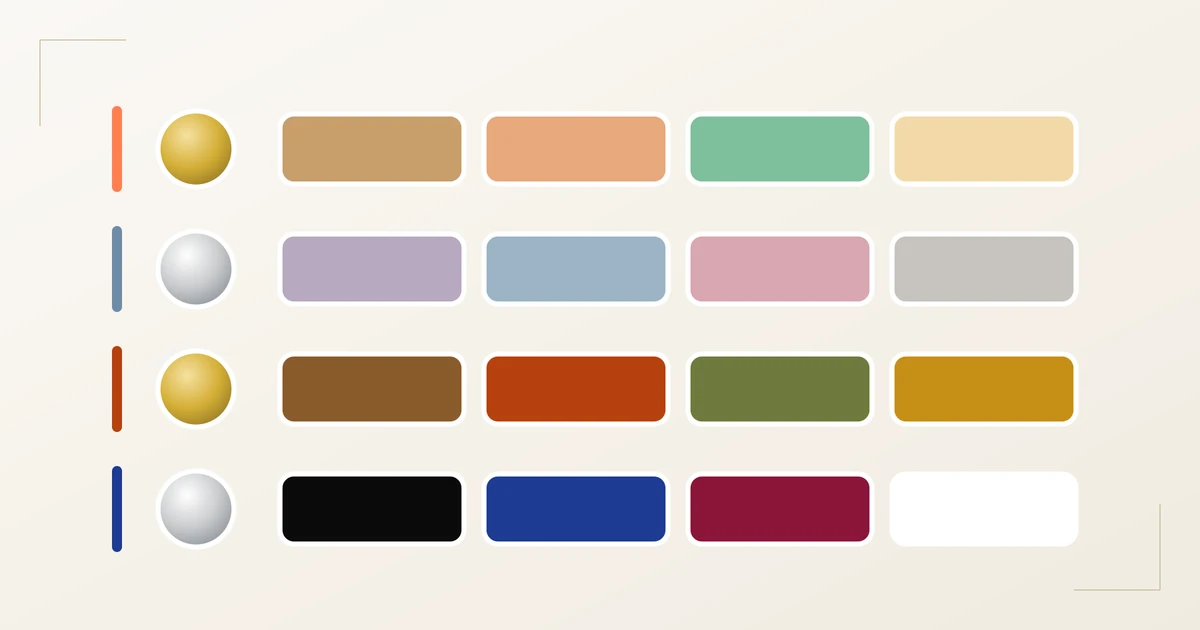
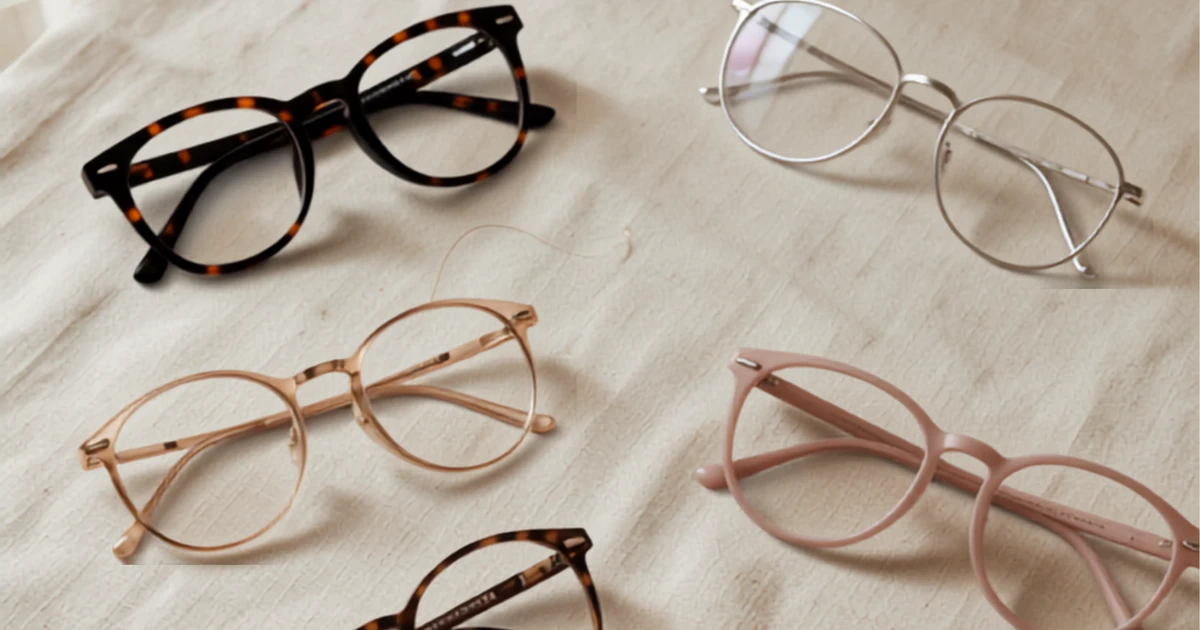
- Spring type: light, warm tortoiseshell, honey, caramel, coral, warm turquoise, transparent warm brown. Metal: light gold. Avoid: heavy black and cold grey.
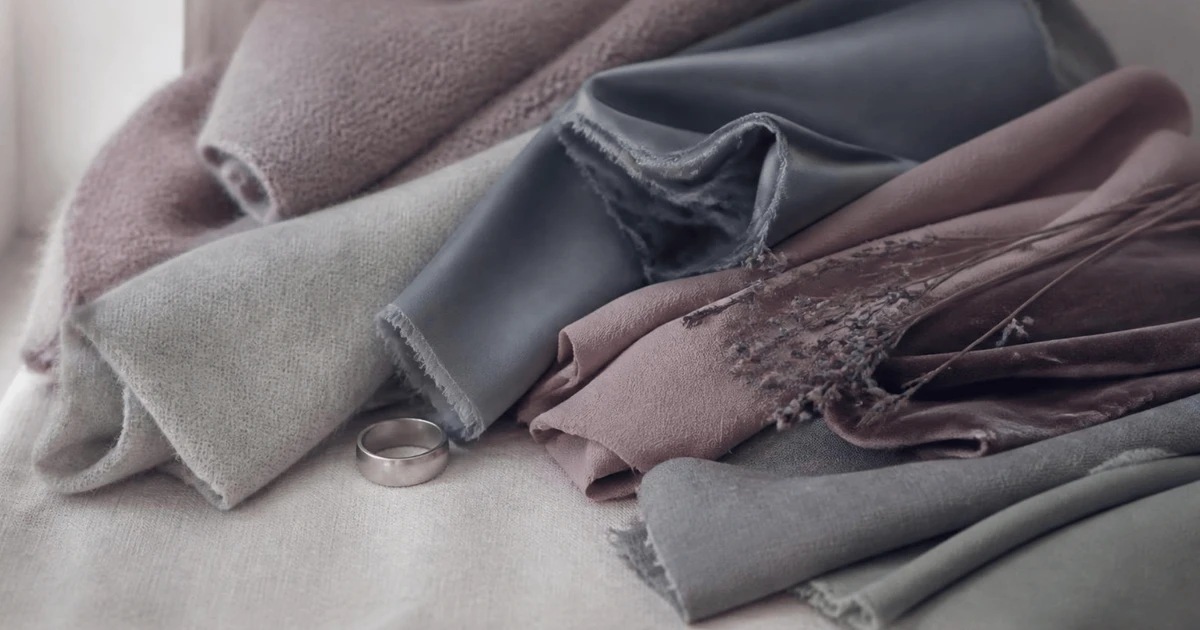
- Summer type: taupe, smoke grey, mauve, muted blue, greyed rose, matt transparent. Metal: brushed silver, white gold. Avoid: black, orange, strong red-brown.
- Autumn type: dark tortoiseshell, olive, cognac, rust red, bronze, warm horn. Metal: brushed gold, copper, brass. Avoid: clear silver and pure black.
- Winter type: black, charcoal, cobalt blue, wine red, pink, clear transparent. Metal: polished silver, white gold, platinum. Avoid: beige, olive, warm caramel.
Gold or silver for the frame
For metal frames exactly the same rule applies as for jewellery: a warm undertone wears gold, rose gold and brass; a cool undertone wears silver, white gold and platinum. If you're unsure, the quick gold-or-silver test from the guide jewellery by colour type will help — it transfers to glasses one to one. One difference remains: glasses sit right next to your eye and are in use every day, so getting it right matters more here than with a bangle you can swap out.
Eye colour as a bonus
A frame that picks up your eye colour or sets its complement visibly intensifies it — provided the shade comes from your palette. Blue eyes gain from a cool blue or a warm amber frame; green eyes from olive, wine red or copper; brown eyes from cognac, tortoiseshell or clear contrast. Which palette is yours is settled by the starting point Which colour type am I?
Contrast level: how bold your glasses may be
Contrast is the difference in brightness between skin, hair and eyes — and it decides how heavy a frame may be before it swallows your face. This is the level optician guides leave out entirely: they tell you the colour, but not the dose.
A pair of glasses is a dark bar straight across the middle of your face. How much dark bar you can carry depends on how much contrast your face brings with it in the first place.
- High contrast (typically winter): carries heavy black, bold rims, hard colour edges. Delicate, pale frames vanish completely next to dark hair and light skin.
- Medium contrast (typically spring, autumn): carries medium rim thicknesses with colour and texture — tortoiseshell, horn, two-tone effects. Pure black often looks a touch too hard, very delicate frames too undecided.
- Low contrast (typically summer): needs light rims, muted tones, transparent or semi-transparent frames. A heavy black frame becomes the lead actor on a low-contrast face — you see the glasses, not the person.
You can estimate your own contrast in seconds: take a selfie and convert it to black and white. If hair, skin and eyes sit clearly apart, you have high contrast. If they blur into similar greys, you have low contrast. Hold a black frame next to your face in the same picture — the test becomes unmistakable straight away.
Material: acetate, metal, rimless
The material determines how present a frame feels, regardless of shape and colour. Acetate is solid and carries colour; metal is graphic and light; rimless all but disappears. Which material suits you follows the same line logic as the shape.
Acetate
Acetate is the best choice when your line needs presence — Natural, Gamine, Romantic and many Dramatic frames. Thick, matt acetate reads as relaxed and rugged (Natural). Glossy acetate looks softer and more polished (Romantic). Coloured or two-tone acetate is the home of the Gamine line. Important: acetate increases the perceived weight — at low contrast, stick to transparent or muted tones.
Metal
Metal frames draw a line rather than a surface. They are the natural choice of the Classic line and work superbly on Dramatic as long as they stay narrow and geometric. Romantic goes for fine metal with a soft curve, ideally in rose gold. With metal, the colour of the metal speaks directly to your undertone — this is where the choice is least forgiving.
Rimless and semi-rimless
Rimless frames reduce the glasses to the lens. They are ideal for the Classic line and for anyone who deliberately wants their glasses to recede — especially at low contrast, where any bold frame quickly takes over. They rarely work, on the other hand, on the Gamine line, which lives off a graphic statement, and on very high-contrast faces, where they simply get lost. Semi-rimless models are the compromise: they give the top edge structure — handy on oblong faces — and stay light at the bottom, which takes the pressure off a narrow chin.
The right glasses in 5 steps
This order is deliberate: it moves from the level with the biggest impact to the smallest. Stick to it and you'll be standing in the shop in front of three models instead of three hundred.
- Set your scale. Small, medium or large — based on height, bone structure and the size of your facial features. That halves the range before you touch a single frame.
- Derive the character from your Kibbe line. Angular or rounded, sharp or blunt, plain or detailed, matt or glossy. That fixes the type of frame.
- Correct the proportion using your face shape. Match the frame width to the widest point of your face, the lens height and top edge to the length of your face and your brow line. This is where the principle of balance applies.
- Choose the colour from your colour type. Warm palette or cool palette, plus the matching metal — gold for warm, silver for cool.
- Dose the impact via contrast. High contrast carries bold rims and dark tones, low contrast needs light rims and muted colours. Only this step decides between two nearly identical models.
The order in brief: scale → line → proportion → colour → contrast. Start with colour and you'll be trying on models that were never going to work sizewise anyway.
The most common mistakes
- Buying by face shape alone. Shape governs the framing, not the character. That's why the "correct" frame is often technically right and still feels alien.
- Frame size by trend instead of by scale. Oversized frames have dominated the shops for years — on a small scale they're still wrong.
- Black as the safe choice. Black is only genuinely safe for high contrast and cool undertones. On warm, low-contrast faces it drains the colour out of the complexion.
- Ignoring the brows. The top edge of the frame must neither cut through the brows nor double them. It follows the brow line or sits just below it.
- Trying on frames that are too narrow. A frame that ends inside the width of your face makes the face look wider and presses at the temples.
- Deciding under artificial light only. Frame colours shift considerably under shop lighting. Walk to the door and hold the frame up in daylight.
- Deciding without stepping back from the mirror. From 30 cm away you see details, from three metres you see the effect. Only the second view counts.
Checklist for your optician appointment
Take these points with you — they're no substitute for a professional fitting, but they will make sure you leave the shop with the right frame.
- Noted down beforehand: face shape, widest point of your face in centimetres, Kibbe family, scale, colour type and contrast level.
- Hair as you wear it every day and your normal make-up — not tied back, or the overall picture will mislead you.
- Check the width: the frame ends at, or minimally beyond, the widest point of your face.
- Check the top edge: it follows the brow line, it doesn't cut through it.
- Check the pupil position: the pupil sits roughly in the middle of the lens, slightly above centre.
- Check the temple joints: set them low on a long face, higher on a short one.
- Look at yourself from three metres — with a photo, not just in the mirror.
- Take two finalists away with you and decide overnight. First impressions favour habit, not fit.
The technical side — centring, lens type, fit and prescription — belongs in the hands of a qualified optician; in Germany you can find accredited practices via the Zentralverband der Augenoptiker und Optometristen. This guide replaces neither an eye test nor a fitting — it only settles the stylistic half of the decision.
Not sure which line and which palette are yours — and which frame follows from them? The free colour type test settles the colour, the Kibbe test settles the line. In a personal colour and style consultation we turn both into concrete frame recommendations. The first conversation is free.
Frequently asked questions (FAQ)
Which glasses suit my face shape?
The frame balances out whatever the face has in excess: a round face wears square frames, a square face round ones, a long face tall lenses with a strong brow bar, a heart-shaped face shapes that are wider at the bottom. The face shape only sets the width and height, though. Whether the frame has to be sharp-edged or softly drawn is decided by your Kibbe line.
How do I determine my face shape?
Tie your hair back, stand facing the daylight and trace the outline of your face on the mirror — or take a front-on selfie. Then compare three widths: forehead, cheekbones and jaw. Next, set the length of your face against its widest point and check whether the jaw edge is square or rounded. Those four pieces of information identify the shape unambiguously.
Which glasses suit a round face?
A round face gains from edges and angles: rectangular frames, square shapes and cat-eyes with lifted outer corners. Small round frames reinforce the roundness and make the face look wider. How angular the frame may be depends on your line — a Romantic line carries softly broken corners, a Dramatic line real sharpness.
Gold or silver — which frame colour suits me?
That's decided by your skin undertone, not by taste. Warm undertones (spring, autumn) glow in gold, rose gold and brass; cool undertones (summer, winter) in silver, white gold and platinum. The quickest test: hold both metals up to your face in daylight and see which one makes your skin look fresher. Greenish veins at the wrist point to warm, bluish ones to cool.
Which glasses suit a winter type and a summer type?
Winter types suit clear, cool and strong frames: black, charcoal, cobalt blue, wine red, together with polished silver or white gold. Summer types suit muted, light tones: taupe, smoke grey, mauve, muted blue, together with brushed silver. The most important difference is the impact — winter carries heavy black effortlessly, while on a summer type the same frame looks like a mask.
Which matters more: face shape or Kibbe type?
Both, but for different questions. The Kibbe line decides the character of the frame — edges or curves, sharp or blunt, plain or ornate. The face shape decides the proportion — frame width, lens height and where the top edge sits. When the two contradict each other, the line wins on character and the face shape wins on the measurements.
How big may a pair of glasses be?
The frame should be roughly as wide as your face at its widest point — flush with it or minimally beyond, never narrower. The absolute size also follows your body scale: a delicate bone structure and small features carry compact frames, a strong bone structure and large features carry generous ones. The test: from three metres away you should see the face first, then the glasses.
Do rimless glasses suit everyone?
No. Rimless frames deliberately hold the glasses back and therefore suit the Classic line and low-contrast faces particularly well, where bold frames quickly take over. On the Gamine line, which lives off a graphic statement, they often look empty, and on very high-contrast faces they disappear. Semi-rimless models are the compromise and give the top edge structure.
Do the same rules apply to sunglasses?
Shape, scale and line apply unchanged — sunglasses are the same frame with a dark lens. Two things change: sunglasses may go one step bigger and bolder, because they're read as an accessory, and the lens tint acts like a second colour on your face. Warm types choose brown, amber or green lenses, cool types grey or blue-grey ones.
Further reading: Zentralverband der Augenoptiker und Optometristen (ZVA) · Glasses — construction and frame shapes.