
TL;DR — determining your face shape in short
You determine your face shape from four measurements — forehead width, cheekbone width, jaw width and face length — plus one extra question: is your jaw angle soft or sharp? Which of the three widths is largest sets the direction; the ratio of length to width decides between round and long; the jaw decides between square and oval.
- Four measurements, no app needed. Tape measure, mirror, daylight, five minutes.
- The jaw angle is the overlooked criterion. Two faces with identical widths are different shapes if one jaw is rounded and the other angular.
- Shape is not size. A small round face and a large round face need the same direction but different dimensions.
- Borderline cases are the rule, not the exception. Most people sit between two shapes — and that is a usable answer.
- AI scanners contradict each other because they react to angle, light and hair. Measured numbers do not.

Contents
- What face shape is — and is not
- The four measurements
- The decision rule in three questions
- The six face shapes in detail
- The jaw angle decides more than the outline
- Shape is not size
- Why AI scanners contradict each other
- When you sit between two shapes
- What you need the result for
- Face and body: where Kibbe connects
- The most common mistakes
- Frequently asked questions
What face shape is — and is not
Your face shape is the outline of your face seen from the front: the line from hairline over temples, cheekbones and jaw to the chin. It is described by five quantities — three widths, one length and one angle.
What it is not explains most wrong results:
- It is not your weight. A fuller face looks rounder but is not automatically round. The bone structure underneath stays the same.
- It is not your hairstyle. A fringe visually removes half the forehead. That is why you measure before hair comes into it.
- It is not size. Two people can share a shape and have completely different measurements — there is a section on that below.
- It is not set in stone, but it is stable. Bone proportions barely change in adulthood; soft tissue and skin do.
In practice you need the shape because it gives you the basic rule for everything worn near the face: balance rather than double. A round face gains from edges, an angular one from soft lines, a long one from horizontal emphasis. The same logic that applies to the figure — one storey up. How it works on the body is covered in what body shape do I have.
Determining your face shape: the four measurements
To determine your face shape you need a soft tape measure, a mirror in daylight and five minutes. Hair fully back, including the strands at the temples, no smile, head straight, gaze level. Any tilt of the head distorts the length.
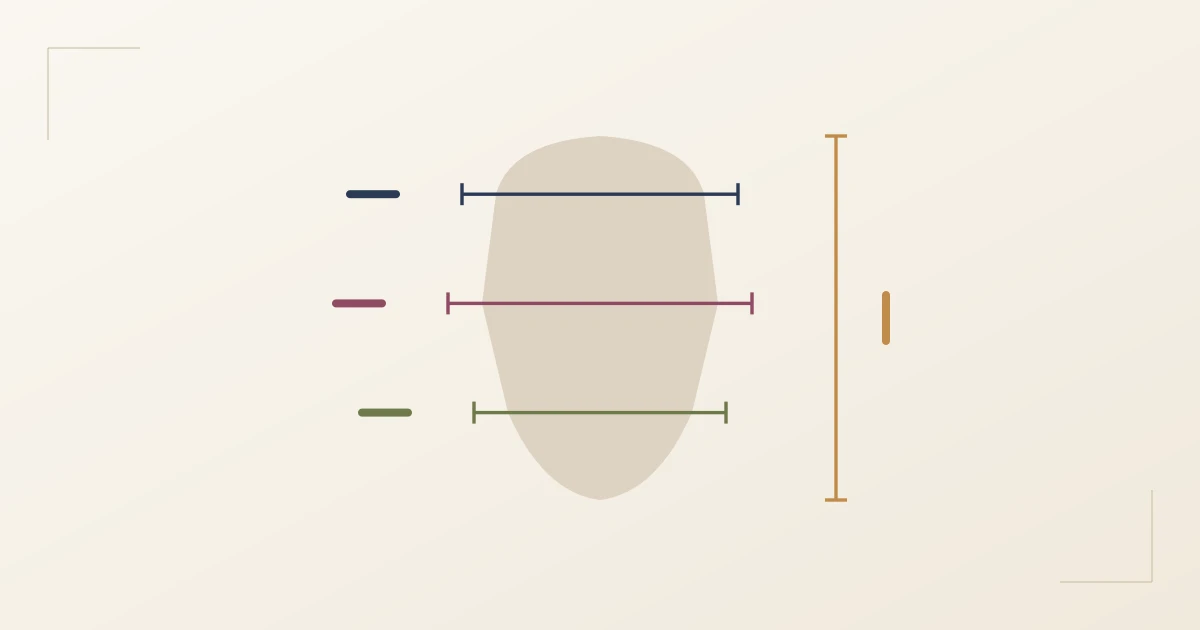
- Forehead width. At the widest point of the forehead, roughly halfway between eyebrows and hairline, from one temple to the other.
- Cheekbone width. From the highest point of one cheekbone to the other — that line sits roughly at the bridge of the nose, not lower. This is where most people measure too far down.
- Jaw width. From one jaw angle to the other, meaning the point just below the earlobe where the jaw turns towards the front. Not at the chin.
- Face length. Vertically from the hairline in the middle to the tip of the chin. With a high or receding hairline, take the point where the forehead curves back — otherwise every face comes out artificially long.
Note the four numbers in centimetres. With those alone you can determine your face shape, without guesswork and without an app.
Almost every guide says "look in the mirror and compare". That is exactly the point at which most people guess — and reach a different answer on the second attempt.
If there is no tape measure in the bathroom: a front-facing selfie without a smile, phone at eye level, hair back, will do. You then measure on the screen — the absolute numbers are wrong, the ratios are right. And the ratios are what matter.
The decision rule in three questions
From the four measurements, the face shape follows through three questions, in this order.
Question 1: which of the three widths is the largest?
- The forehead is clearly widest and the chin tapers → towards heart-shaped.
- The cheekbones are clearly widest, forehead and jaw narrower → towards diamond or round.
- All three are close together (a difference of at most roughly two centimetres) → towards oval, square or long. Questions 2 and 3 settle which.
Question 2: how does the length relate to the largest width?
- Length and width almost equal (ratio up to roughly 1.1 to 1) → round or square.
- Length clearly greater (from roughly 1.4 to 1) → long.
- In between (roughly 1.2 to 1.3 to 1) → oval, heart-shaped or diamond.
Question 3: is the jaw angle soft or sharp?
This is the question missing from almost every guide — and the one that separates two shapes that look identical in all the numbers.
- A softly rounded transition from jaw to neck → round (with equal length and width) or oval (with a little more length).
- A visible corner, the jaw turns noticeably → square (with equal length and width) or rectangular, the angular version of long.
These three questions land you in one of the six shapes. If two answers point in different directions, you are a borderline case — more on that below, and it is not a problem.
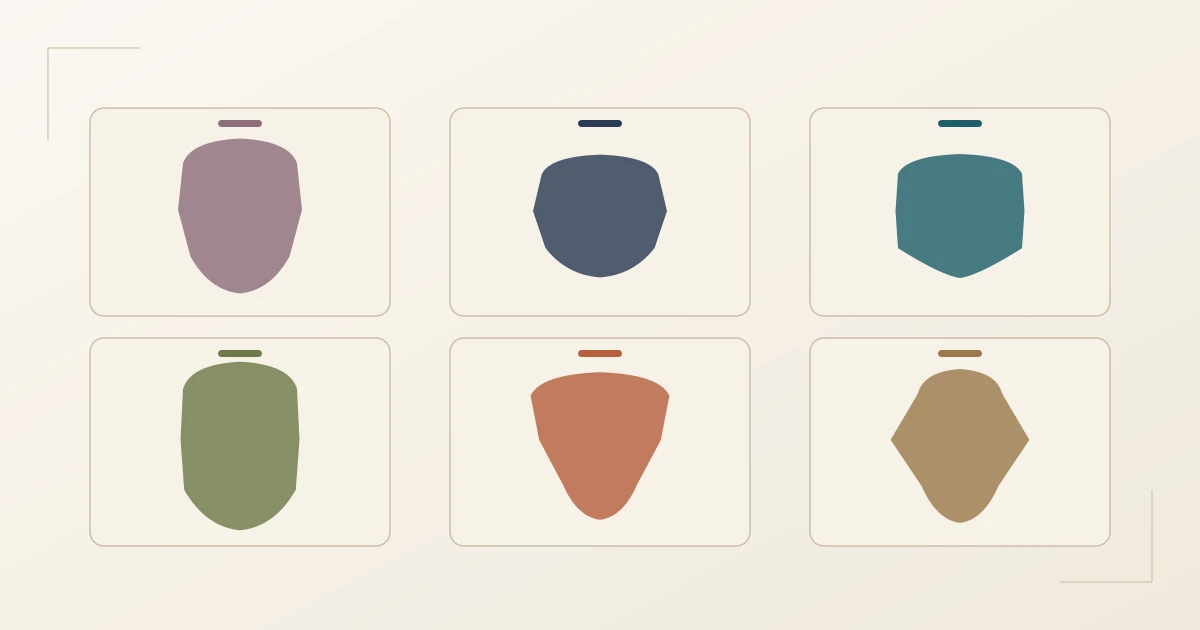
The six face shapes in detail
| Shape | Widths | Length to width | Jaw |
|---|---|---|---|
| Oval | balanced, cheeks marginally ahead | about 1.3 to 1 | soft |
| Round | cheeks widest | about 1 to 1 | soft |
| Square | all three almost equal | about 1 to 1 | sharp |
| Long | all three almost equal | from about 1.4 to 1 | soft or sharp |
| Heart-shaped | forehead widest | about 1.2 to 1.3 to 1 | narrow, pointed chin |
| Diamond | cheeks clearly widest, forehead narrow | about 1.3 to 1 | narrow, pointed chin |
Oval
The widths sit close together, the cheekbones lead marginally, the length exceeds the width clearly but not extremely, and the jaw is softly rounded. The face reads as balanced without any one zone standing out. Guides often call this shape "ideal" — that is a convention inherited from the Renaissance, not a fact. It is simply the shape that needs the least balancing.
Round
Length and width are nearly equal, the cheekbones form the widest point, and the transition from jaw to neck runs as a curve with no visible corner. The chin is usually rounded too. Importantly: round describes the proportion, not the fullness — a very slim face can be round if length and width match.
Square
Forehead, cheekbones and jaw measure almost the same, the length matches the width — and the jaw has a visible corner. That angle is exactly what separates square from round; in the raw numbers the two are often hard to tell apart.
Long
Also called oblong or rectangular. The three widths sit close together but the length clearly exceeds them. A high forehead and a slightly longer chin often come with it. The jaw can be soft or sharp — in the second case the shape is usually called rectangular.
Heart-shaped
The forehead is the widest zone, the jaw narrow, the chin tapers to a point. Sometimes a pronounced widow's peak reinforces the impression — but what gets measured is bone width, not hairline.
Diamond
The rarest of the six. The cheekbones are clearly the widest point, forehead and jaw are narrower, the chin tapers. The difference from heart-shaped: there the forehead is wide, here it is narrow.
The jaw angle decides more than the outline
Take two faces with identical measurements: forehead, cheekbones and jaw each 14 centimetres, length 15 centimetres. By the usual guide they have the same face shape. In practice they do not — if one jaw runs into the neck as a curve and the other as a corner.
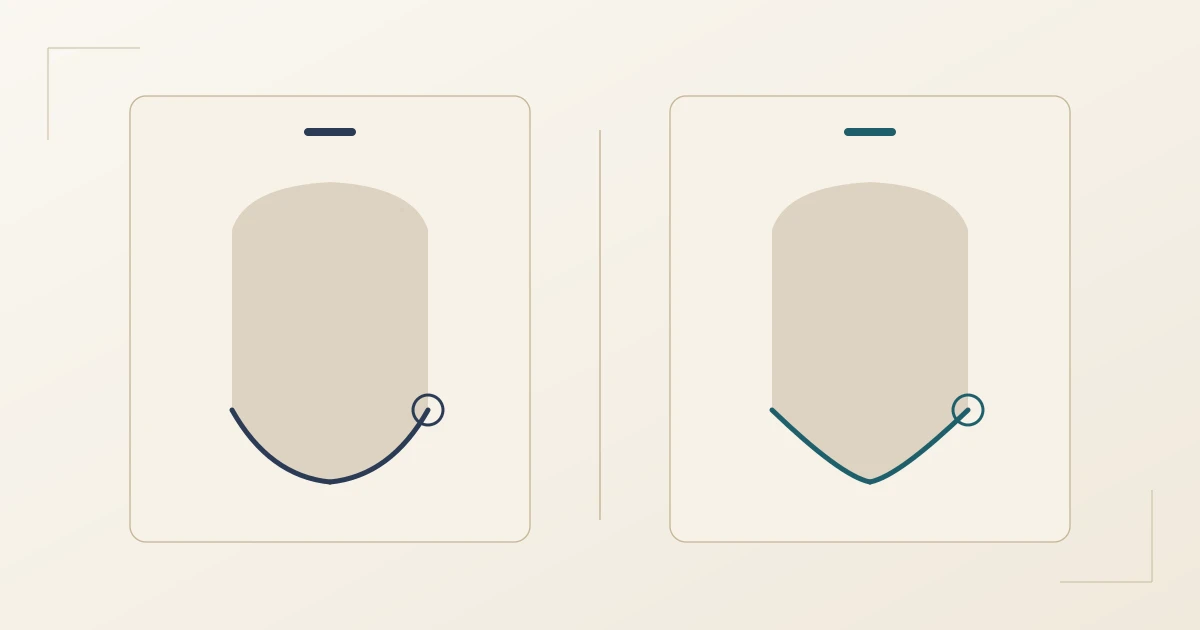
The reason is that everything worn near the face reacts to edges, not to centimetres. A square frame on an angular jaw doubles the corner. The same frame on a soft jaw sets a contrast. The numbers are the same, the effect is the opposite.
Here is how to check the angle in ten seconds: in the mirror, place two fingers just below the earlobe and follow the jaw towards the chin. If you feel a clear change of direction, the jaw is angular. If it runs as a continuous curve, it is soft. Touch is more reliable than sight here, because the eye is fooled by shadows.
Incidentally, that same distinction — soft curve versus clean edge — is the core of the Kibbe system applied to the body. The section below returns to it.
Shape is not size
Two people can both have a round face and still only one of them suits a given pair of glasses. The reason is scale: the absolute size of the face and its features relative to everything else.
The face shape says in which direction to balance. The scale says how large the means may be:
- Small scale — delicate features, narrow nose, small mouth: fine frames, small earrings, narrow brims. Large pieces take over the face here.
- Large scale — pronounced features, strong bones: heavier frames, larger shapes. Delicate pieces disappear.
A practical pointer: hold one hand flat beside your face. If it looks small in proportion, your scale is on the larger side; if it looks large, your scale is small. It is rough, but it prevents the most common bad buy — the right shape in the wrong size.
Why AI scanners contradict each other
Search for a way to determine your face shape and the top positions are held mostly by tools that analyse an uploaded photo. Many people try two of them and get two different answers. That is not because one of them is broken.
Four causes, all of which lie in the photo rather than the face:
- The camera angle. A few degrees of forward tilt visibly shortens the face in the image — long becomes oval, oval becomes round.
- The focal length. Front cameras distort at close range: nose and forehead look larger, the sides fall away. An arm's length of distance changes the result.
- The light. Light from above casts shadows under the cheekbones and makes the jaw look narrower. Side light emphasises one half of the face more than the other.
- The hair. If even one strand falls across the temple, the tool measures in the wrong place.
That does not make the tools worthless — as a second opinion on a result you measured yourself they are useful. But they are no substitute for four numbers you took by hand. Numbers do not react to light.
If two scanners give you two shapes, you do not have two faces. You have two photographs.
When you sit between two shapes
This is the normal case, not the exception. Pure face shapes are rare; most faces sit between two. What matters is only which two — because a usable rule follows from that.
- Round and oval: the only difference is length. Go by the shape you want to balance — so by round, if more length would suit you.
- Round and square: here the jaw angle alone decides. If in doubt, the touch test counts, not the look.
- Oval and long: from a ratio of about 1.4 to 1 it is long. Below that, treat it as oval.
- Heart-shaped and diamond: the forehead decides. Wide means heart-shaped, narrow means diamond.
- Square and long: both angular, the difference is length — the same threshold as above.
In practice a borderline case means: take the recommendations for both shapes and choose what they share. Whatever appears on both lists will work.
What you need the result for
A determined face shape on its own is a numbers game. It only becomes useful in the five decisions made directly at the face:
- Glasses. The frame is the largest thing you wear on your face and reacts most strongly to shape. The allocation for all six shapes is in glasses by face shape.
- Hats and caps. Brim width and crown height balance length and width — covered in which hat suits me.
- Earrings. They sit exactly on the jawline and either emphasise or break it. The shapes in detail in which earrings suit me.
- Hairstyle. Volume at the right height changes the perceived shape more than any accessory. The allocation by line is in hairstyles by Kibbe type.
- Neckline. The neckline repeats or breaks the chin line — often overlooked and highly effective. More in which neckline suits me.
One note that saves a lot of frustration: these five decisions follow not only shape but also colour. Which tone works directly beside your face is settled by finding your colour type or directly by the colour type test.
Face and body: where Kibbe connects
The distinction everything comes down to — soft curve versus clean edge — does not apply only at the jaw. It is the founding principle of the Kibbe system, which sorts the whole body by the relationship between bone structure, soft tissue and facial features.
That is no coincidence: face and body usually run in the same direction. An angular jaw sits on a body with pronounced bone structure more often than not; a soft jaw on a softer line. When both coincide, the decision is easy.
The interesting cases are the ones where they diverge — a soft face on an angular body or the reverse. That mixture is exactly what Kibbe describes with the combined types such as Soft Natural or Dramatic Classic. The system is explained in the 13 Kibbe types explained; the quickest way in is the free online Kibbe analysis.
For practice there is a clear order of precedence: at the face, the face decides. For glasses, earrings and hair, face shape takes priority over body line. Further down the body the relationship reverses.
The most common mistakes when determining face shape
- Measuring with hair in the face. One strand at the temple shifts the forehead width by centimetres. Tie everything back, including a fringe.
- Setting the cheekbones too low. Measure at the level of the bridge of the nose, not the tip. The single most common measuring error.
- Measuring at the chin instead of the jaw angle. Jaw width is taken just below the earlobe, where the bone turns.
- Tilting the head. Even a slight tilt visibly shortens the length in the image and shifts the result by a whole shape.
- Confusing fullness with shape. A fuller face looks rounder; the bone structure underneath stays the same. Weight changes do not change the shape.
- Skipping the jaw angle. Without it, round and square cannot be told apart reliably.
- Believing a single scanner. Two tools, two results — that is the normal case and a clue about the photo, not the face.
Frequently asked questions
What face shape do I have?
Four measurements and one extra question settle it: forehead width, cheekbone width, jaw width, face length — and whether the jaw angle is soft or sharp. If the forehead is widest, it points to heart-shaped; if the cheekbones are, to round or diamond; if all three sit close together, the ratio of length to width decides between square, oval and long. The jaw angle separates round from square.
How do I measure my face shape correctly?
Hair fully back, daylight, head straight, no smile. Then four measurements with a soft tape: the forehead at its widest point from temple to temple, the cheekbones from one highest point to the other at the level of the bridge of the nose, the jaw from one jaw angle to the other just below the earlobes, and the length vertically from hairline to the tip of the chin. The absolute numbers are secondary — it is the ratios that count.
How many face shapes are there?
Six are common: oval, round, square, long, heart-shaped and diamond. Some sources list five because they merge long and square, others seven because they separate rectangular and triangular. The classification is a convention, not a law of nature — what matters is not the name but which zone is widest on you and whether your jaw runs soft or sharp.
Which face shape is the rarest?
The diamond: wide cheekbones with a narrow forehead and a narrow jaw at the same time. That combination is uncommon. It is often confused with heart-shaped — but there the forehead is the widest zone, while on a diamond it is the narrowest.
How do I recognise a round face?
By two things at once: length and width are nearly equal, and the jaw runs into the neck as a curve with no visible corner. If either is missing, it is not a round shape. The distinction from fullness matters — a very slim face can be round if length and width match, and a full face can be square.
How do I tell round from square?
Only by the jaw angle, because in the widths and the length ratio the two are often practically identical. In the mirror, place two fingers just below the earlobe and follow the jaw towards the chin. A clear change of direction means angular, so the shape is square. A continuous curve means soft, so the shape is round. Touch beats sight here, because shadows mislead.
Does my face shape change with weight?
The underlying bone structure does not. What changes is the soft tissue: a fuller face looks rounder, a slimmer one more angular. In practice that means going by bone structure rather than impression — which is exactly why measuring is worth it, since numbers react less to weight fluctuations than the eye does.
How reliable are AI face shape scanners?
Useful as a second opinion, not as the sole basis. They analyse a photo, and the photo depends on four things that have nothing to do with your face: camera angle, the focal length of the front camera, the direction of the light, and hair in the frame. That is why two tools often give two results. Four measurements taken by hand are more stable.
What if I sit between two shapes?
That is the normal case, not the exception — pure shapes are rare. What matters is which two: round and square are separated by the jaw angle, oval and long by the threshold of about 1.4 to 1 for length to width, heart-shaped and diamond by forehead width. In practice you take the recommendations for both shapes and choose what appears on both lists.
Which face shape do most people have?
There are no reliable figures. No representative survey exists, and every source counts differently because even the number of shapes varies. Your own measurement is more dependable than any statistic. What can be said: mixed shapes are more common than pure ones.
Do I need my face shape for my Kibbe type?
It is one building block, but not the decisive one. Kibbe sorts the whole body by the relationship between bone structure, soft tissue and facial features; the face is one of several clues. The other way round, practice has a clear order: for anything worn at the face — glasses, earrings, hair — face shape takes priority over body line.
Does face shape really matter for a hairstyle?
Yes, and more than for any accessory, because hair can change the perceived shape directly. Volume at cheekbone height widens, volume on top lengthens, a fringe shortens. The principle stays the same as everywhere: balance rather than double — a round face gains from height, a long one from width at ear level.