
TL;DR — Which earrings suit me?
- The right earrings depend on four things: face shape, neck length, bone structure and body line.
- The most important rule: wherever an earring is widest, your face looks wider too. If the widest point sits at jaw level, it widens the jaw.
- Round face: long, slim drops. Square face: round, soft shapes. Long face: wide, short earrings close to the ear. Heart-shaped face: teardrops that widen at the bottom.
- There should be a visible gap between the end of the earring and your shoulder. With a short neck, short earrings are therefore the calmer choice.
- Nickel is the most common contact allergy in industrialised countries. In the EU, posts for pierced ears may release no more than 0.2 µg of nickel per cm² per week.
Which earrings suit me? Face shape, neck length, bone structure and body line decide it. The most important rule: wherever an earring is widest, the face looks wider. A round face benefits from long, slim drops, a square face from soft curves, a long face from wide, short shapes close to the ear. The size follows your bone structure.
Almost all earring guides come from jewellery retailers and sort only by face shape. That is a good start, but it does not explain why the same hoop opens up one woman's face and widens another woman's jaw. The reason lies in the height at which an earring shows its width, in neck length and in bone structure. That is what this guide is about.
Contents
- Types of earrings at a glance
- The basic rule: the widest point
- Which earrings suit me by face shape?
- Earring length by neck length
- Earrings, hairstyle and glasses
- Size by bone structure and body line
- Gold or silver by colour season
- Earrings, necklace and neckline
- Earrings by occasion
- Nickel allergy: what to look for in materials
- 5 steps to your earrings
- FAQ — Frequently asked questions
- Next steps
Types of earrings at a glance
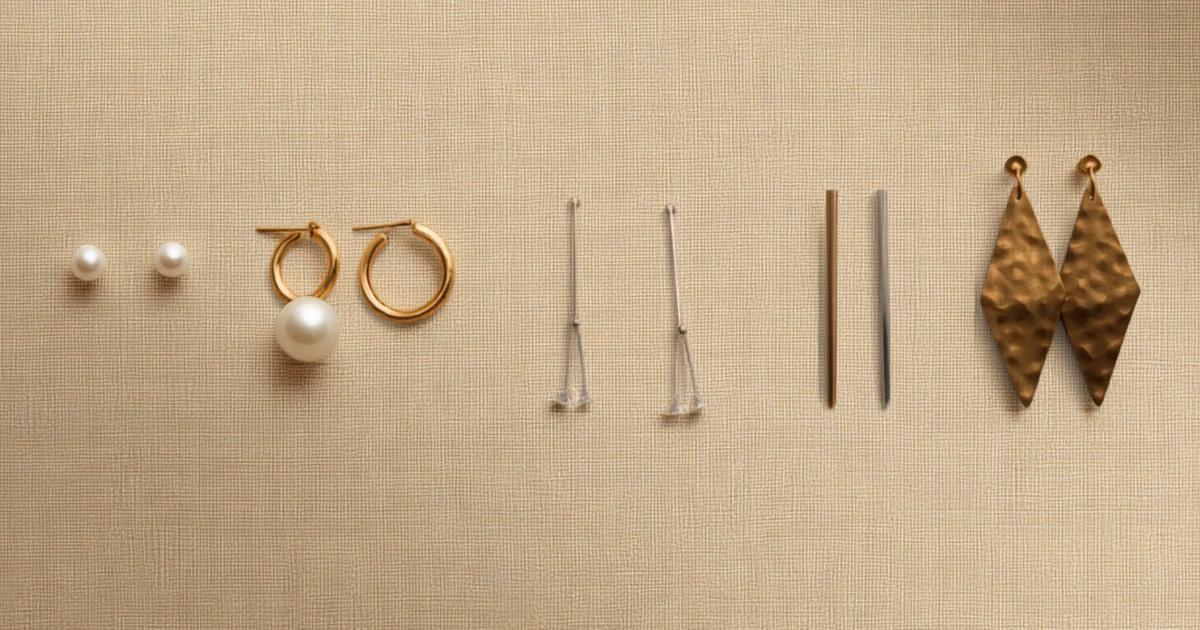
An earring is a piece of jewellery worn on the ear. According to Wikipedia, earrings are usually worn through earlobe piercings or attached by other means such as clip-ons. When it comes to what suits you, two properties matter most today: how long an earring is and at what height it is widest.
| Type | Description | Effect | Especially suits |
|---|---|---|---|
| Stud | sits directly on the earlobe | calm, draws the eye to cheek height | short neck, occasions calling for restraint |
| Small hoop | ring that sits close to the earlobe | light, frames the ear | almost every face shape |
| Large hoop | ring with a clearly visible diameter | round, adds width at mid height | square and long faces |
| Straight drop | slim bar or chain | vertical, lengthens | round face, long neck |
| Teardrop | hangs and widens towards the bottom | adds width low down | heart-shaped face, diamond |
| Statement earring | large, eye-catching, often multi-part | strong, dominates the face | strong bone structure, simple outfit |
| Clip-on | clamps on without a piercing | like a stud or hoop, depending on shape | no piercing, sensitive skin |
Besides shape, weight matters. According to Wikipedia, heavy earrings worn over long periods can stretch the piercing. That is why large shapes also come hollow or in light materials such as wood, horn or acrylic. They look just as big but pull less on the earlobe and stay comfortable even after a long day.
The basic rule: the widest point
The widest point of an earring is the height at which it extends furthest to the side. That is exactly where it visually adds width to the face. A large hoop is widest in the middle, a teardrop at the bottom, a straight drop nowhere. This is the difference between an earring that lengthens a face and one that widens the jaw.
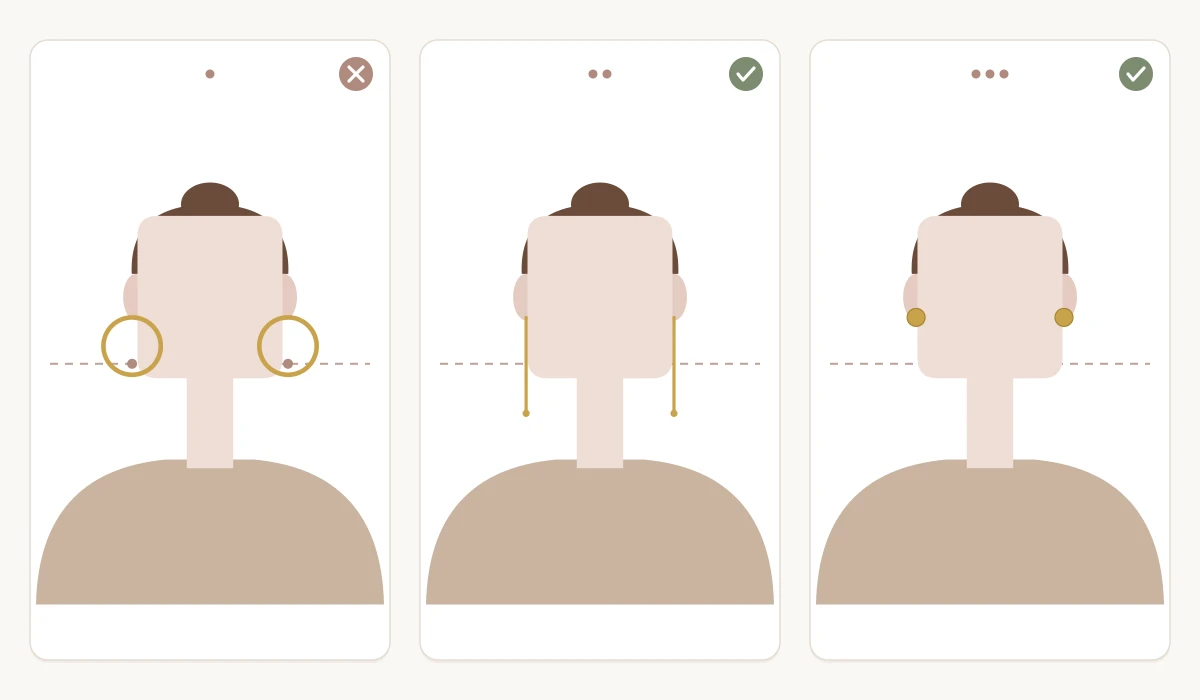
An earring widens your face exactly where it is widest itself.
This translates into a simple rule: place the widest point at a height where your face is narrow, and keep it away from the height where it is already wide. A square face with a strong jaw benefits from earrings that are wide above the jaw. A heart-shaped face with a narrow chin benefits from earrings that widen at the bottom. It is the same logic as with scarves, described in the guide How to tie a scarf: volume works at the height where it sits.
Which earrings suit me by face shape?
Face shape describes the relationship between forehead, cheekbones and jaw, and the length of the face relative to its width. You can determine it in front of the mirror: if the forehead is widest, you are heading towards heart-shaped; if the cheekbones are, towards diamond or round; if all three are almost equal, towards square, long or oval. The detailed instructions are in the guide Glasses by face shape.
| Face shape | Goal | Works well | Better avoid |
|---|---|---|---|
| Oval | keep the proportion | almost any shape, medium size | very long drops that lengthen the face |
| Round | add length | straight drops, slim bars, elongated shapes | large round hoops, round studs |
| Square | soften the edges | hoops, oval and round shapes above the jaw | angular shapes with width at jaw level |
| Heart-shaped | add width at the chin | teardrops, shapes that widen at the bottom | shapes that are wide at the top and pointed at the bottom |
| Long | add width, shorten length | wide, short earrings, hoops, larger studs | long, slim drops |
| Diamond | emphasise forehead and chin | teardrops, shapes with width at the bottom | earrings with width at cheek height |
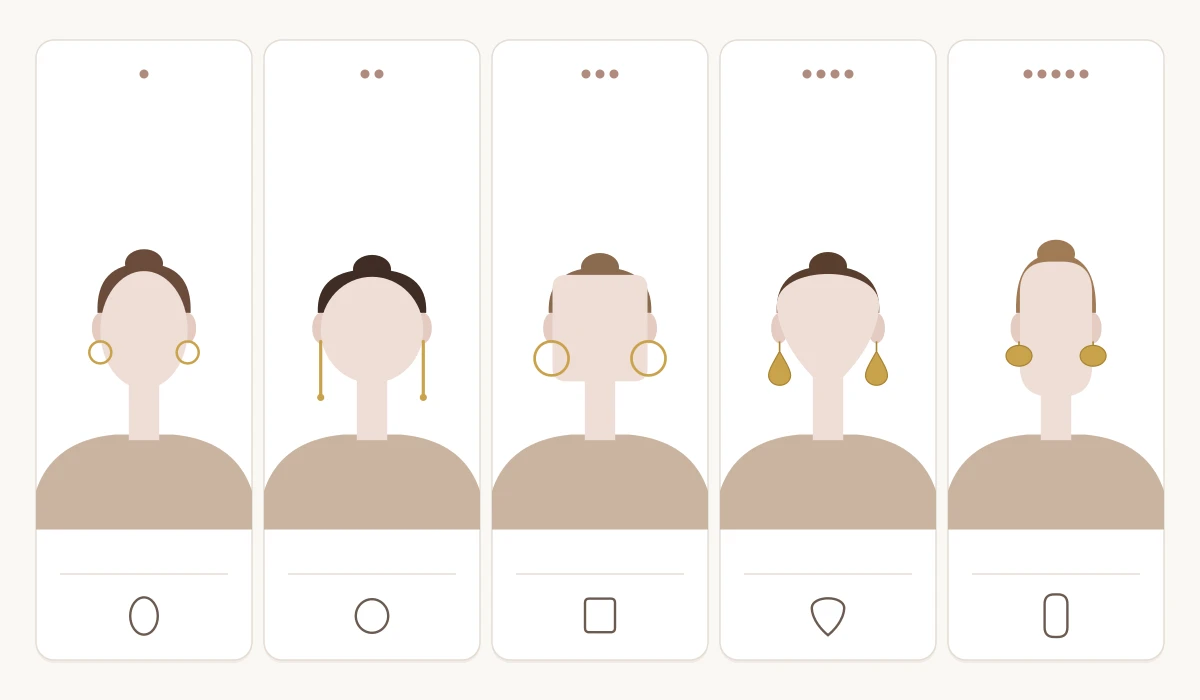
Many faces are mixed shapes, such as round with a slightly square jaw or oval with a wide forehead. The table helps only partly then, but the basic rule always does: find the height at which your face is widest and choose earrings that are narrow exactly there. The widest point of the earring belongs at a height where your face can take width.
The table answers what shape an earring should have. How long and how big it can be depends on the neck and the bone structure.
Earring length by neck length
Neck length is the visible distance between earlobe and shoulder line. It determines how much space a dangling earring has. If an earring almost touches the shoulder or collar, it fills that space completely and the neck looks shorter.
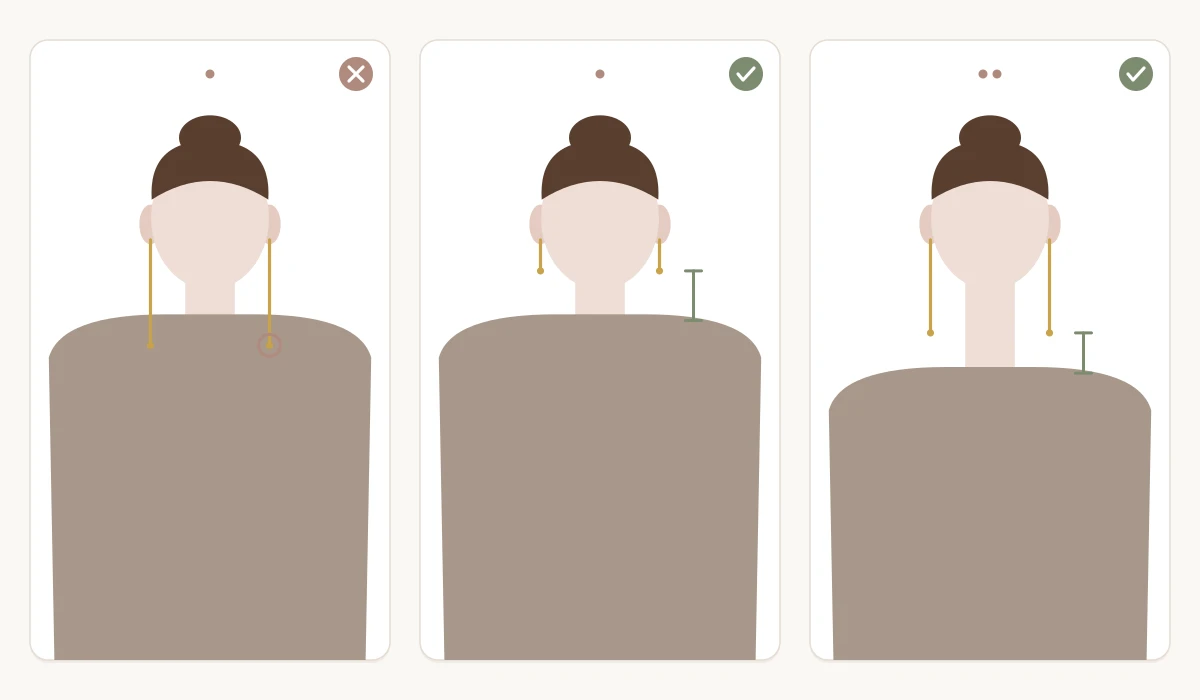
Short neck
With a short neck, studs, small hoops and short drops are the calmer choice. If you love long earrings, choose slim, light styles and pair them with an open or V-shaped neckline that creates extra space.
Long neck
A long neck offers room for long drops and larger shapes. Very small studs do not get lost on a long neck, but they leave the space unused. Here earrings can show line and movement.
A quick test in front of the mirror: look straight ahead and place two fingers horizontally below the end of the earring. If they fit between earring and shoulder line, there is enough room. If not, the earring is too long for your neck.
Keep in mind what you wear on top. A high collar, a blazer with lapels or a jacket reduces the space between ear and shoulder even further. An earring that works with a sleeveless dress can already be too long with a winter coat. So try long earrings on with the top you want to wear them with.
Earrings, hairstyle and glasses
Hairstyle, glasses and earrings all sit in the same small area around the face. They either compete for attention or complement each other, depending on how much each element shows.
Short hair
Short hair exposes ear, jaw and neck. Earrings are fully visible and have a stronger effect. Compact shapes such as studs, small hoops and graphic earrings work especially well; large statement earrings quickly look dominant.
Long, loose hair
Long loose hair covers part of the earring. Small studs almost disappear. Here earrings can be bigger or longer so they stay visible between the strands.
Bun, ponytail and updos
Hair worn up turns the face into a stage. Drops and teardrops show especially well here, because nothing covers them. Which hairstyle suits your body line is explained in the guide Hairstyles by Kibbe type.
With glasses
Glasses already create a horizontal line at eye level. A strong frame and large statement earrings make two strong elements side by side. With a striking frame, choose calmer earrings; with a light frame, bigger ones are fine. Which frame suits you is covered in the guide Glasses by face shape.
Size by bone structure and body line
Body scale describes how fine or strong your bone structure is, visible in your wrists, shoulders and facial features. It determines how big an earring can be. Delicate earrings disappear on a strong bone structure, large earrings overwhelm a fine one. The basics of jewellery size are in the guide Jewellery by colour season.
Body line determines character: smooth or organic, geometric or round, plain or decorated. The classification follows the Kibbe system, explained in the guide Understanding the Kibbe body type system.
| Body line | Character | Typical earrings |
|---|---|---|
| Dramatic | large, clean, geometric | long straight drops, architectural shapes; Soft Dramatic: large round earrings |
| Natural | large, organic, matte | chunky hoops, hammered metal, wood or horn |
| Classic | fine, symmetrical, timeless | discreet studs, pearls, classic half hoops; Dramatic Classic: slim bars and clean hoops |
| Gamine | small, graphic, cheeky | geometric studs, small diamonds and triangles; Soft Gamine: delicate studs with a round stone |
| Romantic | delicate, round, decorated | teardrop earrings, pearls, round stones; Theatrical Romantic: filigree earrings with a stone |
A simple comparison helps with size: place the earring on the inside of your wrist. If it looks wider than the wrist itself or clearly heavier, it is usually too big for a fine bone structure. If it looks lost on a strong wrist, it can be a size bigger. The test is rough, but it quickly shows the direction.
Gold or silver by colour season
The metal of an earring sits right next to your skin and affects how fresh your face looks. So with earrings, if in doubt, stick to your lead metal. Roughly: Springs wear light, clear gold, Summers matte silver and white gold, Autumns warm gold, copper and brass, Winters clear silver, white gold and platinum. The full explanation with a self-test is in the guide Jewellery by colour season.
Stones and pearls follow the colour season too. Warm types wear creamy pearls and warm stone shades, cool types pure white pearls and clear, cool stones. You can find your colour season in the guide What colour season am I?.
Earrings, necklace and neckline
Earrings, necklace and neckline together form the face zone. An outfit looks calmest when exactly one element leads in this zone. If you wear statement earrings, keep the necklace simple or leave it off. If you wear a striking necklace, small studs are enough.
In autumn and winter the face zone changes. Turtlenecks, scarves and hats take up space at the neck and head. Long drops then quickly catch on the scarf, and large earrings compete with the knit. Small hoops or studs are often the more practical and calmer choice in this season.
The face zone has only one lead. Everything else supports it.
The neckline plays a part too: a high crew neck or turtleneck leaves little room at the neck, so long drops show especially well there. A deep V-neck can take a necklace and smaller earrings. Which neckline suits you is shown in the guide Which neckline suits me?. A hat also belongs to the face zone, which is why a large hat and statement earrings quickly compete, as the guide Which hat suits me? describes.
Earrings by occasion
The occasion sets how much attention earrings may draw. The more formal or serious the setting, the smaller and calmer they become.
- Office and job interviews: studs, small hoops or short, simple drops. They look polished without distracting. More on your appearance in an interview is in the guide Job interview outfits for women.
- Wedding: pearls, teardrops and delicate drops work well, a statement piece only with a simple dress. More in the guide Wedding guest outfits.
- Funeral: small studs or pearls, no large hoops. Details in the guide What to wear to a funeral.
- Evening and party: here earrings may sparkle, be longer and carry the outfit.
- Sport and travel: small, flat studs or hoops that do not catch on anything.
Nickel allergy: what to look for in materials
A nickel allergy is a contact allergy to nickel that is released from metal and absorbed through the skin. According to Wikipedia's article on nickel allergy, it is the most common contact allergy in industrialised countries, affecting around 8 to 19 percent of adults, with women affected four to ten times as often as men. A typical site for the rash is the earlobe under nickel-containing earrings.
The EU has regulated nickel release since the Nickel Directive of 1994. Since 1 June 2009, the restriction has been part of Annex XVII, entry 27, of the REACH Regulation. Posts inserted into pierced ears may release no more than 0.2 µg of nickel per cm² per week, other products in prolonged skin contact no more than 0.5 µg. It is measured with the EN 1811 test method in artificial sweat.
In practice, this means: check the material information on studs in particular, because they sit directly in the tissue of a pierced ear. If your earlobe repeatedly turns red or itches, it is worth seeing a dermatologist, who can test which metals you tolerate. Clip-ons are an alternative if you have no piercings or want to rest the piercing.
5 steps to your earrings
When you are standing in front of your jewellery box or in a shop, go through this order:
- Determine your face shape: compare forehead, cheekbones and jaw and note at which height your face is wide or narrow.
- Check the widest point: hold the earring to your ear and see at which height it is widest. If that is where your face is already wide, choose a different shape.
- Check the length: there should be a visible gap between the end of the earring and your shoulder.
- Match the size: compare the earring with your wrist and facial features. If it looks heavier, it is too big for your bone structure.
- Organise the face zone: decide whether earrings, necklace, glasses or neckline take the lead today.
FAQ — Frequently asked questions
Which earrings suit me?
Which earrings suit you depends on face shape, neck length, bone structure and body line. The most important rule: wherever an earring is widest, the face looks wider. Place that point where your face is narrow, and choose the size to match your bone structure.
Which earrings suit a round face?
A round face suits long, slim drops and elongated shapes, because they create a vertical line. Large round hoops and round studs, on the other hand, repeat the roundness. Angular, slim shapes can also give a round face more definition.
Which earrings suit a long face?
A long face benefits from earrings that add width without emphasising length. Wide, short shapes, hoops and larger studs close to the ear work well. Very long, slim drops lengthen the face even more.
Which earrings suit short hair?
Short hair suits compact earrings such as studs, small hoops and graphic shapes, because the ear is fully visible. Large statement earrings quickly look dominant with short hair. If you wear them anyway, keep the rest of the face zone simple.
How do I know whether earrings suit me?
Hold the earring to your ear in front of the mirror and check two things: at which height it is widest and how much space is left to the shoulder. If your face looks wider where it is already wide, or the earring almost touches your shoulder, it does not suit you. Your face should look open, not be upstaged by the earring.
Which earrings suit a narrow face?
A narrow face benefits from earrings that add width at cheek height. Hoops, round shapes and slightly larger studs work well. Long, thin drops make a narrow face look even narrower.
Can I wear large earrings with glasses?
Yes, if the glasses are rather light, for example with a fine metal frame or rimless. A strong, dark frame works better with calmer earrings, because otherwise two strong elements compete. Choose one lead for the face zone.
Do gold or silver earrings suit me?
That depends on your undertone. Warm types such as Spring and Autumn wear gold, cool types such as Summer and Winter silver, white gold or platinum. Because earrings sit right next to your face, stick to your lead metal with them if in doubt.
What helps with a nickel allergy?
With a nickel allergy, pay attention to material information, especially for studs in pierced ears. In the EU, such posts may release no more than 0.2 µg of nickel per cm² per week. Which metals you tolerate is best clarified with an allergy test at a dermatologist.
Next steps
Next time you buy jewellery, run three checks: where is the earring widest, how much space is left to the shoulder, and does the size suit your bone structure? That way you find earrings that open up your face instead of covering it.
Which colours and metals really suit you is explained step by step in the guide What colour season am I?. A personal colour and style consultation clarifies it together with your body line. And if you are torn between two pairs of earrings, send me a photo on WhatsApp. I reply personally, usually the same day.