TL;DR — Which neckline suits me?
- Which neckline suits you is decided not by bust size alone, but by three layers: the neckline shape relative to your body line, the framing of face and neck, and the balancing of proportion.
- Guides sort almost only by bust and shoulders. That’s true — but only half the story. Whether the same V-shape carries you depends on your body line.
- The neckline frames your face like a picture frame — a round face gains from a long V, an angular one from soft curves.
- A deep, narrow neckline lengthens (vertical), a wide, flat one widens (horizontal) — regardless of bust size.
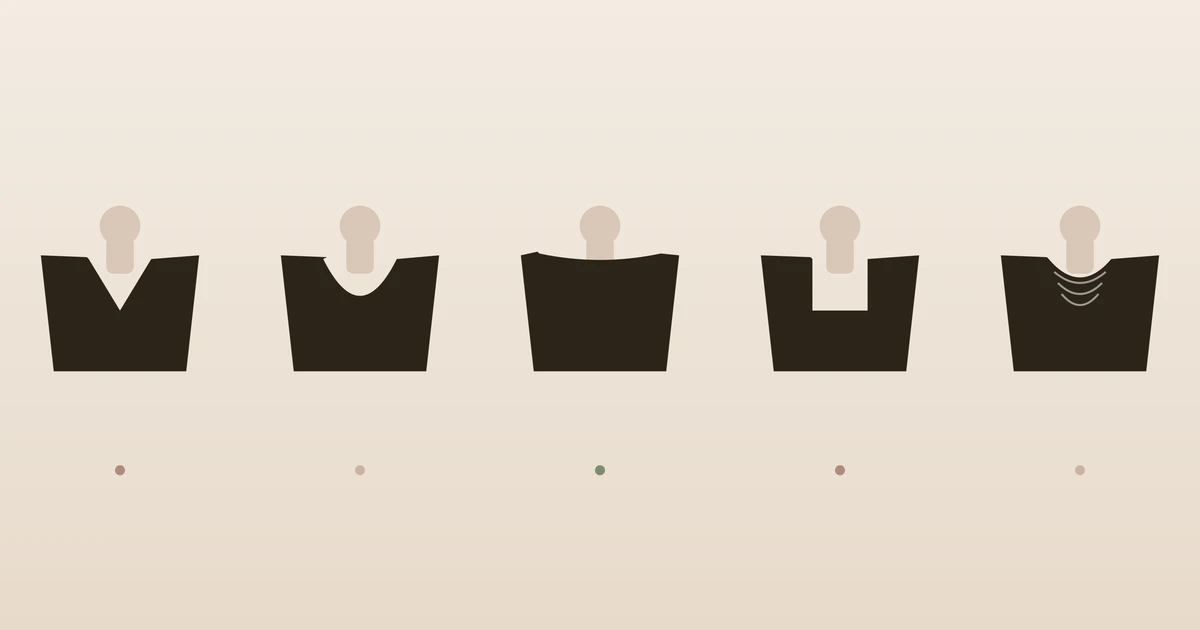
- Six basic shapes are enough: V, crew, scoop, bateau, square and sweetheart. Which one carries you follows from line, face and proportion.
Which neckline suits you is decided not only by your bust size, but by three things: the neckline shape relative to your body line, how the neckline frames your face and neck, and how it balances your proportions. A neckline sits right when its shape mirrors your line and frames your face flatteringly. The classic rule by bust and shoulders is only one of these three layers.
Almost every neckline guide sorts by problem zones: a deep V for a big bust, a wide neckline for narrow shoulders. That’s right — and incomplete. It doesn’t explain why the same V-neck looks completely different on two women with the same figure. The reason is the body line.
Contents
- Why “which neckline makes you look slim” is the wrong first question
- The three layers: line, face, proportion
- The six neckline shapes at a glance
- Neckline by body line
- Neckline by face shape and neck length
- Shoulder construction: the overlooked factor
- Neckline by bust and proportion
- Detail scale: collars, ruffles, bows
- The conflict case: when bust and line disagree
- Step by step to the right neckline
- From the neckline to the whole blouse
- The most common mistakes when buying blouses
- FAQ — Frequently asked questions
Why “which neckline makes you look slim” is the wrong first question
“Which neckline is slimming” and “which one hides a big bust” are the most-asked neckline questions — and the reason so many blouses are lovely on their own and still don’t sit right. The question optimises for a problem zone and skips the essential: a neckline has to belong to your line and frame your face before it hides anything.
A neckline suits you when its shape mirrors your body line and frames your face flatteringly. The neckline is the garment part that sits closest to your face — it works like a picture frame. An angular, strict V on a soft, round face looks hard; a playful ruffled curve on a sharp line looks costumed. Both “work” by the cover-up logic. Both are wrong.
So this guide works in layers. First the fit: line and face. Then the balance: bust, shoulders, proportion. Keep that order and you buy fewer mistakes — and need to hide less, because a neckline that suits your line already looks harmonious.
The three layers: line, face, proportion
Three levers decide whether a neckline suits you:
- The line (character). Whether the neckline is angular, round or open has to match your body line. This is the layer almost everyone skips.
- The face (framing). The neckline frames your face and neck — its shape should balance your face shape and support your neck length.
- The proportion (balance). Only here do bust, shoulder width and torso length come in. This is the fine-tuning, not the starting point.
Classic neckline advice covers only the third layer. Line and face almost never come up — yet they decide whether a neckline belongs to you. Let’s take the layers in order.
The six neckline shapes at a glance
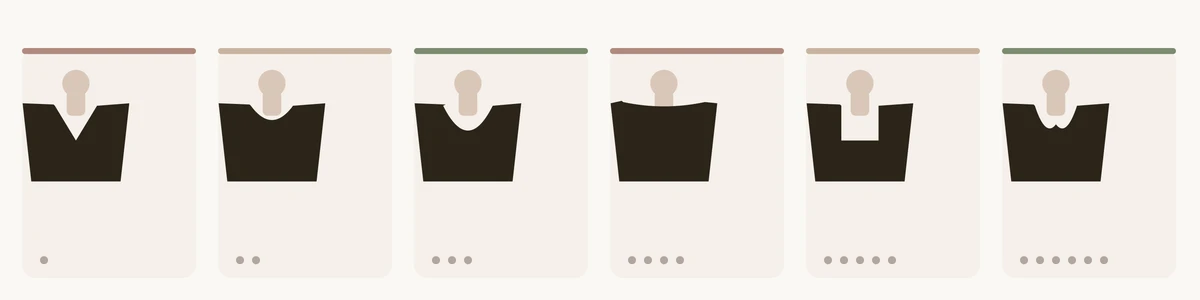
Six basic shapes cover almost every neckline. Each has its own character and effect — lengthening vertically or widening horizontally:
| Neckline shape | Effect | Suits which line |
|---|---|---|
| V-neck | lengthens, emphasises the vertical | sharp, clean lines |
| Crew / round | neutral, frames round and calm | balanced lines |
| Scoop | open and soft, emphasises the décolleté | soft, round lines |
| Bateau / boat | widens the shoulder, emphasises the horizontal | balanced to relaxed lines |
| Square | clean and architectural | sharp, clean lines |
| Sweetheart | soft and feminine, rounds | soft, round lines |
The “line” column is the starting point — face shape, neck length and proportion shift the effect of every shape.
Neckline by body line
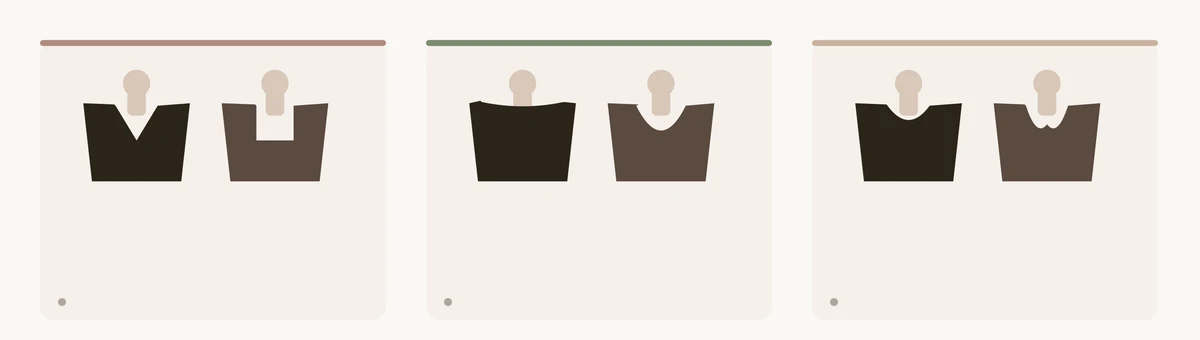
Your body line describes whether your contours are sharp and straight, soft and round, or strong and relaxed. It decides which neckline language carries you — and this is exactly where classic bust-based advice stops. Two women with the same bust get the same deep V recommended; the one with a sharp line suits a clean, angular V, the one with a soft line a gently curved sweetheart or scoop. The body line by Kibbe gives the direction.
Sharp, clean lines (Dramatic family)
Long, straight, angular body lines wear necklines with the same clarity: narrow V-necks, angular square shapes, clean edges without decoration. Ruffles, flounces and soft curves dilute the effect. A precise, deep V-neck sits better here than a playful sweetheart.
Strong, relaxed lines (Natural family)
Broader bones and relaxed contours wear open, unstructured necklines: the open shirt collar, a soft V, a loose henley. Too strict, high-necked or heavily decorated shapes look costumed here. The neckline may be casual and slightly open.
Soft, round lines (Romantic family)
Curved, soft contours wear necklines with roundness: round scoop, sweetheart and draped cowl necklines, soft details. Hard, angular and strictly straight shapes look foreign on soft lines. The neckline should pick up the roundness of your contour.
Balanced and compact lines (Classic, Gamine)
Balanced lines (Classic) wear neat crew and moderate V shapes without extremes. Compact, small-scale lines (Gamine) wear smaller, cheeky necklines with detail — a small Peter Pan collar, a clean boat neckline. For both: medium shape, no single feature dominates.
Neckline by face shape and neck length
The neckline frames your face — and the basic rule is balance, not repetition. A round face looks more harmonious with a long, pointed V that adds length; a long or angular face is framed more softly by round, gently curved necklines. You use this same balancing logic when choosing glasses by face shape.
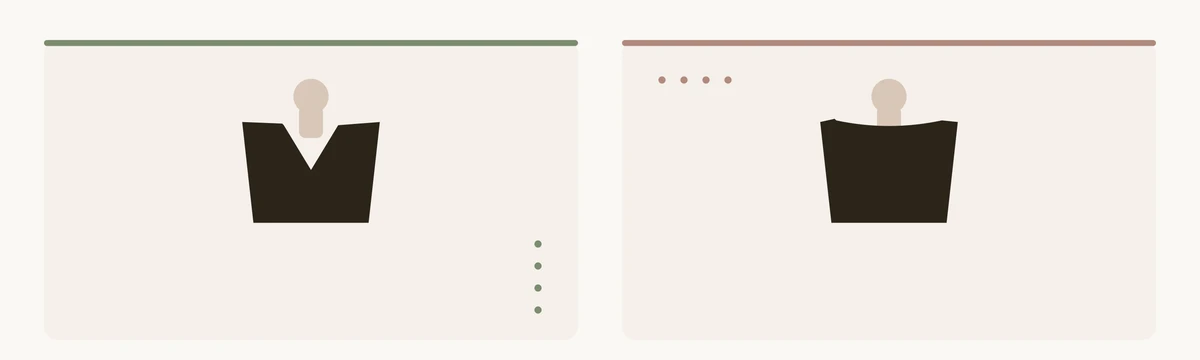
Neck length decides depth and width. A short neck gains length from deep, narrow, open necklines that create free space under the chin — V, open shirt collar, narrow scoop. High, round and wide shapes as well as turtlenecks shorten a short neck further. A long neck, by contrast, carries higher, wider and round necklines that don’t over-lengthen it — here crew, boat and even a turtleneck work.
Shoulder construction: the overlooked factor
The shoulder line of a blouse has to match your own shoulder — the factor almost nobody checks. A sharp, straight shoulder wears structured, clean shoulder seams; a soft, sloping shoulder needs unconstructed, soft joins; a strong, broad shoulder carries volume and structure. If the shoulder seam sits next to your real shoulder edge, the whole blouse looks wrong — however good the neckline.
The neckline directs the eye, the shoulder construction carries the shape. Both have to be right: a perfect neckline on a badly sitting shoulder doesn’t rescue the blouse.
The same logic applies to the coat by body line: the shoulder is where the whole top hangs. Puff sleeves, raglan and saddle shoulders, set-in seams — each construction sends a different signal and suits a different shoulder shape. When trying on, first check that the shoulder seam ends exactly on your shoulder edge.
Neckline by bust and proportion
The classic layer stays useful — as one of several levers. It balances bust, shoulder width and torso length:
- Large bust: deep, elongated necklines (V, sweetheart, narrow scoop) visually divide the chest and lengthen. High and wide shapes make the bust look more massive.
- Small bust: detail and fullness suit well — ruffles, cowl, Carmen. A deep, narrow V emphasises the narrowness instead.
- Broad shoulders: narrow, deep necklines lead the eye to the centre. Wide bateau shapes pull the shoulder further apart.
- Narrow shoulders: wide, flat necklines (bateau, Carmen) create width and balance to the hip.
What matters is combining this layer with line and face — not taking it as the only rule. That’s exactly where the next section comes in.
Detail scale: collars, ruffles, bows
The size of the details — collar, tie, ruffle, button placket — follows your bone structure, not the trend. Fine bones are overwhelmed by a big pussy-bow blouse or a wide Peter Pan collar; strong bones make a tiny ruffle disappear. Check the detail size like the neckline shape on yourself, not on the hanger.
The rule of thumb follows the bone scale you can read at the wrist: if thumb and middle finger barely touch around the joint, you have strong bones and wear larger collars, wider bows and bold details. If they clearly overlap, you have fine bones and wear delicate details, narrow collars and fine fastenings. The same scale logic applies to jewellery at the neckline — more on that in the guide Jewellery by colour type.
The conflict case: when bust and line disagree
The interesting case is the contradiction. What if your bust asks for one thing and your body line for another? Example: you have a large bust (rule says: deep, narrow V to lengthen) and at the same time a soft, round line (line says: round, curved, no hard V). A strict, angular V does divide the chest — but looks hard and foreign on a soft line.
In a conflict, the line wins for harmony, the proportion for balance. Translated: take the form language of your line — and solve the balance through depth and colour, not through an edge that works against your line.
In the example that means: not a hard, pointed V, but a deep, softly curved scoop or sweetheart neckline. The roundness honours your line, the depth divides the bust and still lengthens. You get both — harmony and balance — without one fighting the other. This order is the core: line first, balance as fine-tuning.
Step by step to the right neckline
Here’s how to proceed at your next purchase — in this order:
- Determine your body line. Sharp, soft, relaxed, balanced or compact? The Kibbe test gives the direction.
- Choose the neckline shape by the line. Angular and clean, round and soft, or open and unstructured.
- Balance your face. A round face needs length (V), an angular face needs roundness.
- Account for neck length. Short neck: deep and open. Long neck: higher and rounder allowed.
- Check the shoulder construction. The shoulder seam must end on your shoulder edge.
- Balance the proportion. Only now: balance bust and shoulder width through depth and width.
- Adjust the detail scale. Collar, ruffle and bow in the size of your bone structure.
From the neckline to the whole blouse
The neckline is the start — the whole blouse follows the same three layers. Collar and cut mirror your line, the neckline frames your face, the shoulder construction carries the shape. A clean shirt blouse with a structured collar suits sharp lines; a fluid blouse with a soft drape and tie suits soft lines; an unstructured blouse with an open collar suits relaxed lines.
The neckline also sets the stage for the necklace: a V carries a pendant along the V-line, a crew frames short colliers, a deep or square neckline leaves room for statement pieces. The same principle of neckline and framing works with dresses too — the neckline is always what sits closest to your face.
The most common mistakes when buying blouses
The most expensive neckline is not the pricey one, but the one that makes your face look tired — because it was chosen by bust, never by line and face.
- Buying by bust only. The cover-up rule is one of three layers — line and face are missing otherwise.
- Forgetting the face. The neckline sits closest to the face and frames it — the wrong shape makes the face look more angular or rounder.
- Ignoring the shoulder seam. If it sits beside the shoulder edge, no neckline rescues the blouse.
- Overlooking the detail size. A huge bow on fine bones overwhelms, a tiny ruffle on strong bones disappears.
- Buying against your own line. A hard V on a soft line looks strict, a ruffle on a sharp line looks costumed.
- Checking only from the front in the mirror. Check the neckline next to your face and together with the necklace and hairstyle.
From the neckline to the whole silhouette
Find the necklines that carry your line
This guide gives you the tools. A professional Kibbe and colour analysis gives you your personal result: which shapes, necklines and tones your structure really carries — from the neckline to your whole silhouette. A free initial consultation is always included.
The neckline does not only decide on blouses and dresses. With swimwear it acts even more directly, because there is no collar and no scarf in between — the allocation by bust shape is in which swimwear suits my figure.
A neckline repeats or breaks the chin line — so it is worth settling your face shape before choosing one. The method is in what face shape do I have.
FAQ — Frequently asked questions
Which neckline suits me?
The neckline that suits you is the one whose shape mirrors your body line and balances your face shape: clean, sharp lines wear V and square necklines, soft lines wear round and sweetheart necklines, strong, relaxed lines wear open, unstructured shapes. Bust size is only one of several layers. First comes the fit to line and face, then the balancing of proportion.
Which neckline is slimming and lengthening?
The most reliably lengthening neckline is a deep, narrow one that emphasises vertical lines — above all the V-neck. It lengthens the neck and torso and leads the eye up to the face. Wide, flat necklines like the bateau or Carmen emphasise the horizontal instead and make the torso look broader. If you want to lengthen, choose depth over width.
Which neckline suits a large bust?
With a large bust, deep, elongated necklines work best: V, sweetheart and narrow scoop necklines visually divide the chest and lengthen the torso. High crew and turtleneck shapes make the bust look more massive, wide Carmen necklines emphasise the width. What matters is a neckline that creates length and leads the eye upward.
Which neckline suits a short neck?
With a short neck, an open, deep neckline with a vertical line lengthens — a V-neck, open shirt collar or narrow scoop. They create free space under the chin and make the neck look longer. High, round and wide necklines as well as turtlenecks shorten the neck further. Open collars and a lower sit also help.
Which neckline for broad or narrow shoulders?
Broad shoulders are balanced by narrow, deep necklines like the V or narrow scoop, which lead the eye to the centre. Narrow shoulders gain width with wide, flat necklines like the bateau or Carmen. The neckline directs the perceived shoulder line — narrow draws together, wide pulls apart.
Which neckline suits my Kibbe type?
Sharp, long lines (Dramatic family) wear clean, angular necklines — narrow V, square and strict shapes. Strong, relaxed lines (Natural family) wear open, unstructured necklines like the open shirt collar or soft V. Soft, round lines (Romantic family) wear round, sweetheart and draped cowl necklines. Balanced and compact lines (Classic, Gamine) wear neat medium shapes without extremes.
Which neckline suits which face shape?
The basic rule is balance: a round face looks more harmonious with an elongated, pointed neckline like the V, which adds length. A long or angular face is framed more softly by round, gently curved necklines. Heart-shaped faces carry round and scoop necklines well, angular faces benefit from soft curves. The neckline frames the face like a picture frame.
Which blouse suits my body?
The right blouse follows the same three layers as the neckline: its collar and cut should mirror your body line, its neckline frame your face, and its shoulder construction match your own shoulder. Fluid blouses with a soft drape suit soft lines, clean shirt blouses with a structured collar suit sharp lines, unstructured styles suit relaxed lines. The detail size follows your bone structure.
Which neckline for which necklace?
The neckline sets the stage for the necklace. A V-neck carries a pendant that follows the V-line; a crew frames short necklaces and collier shapes; a deep or square neckline leaves room for statement pieces. Basic rule: the necklace should pick up the neckline or deliberately contrast it, never compete with it. With high necklines, long necklaces work best.