
TL;DR — organising a wardrobe in short
You organise a wardrobe by reach, not by garment type: what you wear often goes at eye level, what you wear rarely goes above or below. Within each zone you sort by outfit blocks rather than by stacks of identical items — and only then by colour. Boxes and folding technique are tools, not the system.
- Three zones: eye level for everyday, above it season and occasion, below it heavy and rarely worn.
- Hang or fold is decided by the material, not by space: anything that stretches gets folded.
- Outfit blocks instead of garment stacks. Not all blouses together, but the things worn together.
- Sorting by colour is not a decorating trick. It makes combinability visible — and shows which colour family your wardrobe actually has.
- Order only holds if every item has a fixed place. Where no place is defined, a pile reappears within three weeks.

Contents
- Why order collapses after three weeks
- The principle: by reach, not by garment type
- The three zones of your wardrobe
- Hang, fold or roll
- Outfit blocks instead of garment stacks
- Sorting by colour — and why
- Putting it back in six steps
- Little space: small wardrobes
- The seasonal changeover
- Hangers, boxes, baskets: what is worth it
- The most common mistakes
- Frequently asked questions
Why order in a wardrobe collapses after three weeks
Almost every guide to organising a wardrobe describes the same day: everything out, everything folded, everything back in. The result looks wonderful that evening. Three weeks later there is a pile on the chair again.
The reason is not a question of discipline. It is structural: most systems sort by what clothing is called, not by how it is used. All T-shirts together, all trousers together, all blouses together. That is right for a warehouse and wrong for a wardrobe, because nobody puts on "a T-shirt" in the morning. You put on an outfit — and in this sorting its parts sit in three different places.
The second problem is simpler still: items without a fixed place migrate. If a jacket has no defined spot, it lands wherever there happens to be a gap. Next time somewhere else. After three weeks the order is not destroyed; it never formed.
A wardrobe does not become untidy because you are careless. It becomes untidy because the system does not describe how you actually get dressed.
This guide therefore reverses the order: zones first, then blocks, then colour — and only at the very end boxes and folding technique. If you have not decluttered yet, start one stage earlier, with decluttering your wardrobe. Sorting out and putting back are two steps, not one: what you keep is decided beforehand, where it belongs afterwards.
The principle: by reach, not by garment type
There is one observation every professional organiser confirms and almost nobody builds into a system: what sits at eye level gets worn. What sits above or below it is forgotten.
From that follows a rule that contradicts the usual one. Placement is determined by how often something is worn, not by what kind of garment it is. A dress you wear twice a year does not belong beside the dress you wear every week — merely because both are dresses.
The practical check takes two minutes: go through your wardrobe and mentally mark every item weekly, monthly or less often. You will find the weekly group is small — for most people well under a third. That group gets the best place, all of it, even if it is a mix of trousers, tops and a cardigan. Which items that group ought to consist of is covered in timeless basics.
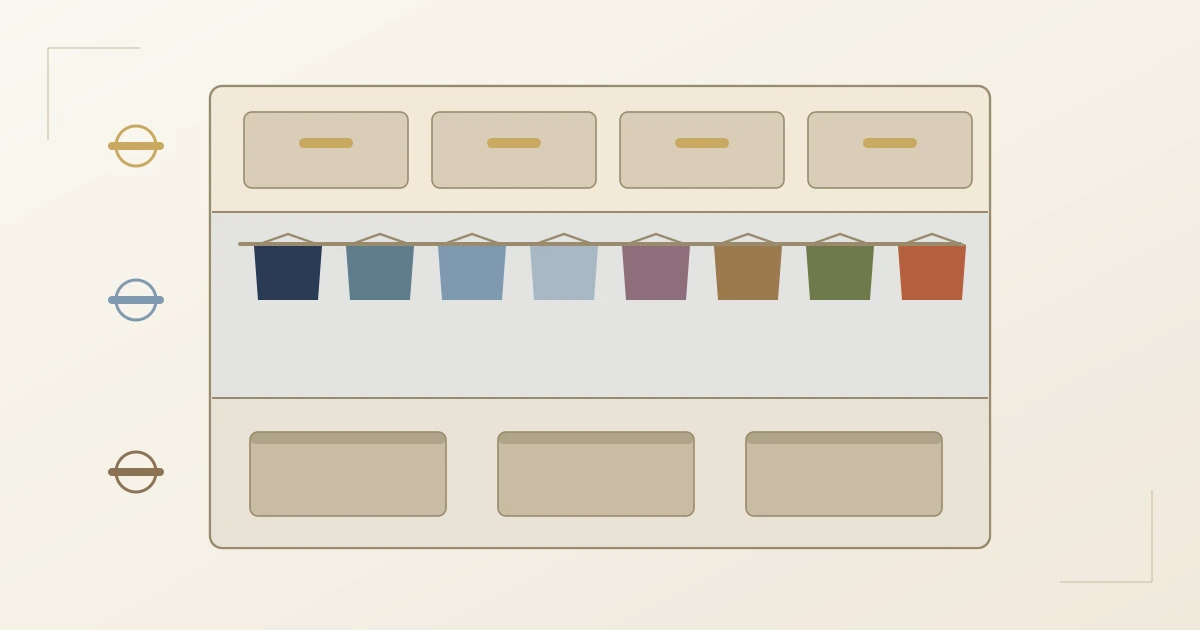
The three zones of your wardrobe
Every wardrobe can be divided into three horizontal bands, regardless of size or construction.
Zone 1 — eye to chest height: everyday
This is where what you wear weekly hangs and lies. It is the most expensive space in the wardrobe, and it belongs to the most-used group, not the largest category. If that means three pairs of trousers, five tops and a cardigan hang side by side, that is correct.
Zone 2 — above: season and occasion
Everything not currently in play: the other season, formal pieces, the suit for two appointments a year. Boxes genuinely help here, because the height is hard to see into anyway and a labelled lid is faster than searching.
Zone 3 — below: heavy and infrequent
Shoes, bags, heavy knitwear, sports kit. Everything you want to reach without a ladder but do not need daily. Heavy things belong at the bottom as a matter of principle — in open shelving for stability too.
Two extra rules that pay for themselves:
- The inside of the door is Zone 1. It is at eye level and almost always wasted. Hooks or a flat hanging organiser there will take belts, scarves and jewellery.
- One gap per zone stays free. A wardrobe used to the last centimetre cannot be used without destroying it — you pull one item out and push two others out of shape.
Hang, fold or roll
The most frequently asked question on the subject is whether hanging or folding saves more space. The honest answer: that is not decided by space but by material. Space is gained elsewhere.
| Item | Hang, fold or roll | Why |
|---|---|---|
| Blouses, shirts | hang | woven, creases in a stack |
| Blazers, coats, jackets | hang, on shaped hangers | the shoulder shape is built in and should be held |
| Dresses, skirts | hang | length and drape suffer in a stack |
| Knitwear, cardigans | fold | knitted fabric stretches under its own weight |
| T-shirts, tops | fold or stand upright | jersey stretches at the shoulders on a hanger |
| Jeans, firm trousers | either | robust; folded is more compact, hung is clearer |
| Sports and technical wear | roll | elastic, barely creases, rolling genuinely saves space here |
| Underwear, socks | upright, in compartments | small items are only visible standing up |
The one technique that genuinely changes things: do not stack folded items, stand them upright side by side like books on a shelf. A stack shows only the top item and collapses when you pull out the third. Standing upright, you see everything at once and nothing shifts. That is the core of what is known as the KonMari folding method, and it is the only part of it that works without the rest.
For that to hold you need boundaries: a compartment, a drawer or an open box as deep as the folded item is tall. Without side support the row tips over, and then it is a stack again.
On hangers: matching hangers are not a styling matter but a space matter. Different thicknesses and shapes create gaps that cannot be used. Slim velvet-covered hangers gain more real space on a full rail than any other accessory, and items stop slipping off. For blazers and coats, wide shaped hangers remain correct — there shoulder shape beats space.
Outfit blocks instead of garment stacks
This is where a tidy wardrobe differs from a usable one. The usual sorting groups by garment type. The better one groups by what is worn together.
An outfit block is a small group of items that work together and that you wear in a recurring situation. Most people have three to five of them:
- Work — what you wear in the office or in meetings
- Everyday — shopping, children, walks
- Evening and occasion — dinner, parties, theatre
- Sport — training kit and technical layers
- Home — what never leaves the house and still needs a place
Within a block the items hang and lie together, across categories. So the work block holds trousers, blouses and a blazer side by side — not the blouses with all the other blouses. What such a block looks like for the office is covered in business looks by Kibbe type.
The gain only shows in the morning: you reach into one area, not three. And you see immediately whether the block is complete. If the second top for the good trousers is missing, you notice it here rather than while dressing. Those gaps are exactly why replacement purchases so often go wrong — covered in avoiding bad buys.
One limitation belongs with this: block sorting needs slightly more space than strict categories, because items can double up — black trousers that suit both work and evening have to choose a block. Rule of thumb: they belong in the block where you wear them more often, and the other block gets a placeholder in your head, not a second hanger.
If you already work with a reduced set, the logic behind it is covered at length in capsule wardrobe by Kibbe type — there the same blocks are thought of as a buying plan rather than a storage order.
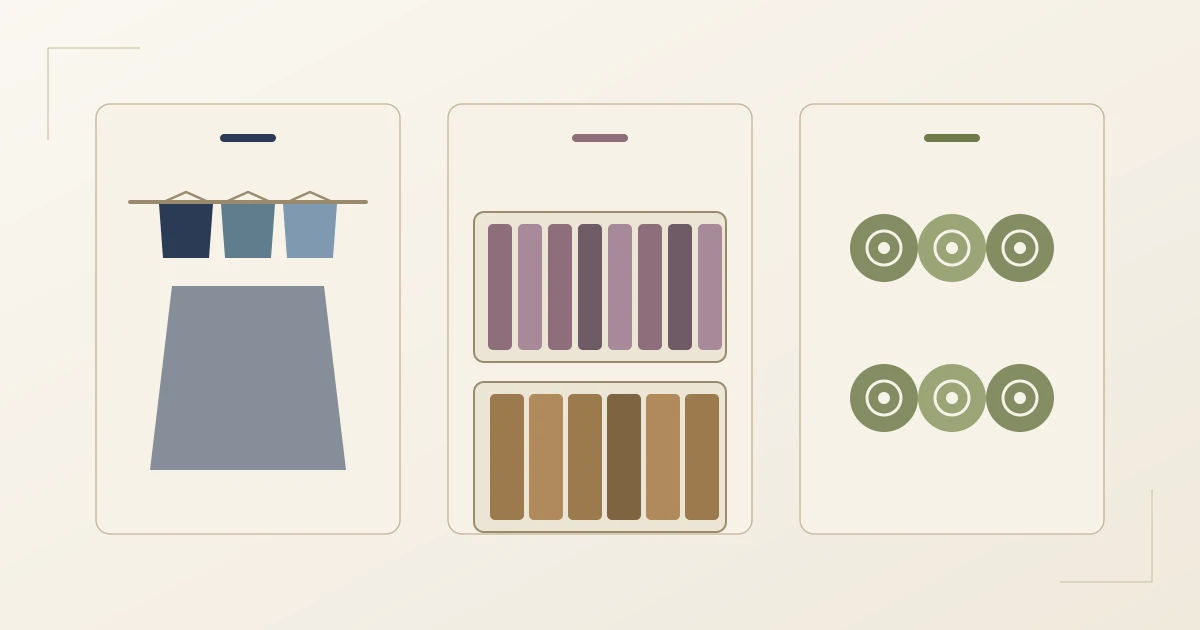
Sorting by colour — and why
Colour sorting has a reputation as decorative play for Instagram. It has two concrete functions, though, and both have little to do with looks.
First, it makes combinability visible. When the items in a block hang sorted by colour, you see in a second what goes together — and what stands alone. A single bright red piece among muted tones explains itself: it has no partners, which is why it is never worn. Whether the colour belongs to you at all is settled by the free colour type test.
Second, it shows which colour family your wardrobe actually has. Most people misjudge this. After sorting you can see it: two thirds blues and greys, one third the rest, and within that three bad buys in a colour that appears nowhere else. That is the same insight a colour consultation delivers, only read backwards out of your own wardrobe.
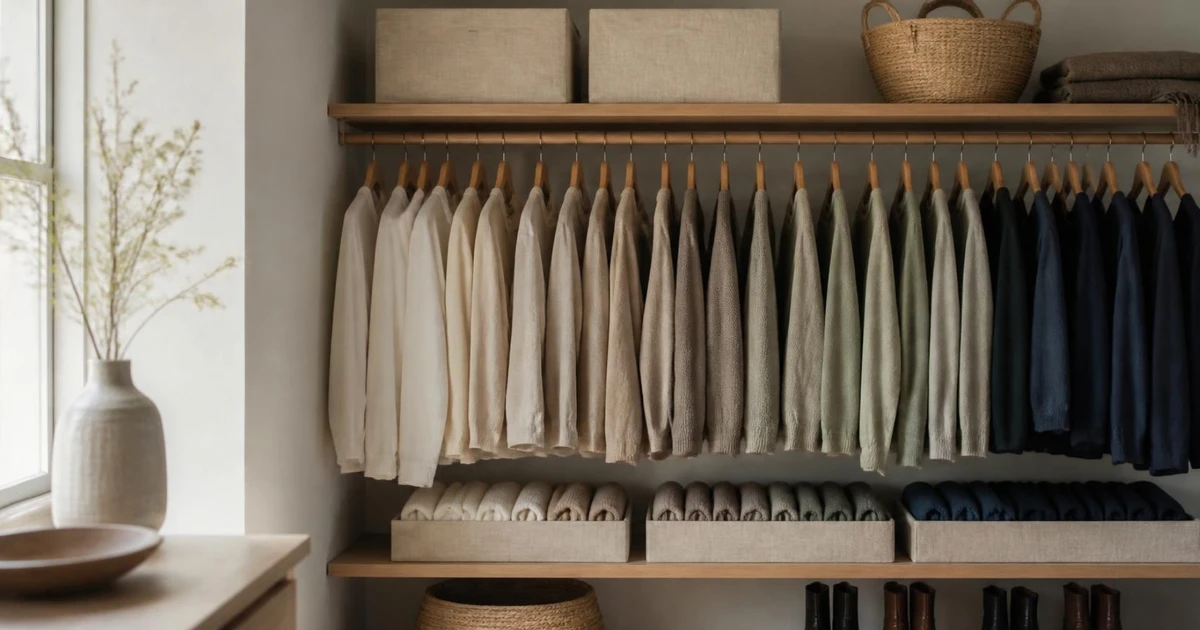
In practice: within each block and each garment type, sort from light to dark, neutrals first, then the colours. Not a rainbow across the whole wardrobe — that looks good and destroys the blocks.
If many colours turn out not to work next to one another, that is rarely the sorting's fault. Which tones belong to you is settled by finding your colour type, and how to combine two of them is in combining colours in clothing.
Putting it back in six steps
The order matters more than the speed. Allow two to three hours and do it in one go — a half-reorganised wardrobe stays half-reorganised for weeks.
- Empty and wipe. Everything out, shelves and rails wiped. It sounds like housework and has a practical reason: you only see the actual dimensions and compartments in an empty wardrobe.
- Separate by frequency. Three piles on the bed: weekly, monthly, less often. Not yet by type, not yet by colour.
- Define the zones. Decide which shelf and which section of rail is Zone 1, 2 and 3 — before you put a single item back.
- Form the blocks. Divide the weekly pile into your three to five outfit blocks. Each block gets a contiguous section in Zone 1.
- Put back, hanging items first. Fill the rail, then the shelves, then the drawers. Within each section, sort by colour from light to dark.
- Define the leftover. Whatever remains gets a named place — not "wherever there is room". Anything without a place goes into a box that stays put for four weeks. What you have not fetched in that time belongs in the decluttering decision.
A wardrobe is finished when you can say with your eyes closed where your favourite trousers are.
Little space: organising a small wardrobe
In a narrow wardrobe the same system applies, only with harder decisions. Four measures make a real difference:
- Only one season in the wardrobe. This is the single biggest lever — it halves the contents without you giving away a thing.
- Adjust the rail height. Under short hanging tops there are often 40 to 60 centimetres going unused. A second, lower rail or a hanging fabric tower doubles that section.
- Upright rather than stacked. In shallow compartments more fits standing up than stacked, and it stays visible.
- Multiple hangers for trousers and skirts. Four pairs in the space of one. No good for knitwear, good for firm fabrics.
What rarely works in small wardrobes: vacuum bags for the current season. For storage they are right; in everyday use they create a hurdle that means the items stop being worn at all.
The seasonal changeover
Twice a year Zone 1 and Zone 2 swap contents. With a working system that takes under an hour, and it is the moment when order renews itself. What helps in the transition between the two, when both seasons half apply, is covered in layering for the transitional season.
- Wash before storing. Invisible residues from sweat and deodorant attract moths and set during winter storage. Wool put away unwashed is the most common reason for holes in spring.
- Store dry and dark. Light bleaches, damp breeds mould. Cotton bags beat plastic because they let residual moisture out.
- Review as you swap. What you have not worn for a whole season shows up exactly now — the most honest check of the year. Swimwear and winter coats are among the pieces that lie longest: which swimwear suits you and which winter coat settle which of them are worth the space.
How to wash wool and knitwear so it survives storage unharmed is in washing and caring for clothes properly.
Hangers, boxes, baskets: which organisers are worth it
Organising accessories are the first thing people buy and should be the last thing that helps. The right order is the reverse: system first, containers second — otherwise you buy boxes for an order that does not exist yet.
What is worth it, in this order:
- Matching slim hangers. The biggest space gain per euro. Wide shaped hangers stay for blazers and coats.
- Drawer dividers or flat open boxes. They give upright items the support without which the row tips over.
- Labelled boxes with lids for Zone 2. Only up top, only for season and occasion. In the everyday zone a lid is a hurdle.
- Hooks on the inside of the door. Cheap and effective for belts, scarves and bags.
What you usually do not need: hanging fabric shelves for the current season — they are hard to see into and lose their shape quickly — and a dedicated organiser for every single category. Two container sizes are enough in almost any wardrobe.
The most common mistakes
- Buying boxes before the system exists. Containers set an order in concrete. If there is none yet, they set the chaos.
- Sorting strictly by garment type. Right for a warehouse, wrong for a wardrobe you dress from in the morning.
- Hanging knitwear. Knitted fabric stretches under its own weight and develops shoulder bumps that never come out.
- Filling the wardrobe to the last centimetre. A full wardrobe cannot be used without destroying the order.
- Stacking instead of standing upright. A stack shows one item and collapses on the third reach.
- Leaving both seasons in at once. The simplest space gain goes unused and visibility halves.
- Organising instead of deciding. If you own too much you can lay it out neatly, but not see it. At some point decluttering is the next step, not another box — and before that, the question of which clothing style suits you at all.
Frequently asked questions
How do I organise my wardrobe?
In four layers, in this order. First define zones — what you wear weekly goes at eye level, season and occasion above, heavy things below. Second, within the zones, group by outfit blocks rather than garment type. Third, within each block sort by colour from light to dark. Only then choose boxes, hangers and folding technique. Anyone who starts with the accessories organises containers rather than clothes.
Is it more space-saving to hang or to fold clothes?
Folded fits more into the same volume, but that is not the criterion. The material decides: everything woven — blouses, shirts, dresses, blazers — belongs on a hanger, because it creases in a stack. Everything elastic — knitwear, jersey, T-shirts — belongs folded, because knitted fabric stretches on a hanger under its own weight. Real space is gained elsewhere: matching slim hangers, a second rail, and moving the other season out.
Which folding technique saves the most space?
Not stacking, but standing items upright side by side like books on a shelf. Fold the item so it stands on its own and is roughly as tall as the compartment is deep. The gain is less about space than visibility: a stack shows only the top item and collapses on the third reach, an upright row shows everything and stays stable. To stop it tipping, it needs side support from drawer dividers or a flat box.
How do I fold a jumper properly?
Lay it face down, fold both sleeves inwards across the back, then fold from the bottom up into two or three equal sections — so the result stands on its own. Jumpers do not belong on hangers as a matter of principle: gravity pulls the stitches long and leaves bumps at the shoulders that cannot be washed out.
What ideas are there for a wardrobe organising system?
Four things work reliably, and in this order: matching slim hangers, drawer dividers or flat open boxes for upright items, labelled boxes with lids exclusively in the upper area, and hooks on the inside of the door for belts, scarves and bags. Almost no wardrobe needs more. Two container sizes are enough; a separate organiser per category only makes the system harder to read.
Which clothes should you declutter?
That is a separate step before organising, not part of it. As a direction: anything that does not fit, anything broken you have not had repaired in over a year, and anything you have not worn for a whole season although it was hanging there. The seasonal changeover is the most honest check of the year, because you have every item in your hands anyway.
How do I organise a small wardrobe to save space?
The biggest lever is having only one season in the wardrobe — that halves the contents without giving anything away. Then check the rail height, because under short hanging tops there are often 40 to 60 unused centimetres that will take a second rail or a hanging tower. Add standing items upright rather than stacking, and multiple hangers for firm trousers and skirts.
Should I sort by colour or by garment type?
By both, but in the right order: first by use into zones and outfit blocks, within those by garment type, and within the type by colour. A pure colour sort across the whole wardrobe looks good and destroys the blocks. Sorted light to dark within a section, colour instead makes visible what combines and what stands alone.
What belongs at eye level?
What you wear weekly — regardless of what kind of garment it is. That is the most used and therefore most valuable place in the wardrobe, and it belongs to the most-used group, not the largest category. For most people that group is smaller than a third of what they own. The inside of the door counts as part of this zone and is almost always wasted.
Which boxes are suitable for a wardrobe?
In the everyday zone, flat open boxes without lids — anything you have to open first becomes a hurdle and stops being used. In the upper zone for season and occasion, closed labelled boxes, because the height is hard to see into and a label is faster than searching. Measure before you buy: boxes that do not fit the shelf depth cost space rather than creating it.
How often should I reorganise my wardrobe?
Fundamentally twice a year, at the seasonal changeover. In between, a working system needs no action, only putting things back: every item has a fixed place and returns exactly there. If order keeps collapsing anyway, that is almost never discipline — it is that some items have no defined place, or the wardrobe is too full.
How does the order last?
Through three conditions. First, every item has a named place — where none is defined, a pile forms. Second, one gap stays free in each zone, otherwise the wardrobe cannot be used without destroying it. Third, the system matches your day: if you dress in outfits in the morning but the wardrobe is sorted by garment type, you work against your own order every single day.