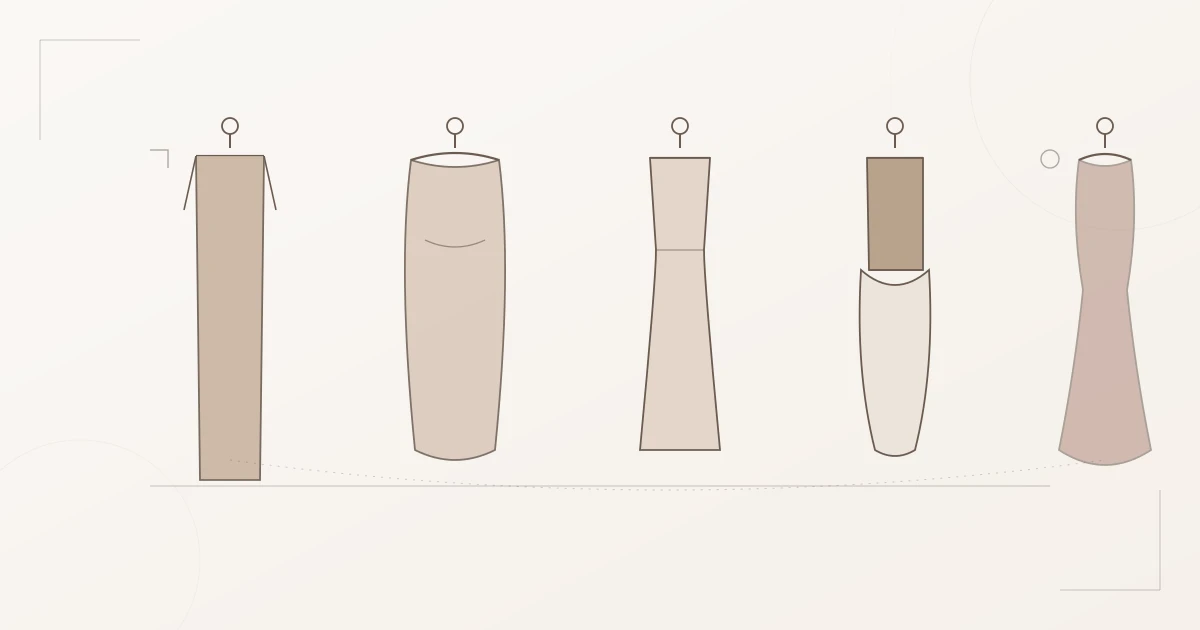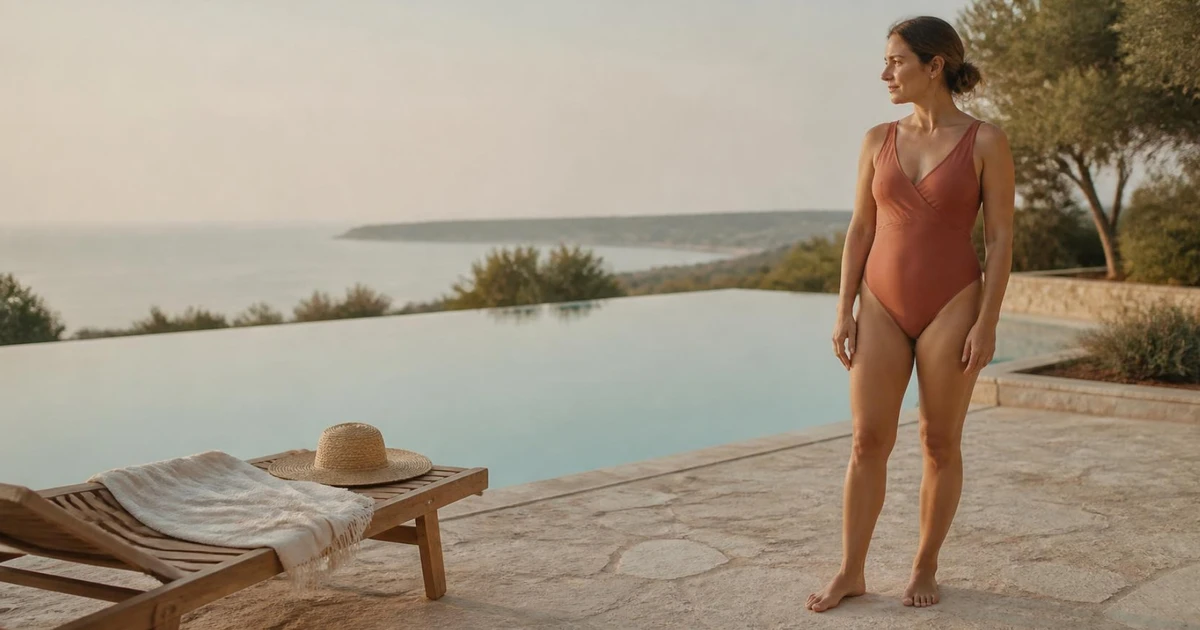

TL;DR — swimwear by body shape in short
Which swimwear suits your figure comes down to three things: where your waist sits, how your upper body is proportioned to your lower body, and what shape your bust is. Bikini or swimsuit is not a figure question at all — it is a question of waist position and occasion. And colour matters more here than with any other garment, because it lies directly on the skin.
- The bottoms decide more than the top. The height of the leg opening changes leg length more visibly than any cut above the waist.
- Bust shape beats cup size. Two women with the same size often need completely different tops.
- Balance, not concealment. Hiding creates surface area. Balancing creates proportion — the same principle as with dresses and trousers.
- Colour sits on the skin with nothing in between. No scarf, no blouse, no make-up as a buffer. Your season shows more clearly here than anywhere else.
- Swimwear runs smaller than outerwear, and it stretches when wet. Going up a size is usually the wrong move.

Contents
- Bikini or swimsuit — the first decision
- The swimwear shapes at a glance
- Swimwear by body shape
- Bust shape beats cup size
- The bottoms decide more than the top
- Swimwear meets your body line
- Colour with no buffer: your season at the pool
- What tummy control really does — and does not
- Size, fit and the fitting-room test
- From the water to the bar
- The most common buying mistakes
- Frequently asked questions
Bikini or swimsuit — the first decision
Almost every guide to which swimwear suits your figure begins with the figure. That is the second step. The first is a question that has nothing to do with your body: what are you doing that day?
A swimsuit is one continuous garment. It holds, it stays where it is when you jump in, and in the evening it passes as a bodysuit under a wide skirt. A bikini is two pieces, dries faster, lets you choose top and bottom in different sizes, and is simpler on a sunbed.
From that follows a straightforward allocation:
- Swimming, waves, slides, sport: a swimsuit, or a bikini with a firm back fastening and wide straps.
- Lying down, reading, sunbathing: a bikini, because you can open part of it and it dries faster.
- Hotel pool with a move into the restaurant: a swimsuit, because it passes as a bodysuit.
- Long trip with little luggage: one swimsuit and one bikini, not three bikinis — separate pieces mix and double the combinations.
Only once that is settled is the figure worth looking at. And there the rule is: both suit every figure — what changes is only which cut works within the category. The widespread claim that a swimsuit is the answer "if you have a tummy" is precisely not true. A badly cut swimsuit pushes the middle together and makes it more visible than a high-cut bikini bottom that leaves the waist free.
There is no figure that cannot wear a bikini. There are only bikinis that do not fit a particular figure — and that is a cut problem, not a body problem.
The swimwear shapes at a glance
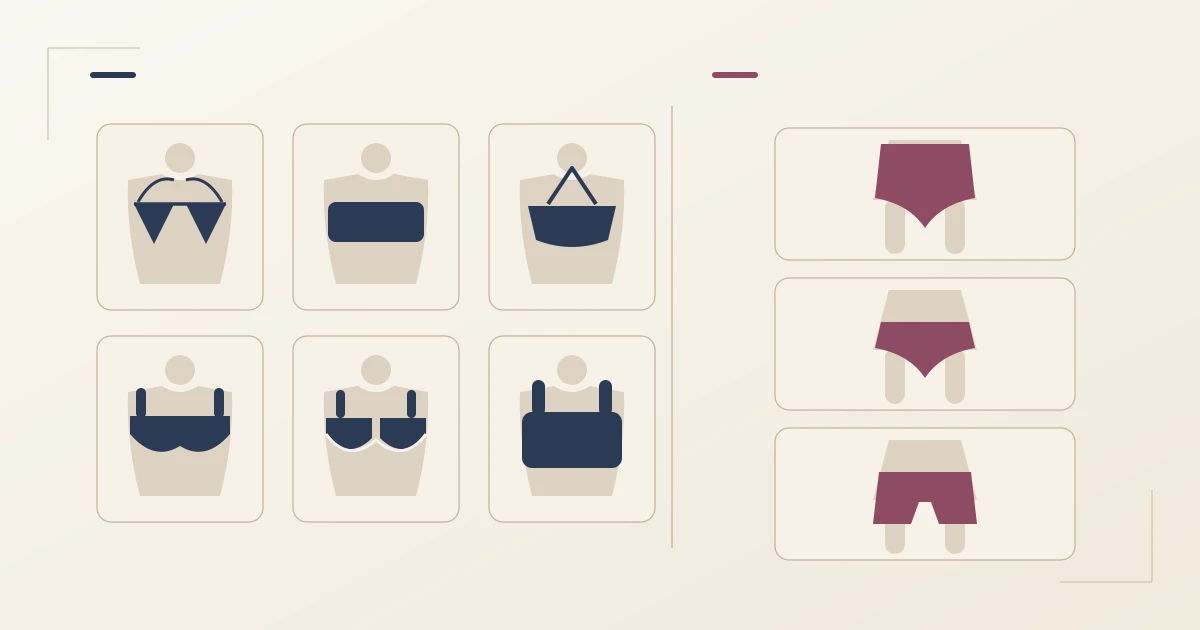
Before allocating anything, it helps to know what exists. The names are used inconsistently in retail; the table below describes what each shape actually does.
| Shape | What it does | Particularly suits |
|---|---|---|
| Triangle top | adjustable triangles, no fixed fit | small to medium bust |
| Bandeau | strapless band, emphasises the shoulder line | narrow shoulders, inverted triangle |
| Halterneck | neck strap, draws the eye vertically upwards | pear shape, fuller lower body |
| Balconette | horizontal upper edge, wide-set straps, supports | fuller bust, bottom-heavy bust shape |
| Underwired top | shapes and lifts, needs the right cup size | anyone who needs support |
| Bralette / sports | even pressure, no shaping | movement, athletic line |
| High-waisted bottoms | end at or above the waist, lengthen the leg | short torso, apple, rectangle |
| Hipster / shorts | sit on the hip, cover more leg | long torso, athletic figure |
| Tankini | long top plus bottoms, chosen separately | anyone who needs two sizes |
| Ruched swimsuit | side gathers break up the surface | apple, rectangle |
| Low-back swimsuit | shifts attention to the back | hourglass, straight back |
Two terms that are often confused: a tankini is two pieces with a long top, a monokini is a one-piece with cut-outs. The difference matters in practice — with a tankini you can take different sizes top and bottom, with a monokini you cannot.
Swimwear by body shape
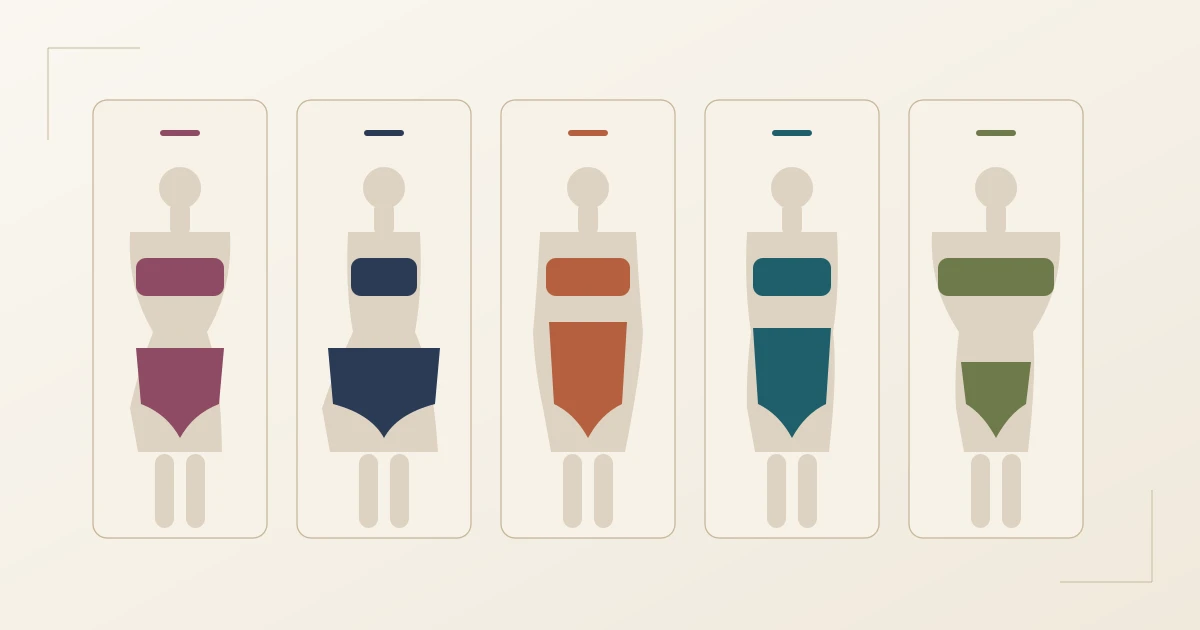
Which swimwear suits your figure depends first on how shoulders, waist and hips relate to one another. The five body shapes describe exactly that. If you do not know yours yet, what body shape do I have takes you there in four steps.
The principle is the same as with dresses and trousers: balance, not concealment. This is not about hiding something — hiding creates surface area, and surface area draws the eye. It is about balancing the proportion so the eye reads one continuous line.
Hourglass
Shoulders and hips roughly equal, waist clearly narrower. Almost everything works here — provided the waist stays visible. High-waisted bottoms with a narrow top show it; a straight swimsuit with no waist definition wastes it. Underwired and balconette tops give support without shifting the proportion. Take care with very wide hip bands: they place a horizontal line exactly where the narrowest point sits.
Pear
Hips wider than the shoulders. The aim is to gain width above rather than remove it below. That works through light or patterned tops with plain bottoms, through halternecks and wide straps, and through ruffles or gathers at the bust. For the bottoms, a higher-set leg opening carries — it lengthens the leg and visually narrows the hip line. Covering shorts styles often do the opposite, because they add another horizontal edge across the thigh.
Apple
The width sits in the middle of the body, with arms and legs often slim. So the right shapes are those that show legs and décolletage and do not constrict the middle. A swimsuit with side gathering breaks up the surface better than a smooth one. A deep V neckline pulls vertically. High-waisted bottoms work well here because they end at the narrowest point of the upper body rather than in the middle of the widest. What rarely works: a tight bandeau plus low-slung bottoms — that places two horizontal edges around the middle.
Rectangle
Shoulders, waist and hips roughly equal, little definition. Here it is about creating a waist where there is no pronounced one. Two pieces help by themselves, because the gap between them interrupts the middle. Add tops with volume — ruffles, gathers, pattern — and bottoms with a side band or tie. A swimsuit should have a colour or material change at the waist; a plain, smooth one-piece reinforces the straight line.
Inverted triangle
Shoulders wider than the hips, often with an athletic back. Here weight is needed below: patterned or lighter bottoms, ruffles, side ties, shorts styles. Above, plain dark tops keep the shoulder line quiet. Halternecks and wide neck straps emphasise the shoulders further and are therefore usually the wrong direction — bandeau and horizontal upper edges balance better.
One limitation belongs with every body-shape list: the shape describes outlines only, not bone structure, stature or proportions within the torso. Where it reaches its limits, and what comes after, is covered below under body line.
Bust shape beats cup size
This is where almost every swimwear guide stops — and it is what explains the most in practice. Two women with an identical cup size often need completely different tops, because busts differ not only in size but in how the volume is distributed.
Three questions are enough to place your own shape:
- Where does the volume sit? Higher towards the décolletage, evenly distributed, or lower?
- How far apart are they? Close together, or wide with a clear gap in the middle?
- How does the shape run towards the armpit? Compact and forward, or wider to the side?
From that follow the practical allocations:
- Volume lower, flatter above: balconette and underwired tops. They lift and fill the upper half, which otherwise looks empty. A triangle top tends to slip here and gives no support.
- Volume evenly distributed: almost everything works. All that matters is a firm underband.
- Wide-set: tops with a narrow centre gore and inward-set straps. A bandeau often looks gappy here.
- Close together: V necklines and triangle tops create air. A high, closed cut makes the area look solid.
- Running wide towards the armpit: tops with side reinforcement and a wider underband so nothing spills sideways.
The same principle applies on land: which neckline carries your bust and neck area is covered at length in which neckline suits me.
The bottoms decide more than the top
When buying a bikini, attention almost always goes upwards. Yet the bottom half changes perceived proportion far more, and it does so through one measure: the height of the leg opening.
The higher the opening sits on the hip, the longer the eye reads the leg — because the transition from torso to leg moves upwards. A low, horizontally cut short does the opposite: it moves the boundary down and cuts the thigh in two.
The second measure is the rise. It decides whether the torso looks long or short:
- Short torso (little distance from underbust to waist): lower-sitting bottoms, otherwise the middle gets compressed.
- Long torso: high waist. The high rise visually shortens the stretch and lengthens the leg at the same time — the only cut that does both at once.
This interplay is the same one that decides which trousers work; if you know it from there, it is explained in detail in which trousers suit my figure.
Swimwear meets your body line
Body shape describes the outline. It says nothing about how fine or strong your bone structure is, how large your scale reads, or whether soft or sharp edges suit you. That is what the body line in the Kibbe system describes — and with swimwear the difference is especially visible, because there is so little fabric to soften it.
Four practical directions:
- Soft line (Romantic, Soft Natural, Soft Classic): curves and soft edges. Ruffles, gathers, curved necklines, floral prints with blurred edges. Hard geometric cut-outs look applied here.
- Long line (Dramatic, Soft Dramatic): clean edges, little decoration. A plain swimsuit with a sharp neckline or a low back carries better here than any ruffled style. Small, playful details disappear at this scale.
- Compact line (Gamine, Soft Gamine, Flamboyant Gamine): small patterns, strong colour contrast, two pieces with a clear break in the middle. Large florals or wide ruffles quickly take over the picture.
- Angular line (Natural, Flamboyant Natural, Classic, Dramatic Classic): sporty cuts, wider straps, straight edges, materials with texture. Very fine spaghetti straps look lost on stronger shoulders.
If you do not know your line yet, the free online Kibbe analysis is the quickest way in; the system behind it is explained in the 13 Kibbe types explained.
Colour with no buffer: your season at the pool
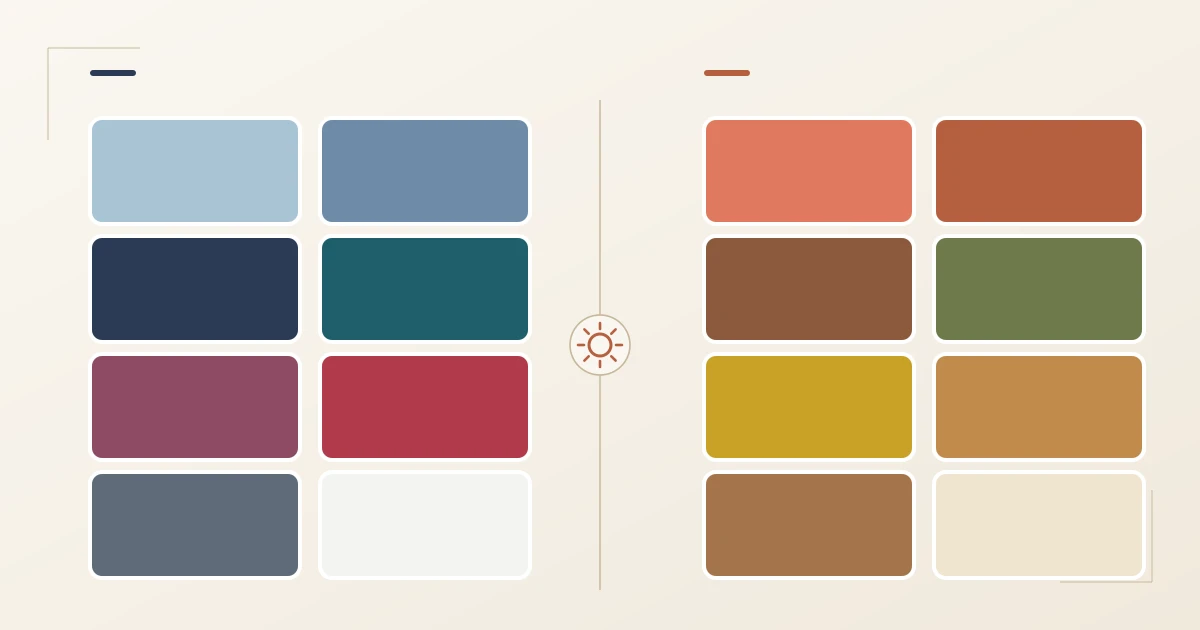
With no other garment does colour act so directly as with swimwear. With a blouse there is a collar in between, often a scarf, usually make-up. With swimwear the tone lies straight on the skin, across a large area, in hard light and with no buffer at all. That is why a colour that just about works on a jumper is often clearly wrong at the pool.
Worth noting: of the eleven results Google returns in Germany for this question, not one mentions colour with a single word. They all talk about cuts.
Cool seasons — summer and winter
Navy, petrol, berry, cool red, ice blue, slate and pure white. A winter type can take the clear, strong versions and is the only type who carries true black right at the face. For a summer type the same colours work better muted — soft navy rather than royal blue. Difficult for both: terracotta, mustard and warm cream. More in summer type colours and winter type colours.
Warm seasons — spring and autumn
Terracotta, olive, mustard, warm coral, bronze and cream white. An autumn type wears the deep, muted versions, a spring type the light and clear ones. The difficult ones here are ice blue, pure white and cool berry red. Covered in autumn type colours and spring type colours.
One misunderstanding belongs cleared up here: your colour type has nothing to do with how quickly you tan. That is described by the Fitzpatrick scale, a dermatological classification of UV response. Two people with the same Fitzpatrick type can belong to different colour types — and tanned skin does not shift the undertone, it only makes it darker. If you do not know your season yet, find your colour type takes you there, or go straight to the colour type test.
On prints: a large-scale print draws the eye to wherever it sits. That is a tool, not an accident — a patterned top with plain bottoms shifts weight upwards, the other way round shifts it down. Which pattern scale suits you is covered in which pattern suits my figure.
What tummy control really does — and does not
Few terms in swimwear are used so often and explained so rarely. What lies behind it is usually one of three things — and they achieve different outcomes.
- A higher elastane content. More recovery in the fabric, so more pressure. That smooths the surface but changes nothing about the circumference. As pressure increases, the volume simply moves to the edge of the fabric.
- A second layer in the front panel. The most effective of the three, because it calms the surface without constricting.
- Ruching. The actual optical device: folds break the light and dissolve a smooth surface. That is why a ruched style looks quieter than a smooth one in the same fabric.
What none of them does: change a figure. What all three can do: make the surface busier and therefore less noticeable. The same mechanics with different means are covered in looking slimmer through clothing.
A garment that is too tight never makes anyone look slimmer. It only makes it visible where it presses.
Size, fit and the fitting-room test
Swimwear sizes differently from outerwear, for a technical reason: it is engineered on stretch. At rest the garment is smaller than the body and is meant to tension. That is why your usual dress size regularly misleads.
Four checks in the cubicle that settle more than any size chart:
- The arm test. Stretch both arms over your head. If the top rides up, the underband is too loose — not the cup too small.
- The bend test. Lean forward. If everything stays in place, it fits. That answers the question of whether it holds when you get up from a sunbed.
- The two-finger test at the waistband. Two fingers must fit between band and skin. If only one does, it will press harder when wet.
- The sitting test. Sit down and look at the middle. What lies flat standing behaves differently seated — and you will be seated most of the day.
One more point that is rarely mentioned: wet swimwear stretches. A piece that fits snugly when dry usually fits correctly when wet. One that is already loose when dry becomes a problem in the water. How to get several seasons out of the fabric — rinse, do not wring, do not dry in the sun — is in washing and caring for clothes properly.
From the water to the bar
The part of the day when swimwear is worn most is the part when nobody is swimming. So the layer on top is worth a look.
- The beach dress follows the same rules as any dress — waist position and length relative to your leg line decide. Covered in which dress suits my figure.
- The open shirt is the least complicated solution: it places two vertical lines either side of the middle and therefore works on every body shape.
- The sarong is decided by where you knot it. Tied at the waist it creates a waist; tied on the hip it widens it.
- The hat is not just an accessory but the most effective shade you can carry. Which brim suits your face is covered in which hat suits me.
On sun protection, one note that belongs in a fashion text: swimwear is not protective clothing. The UV index of the German Federal Office for Radiation Protection is the internationally standardised measure of sunburn-effective radiation — the higher it stands, the faster unprotected skin burns. Textiles, shade and a midday break handle that, not the cut of a bikini.
The most common buying mistakes
- Going a size up because it is "more comfortable". Swimwear works through tension. Too large means slipping, wrinkling and getting looser still when wet.
- Buying by cup size instead of bust shape. Size tells you how much. Shape tells you where — and that is what decides the cut.
- Choosing the top first. The bottoms change the proportion more. Decide below first, then find the top to match.
- Checking only while standing. You will be seated most of the day. What cuts in when seated ruins the whole holiday.
- Combining two dominant pieces. A patterned top with patterned bottoms cancels itself out. One piece leads, the other carries.
- Choosing pure white without testing it wet. Light swimwear often turns sheer in water. That is a question of material, not of price.
- Concealing instead of balancing. More fabric over an area makes it larger, not smaller. The answer is almost always on the opposite side.
Frequently asked questions
Which swimwear suits my figure?
Three measures decide: your body shape, meaning how shoulders, waist and hips relate; the height of the leg opening, which sets leg length; and the rise, which makes the torso look long or short. As a direction: a pear gains width above, an inverted triangle gains width below, an apple shows legs and décolletage, a rectangle creates a waist, an hourglass keeps hers visible.
Bikini or swimsuit — which is better if you have a tummy?
Both work, and the common assumption that a swimsuit is automatically the answer is not correct. A tight, smooth one-piece pushes the middle together and makes it more visible. Better are either a swimsuit with side ruching or a high-waisted bikini whose band ends at the narrowest point of the upper body rather than in the middle of the widest.
Which bikini works with wide hips?
One that gains width above rather than removing it below: a light or patterned top with plain bottoms, a halterneck or wide straps, ideally with a ruffle or gathering at the bust. For the bottoms, a high-set leg opening carries, because it lengthens the leg. Covering shorts styles often work against you, because they add another horizontal edge across the thigh.
Which bikini suits which bust shape?
If the volume sits low and the upper half is flatter, balconette and underwired tops lift. If the breasts are wide-set, a narrow centre gore and inward-set straps help. If they sit close together, a V neckline and triangle top create air. If the volume runs wide towards the armpit, you need side reinforcement and a wider underband. Cup size alone does not answer the question.
Which swimsuit makes a flat stomach?
None — but several make the surface look calmer. Ruching is the most effective, because folds break the light and dissolve a smooth surface. A second layer of fabric in the front panel works similarly without constricting. A higher elastane content smooths the surface but changes nothing about the circumference: where pressure increases, the volume simply moves to the edge of the fabric.
What size should I order swimwear in?
Usually your normal size, not larger. Swimwear is engineered on stretch — at rest it is smaller than the body and is meant to tension. Wet, it stretches further. A piece that fits snugly when dry usually fits correctly in the water; one that is already loose when dry will slip. For tops: if it rides up when you raise your arms, the underband is too loose, not the cup too small.
Which bikini makes you look slimmer?
The one that balances the proportion, not the one that covers the most. More fabric over an area enlarges it visually, because it creates surface. What works instead are vertical lines, a high-set leg opening that lengthens the leg, and a weight balance between top and bottom through colour and pattern.
Which swimwear suits a small bust?
Triangle tops, bandeaus and padded tops with a ruffle or gathering — anything that gives the upper half volume. Patterns and lighter colours above with plain, darker bottoms help as well. Underwired tops with a firm cup are often too structured and stay hollow if they are not filled.
What colour should my swimwear be?
The one from your own colour family, because here the tone lies straight on the skin, across a large area and in hard light. Cool types reach for navy, petrol, berry and ice blue; warm types for terracotta, olive, mustard and warm coral. Tanned skin changes nothing about this: a tan makes the undertone darker, it does not shift it.
Which swimwear suits a long torso?
High-waisted bottoms. They are the only cut that does two things at once: they visually shorten the stretch between underbust and hip and lengthen the leg at the same time. With a short torso the opposite applies — there a high rise compresses the middle, and lower-sitting bottoms are correct.
How long does swimwear last?
That depends less on price than on handling. Chlorine, salt, sunscreen and UV radiation all attack the elastane, and it is exactly that recovery which holds the garment in shape. Rinse in clear water after every wear, do not wring, dry flat and in the shade — and alternate two pieces so the fabric can recover in between.
Do I need to know my Kibbe type before buying swimwear?
No. Body shape and bust shape carry the decision a long way. Your body line then explains why two pieces with an identical cut look different on two women with the same body shape — that is the fine tuning, not the entry point.