
TL;DR — Which winter jacket suits me?
- A winter jacket has to pass two tests: it has to keep you warm, and its line has to suit your figure. Most guides only explain one of them.
- Warmth comes from the filling, the fill power and the baffle construction. Down insulates best per gram, synthetic stays warm when wet.
- Fill power is measured in cuin: 600 to 650 is good, 800 to 950 is top of the range.
- The key figure rule: the hem must not end at your widest point. It belongs above it or well below it.
- More than 90 per cent of down is a by-product of slaughter. Live plucking is banned in the EU, but there is no labelling requirement, so a standard such as RDS is the practical guide.
Which winter jacket suits me? Four things decide it: filling and fill power for warmth, where the hem lands, the volume in relation to your bone structure, and the hood at your face zone. A jacket that keeps you warm but ends at your widest point is as much a mistake as one that fits well and lets you freeze.
There are two kinds of guides online. Outdoor shops explain fill power, baffles and water columns but say nothing about your figure. Fashion shops explain the figure and say nothing about warmth. This guide joins the two, because in winter you wear the same jacket every day for three months.
Contents
- The winter jacket types at a glance
- Understanding warmth: filling, fill power, baffles
- Water, wind and the water column
- The length rule: where the hem lands
- Volume and quilting by bone structure
- Winter jacket by body shape
- Winter jacket by body line
- Hood, collar and the face zone
- The jacket colour by colour season
- Down, live plucking and standards
- Washing and caring for a down jacket
- 6 steps to the right winter jacket
- FAQ — Frequently asked questions
- Next steps
The winter jacket types at a glance
A winter jacket is outerwear that insulates the body in the cold. The difference between the types lies in three things: how they insulate, how they cope with moisture and which silhouette they create.
| Jacket type | Insulation | Weather | Silhouette | Suits especially |
|---|---|---|---|---|
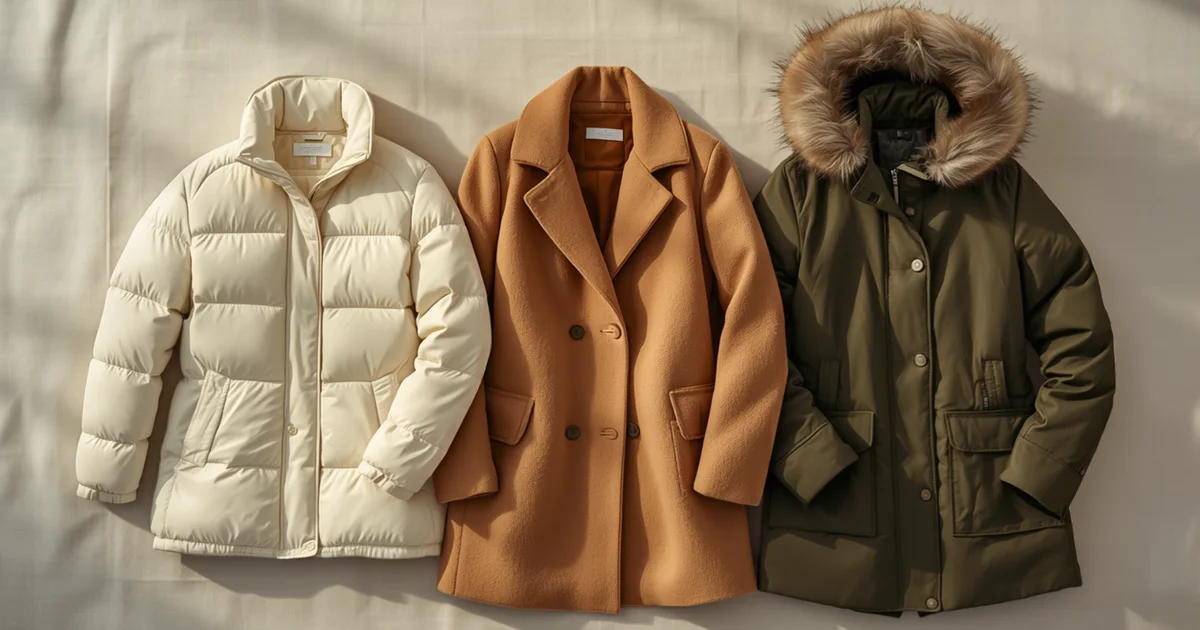
| Down jacket | very high per gram | dry to slightly damp | round, voluminous | hard frost, large scale |
| Synthetic puffer | medium to high | wet too | slim to round, depending on quilting | changeable weather, everyday |
| Parka | medium to high | rain and wind | straight, long | tall height, natural lines |
| Wool coat | medium, sensitive to wind | dry | clear, structured | office, classic and dramatic lines |
| Padded short coat | medium | dry to damp | slim, can be belted | petite height, transition season |
| Hybrid jacket | down at the front, synthetic at shoulder and sleeve | changeable | close-fitting | an active day, bike and train |
How jacket length, volume and cuffs affect the figure in general is covered in the guide Which jacket suits my figure?. This one is about the winter version, where warmth comes into it.
Understanding warmth: filling, fill power, baffles
Warmth in a jacket does not come from the fabric but from air. The filling holds pockets of air that store your body heat. The more air a filling traps at the same weight, the warmer the jacket.
Down or synthetic
Down is the fine under-plumage of geese and ducks. According to Wikipedia, its three-dimensional structure traps considerably more air than flat feathers, and a single down cluster weighs only about 0.002 grams on average. The price for that: wet down collapses and barely insulates. Synthetic fill insulates less per gram but stays warm when damp and dries faster. For cities with a lot of drizzle, synthetic is often the more sensible choice.
What fill power in cuin means
Fill power measures how much volume a given amount of down builds up. It is stated in cuin, cubic inches per ounce. According to the English Wikipedia entry on fill power, 300 to 500 counts as poor, 600 to 650 as good, 700 to 750 as very good and 800 to 950 as excellent. Higher fill power means the same warmth at less weight and less bulk. For everyday wear in central Europe, 600 to 700 cuin is plenty.
The baffle construction
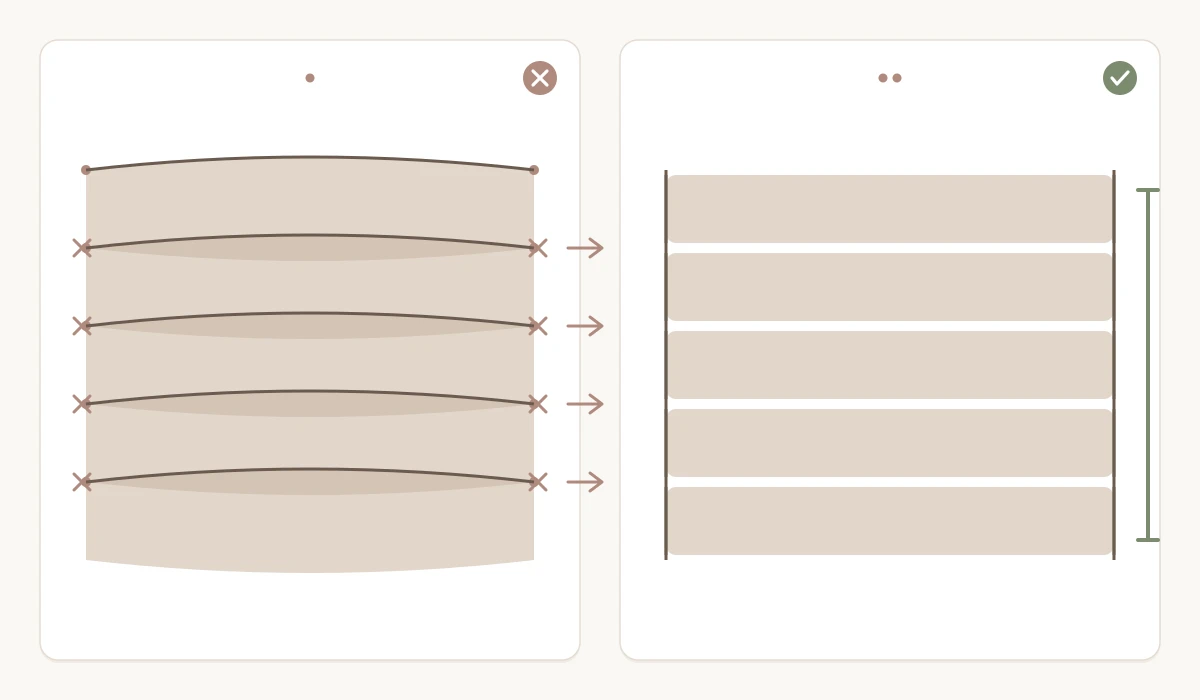
Baffle construction describes how the filling is held inside. In a sewn-through jacket, the outer and inner fabric are stitched directly together. There is no filling at each seam, so a cold bridge forms there. With box baffles, small fabric walls stand between the two layers and the loft stays even across the whole surface. That costs more but is noticeably warmer. For everyday wear a sewn-through jacket is usually enough; for real cold, baffles are worth it.
Warmth comes from air, not from fabric. Where the seam sits, there is no air.
Water, wind and the water column
The water column states how much water pressure a material withstands before it lets water through, measured in millimetres. From about 1,300 millimetres a fabric counts as waterproof in Europe; for constant rain, 10,000 millimetres and more is more comfortable. For the walk to the train, water-repellent is enough; for long walks in sleet it is not.
Wind matters just as much. A wool coat insulates beautifully but lets wind through unless there is a dense lining behind it. That is why a thin parka often feels warmer in a storm than a thick coat. If you are out a lot, look for adjustable cuffs, a high collar and a storm flap over the zip. How to layer underneath is shown in the guide Layering in the transition season.
The length rule: where the hem lands
The landing point is where the hem of your jacket ends. It draws a horizontal line and pulls the eye exactly there. That gives the key figure rule for every winter jacket: the hem must not end at your widest point.
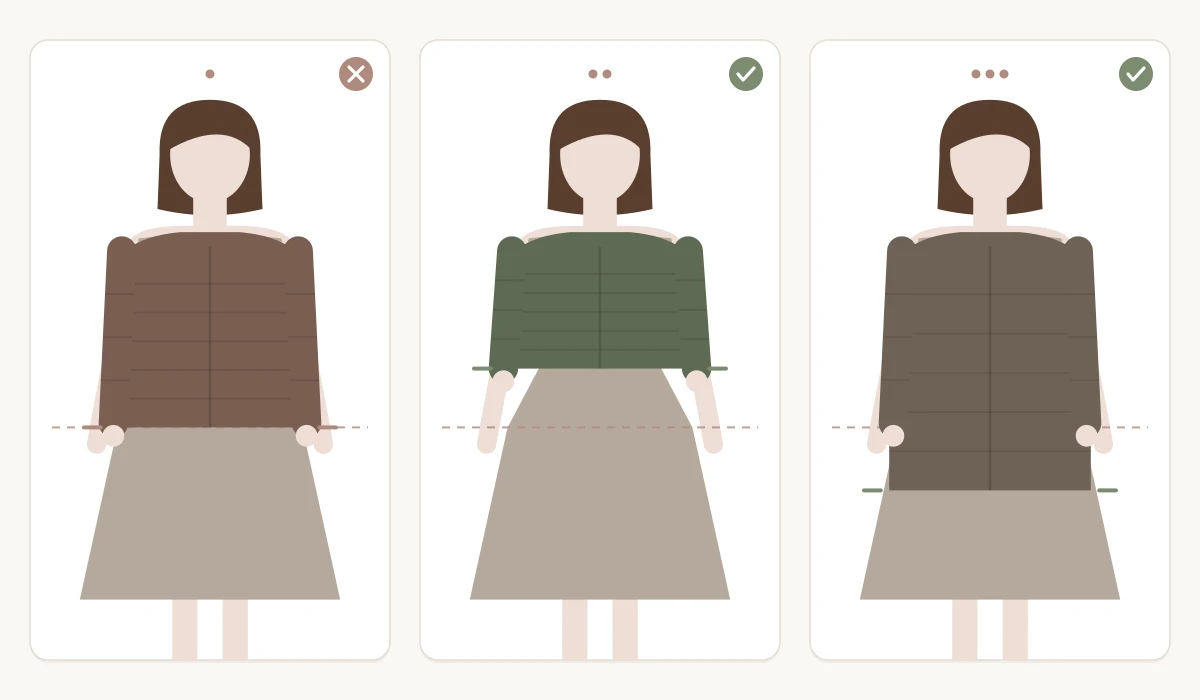
In practice: with wider hips the jacket ends either at the waist or below the seat at the thigh. With a fuller midsection, a jacket to mid-thigh looks calmer than one that stops right at the stomach. At petite height a floor-length jacket shortens the leg sharply, so a length just above the knee is the safer choice. More proportion rules are in the guides Styling for petite women and Fashion for tall women.
A second point is the cuff. A tight elastic hem gathers the volume exactly where it sits. At hip level it creates a ball, at the waist a silhouette. Open, straight hems spread the volume more calmly.
Volume and quilting by bone structure
Volume is unavoidable in a winter jacket, because air needs room. The only question is how much volume your figure carries without disappearing inside it. The yardstick is your bone structure, visible at wrists, shoulders and facial features.
A fine bone structure carries narrow, flat quilting and a slim fit. Large baffles and a thick puffer quickly make a petite woman look like she borrowed a sleeping bag. A strong bone structure carries large baffles and plenty of volume easily, while very fine quilting looks lost on it.
| Bone structure | Quilting | Fit | Better avoid |
|---|---|---|---|
| Fine and petite | narrow baffles, flat quilting | close to the body, short to knee-length | XXL puffers, huge hoods |
| Medium | medium baffles | can be belted | extreme volume in either direction |
| Strong | large baffles, pronounced quilting | straight, generous | very fine quilting, tight cuts |
The second question is height: where does most of the volume sit? Many down jackets are widest at the top, because chest and shoulder get more filling. That helps with narrow shoulders and wider hips, but adds to already broad shoulders.
Winter jacket by body shape
Body shape describes the ratio of shoulders, waist and hips. It decides which length and which volume balance rather than reinforce. How to determine your shape is explained in the guide What body shape do I have?.
| Body shape | Good length | Good model | Better avoid |
|---|---|---|---|
| Hourglass (X) | waist or thigh | belted puffer, waist tie | straight boxy cut with no centre |
| Pear (A) | waist or below the seat | volume on top, calm hips | hem and cuff at hip level |
| Apple (O) | mid-thigh | straight parka, open zip | tight elastic hems at the stomach |
| Rectangle (H) | waist or knee-length | puffer with belt or drawcord | voluminous jackets with no waist |
| V shape | thigh | slim shoulder, volume below | thick shoulder pads, large fur collars |
Which winter jacket suits me if I am a mixed shape? Then what counts is the point you want to show: if the hem ends above your narrowest point, the waist wins; if it ends below, leg length wins. A belt is the fastest lever on many winter jackets, because it turns straight volume into a silhouette. Which width and height suits your torso is in the guide Which belt suits me?.
Winter jacket by body line
Body line describes the character of your figure: straight or curved, clear or soft, large or fine in scale. It determines which material and which details look coherent. The classification follows the Kibbe system, explained in the guide Understanding the Kibbe body type system.
| Body line | Character | Matching winter jacket |
|---|---|---|
| Dramatic | long, clear, geometric | long straight coat, smooth surfaces, clean edges |
| Natural | broad, organic, relaxed | parka, wool jacket, matte fabrics, large pockets |
| Classic | symmetrical, calm | classic wool coat, medium length, plain buttons |
| Gamine | small, graphic, high contrast | short puffer, fine baffles, clear colour contrasts |
| Romantic | soft, round, detailed | padded short coat, soft collars, waist tie |
You choose the coat for more formal occasions the same way, which the guide Which coat suits me? covers. Which jacket shapes are even on offer this season is shown in the guide Autumn/winter 2026/27 fashion trends.
Hood, collar and the face zone
The face zone is the area between shoulder and crown. Hood, collar and fur trim sit exactly there and change how long your neck and how large your head appear.
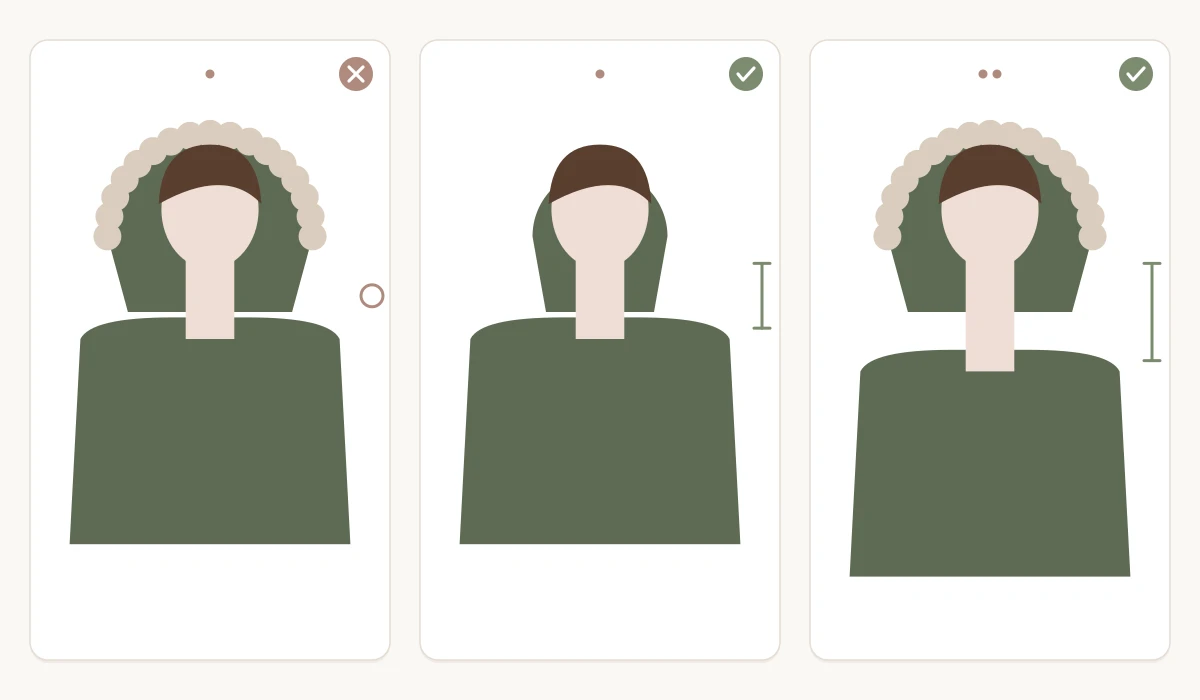
The rule of thumb is: the shorter the neck, the flatter the collar. With a short neck, a large fur hood swallows the entire space between chin and shoulder. Flat stand collars, narrow hoods and removable fur trim keep that space open. With a long neck the opposite is true: there a large hood fills the space pleasantly.
Head size counts too. A very large hood on a fine head looks like a helmet, a skimpy hood on a strong head like a swimming cap. If you also wear a hat and scarf, decide on one lead element, as the guides Which hat suits me? and How to tie a scarf describe.
The jacket colour by colour season
The winter jacket is the garment that frames your face for longest, often from November to March. So the colour question matters more here than for any other piece. The basic rule: the shade should suit your undertone, not just your trousers.
- Spring: warm camel, light cognac, warm navy, cream.
- Summer: taupe, muted grey-blue, cool grey, soft berry.
- Autumn: chocolate brown, olive, rust, warm khaki.
- Winter: pure black, clear navy, pine green, burgundy.
If the jacket is dark anyway, a scarf in your colour right at the face helps. Find your type in the guide What colour season am I?.
Down, live plucking and standards
Down is an animal product, and its origin is the real question for many customers. According to Wikipedia, more than 90 per cent of the world's down and feathers come from slaughter plucking, so they are a by-product of meat production. The market share of down from live plucking is around 3 per cent.
The consumer portal of the German state of Hesse, Verbraucherfenster Hessen, sets out the legal position: live plucking is banned by law in the EU, yet a lot of down is imported, often from China, where that ban does not apply. There is no labelling requirement for origin in textiles. That leaves a standard as the only orientation, most commonly the Responsible Down Standard, or RDS. It certifies supply chains that use down from slaughtered birds only and exclude force-feeding and live plucking.
If you would rather avoid the question, take a synthetic jacket. It usually costs less, stays warm when wet and is easier to wash. The drawback is the higher weight for the same warmth.
Washing and caring for a down jacket
A down jacket loses warmth when the filling clumps or collapses. Care is therefore not optional but part of its insulation. Here is how to do it:
- Wash rarely: air the jacket after wearing and treat stains individually. One or two washes per season are enough.
- Prepare it: close all zips, remove fur trim, turn the jacket inside out.
- Choose the detergent: a down detergent rather than a standard one, and no fabric softener. Softener coats the barbs and takes away their loft.
- Wash gently: delicate cycle at 30 degrees, low spin, then an extra rinse.
- Dry properly: in the dryer on low heat with two or three dryer balls, interrupting several times to break up the filling. Without a dryer it takes days and the down can clump.
- Store it loosely: in summer hanging or lying loosely, never compressed in a stuff sack for months.
Synthetic jackets are less demanding but also dislike fabric softener. The general rules are in the guide How to wash and care for clothes.
A winter jacket you wear for three winters is cheaper than three that last one season each.
6 steps to the right winter jacket
Which winter jacket suits me when I am standing in front of the rail? Go through this order:
- Clarify the use: city and train, standing outside for long, or hiking? That sets how much warmth and weather protection you need.
- Choose the filling: down for dry cold and low weight, synthetic for damp and everyday wear.
- Check the length: stand in front of the mirror and see where the hem lands. Not at your widest point.
- Match the volume: does the quilting suit your bone structure, or is the jacket wearing you?
- Check the face zone: hood up, collar closed. Is your neck still visible, or has it disappeared?
- Test movement: arms forward, zip closed, backpack or bag added. The jacket has to fit over a jumper, not just over a T-shirt.
That last point is the one most often forgotten. Always try a winter jacket on over the thickest jumper you plan to wear underneath. Which knitwear fits under a jacket is shown in the guide Which jumper suits my figure?.
FAQ — Frequently asked questions
Which winter jacket suits me?
Four things decide it: the filling for warmth, where the hem lands, the volume relative to your bone structure and the hood at your face zone. The hem should never end at your widest point. The filling depends on whether your winters are dry cold or wet cold.
Is down or synthetic better?
Down insulates better per gram and packs down smaller, but loses almost all of its warmth when wet. Synthetic insulates even when damp and dries faster, though it weighs more for the same warmth. For central European cities with a lot of drizzle, synthetic is usually more practical.
How much fill power should a winter jacket have?
For everyday wear, 600 to 700 cuin is enough. Values of 600 to 650 count as good, 700 to 750 as very good and 800 to 950 as excellent. Higher fill power means the same warmth at less weight, but costs considerably more.
Which winter jacket is not bulky?
One with fine quilting, a clear shoulder line and a hem that does not end at your widest point. A belt or drawcord at the waist adds shape. Dark, matte fabrics look calmer than shiny ones, because shine emphasises volume.
Which jacket length suits petite women?
Usually a length just above the knee or shorter, because a floor-length jacket visually shortens the leg a lot. Narrow quilting matters too, so the jacket does not look wider than you are. A higher rise on the trousers underneath lengthens the leg further.
What does water column mean on a jacket?
The water column states in millimetres how much water pressure a material withstands before moisture gets through. From about 1,300 millimetres a fabric counts as waterproof; for constant rain, 10,000 millimetres and more is comfortable. For short distances a water-repellent finish is often enough.
How do I wash a down jacket properly?
With down detergent on a delicate cycle at 30 degrees, without fabric softener and with an extra rinse. Then dry on low heat with two or three dryer balls, breaking up the filling in between. That is how the down gets its loft back.
Is down possible without animal suffering?
More than 90 per cent of down is a by-product of slaughter, and the share from live plucking is around 3 per cent. Live plucking is banned in the EU, but much down is imported. Since there is no labelling requirement, a standard such as the Responsible Down Standard is the best available orientation.
Is an expensive winter jacket worth it?
If you wear it daily, yes. Higher fill power, box baffles and robust outer fabrics keep you warm longer and last longer overall. For a jacket you only need on a few days, a simpler model makes more sense.
Next steps
Take three checks to your next jacket purchase: is the warmth enough for your everyday life, does the hem end beside your widest point, and is your neck still visible? That way you find a winter jacket that lasts three winters and still looks like you.
Which colour your jacket should be is explained step by step in the guide What colour season am I?. A personal colour and style consultation clarifies it together with your body line. And if you are torn between two jackets, send me a photo on WhatsApp. I reply personally, usually the same day.