
TL;DR — Which dress suits my body?
- The dress shape is not what decides first. Three factors do: the waist placement, the length relative to your leg line and the way the fabric falls.
- The waist placement is the most overlooked point. Clothing sizes describe circumferences, not torso lengths — which is why a dress in the right size still sits wrong if its waist seam does not land on your waist.
- The length is not measured in centimetres. The hem must not end at the widest point of your calf, or the leg reads shorter — no matter whether the label says midi or knee-length.
- Six base shapes are enough: A-line, sheath, wrap, empire, straight shift and fit-and-flare. Which one carries you depends on your body line, not on a letter-based figure type.
- "The A-line suits everyone" is the most common half-truth in dress guides. It is forgiving, but it needs a waist seam in the right place.
Which dress suits my body? The dress that suits you is the one whose waist seam sits on your own waist, whose hem does not end at the widest point of your calf, and whose fabric matches your body line. The dress shape is the last step, not the first. Anyone searching only by cut names skips exactly the three factors that decide the fit.
Contents
- Why "the A-line suits everyone" is misleading
- The six dress shapes at a glance
- Waist placement: the factor almost nobody checks
- Dress length by leg line, not by centimetres
- Dress shape meets body line
- The fabric has a vote
- Step by step to the right dress
- The same dress in your colour world
- Dresses by occasion: wedding, office, everyday
- The most common mistakes when buying a dress
- When nothing fits: what alterations can solve
- FAQ — Frequently asked questions
Why "the A-line suits everyone" is misleading
Anyone looking for the right dress lands on the same sentence in almost every guide: the A-line flatters everybody. It sounds helpful, and it is precisely the point at which the advice stops instead of starting. If one shape supposedly suits everyone, the reader has decided nothing — they have only been given permission.
What is true: the A-line is forgiving, because it widens above the hip and outlines nothing below it. What is false is the conclusion that it therefore fits automatically. An A-line always has a waist seam, and that seam is unforgiving: sitting above your real waist, it compresses the torso. Sitting below it, the whole silhouette reads heavy.
The second error is sorting by letters. A-type, X-type, H-type, V-type, O-type — that system describes circumference ratios and leaves out what actually carries a dress: bone structure, torso length and leg line. Two women with identical measurements can wear the same size and still need completely different dresses.
A dress in the right size can still sit wrong. Sizes describe circumferences — not where your waist sits and how long your torso is. That is where most mistaken purchases come from.
As the clothing size system shows, sizes rest on a few circumference measurements and one assumed standard length. Everything that deviates from that assumption — a short torso, long legs, a high waist — is not captured. That is why this guide does not start with cut names but with the three factors that actually steer the fit.
The six dress shapes at a glance
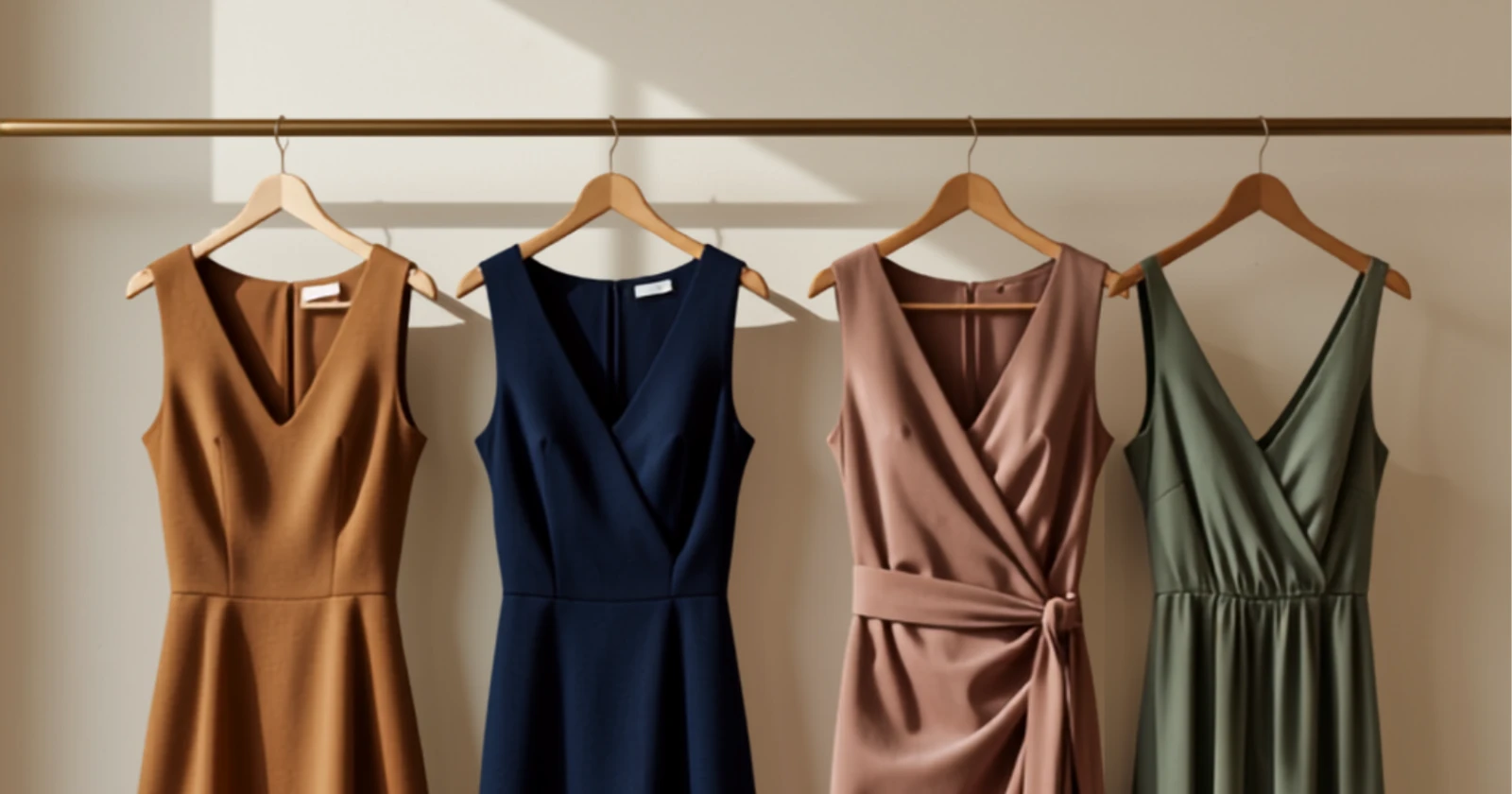
A dress shape is defined by three things: where the waist sits, how tight it is and how wide the hem falls. Everything else is a variation. Six base shapes cover practically every wardrobe.
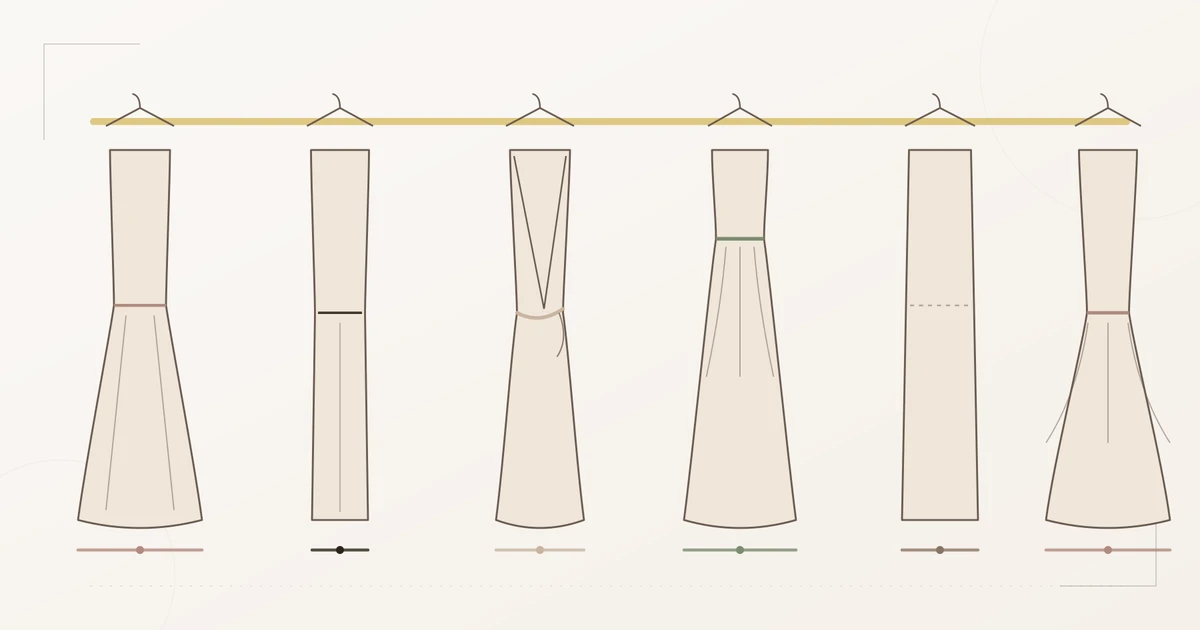
| Dress shape | Waist | Effect | Carries especially well |
|---|---|---|---|
| A-line | at waist height, moderately fitted | Emphasises the top, balances the hip | Balanced lines, wider hips |
| Sheath | at waist height, narrow | Continuous, clean column line | Sharp, long lines; formal occasions |
| Wrap dress | adjustable by you | Marks the waist exactly where it really is | Almost every line — the most forgiving shape |
| Empire | under the bust | Lengthens optically, draws attention from the middle | Long torso, softening the stomach area |
| Straight shift | no waist emphasis | Quiet, understated, without contour | Straight, strong lines; casual occasions |
| Fit-and-flare | at waist height, tight | Strongest waist contrast | Soft, curvy lines; defined waist |
The wrap dress is a special case, and the reason it has not gone out of fashion for decades: it does not fix its waist but leaves the decision to you. Anyone torn between two shapes is almost never wrong with it.
Waist placement: the factor almost nobody checks
Waist placement is the height at which a dress forms its waist. It is the single most important factor for the fit — and the only one no label states.
The test takes ten seconds: put your hands on your sides and bend sideways. The fold that appears is your real waist. Hold the dress in front of you and check whether its waist seam sits at the same height.
- Seam sits too high: the torso reads compressed, the skirt starts too early, the proportion tips. Typical with a long torso.
- Seam sits too low: the waist disappears, the silhouette reads heavy and wide through the middle. Typical with a short torso.
- Seam sits right: the dress follows your contour without you having to adjust anything.
From this single check follows a surprisingly clear rule: with a short torso, empire lines and lower-set waists work; with a long torso, higher-set waists and belts above the natural line are the better choice. If you wonder how that interacts with overall proportion, the guide on styling for petite women covers the vertical-line principle in detail.
Dress length by leg line, not by centimetres
Dress lengths are sold as labels: mini, knee-length, midi, maxi. Those labels say nothing about where the hem ends on your leg. And that is what matters.
The rule is simple: a hem ends at a narrow point, never at the widest one. The leg has three narrow zones — above the knee, just below the knee, and below the calf towards the ankle. Between them lies the widest point of the calf, and there any hem reads like a crossbar.
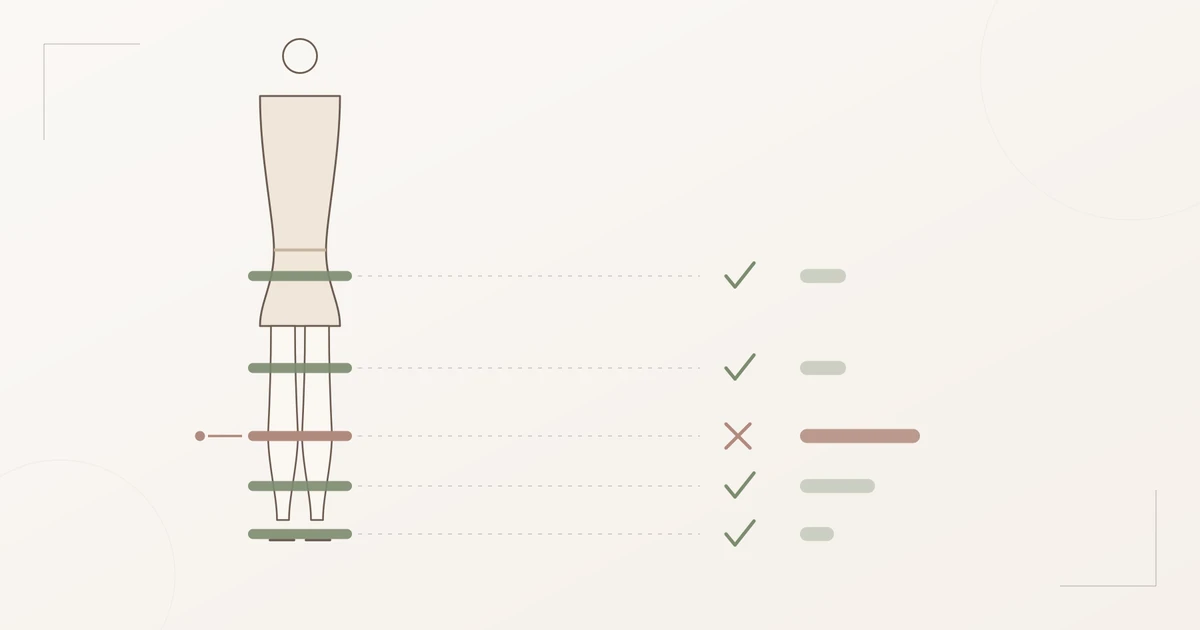
From that follows something no centimetre table contains: the same midi length can lengthen the legs on one woman and compress them on another. Not because one of them is "too short", but because the widest point of the calf sits at a different height on different leg lines.
In practice: do not measure, look. Stand in front of the mirror and walk the hem down your leg. There are two or three heights at which the leg visibly reads narrower — those are your lengths. If a dress misses them only slightly, alterations solve it for very little money.
Dress shape meets body line
Only now does the shape come in. The dress shape is not the answer to "which figure type am I" but to "which structure does my build carry". The Kibbe system describes exactly that structure — through bone and line rather than circumference.
| Body line | Suitable dress shapes | Why |
|---|---|---|
| Sharp and long (Dramatic) | Sheath, straight column cuts, clean edges | The line carries uninterrupted length; wide skirts break it |
| Strong and relaxed (Natural) | Shift, unstructured shirt dresses, linen | Constructed waists read constricting here; texture carries |
| Balanced (Classic) | A-line, waisted classics, sheath in a softer version | Symmetry and a moderate waist match the structure |
| Compact and high-contrast (Gamine) | Shorter lengths, fit-and-flare on a small scale | Small-scale detail and clean breaks instead of long surfaces |
| Soft and curvy (Romantic) | Wrap dress, fit-and-flare, fluid empire lines | The waist is there and may be marked — softly, not stiffly |
Two things stand out. First, every line has a shape that works almost by itself. Second, that does not rule out the other shapes — they simply need a different execution, usually through fabric. That is exactly what the next section is about. If you do not know your line yet, the Kibbe test gives you a first orientation.
The fabric has a vote
The same cut in two materials reads like two different dresses. That is the lever with which almost any shape can be adapted to almost any line — and the reason online orders so often disappoint: the photo shows the cut, not the fall.
- Fluid (viscose, crêpe, silk, jersey): follows the silhouette, settles against the body, moves with you. Suits soft and curvy lines and softens strict cuts.
- Structured (cotton blends, twill, scuba, wool mixes): holds its own shape regardless of the body underneath. Suits clean, sharp lines and turns an A-line into architecture.
- Textured (linen, chunky knit, suede finishes): brings movement to the surface. Suits strong, relaxed lines and quickly reads too heavy on very fine structures.
Stiff fabric stands away from the body and adds bulk; fluid fabric settles against it. Anyone wanting to soften the stomach should therefore not reach for the stiff A-line dress but for the soft-falling one — same shape, opposite effect.
The drape test in the fitting room
There is a test that reveals more in five seconds than any material label: take the hem in your hand, lift it about twenty centimetres and let go. If the fabric falls back immediately and calmly into its original shape, it is fluid. If a wave stays standing or it takes several seconds, it is structured.
The second half of the test is just as quick: squeeze the fabric in your fist and open your hand again. Whatever creases instantly will do the same after twenty minutes in the car — for a dress worn through a long occasion, that is a disqualifier, however well it fits.
Together these two explain an effect many know from online shopping: two dresses with identical cut descriptions arrive, and one reads expensive while the other reads cheap. The difference is almost never the cut but the fall and the weight of the material.
Step by step to the right dress
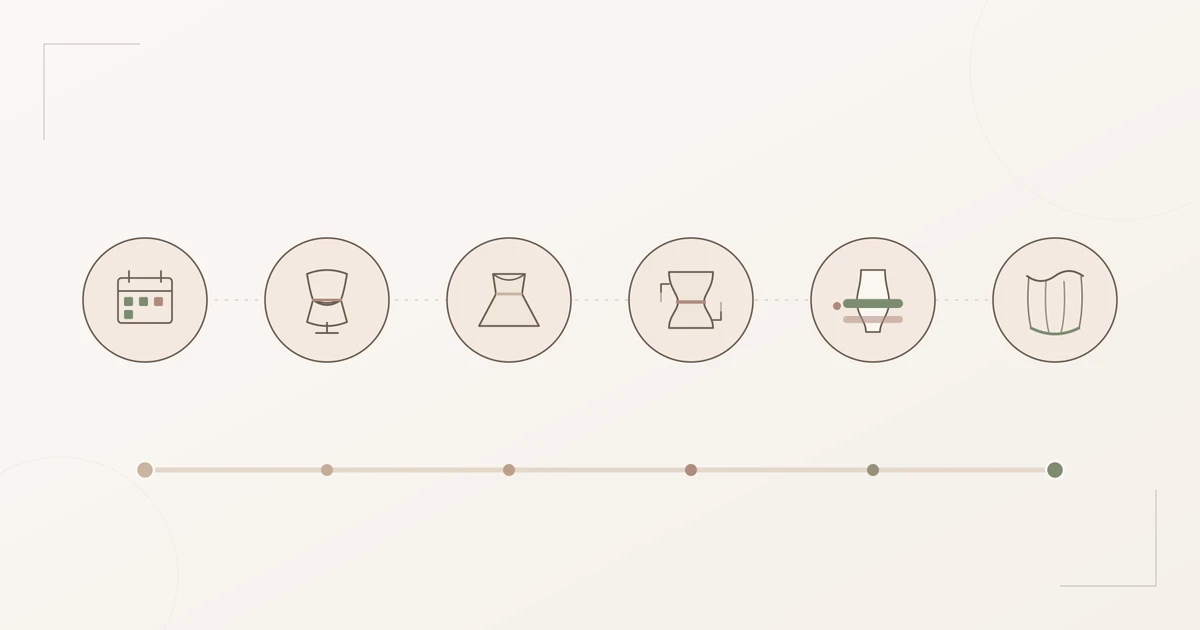
- Set the occasion and formality. A dress for a wedding, for the office and for a Saturday are three different tasks. The dress code scale sorts that out in a minute.
- Determine your body line. Not the circumference type but the structure: rather sharp, strong, balanced, compact or soft.
- Preselect a dress shape. Two shapes from the table above are enough. More makes the fitting room confusing.
- Check the waist placement. Side bend, find the fold, compare the seam. If it does not match, neither size nor colour will help.
- Check the length on your leg. Walk the hem down the leg and find the narrow zones. Do not measure — look.
- Judge how the fabric falls. Take the fabric in your hand and let go. Does it fall or stand away? That decides whether the chosen shape works on your line.
Anyone who runs these six steps once for two or three occasions needs surprisingly few dresses afterwards. How to build a working core wardrobe from that is covered in the guide to the capsule wardrobe.
The same dress in your colour world
Cut and colour are two separate decisions. The cut determines the silhouette; the colour determines whether your face above it reads fresh or tired. A perfectly fitting dress in the wrong shade still stays in the wardrobe.
An example from consulting practice: navy is considered the safe bet for occasion dresses. On a cool summer type that is true. On a warm autumn type the same navy reads hard and washed out — there a deep teal or a warm dark brown produces exactly the same serious effect, only in her own temperature.
- A single colour lengthens most strongly, especially when shoes and hosiery pick up the same tone.
- Pattern draws the eye to wherever it is largest — put it where you want emphasis, not where you want balance.
- Contrasting belts divide the silhouette. That helps with a long torso and hurts with a short one.
Which shades are yours is settled by the guide Which colour type am I?. How colour and cut work together is explained in combining colour type and Kibbe type.
Dresses by occasion: wedding, office, everyday
The dress shape stays; material and formality change. The same wrap dress is a wedding-guest outfit in crêpe with heels, an office dress in jersey with loafers, and a Saturday dress in cotton with trainers.
Wedding
Knee- or calf-length, refined fabric, no white and nothing heavily white-dominated. If the invitation gives no more precise instruction, a knee-length dress in a muted colour is almost always right. The details are in the guide to the wedding guest outfit.
Office
Sheath and A-line in structured material, knee-length, closed shoes. What matters is the armhole width: an armhole that is too tight makes any office dress restless as soon as you sit at a desk.
Everyday
Shift and wrap in washable jersey or cotton. Here freedom of movement counts more than silhouette — a dress that rides up when you sit down will not be worn, however well it suits you.
The most common mistakes when buying a dress
Mistake 1: buying by size instead of by waist placement
The size is right and the dress still does not sit — that is almost always the waist placement. It appears on no label and is therefore overlooked.
Mistake 2: thinking of length in centimetres
"Midi" says nothing about your leg. Two dresses with identical centimetre lengths end at completely different points on different women.
Mistake 3: covering up with volume
More fabric does not conceal, it adds bulk. What conceals is fabric that falls and a seam that sits in the right place.
Mistake 4: ignoring the armhole
With fuller upper arms it is not sleeve length that decides but armhole width. A tight armhole cuts in and emphasises exactly what it is meant to cover.
Mistake 5: buying online by photo instead of by material
The photo shows the cut, not the fall. The material listed in the product description says more about the final effect than any model shot.
Mistake 6: looking for the one shape
No dress covers every occasion. Two well-fitting dresses at different formality levels beat five that almost fit. How to avoid mistaken purchases in general is covered in the guide avoiding mistaken purchases.
When nothing fits: what alterations can solve
With dresses, alterations pay off more than with any other garment, because a single change shifts the entire proportion. Not everything is correctable, however.
- Easy to solve: shortening the hem (changes the leg proportion immediately), taking in side seams, shortening straps (which lifts the waist placement with them), narrowing sleeves.
- Possible but involved: moving the waist seam, resetting darts — worth it only with good material.
- Not solvable: an armhole that is too tight on a narrowly cut yoke, or a waist set clearly too high. That dress belongs back on the rail.
As a rule of thumb: if shoulder and waist placement fit, the rest can be adjusted. If either of the two does not fit, it is the wrong dress.
A look at the costume collections of museums such as the Victoria and Albert Museum shows the same principle across centuries: what is sold today by size used to be built on the wearer. Alterations bring part of that back.
The same two measures — waist position and length relative to your leg line — also decide the beach dress and what goes underneath it. Covered in which swimwear suits my figure.
FAQ — Frequently asked questions
Which dress suits my body?
The dress that suits you is the one whose waist placement sits on your own waist, whose hem does not end at the widest point of your calf, and whose fabric matches your body line. The dress shape itself is the last step, not the first. Searching only by cut names such as A-line or sheath skips the three factors that actually decide the fit.
Does the A-line really suit every body?
No, that is the most common simplification in dress guides. The A-line is forgiving because it widens above the hip, but it needs a waist seam that sits on your waist. With a short torso that seam rides too high and compresses; on a very soft body line the stiff A-line skirt quickly reads like a costume.
Which dress shapes exist?
For practical purposes six base shapes are enough: A-line, sheath, wrap, empire, straight shift and fit-and-flare. Every other name is a variation of these. They differ in three measurable points: where the waist sits, how tight it is and how wide the hem falls.
Which dress length suits me?
The right length does not come from centimetres but from your leg line. The hem should end at a narrow point — above the knee, just below the knee, or below the calf. If it ends exactly at the widest point of your calf, the leg reads shorter and heavier, however well the dress fits otherwise.
What is waist placement and why does it matter so much?
Waist placement is the height at which a dress forms its waist. Sitting above your real waist, it compresses the torso; sitting below it, the silhouette reads heavy. Because clothing sizes only describe circumferences and not torso lengths, a wrong waist placement is the most common reason a dress in the right size still does not fit.
Which dress works with fuller upper arms?
What matters is not coverage but armhole width. An armhole that is too tight cuts in and emphasises exactly what it is meant to hide. A slightly dropped sleeve or a more generously cut armhole in fluid fabric reads slimmer than a tight short sleeve — and considerably better than a bolero on top.
Which dress softens the stomach?
A dress with a raised waist and soft-falling fabric from that seam down, meaning the empire line in a moderate form. What matters is that the fabric falls rather than stands away: firm cotton poplin stands away and adds bulk, while viscose or crêpe follows the silhouette. Tight bands exactly at stomach height are unfavourable.
Which dress shape suits my Kibbe type?
Sharp, long lines carry straight sheath and column cuts with clean edges. Strong, relaxed lines need unstructured shapes with texture. Balanced lines suit waisted classics, compact lines shorter lengths with small-scale detail, and soft, curvy lines carry wrap and fit-and-flare cuts with a fluid fall.
Fluid or firm fabric — which is better?
That depends on your body line, not on the dress shape. Fluid fabrics such as viscose, crêpe and silk follow the silhouette and suit soft lines. Structured fabrics such as cotton blends, twill and scuba hold a constructed shape and suit clean, sharp lines. The same cut reads completely differently in the two.
Are alterations worth it for dresses?
With dresses they pay off more than with any other garment. A shortened hem changes the entire leg proportion, tightened straps lift the waist placement, and taken-in side seams turn a passable dress into a fitting one. A waist seam set too high, by contrast, can barely be corrected — that dress belongs back on the rail.
From the cut to a dress that fits
Find the cuts your line carries
This guide gives you the tool for the right dress. A professional Kibbe and colour analysis gives you your personal result: which cuts, lengths and shades your structure actually carries, in an individual dossier. A free initial consultation is always included.