TL;DR — How to tie a scarf: which knot suits me?
- Every way to tie a scarf places volume at a specific height: at the neck, at the collarbone or as a long line down your upper body.
- A long neck and narrow shoulders can carry volume up high (loop, double wrap). A short neck and a full bust need open, long ends.
- Length works differently depending on your height: a 200 cm scarf worn open ends at roughly knee height on a woman of 1.60 m, and about a hand's width above the knee at 1.78 m.
- Scarf size follows your bone structure, not just your height. A chunky blanket scarf overwhelms a fine frame.
- The scarf sits right next to your face. Choose its colour by your colour season, not to match your coat.
You tie a scarf well when the knot puts volume where your figure can carry it: high at the neck if you have a long neck and narrow shoulders, loosely at the collarbone if your figure is balanced, open and long if you have a short neck or a full bust. Choose the length by your height and the colour by your colour season.
Most guides on how to tie a scarf come from fashion retailers. They show seven, ten or fifteen knots, each with a photo. What they do not explain: why the same knot looks elegant on your friend and swallows your neck. That is what this guide is about. You get the most useful ways to tie a scarf with instructions, and a clear match by figure, neck, height, body line and colour season.
Contents
- The basic rule: a knot is volume
- The 7 most useful ways to tie a scarf
- Parisian knot: instructions in 4 steps
- How to tie a scarf for your figure
- Short neck, long neck, full bust
- Scarf length by height and bone structure
- Scarves by body line
- Scarf colour by colour season
- Fabric: wool, cashmere, silk
- Patterns, checks and fringe
- The most common mistakes when tying a scarf
- FAQ — Frequently asked questions
- Next steps
The basic rule: a knot is volume
A scarf is a textile worn around the neck and shoulders, usually rectangular. That is how Wikipedia defines it, and its history is just as telling: the word "shawl" goes back to Persian, and the prized shawls of Kashmir reached Europe as luxury goods. In the 19th century women wore large shawls draped over the shoulders; once the coat took over in the 20th century, scarves became smaller. Today the word mostly means a long, narrow piece of fabric for the neck.
When you decide how to tie your scarf, one simple observation matters: fabric has volume. Every way of tying gathers that volume in one place on your body. That is where you look wider, and that is where people look first. There are three heights:
- At the neck: loop, double wrap, tight knot. The volume frames your chin and neck and visually widens the shoulder line.
- At the collarbone: Parisian knot, loose simple knot. A compact point below the neck with two ends underneath.
- As a vertical line: scarf draped open, waterfall. Hardly any volume at the neck, instead two vertical panels down the upper body.
A scarf is volume you place at a specific height on your body. The way you tie it decides which height that is.
This leads to the rule that runs through this whole guide: put volume where you want width or attention. Take it away where there is already enough. It is the same logic as with necklines, which the guide Which neckline suits me? explains in detail: vertical lines lengthen, horizontal lines widen.
The 7 most useful ways to tie a scarf
If you want to tie a scarf for everyday life, these seven methods cover almost everything. They are sorted by the height where the volume sits, from the slimmest line to the most volume at the neck.
1. Draped open
Place the scarf centrally at the back of your neck and let both ends fall forward at the same length. This is the easiest way to wear a scarf and the slimmest: almost nothing sits at the neck, and two vertical lines run down your upper body. Under an open coat it looks especially calm.
2. Wrapped once
Place the scarf at the back of your neck, take one end once around your neck and let both ends hang at the front. Volume at the neck stays moderate and the ends get shorter. This version already keeps you noticeably warm and suits almost every figure, as long as the scarf is not too thick.
3. Parisian knot
The Parisian knot is the best-known scarf knot: you fold the scarf in half lengthwise, place it around your neck and pull the open ends through the loop. The result is a compact knot at the collarbone with two ends below. It looks neat, holds well and is the safest choice to start with. The exact instructions are in the next section.
4. Loop or double wrap
Wrap a long scarf twice around your neck and tuck the ends inside, or wear an infinity scarf doubled. This is the warmest version and the one with the most volume directly at the neck. It frames the face but visibly shortens the neck.
5. Waterfall
Place the scarf at the back of your neck so that one end is clearly longer. Wrap the long end once around your neck and loosely tuck one corner of the short end under the wrap. The fabric then falls in soft folds down one side. The volume sits asymmetrically and runs lengthwise, which is why the waterfall looks soft and still lengthens.
6. Simple knot
Place the scarf at the back of your neck and tie both ends once, loosely, in front of your chest, centred or slightly to one side. The knot is small and the ends stay long. This works well with thin scarves and silk squares; with thick wool the knot quickly becomes bulky.
7. Over the shoulders
A stole or a large, thin scarf is draped around both shoulders, with the ends falling forward or one end thrown over a shoulder. The volume sits on the shoulder line and runs horizontally. This is the classic solution with a dress and for narrow shoulders.
| Method | Where the volume sits | Line | Especially suits |
|---|---|---|---|
| Draped open | hardly any volume | two vertical lines | short neck, full bust, O shape |
| Waterfall | to one side, falling | soft vertical | short neck, soft body line |
| Simple knot | small point in front of the chest | vertical | almost every figure, thin scarves |
| Parisian knot | collarbone | point plus two ends | H and X shape, medium neck length |
| Wrapped once | moderate at the neck | balanced | almost every figure, medium thickness |
| Over the shoulders | shoulder line | horizontal | narrow shoulders, A shape, with a dress |
| Loop / double wrap | all around the neck | horizontal | long neck, narrow shoulders, A shape |
Parisian knot: instructions in 4 steps
If you are just learning how to tie a scarf, start with the Parisian knot: it is quick, stays in place all day and sits right between too much and too little volume. You need a long scarf for it. If the scarf is shorter than about 150 cm, only short ends remain after folding.
- Fold: Fold the scarf in half lengthwise. A loop forms on one side, the two open ends lie on the other.
- Drape: Place the folded scarf at the back of your neck. The loop hangs short in front of your chest on one side, the open ends hang longer on the other.
- Pull through: Pass both open ends through the loop from the front.
- Adjust: Slide the loop up until the knot sits loosely at your collarbone. Pull the knot wider or narrower, depending on how much volume you want.
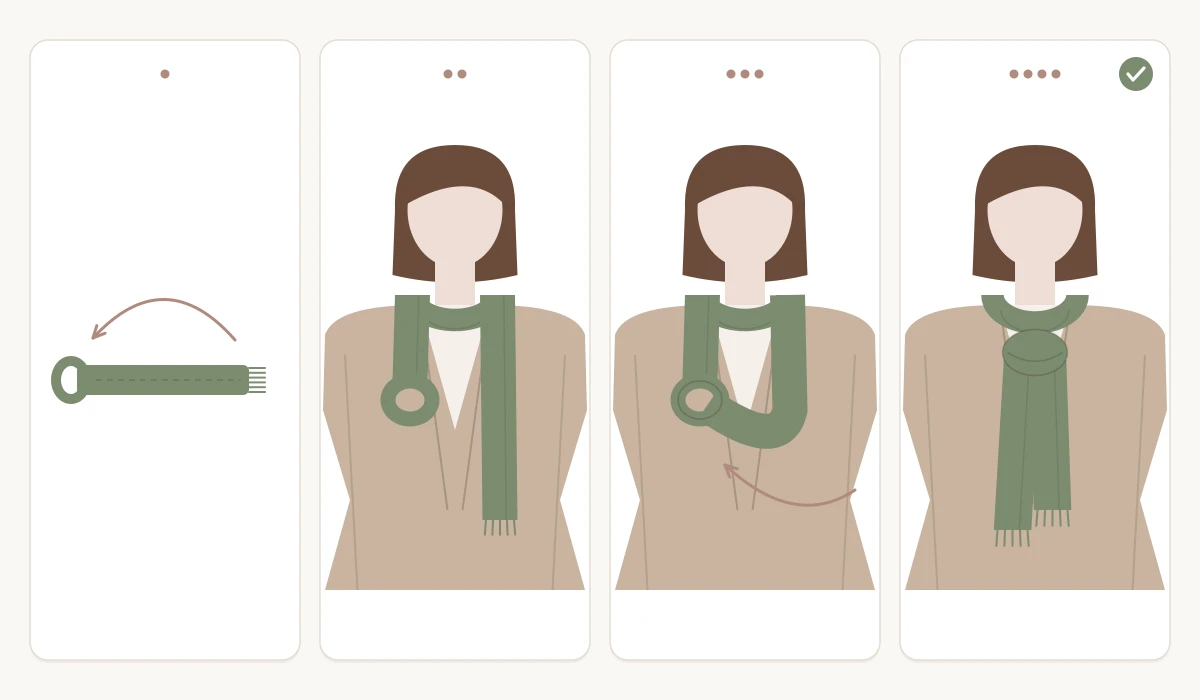
The most common mistake with the Parisian knot is pulling it too tight. It then slides under the chin and looks like a bandage. Keep it loose enough to fit two fingers between knot and neck. If you have a short neck, pull the knot a hand's width lower so that the neckline stays free.
How to tie a scarf for your figure
Body shape describes the relationship between shoulders, waist and hips. It matters when you tie a scarf, because the scarf almost always sits on the upper half: it can widen the shoulders visually or lengthen the upper body. If you do not know your body shape yet, the guide What body shape do I have? helps.
| Body shape | Goal | Method | Better avoid |
|---|---|---|---|
| A shape (hips wider than shoulders) | create width on top | loop, double wrap, over the shoulders | long ends that stop at the hips |
| V shape (shoulders wider than hips) | calm the shoulders | draped open, waterfall, simple knot | thick loops, stole over the shoulders |
| H shape (shoulders, waist, hips similar) | create a focal point | Parisian knot, wrapped once | very long, straight ends without a knot |
| X shape (waist clearly narrower) | keep the waist visible | Parisian knot, thin scarf, short ends | blanket scarf covering the waist |
| O shape (widest at the middle) | build a vertical line | draped open, long ends | volume at the neck, knot in front of the chest |
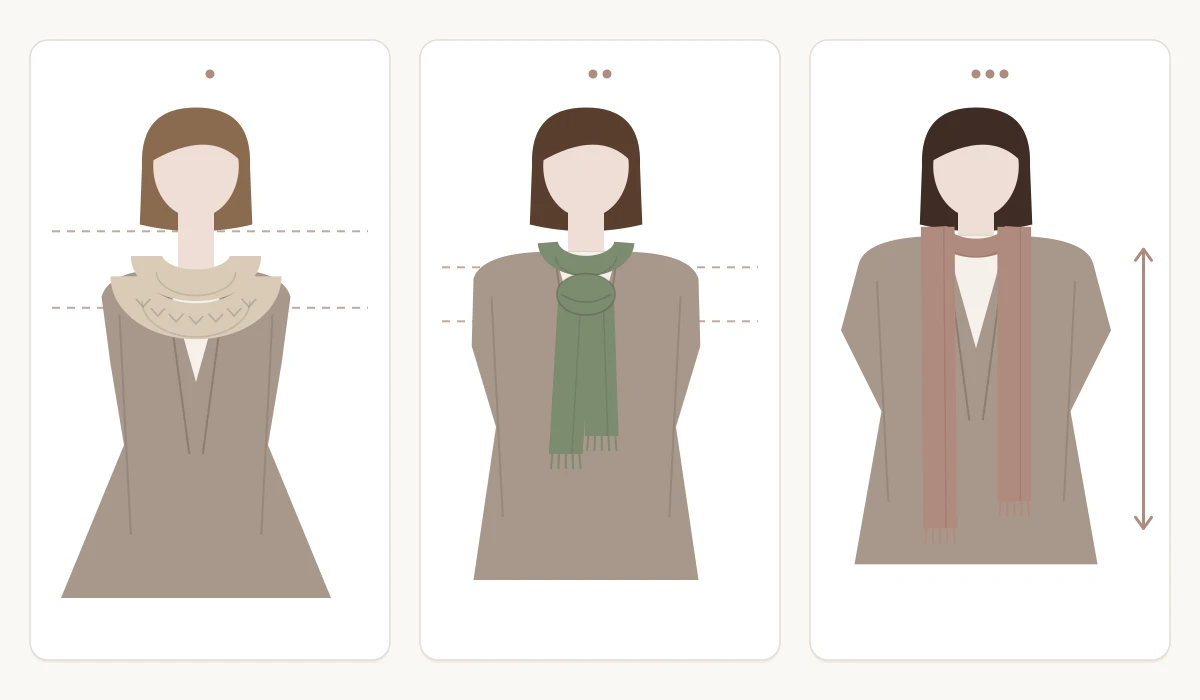
One thing changes the table: the end of the scarf. Where the ends stop, a horizontal line appears, and fringe makes that line even more visible. If a scarf ends exactly at the hips, it draws the eye right there on an A shape. In that case shorten the ends by wrapping once, or choose a knot that lets them end higher.
Short neck, long neck, full bust
When you tie a scarf, neck length matters more than body shape, because the scarf lies directly on it. A simple mirror test shows how much volume your neck can take: tie your thickest scarf as a loop, look straight ahead into the mirror and check whether the fabric touches your chin. If your chin rests on it, this method sits too high for you.
Short neck
A short neck needs air between chin and scarf. Wear the scarf open or as a waterfall, and if you want a knot, tie it low: a Parisian knot a hand's width below the neck works better than one right at the chin. Thin, fluid fabrics are lighter than chunky knits because they add less bulk. Avoid thick loops and double-wrapped scarves.
Long neck
A long neck is an advantage with scarves. You can wear volume at the neck without looking compressed, including loops, double wraps and chunky knits. An open scarf without a knot, on the other hand, emphasises the length even more, which is not always what you want.
Full bust
A knot in front of the chest places volume on the widest part of the upper body. With a full bust, long open ends that fall vertically over the chest work best. A waterfall in a soft fabric also works. Make sure the scarf does not end at bust level but clearly below it.
Narrow or broad shoulders
Narrow shoulders benefit from volume on the shoulder line: loop, double wrap or a stole over both shoulders. Broad shoulders need the opposite, with ends that lead inwards and downwards. A scarf draped open draws attention away from the shoulder edges towards the centre of the body.
Scarf length by height and bone structure
Scarf length is the measurement from end to end without fringe. In shops, long scarves usually range from 180 to 200 cm, stoles are wider, and infinity scarves are sold as a closed ring. What the labels do not tell you: where the same scarf ends on you depends on your height.
To make this tangible, I calculated with average body proportions. Biomechanics uses the body segment ratios by Drillis and Contini for this, shown for example in course material from the University of Illinois: shoulder height is about 81.8 % of body height, knee height 28.5 %. I allowed 30 cm for the path around the back of the neck, and another 35 cm for each extra wrap around the neck.
| Scarf | Worn | Ends at 1.60 m | Ends at 1.78 m |
|---|---|---|---|
| 150 cm | draped open | approx. 70 cm above the floor, mid-thigh | approx. 85 cm, just below the hips |
| 180 cm | draped open | approx. 55 cm, a hand's width above the knee | approx. 70 cm, mid-thigh |
| 200 cm | draped open | approx. 45 cm, at knee height | approx. 60 cm, a hand's width above the knee |
| 200 cm | wrapped once | approx. 65 cm, mid-thigh | approx. 80 cm, upper thigh |
These values are an approximation, not a measurement of you, and every extra wrap shortens the ends further. But they show the principle: a 200 cm scarf worn open reaches the knee on a woman of 1.60 m, where it quickly looks like a second garment. As a petite woman, wrap long scarves once around your neck or choose 150 to 180 cm. More on proportions for shorter women is in the guide Styling for petite women.
The centimetres on the label do not tell you where the scarf ends on you. Your height decides that.
Size follows bone structure
Besides length there is scale: how wide, how thick and how chunky a scarf is. It follows your bone structure, not your height. A tall woman with fine wrists and a narrow face disappears in a chunky blanket scarf just as much as a petite woman does. A petite woman with a strong bone structure, on the other hand, wears a thick knit scarf well. The guide Fashion for tall women explains the difference between height and scale in more detail.
A quick test: hold the folded scarf next to your face. If it looks wider than your face and thicker than your wrist, it is too bulky for a fine bone structure. In that case wear it wrapped once at most, or choose a thinner fabric.
Scarves by body line
Body line describes whether your body is more straight and sharp, more soft and rounded, or a mix of both. The Kibbe system groups these lines into five families. When you tie a scarf, your body line decides its character: smooth or textured, knotted or draped, fine or chunky. The basics are explained in the guide Understanding the Kibbe body type system.
- Dramatic (Dramatic, Soft Dramatic): long, smooth scarves with a clean edge, solid or with large graphic prints. Worn open or as a long, narrow stole. Soft Dramatics can drape large amounts of fabric softly.
- Natural (Flamboyant Natural, Natural, Soft Natural): relaxed and unstructured, with visible texture. Chunky knits and blanket scarves wrapped loosely, never tied strictly. Soft Naturals choose soft fabrics draped loosely around the shoulders rather than a stiff silk scarf.
- Classic (Dramatic Classic, Classic, Soft Classic): medium size, tied symmetrically. The Parisian knot and the silk square are at home here. Soft Classics choose fine, softly flowing fabrics.
- Gamine (Flamboyant Gamine, Gamine, Soft Gamine): smaller scale, tied crisply, often with contrast. Narrow scarves, short ends, small silk squares. Flamboyant Gamines wear thin scarves, never wrapped bulkily around the neck, Soft Gamines delicate fabrics with small prints.
- Romantic (Theatrical Romantic, Romantic): soft, fluid and delicate. Silk, fine cashmere, chiffon, draped loosely or tied into a soft bow. Chunky knits and hard edges look heavy on this line.
Body line and figure rules sometimes contradict each other. A Natural with a short neck loves chunky wool, which is too much at her neck. The solution is almost always to keep the character and adjust the method: chunky knit, but worn open instead of double-wrapped.
Scarf colour by colour season
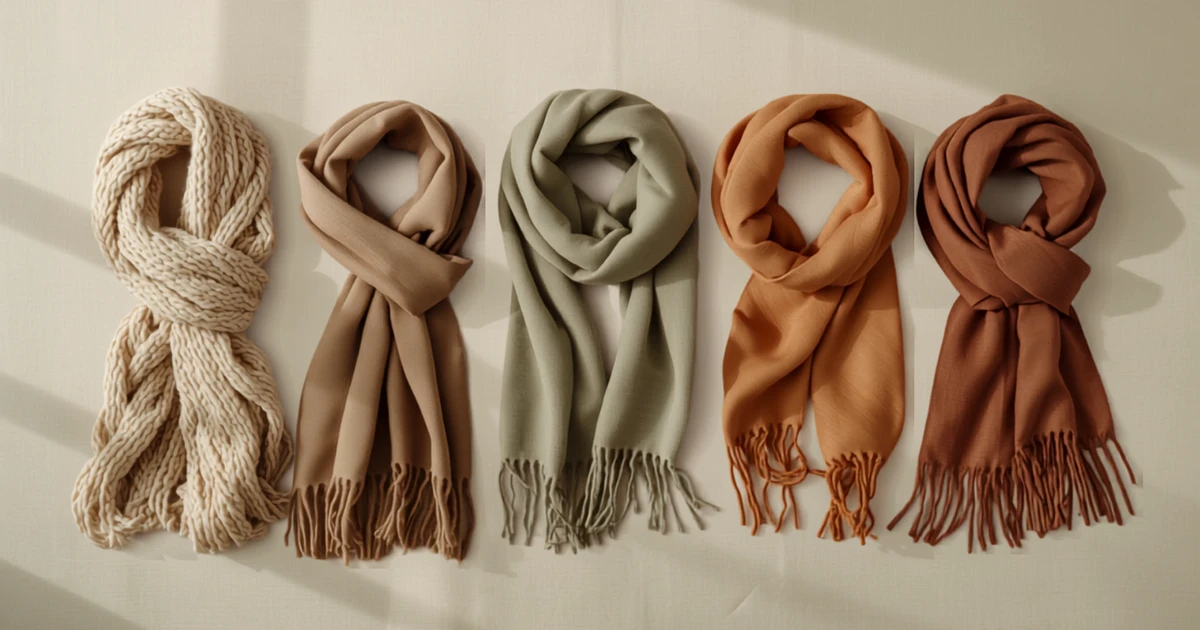
Scarf colour is the colour closest to your face. In the roughly 30 centimetres around your face it decides whether your skin looks fresh or tired. That makes the scarf the strongest colour tool in winter: your coat is often neutral and rarely ideal, and the scarf sits in between and corrects it.
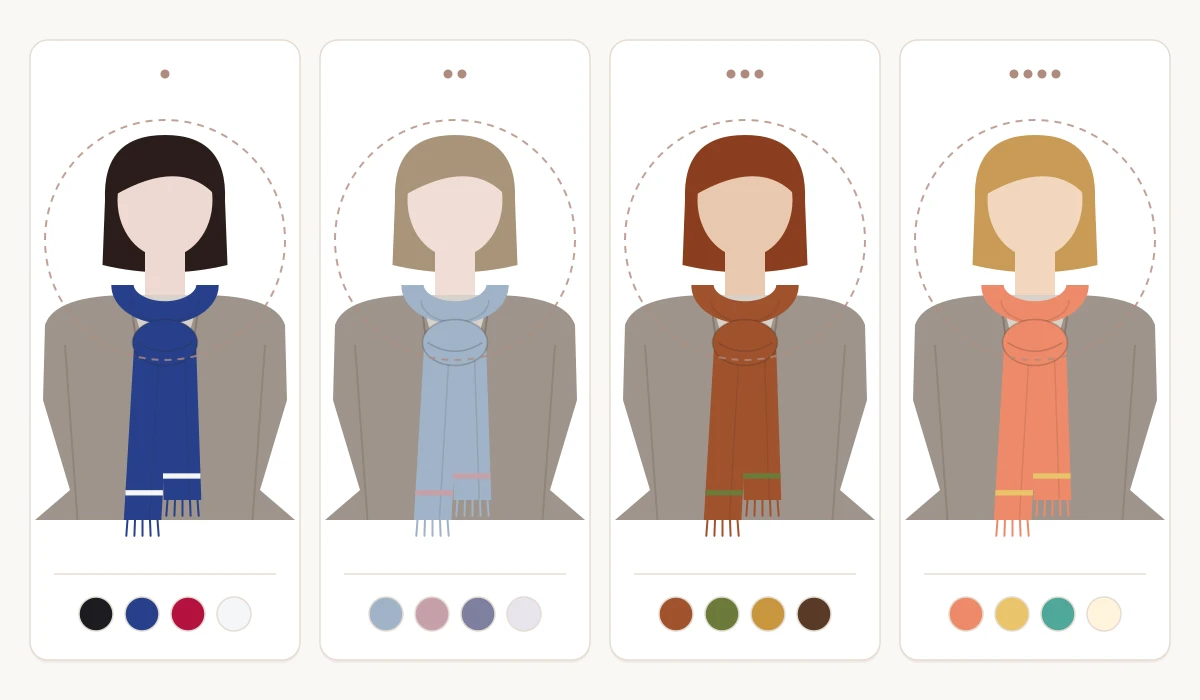
- Winter: royal blue, emerald, clear red, magenta, black and pure white. Avoid camel, mustard and olive near your face. Details in the guide Winter colours.
- Summer: dove grey, muted blue, dusty rose, mauve, lavender and cool navy. Avoid pure black, orange and rust. More in the guide Summer colours.
- Autumn: rust, terracotta, mustard gold, olive, forest green, camel and chocolate brown. Avoid pure white, fuchsia and cool grey. More in the guide Autumn colours.
- Spring: coral, peach, golden yellow, warm turquoise, apple green and camel. Avoid black, burgundy and dusty shades. More in the guide Spring colours.
Your coat can be neutral. The scarf sits at your face and decides how fresh you look.
So the question of which scarf colour goes with everything has no single answer, but four. Winters choose black or pure white, Summers dove grey or cool navy, Autumns camel or chocolate brown, Springs camel or cream. If you do not know your colour season yet, start with the guide What colour season am I?.
Fabric: wool, cashmere, silk
When you tie a scarf, the fabric decides how much volume a knot creates and how well it holds. The same Parisian knot is a thick bulge in chunky knit and a small point in silk. So choose the method for your figure first, then the fabric that suits it.
- Wool: warm, elastic, holds knots well. Fine merino adds little bulk, chunky knits a lot. The right choice from October to February.
- Cashmere: according to Wikipedia it comes from the fine undercoat of the cashmere goat. Very soft, light and warm with little volume, which makes it good for short necks and fine bone structures.
- Silk: smooth, lustrous, fluid. Silk slips, so knots come loose more easily. Good for squares, the simple knot and transitional seasons, less so for a Parisian knot in the wind.
- Cotton and linen: light and breathable, but they crease. For spring and summer, worn loosely open or as a waterfall.
- Viscose and modal: flow softly but give little warmth. Good for draped methods and soft body lines.
Temperature decides how thick your scarf needs to be, and with it how much volume you have to accept. For the reference period 1991 to 2020, the German Weather Service (DWD) gives monthly means of 9.4 °C in October and 4.8 °C in November for Germany. In October a thin wool scarf, open or wrapped once, is usually enough. From November it is time for thicker fabrics, and that is exactly when it pays to choose the method deliberately. Which layers go underneath is shown in the guide Autumn outfits for women.
Wool and cashmere last longer when you treat them right. How to do that is in the guide How to wash and care for clothes.
Patterns, checks and fringe
A pattern on a scarf sits right in the line of sight, so the same rules apply as for blouses, only stronger. Pattern scale follows your bone structure: large checks and wide stripes suit a strong bone structure, small patterns a fine one. Contrast within the pattern follows your own colouring: dark hair and light skin carry a high-contrast check, soft and similar tones a tone-on-tone pattern. More in the guide Which pattern suits my figure?.
Stripes work differently on a scarf than on a top. When the ends hang open, lengthwise stripes run vertically and strengthen the lengthening effect. Wrap the same scarf around your neck and the stripes lie horizontally and widen. Fringe places an accent exactly where the scarf ends. So check where the fringe sits on you: at the hips, the bust or the thigh.
The most common mistakes when tying a scarf
- Putting volume where there is already width: a thick loop with broad shoulders or a knot in front of a full bust.
- Letting the scarf end at the widest point: the ends form a horizontal line, and fringe makes it even more visible.
- Ignoring scale: a chunky blanket scarf on a fine frame, or a tiny square on a strong bone structure.
- Matching the scarf colour to the coat instead of the face: the scarf sits closer to your face than the coat and should come from your palette.
- Pulling the knot too tight: it slides under the chin and shortens the neck, especially with the Parisian knot.
- Not matching fabric and method: silk in a Parisian knot comes undone, chunky knit wrapped twice turns into a bulge.
FAQ — Frequently asked questions
What is the easiest and quickest way to tie a scarf?
The quickest way is to drape it open: scarf centred at the back of your neck, both ends to the front. If it needs to stay in place, the Parisian knot is the best simple method. You fold the scarf in half, place it around your neck and pull the ends through the loop, which takes less than ten seconds.
How should you tie a scarf with a short neck?
With a short neck, choose methods that keep the neck free: draped open, waterfall, or a Parisian knot that sits a hand's width lower. Avoid thick loops and double-wrapped scarves. Thin fabrics such as cashmere or fine wool add less bulk than chunky knits.
Which scarf colour goes with everything?
That depends on your colour season. Winters choose black or pure white, Summers dove grey or cool navy, Autumns camel or chocolate brown, Springs camel or cream. That way the scarf goes with your coats and with your face at the same time.
How long should a scarf be?
For most methods a long scarf of 180 to 200 cm is ideal. If you are petite, 150 to 180 cm is enough, otherwise open ends end close to the knee. According to an approximate calculation, a 200 cm scarf worn open ends at about knee height at 1.60 m and a hand's width above it at 1.78 m.
How do you tie a thin scarf so it holds?
Thin scarves and silk squares hold knots less well but add little bulk. The simple knot in front of the chest, the waterfall or a small square folded diagonally and knotted at the side of the neck all work well. With smooth silk, a double knot helps it stay tied.
How do you wear a blanket scarf without disappearing in it?
A blanket scarf needs a strong bone structure or a sparing method. Fold it in half lengthwise and wear it open or wrapped once rather than twice. Pair it with slim pieces underneath so that you do not have volume both on top and below.
How do you tie a scarf without a knot?
Without a knot, you can drape it open, wrap it once, wear it as a waterfall or over the shoulders. For more hold, tuck the ends under your coat collar or secure them with a belt. These methods are especially good with a short neck, because no knot creates volume at the neck.
How do you wear a scarf with a coat?
With an open coat, a scarf draped open or a waterfall works best, because both continue the vertical line of the coat edge. With a closed coat, choose a Parisian knot, a loop or a single wrap, depending on your neck length. Which coat suits you is explained in the guide Which coat suits me?.
How do you stop a scarf from slipping?
Wool and cashmere grip better than silk and viscose, so the knot holds on its own. With the Parisian knot, it helps to slide the loop up until the knot is slightly taut. With smooth fabrics, a double knot or a discreet pin on the inside keeps everything in place.
Next steps
When you tie your scarf tomorrow, remember three things: choose the method by your neck and figure, check the length against your height and take the colour from your palette. That way your scarf does not just look good on the shelf, but on you. How the scarf connects with your other layers is shown in the guide Layering for the transitional season.
Which colours really suit your face is explained step by step in the guide What colour season am I?. A personal colour and style consultation clarifies it together with your body line. And if you are standing in front of the mirror torn between two scarves, send me a photo on WhatsApp. I reply personally, usually the same day.