TL;DR — Which belt suits me?
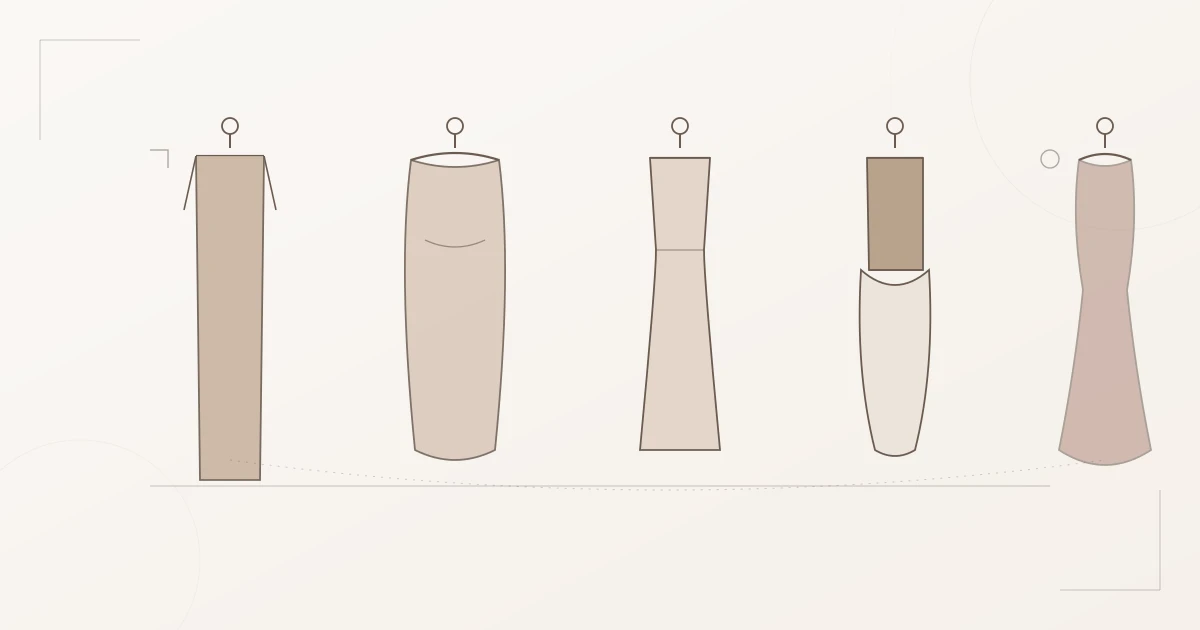
- The right belt depends on three variables: height (where it sits), width (how much surface it covers) and line (buckle and material).
- The core rule: a belt draws a horizontal line and emphasises the spot where it sits. Place it where you want to be seen, usually the narrowest point of your torso.
- Short torso: narrow belts up to about 2 cm. Long torso: wide belts from 4 cm that fill the space up to the bust.
- Hourglass and pear wear the belt on the waist, apple just above it or open under a blazer, rectangle uses it to shape a waist.
- Belt size equals the waist measurement of the belt: measured from the tip of the prong to the middle hole. If only the total length is given, the rule of thumb is: total length minus 15 cm.
Which belt suits me? Three things decide it: the height at which the belt sits, how wide it is and the line its buckle and material show. A belt always emphasises the spot it lies on. So place it where you want to draw the eye, and choose the width to match the length of your torso.
Most belt guides come from leather goods shops and know exactly one rule of thumb: petite woman, narrow belt, tall woman, wide belt. That is not wrong, but it does not explain why the same waist belt looks completely different on two women of the same height. The reason lies in torso length, in the height at which the belt sits and in your body line. That is what this guide is about.
Contents
- Types of belts at a glance
- The core rule: where the belt sits
- Which belt suits me by body shape?
- Belt width by torso and height
- Buckle and material by body line
- Belt colour: contrast, shoes and colour season
- Belts with dresses, trousers, blazers and coats
- How to measure your belt size
- Leather, chromium(VI) and care
- 5 steps to the right belt
- FAQ — Frequently asked questions
- Next steps
Types of belts at a glance
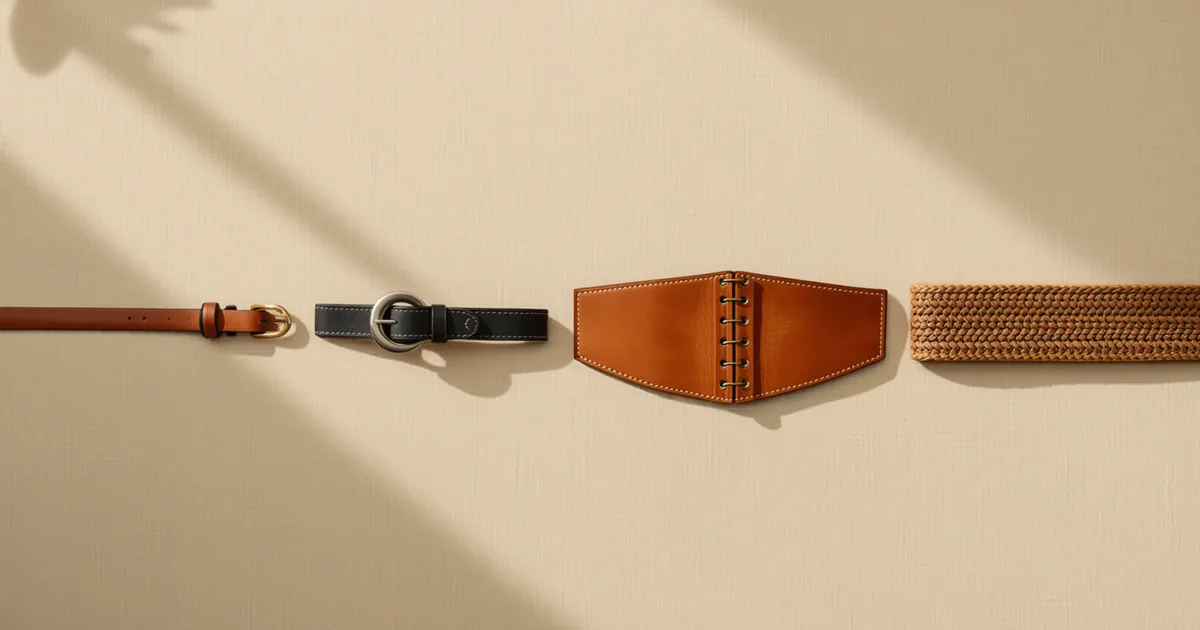
According to the German Wikipedia, a belt is a band or braid worn around the middle of the body. It holds up trousers or skirts, decorates and structures the silhouette. Stone sculptures from the late Neolithic already show belts, while belt loops on trousers only became common after 1900. For the question of what suits you, three properties matter today: width, shape and the height at which a belt is worn.
| Belt type | Width | Sits on | Effect | Suits especially |
|---|---|---|---|---|
| Skinny belt | up to approx. 2 cm | waist or underbust | delicate, draws a light line | short torso, fine bone structure, dresses |
| Classic trouser belt | approx. 2.5 to 3.5 cm | waistband | calm, suitable for everyday | jeans, tailored trousers, business |
| Wide waist belt | from approx. 4 cm | natural waist | strong, shapes a waist | long torso, coat, knitted dress |
| Corset belt | approx. 8 cm and more | natural waist | very strong, sculpted | long torso, simple dresses |
| Hip belt | variable | hips | casual, lengthens the torso | short torso, narrow hips |
| Tie belt | variable | waist | soft, organic | wrap dress, coat, soft body line |
| Woven or chain belt | narrow to medium | waist or hips | textured, casual or playful | summer dress, boho, leisure |
The centimetre figures are guide values from retail, not a standard. What counts is how the width looks in relation to your body. A 4 cm belt is a calm detail on a woman with a long torso, while on a woman with a short torso it already fills half the distance between bust and waist.
The core rule: where the belt sits
A belt is a horizontal line. Every horizontal line draws the eye to the height at which it lies and divides the body into a top and a bottom. This has two effects: the belt emphasises the spot where it sits, and it shifts the proportion between torso and legs.
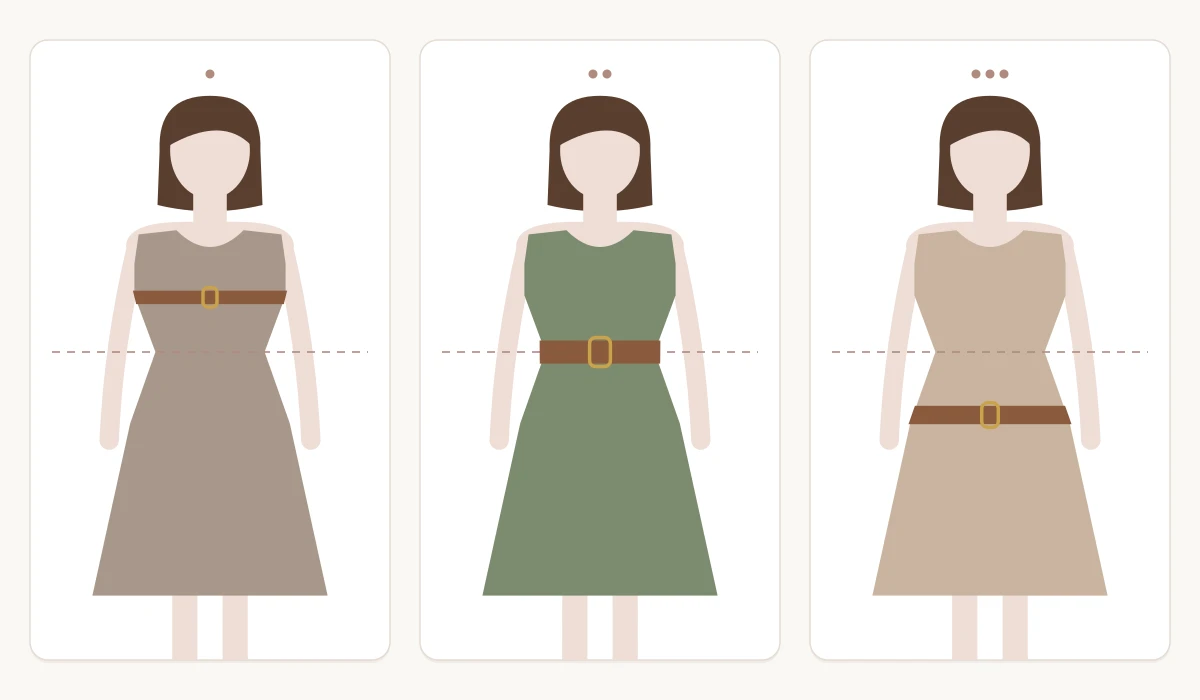
A belt emphasises exactly the spot where it sits. Put it where you want to be seen.
High, directly under the bust
A belt worn high sits at the underbust, as on an empire dress. It visibly lengthens the legs and lets the fabric below fall freely. This is the calmest solution if your midsection shows no waist or you do not want to emphasise your stomach.
On the natural waist
The natural waist is the narrowest point of the torso, usually two to three finger widths above the navel. A belt there shows the waist most clearly and divides the figure into two parts in the classic way. It works best when the waist is visibly narrower than bust and hips.
Low on the hips
A hip belt lengthens the torso and shortens the legs. It places a horizontal line on the hips and draws the eye there. That suits women with a short torso and narrow hips. With wider hips it emphasises exactly the area you often want to balance instead.
A quick test in front of the mirror: put a belt on loosely and slowly slide it from the underbust down to the hips. Notice at which point your silhouette looks clearest and your legs do not get shorter. That height is your belt height for dresses and coats.
Which belt suits me by body shape?
Body shape describes the ratio of shoulders, waist and hips. It determines at which height a belt balances the silhouette instead of reinforcing an imbalance. How to determine your shape is explained in the guide What body shape do I have?.
| Body shape | Goal | Belt height | Width and shape | Better avoid |
|---|---|---|---|---|
| Hourglass (X) | show the waist | natural waist | medium to wide, tie belts too | hip belts that hide the waist |
| Pear (A) | emphasise the top, calm the hips | waist or just above | narrow to medium, discreet buckle | hip belts, eye-catching buckles at hip level |
| Apple (O) | emphasise the vertical line | high under the bust or open under a blazer | narrow, tone on tone | wide belts directly over the stomach |
| Rectangle (H) | shape a waist | waist | wide, corset or tie belts over soft fabric | very skinny, tight belts on straight fabric |
| V shape | emphasise the hips | waist or hips | medium to wide, hip belts too | very high belts directly under broad shoulders |
Belts with a tummy
With a tummy, the question is not whether a belt works but where. A wide belt directly over the stomach puts the horizontal line at the widest point. A skinny belt just under the bust works better, or a belt that is only visible at the front under an open blazer or cardigan. That creates a vertical line between the jacket edges, and the belt only structures the centre. More on this principle in the guide How to look slimmer.
Belts with a straight figure
With a straight figure, the belt shapes a waist that the body does not clearly provide. This works best with a wide, soft belt over flowing fabric that gathers slightly under the belt. On stiff fabric, a tight belt only creates creases without showing a waist.
Many figures are mixed shapes. Then the core rule helps: place the belt at the narrowest point between bust and hips and check whether your legs look longer or shorter as a result.
Belt width by torso and height
Belt width is the height of the strap, measured from edge to edge. It fills part of the distance between underbust and waist. How much room there is on that stretch depends less on your height than on the length of your torso.
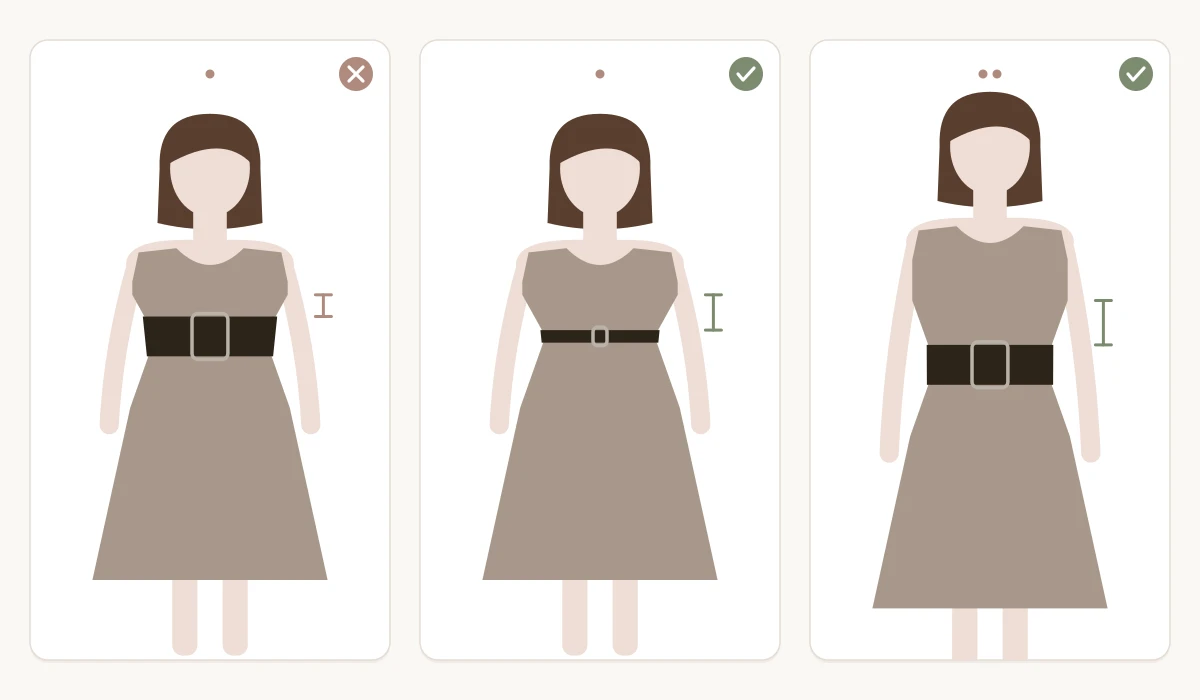
Short torso
A short torso has little distance between underbust and waist. A wide belt fills this stretch almost completely, and bust and belt merge into one surface. Skinny belts up to about 2 cm keep the gap visible. Alternatively, wear the belt a little lower, which lengthens the torso.
Long torso
A long torso offers plenty of room. Wide waist belts and corset belts fill this stretch and structure it. Very skinny belts can look a little lost on a long torso, but they do not divide it the wrong way.
The two-finger test
Fasten the belt where you want it and place two fingers horizontally between your underbust and the top edge of the belt. If they fit comfortably, your torso can carry this width. If the belt almost touches the bust, choose a narrower belt or wear it a little lower.
Height also plays a role, mainly through bone structure. Very petite women quickly look cut in half with a wide belt, very tall women quickly look interrupted with a thin strap. Specific proportion rules are in the guides Styling for petite women and Fashion for tall women.
Buckle and material by body line
Body line describes whether your body is built more straight or curved, angular or soft, large or fine. It determines which buckle and which material look harmonious. The buckle is the most eye-catching part because it sits right in the middle of the body. The classification follows the Kibbe system, explained in the guide Understanding the Kibbe body type system.
| Body line | Character | Typical belts |
|---|---|---|
| Dramatic | large, clear, geometric | smooth leather, angular or graphic buckles, often wide; Soft Dramatic: wide belts with a round buckle |
| Natural | large, organic, relaxed | woven belts, suede, tie belts, matte metals |
| Classic | balanced, symmetrical, timeless | plain smooth leather, medium width, oval or rectangular buckle; Dramatic Classic: clean, flat buckles |
| Gamine | small, graphic, high contrast | skinny belts with a small, geometric buckle, contrasting colours |
| Romantic | soft, round, ornate | soft tie belts, round or decorated buckles, fine leather; Theatrical Romantic: delicate belts with a jewel buckle |
The buckle follows your bone structure. A large buckle on a petite woman pulls all attention to the centre, a small buckle on a strong bone structure gets lost. A rough comparison: hold the buckle next to your wrist. If it looks clearly wider than the wrist, it is usually too large for a fine bone structure. You choose the metal colour of the buckle like jewellery; the reasoning is in the guide Jewellery by colour season.
Belt colour: contrast, shoes and colour season
Belt colour determines how strong the horizontal line is. A belt that contrasts with the outfit sets a clear line, a tone-on-tone belt a quiet one. This is the second lever next to width: a wide belt in the colour of the dress looks calmer than a skinny belt in strong contrast.
- Contrast: clearly emphasises the waist. Good if you want to show the waist and your midsection is the narrowest point.
- Tone on tone: structures without dividing. Good with a tummy, a short torso or when the belt should only add shape.
- Colour of the shoes: a belt in the colour of your shoes connects top and bottom. It does not have to match exactly but should be in the same colour family. How shoes affect the figure is shown in the guide Which shoes suit my figure?.
- Colour season: warm types wear cognac, camel and warm brown, cool types black, grey, taupe and cool dark brown. Find your type in the guide What colour season am I?.
Belts with dresses, trousers, blazers and coats
Which garment you belt changes the effect. Firm fabric can be shaped less than flowing fabric, and a belt sits differently over a jacket than on a dress.
Belts with dresses
A dress is the most rewarding place for a belt. Straight sheath or shirt dresses gain a waist with a belt, flowing dresses a clear centre. Choose the belt so that it gathers the fabric slightly but does not pull. Which dress suits you is covered in the guide Which dress suits my figure?.
Belts with trousers and jeans
With trousers, the belt has a practical job first. It should pass loosely through the loops, so it should be slightly narrower than the belt loops are high. With high-waisted trousers, a belt in the colour of the trousers lengthens the legs, a contrasting belt divides more strongly. More on rise and cut in the guide Which trousers suit my figure?.
Belts over blazers, knitwear and coats
A belt over a blazer or coat shapes the whole silhouette. This works if the fabric is soft enough and the jacket is not too tight. Over thick coats, a wide tie belt or a belt in the same material looks calmest. Which coat suits you is shown in the guide Which coat suits me?. In autumn, a belted knitted dress works well too, as the guide Autumn outfits for women shows.
A belt over a jacket shapes the whole silhouette. It only works if the fabric gives.
Belts at the office
At the office and on formal occasions, restraint applies. A plain leather belt of medium width with a calm buckle suits almost every dress code. Large logos and statement buckles look more casual. Details on the individual codes are in the guide Dress codes for women.
How to measure your belt size
Belt size is usually given as the waist measurement of the belt in centimetres. According to the German Wikipedia, this is the length of the belt from the tip of the prong to the middle hole. For belts without a prong, you measure from the inside of the clasp to the middle hole. If a manufacturer only states the total length, a rule of thumb helps: total length minus 15 cm gives the belt size.
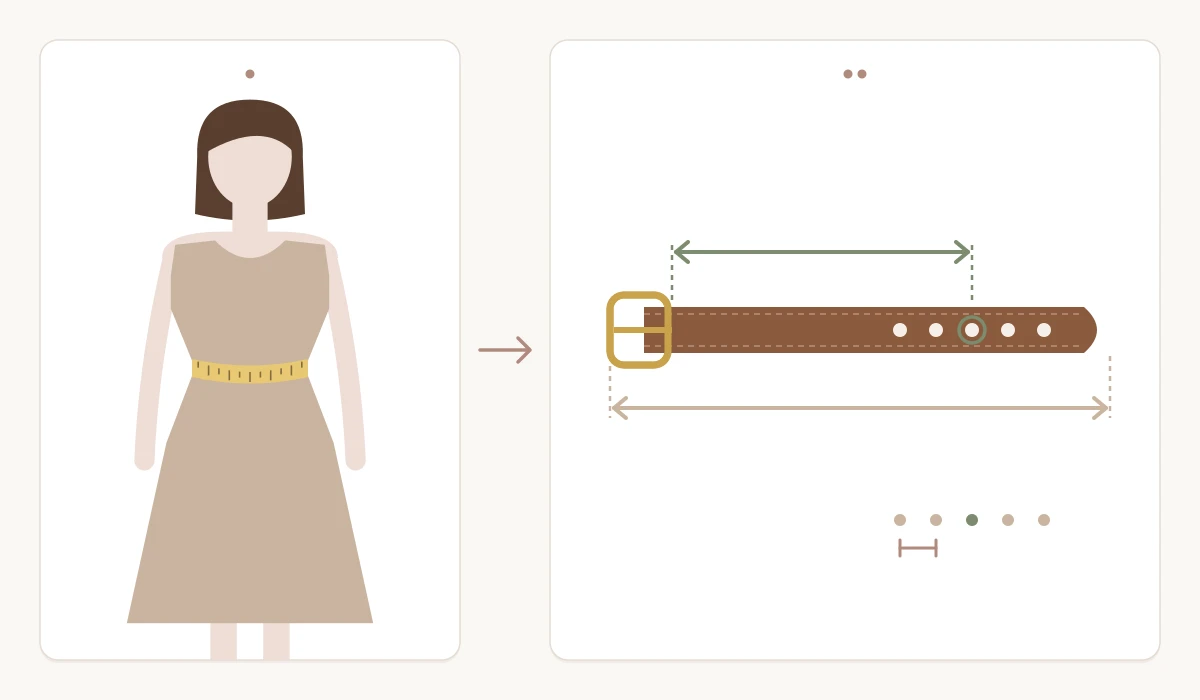
- Choose the spot: decide where the belt should sit: on the waist, on the waistband or on the hips.
- Measure exactly there: place the tape measure over the clothes you will wear underneath, loosely and horizontally.
- Compare with a belt: if you own a belt that fits, measure it from the tip of the prong to the hole you use.
- Choose the size: pick the size at which your measurement falls on the middle hole. If you are between two sizes, take the larger one.
- Check at the fitting: the end of the belt should reach the first loop and not stick out far beyond it.
The middle hole is the target because it leaves room in both directions. Over a thick jumper or coat you need more length than on a thin dress. For a belt you wear over your coat, you therefore measure over the coat, not on the waist.
A waist belt and a trouser belt often have different sizes on the same woman, because the waist is narrower than the spot where the waistband sits. If you wear both, measure twice. That also explains why a belt from your wardrobe that fits your jeans suddenly looks too long on a dress.
Leather, chromium(VI) and care
Most belts are made of leather, that is, tanned animal hide. When tanning with chromium salts, chromium(VI) can form under certain conditions, which can trigger skin reactions. The Bavarian State Office for Health and Food Safety describes the legal situation: under REACH, Annex XVII entry 47, leather articles that come into contact with the skin may not be sold if their chromium(VI) content is 3 mg/kg or more. The EU-wide rule has applied since May 2015 and was introduced by Regulation (EU) No 301/2014.
In practice: a belt usually sits over clothing, but it also touches the skin at the stomach or with cropped tops. If the skin under a belt reddens repeatedly, the tanning or the buckle may be the cause. A dermatologist can find out what is behind it with a test. Alternatives are vegetable-tanned leather, fabric or woven belts.
Care determines how long a leather belt stays beautiful. After wearing, roll it up loosely or hang it by the buckle so it does not crease. Smooth leather tolerates a colourless leather care product now and then, suede a soft brush. How to keep clothes looking good for longer in general is covered in the guide How to wash and care for clothes.
5 steps to the right belt
When you stand in front of your wardrobe or in a shop, go through this order:
- Set the height: slide a belt back and forth between underbust and hips and find the point where the silhouette looks clearest.
- Check the width: do the two-finger test between underbust and the top edge of the belt. If it fails, choose a narrower belt.
- Choose the contrast: contrast for a clear waist, tone on tone for quiet structure.
- Match the buckle: shape by body line, size by bone structure, metal by colour season.
- Measure the size: measure where the belt will sit and choose the size at which you fasten it in the middle hole.
Which belt suits me if I only want to buy one? Then choose a leather belt of medium width, in a neutral colour of your colour season and with a buckle that suits your body line. It works with jeans, tailored trousers and a simple dress. The second belt then adds what you are missing: a skinny one for dresses or a wide one for coats.
FAQ — Frequently asked questions
Which belt suits me?
Which belt suits you depends on three things: the height at which it sits, its width and the line of buckle and material. Place it at the narrowest point between bust and hips and choose the width to match the length of your torso. The buckle follows your body line and your bone structure.
How do I wear a belt correctly?
You wear a belt correctly when it sits at the spot you want to emphasise and does not pull. On the waist it shows your figure, high under the bust it lengthens the legs, on the hips it lengthens the torso. Fasten it in the middle hole so there is room to adjust.
Which belt suits a tummy?
With a tummy, a skinny belt just under the bust works well, or a belt that is only visible at the front under an open blazer. Tone on tone looks calmer than contrast. A wide belt directly over the stomach places the horizontal line at the widest point.
Which belt width suits petite women?
Petite women usually wear skinny belts up to about 2 cm, because wide belts fill the often short torso. What really matters is torso length, not height alone. A petite woman with a long torso can also wear a medium-width belt.
How do I measure my belt size?
Use a tape measure exactly where the belt should sit, over the clothes you will wear underneath. Belt size equals the measurement from the tip of the prong to the middle hole. If only the total length is given, subtract 15 cm according to the rule of thumb.
Does the belt have to match the shoes?
It does not have to be identical, but it should be in the same colour family. A belt in the colour of your shoes connects upper and lower body. On formal occasions, matching matters more than in everyday life.
Which belt goes with a dress?
A dress calls for a belt that sits at your narrowest point and whose width suits your torso length. Soft tie belts and skinny leather belts go with flowing dresses, medium to wide belts with straight dresses. The belt should gather the fabric slightly, not pull it.
Can I wear a belt over a coat?
Yes, if the coat fabric is soft enough and the coat is not tight. Wide tie belts or belts in the coat's material look calmest. Measure the belt size for this over the coat, not on the waist.
Gold or silver for the belt buckle?
That depends on your colour season. Warm types wear gold or brass, cool types silver or gunmetal. If you wear jewellery, it looks most coherent when buckle and jewellery share the same metal colour.
Next steps
Next time you buy a belt, run three checks: at which height does your silhouette look clearest, does the two-finger test between bust and belt pass, and does the buckle suit your bone structure? That way you find belts that structure your figure instead of cutting it in half.
Which colours and metals really suit you is explained step by step in the guide What colour season am I?. A personal colour and style consultation clarifies it together with your body line. And if you are torn between two belts, send me a photo on WhatsApp. I reply personally, usually the same day.