
TL;DR — Which tights with which dress?
- Which tights go with which dress depends on three things: the thickness in denier, the colour chain of hem, tights and shoe and your skin undertone.
- Denier is the yarn weight in grams per 9,000 metres. As a rough guide: up to 20 denier is sheer, 30 to 40 denier semi-sheer, from about 50 to 60 denier opaque.
- The leg line looks longest when tights and shoes share the same shade. A change of colour at the ankle cuts the leg off.
- Black suits dark dresses and the cold season, nude suits light, festive and summery dresses. Nude means the shade of your own skin, not a one-size-fits-all beige.
- Based on German Weather Service monthly means, you need 15 to 30 denier in September, rather 60 to 100 denier in November and often more in December.
Which tights go with which dress depends on three things: the thickness in denier, the colour in relation to dress and shoes, and your skin undertone. Dark dresses call for black or dark tights in the shade of your shoes; light and festive dresses call for sheer tights in the shade of your skin. Choose the thickness by temperature and occasion.
Most guides to tights come from magazines and hosiery brands. They say "black is timeless" and "nude always works". Both are only sometimes true. They do not explain why the same pair of tights lengthens a leg or cuts it off. That is what this guide is about: proportion, colour and how much denier an October day really needs.
Contents
- Denier explained: how thick are your tights?
- How much denier at which temperature?
- The colour chain: hem, tights, shoes
- Which tights with which dress by colour?
- Black or nude?
- Nude tights by undertone
- Tights by dress length and shoes
- Sheen, pattern and texture by figure and line
- Tights by occasion
- 6 steps to the right tights
- The most common mistakes
- FAQ — Frequently asked questions
- Next steps
Denier explained: how thick are your tights?
Tights are a garment that, according to Wikipedia, most often sheathes the body from the waist to the tips of the toes with a tight fit. Their thickness is given in denier. Denier is a unit of yarn fineness: according to Wikipedia's overview of units of textile measurement, it means grams per 9,000 metres of yarn. Tights with 15 denier are therefore made from a yarn of which 9,000 metres weigh 15 grams.
The higher the number, the thicker the yarn, the less skin shows through and the warmer and more durable the tights are. There are no fixed boundaries between sheer and opaque; figures vary by manufacturer and yarn. Microfibre, for example, covers at a lower denier than classic nylon. As a guide, this classification has become common:
| Denier (approx.) | Effect | Skin visible | Typical use |
|---|---|---|---|
| up to 20 | ultra-sheer, transparent | clearly | summer, weddings, festive dresses |
| 30–40 | semi-sheer | slightly, especially at knee and shin | transitional season, office |
| 50–60 | almost opaque | barely | autumn, everyday |
| 70–100 | opaque, matte | no | late autumn, winter |
| over 100 | very dense, often with wool | no | cold winter days |
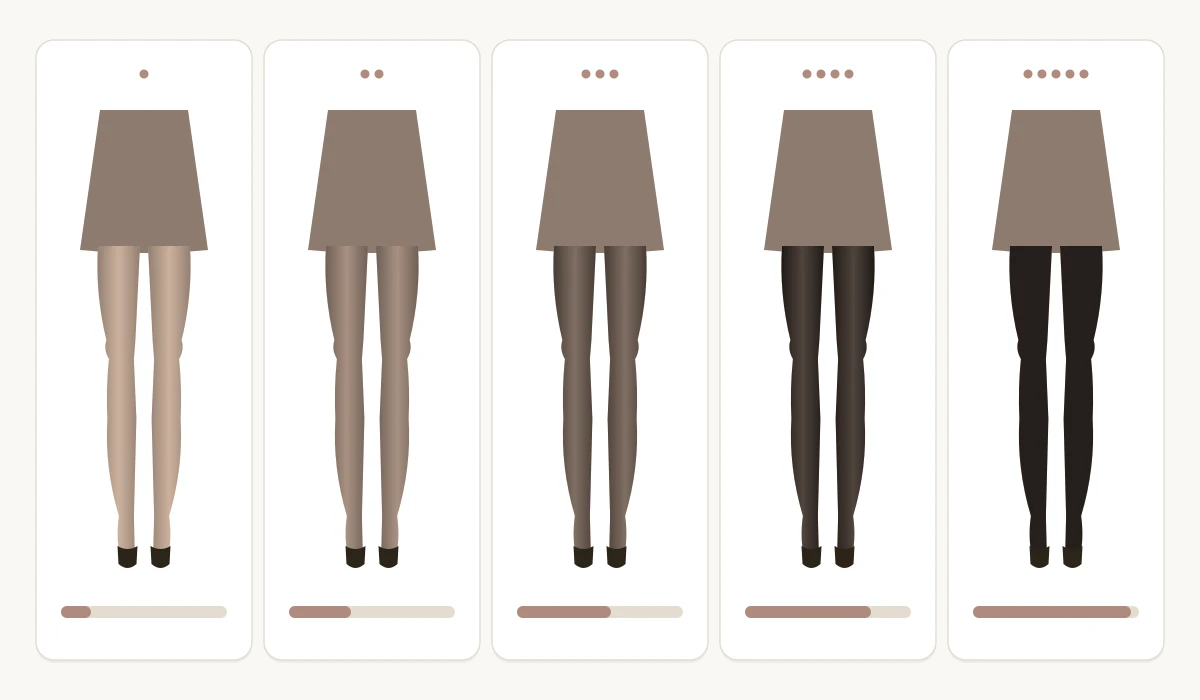
The image shows an effect that helps when choosing: sheer tights look darker at the edges of the leg than in the middle, because the yarn lies at an angle to your view there. That is why they trace the shape of the leg. Opaque tights, on the other hand, turn the leg into a single even surface.
Size changes the density too. Tights that are too small are stretched more at the thighs and knees; the yarn spreads further apart there, and the tights look lighter and sheerer in those places than the figure on the packet suggests. So if in doubt, choose the larger size, especially with opaque styles that are meant to cover evenly.
How much denier at which temperature?
Denier is not just a question of style but of warmth. For the reference period 1991 to 2020, the German Weather Service (DWD) gives these monthly means for Germany: 13.8 °C in September, 9.4 °C in October, 4.8 °C in November and 1.8 °C in December. This gives a simple guide:
| Month | Mean 1991–2020 (DWD) | Recommendation | Pair with |
|---|---|---|---|
| September | 13.8 °C | 15–30 denier | pumps, ballet flats, loafers |
| October | 9.4 °C | 30–60 denier | loafers, ankle boots |
| November | 4.8 °C | 60–100 denier | ankle boots, boots |
| December | 1.8 °C | 100 denier or a wool blend | boots, long coat |
These are monthly means, not daily values. A sunny October afternoon can take 30 denier, a windy November evening needs more. If you spend a lot of time outdoors, go one step up. Which layers go on top is shown in the guide Autumn outfits for women.
The colour chain: hem, tights, shoes
The colour chain is the sequence of shades from the hem of the dress through the tights to the shoe. Every change in this chain creates a horizontal line, and every horizontal line shortens the leg at exactly that point. It is the same rule described in the guide Which shoes suit my figure?: the shoe that lengthens most is the one whose shade comes closest to your tights.
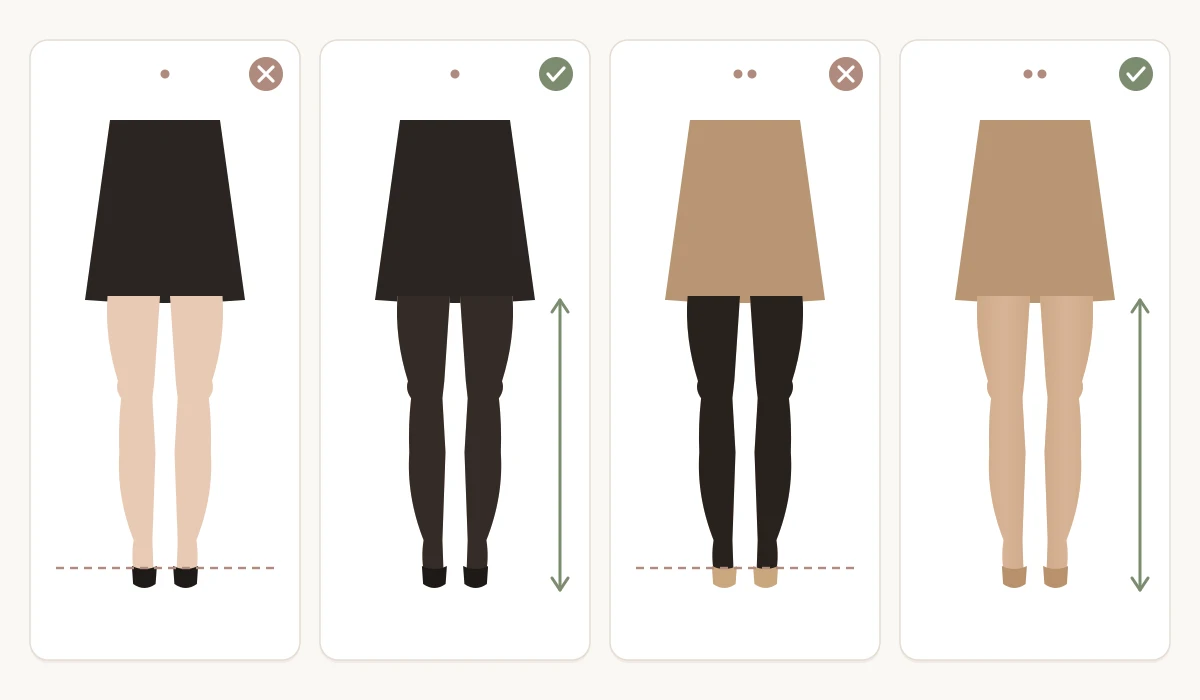
This gives two combinations that always lengthen:
- Dark all the way: dark dress, dark tights, dark shoe. The whole lower half becomes one column.
- Light all the way: tights in your skin tone and a shoe in your skin tone or a light nude. The leg looks bare and runs all the way to the tip of the toe.
Tights are never just a colour. They are the link between dress and shoe, and every gap in that link shows.
How closely you need to watch the colour chain depends on your proportions. With shorter legs or a petite height, the continuous line is almost a must, as the guide Styling for petite women also describes. If you have long legs, you can set a deliberate contrast, such as dark tights with a light shoe. It then looks intentional and fashionable rather than accidental.
Which tights with which dress by colour?
The colour of the dress determines which tights colours are on the table. There are almost always two good routes: tone on tone with the dress, which lengthens most, or neutral in your skin tone, which looks lightest.
| Dress colour | Tone on tone | Neutral | Better avoid |
|---|---|---|---|
| Black | black, 20–100 denier depending on the season | sheer black, or your skin tone with a festive dress | shiny nude with a simple dress |
| Navy | navy or dark blue | your skin tone, sheer | opaque black, which quickly looks dull next to it |
| Green | dark green, olive | your skin tone, or black with dark green | light grey |
| Burgundy, red | burgundy, aubergine | sheer black | light nude with dark red in winter |
| Camel, beige | camel, cognac, brown | your skin tone | opaque black with light shoes |
| Grey | charcoal, grey | sheer black | warm brown |
| Light, pastel, white | rarely useful | your skin tone, 8–20 denier | opaque black |
With patterned dresses, take the darkest colour from the pattern for the tights. That way the tights repeat the dress instead of adding a new colour.
Black or nude?
Black or nude is the most common question about tights, and brightness gives it a clear answer. Tights should never be lighter than the rest of the outfit and never clearly darker than the shoe.
When to wear black
Black suits dark dresses, dark shoes and the cold season. Sheer black at 15 to 30 denier looks elegant and traces the shape of the leg; opaque black looks calm and modern. With very light dresses and light shoes, on the other hand, black looks heavy.
When to wear nude
Nude suits light, pastel and festive dresses, nude shoes and the warm season. The tights should look invisible. That only works with a shade that matches your own skin tone and undertone, more on that in the next section.
The third option: colour
Coloured tights in burgundy, dark green or navy are the solution when black looks too harsh and nude too cool. They work best tone on tone with the dress or shoe. Which dark shades suit you depends on your colour season, explained in the guide What colour season am I?.
As a rule of thumb from the colour palettes: Winters wear black, Summers cool navy or dove grey instead of black, Autumns chocolate brown or olive and Springs caramel or light golden brown. That way dark tights do not look harsh but like part of your own colours.
Nude tights by undertone
The undertone is the base colour beneath the surface of the skin: warmer with a golden or peachy sheen, or cooler with a rosy or bluish sheen. It decides whether nude tights look invisible or sit on the leg like a foreign layer. The colour name on the packet, such as "beige" or "nude", says little about it.
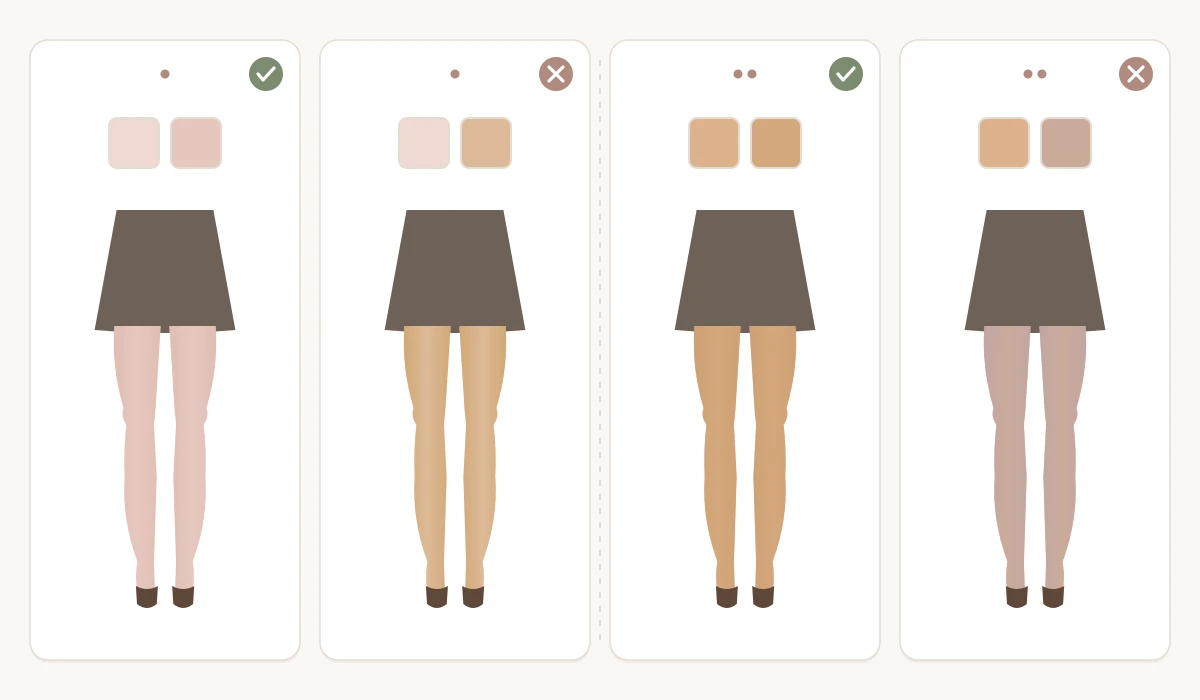
- Cool undertone: shades with a hint of rose or taupe. Golden beige shades look orange on cool skin.
- Warm undertone: shades with gold, honey or caramel. Greyish and rosy shades look sallow on warm skin.
- Neutral undertone: a shade that is neither rosy nor golden, usually labelled "natural".
Nude is not a colour on the packet. Nude is the colour of your skin.
The colour seasons are built on the same principle: Summers and Winters have a cool undertone, Springs and Autumns a warm one. How to determine your undertone is shown in the guide Make-up by colour season, which answers the same question for foundation. A simple test helps when buying: hold the tights over the back of your hand, not the palm. If they look like skin there, they will work on your leg too.
Tights by dress length and shoes
Dress length determines how much of the tights you see. The more leg is visible, the more the tights affect your proportions.
Mini dress
With a mini dress, almost the whole leg is visible. Opaque tights look youthful and calm here, sheer ones more like evening wear. Tone on tone with the dress and the shoe is the safest choice.
Knee-length dress
With a knee-length dress, the colour chain matters most, because knee and calf are visible at the same time. Sheer tights work with pumps; opaque ones work better with ankle boots, as otherwise a light strip appears between hem and boot shaft.
Midi dress
With a midi dress, only the calf is visible, and the tights connect hem and shoe over a short distance. Opaque tights in the shade of the shoe let the calf flow into the boot. More on the right dress length is in the guide Which dress suits my figure?.
With trainers, loafers and boots
With trainers, opaque tights that pick up their sporty character work well, or a deliberately visible contrast with socks. With loafers, opaque tights in the shade of the shoe look calm. With boots, the tights should be dark so that no light gap shows between hem and shaft.
Sheen, pattern and texture by figure and line
Surface and pattern change how wide a leg looks. Sheen reflects light and makes surfaces look larger; matte surfaces absorb light and look narrower. Matte tights are therefore the calmer choice if you want to lengthen your legs.
Patterns follow the same rule as dresses, explained in detail in the guide Which pattern suits my figure?: scale follows bone structure. Fine dots and delicate vertical stripes suit a fine bone structure, larger patterns and chunky ribs a strong one. Vertical ribs lengthen, large-scale patterns widen.
Leg shape plays a part too. Sheer tights with darker edges trace the outline of the leg most clearly. With slim legs that is an advantage; with strong calves, opaque matte tights in the shade of the shoe draw the eye down more calmly.
Your body line decides the character of the tights:
- Dramatic: smooth, matte, solid colour, often opaque. A clean surface rather than a pattern.
- Natural: structure and texture, such as ribs or wool blends, rather matte.
- Classic: sheer or semi-sheer, solid colour, discreet.
- Gamine: small graphic patterns, contrasting colours, often opaque.
- Romantic: delicately sheer, fine dots or delicate lace, a light sheen is allowed.
How the families work in principle is explained in the guide Understanding the Kibbe body type system.
Tights by occasion
The occasion sets how formal the tights need to be. The more formal the occasion, the sheerer and more discreet they usually become, with the exception of funerals.
- Office: sheer to semi-sheer in your skin tone or black, opaque in winter in a colour from your wardrobe. The guide Dress codes for women helps you judge how formal your environment is.
- Wedding: sheer in your skin tone with light dresses, sheer black with dark evening dresses. More in the guide Wedding guest outfits.
- Funeral: in traditional communities, tights in black or navy, sheer or opaque. Details in the guide What to wear to a funeral.
- Evening and party: sheer black, a light sheen or fine patterns are allowed here.
- Everyday: opaque in black, brown, navy or a colour from your palette.
And without tights? Bare legs are accepted at many occasions in summer, and with a knee-length dress now also at many funerals. In conservative industries and at very formal occasions, however, sheer tights remain the safe choice.
6 steps to the right tights
When you stand in front of your wardrobe wondering which tights go with which dress, go through this order:
- Check the temperature: set the denier by the weather and time spent outdoors.
- Choose the shoe: the shoe sets the colour chain, so it comes before the tights.
- Set the brightness: a dark dress and dark shoe mean dark tights, a light dress and light shoe mean tights in your skin tone.
- Fine-tune the colour: tone on tone with the dress or shoe, or the darkest colour of a pattern.
- Check the undertone: test nude tights on the back of your hand.
- Mirror check: look from the front and the side to see whether an unwanted horizontal line appears between hem and shoe.
The most common mistakes
- Light tights with a dark shoe: the change of colour at the ankle cuts the leg off.
- Standard beige instead of your skin tone: the tights look orange on cool skin and grey on warm skin.
- Too little denier in November: being cold shows, and sheer tights look out of place in a winter look.
- Sheen where you want to lengthen: shiny surfaces make legs look wider than matte ones.
- A light gap between hem and boot: boots need dark tights.
- A new colour element: tights in a colour that appears nowhere else in the outfit draw the eye to the legs.
FAQ — Frequently asked questions
Which tights with which dress?
Dark dresses suit dark tights in the shade of the dress or shoe; light and festive dresses suit sheer tights in the shade of your skin. Choose the denier by temperature and occasion. Tights and shoes should ideally share the same shade so the leg runs through.
When do you wear black tights and when nude?
Black suits dark dresses, dark shoes and the cold season. Nude suits light, pastel and festive dresses and nude shoes. Tights should never be lighter than the rest of the outfit.
Which tights go with a navy dress?
A navy dress suits navy tights tone on tone or sheer tights in your skin tone. Opaque black often looks dull next to navy. With navy or nude shoes, the leg line stays calm.
Which tights with a black dress?
In autumn and winter, a black dress suits black tights, sheer for the evening and opaque for everyday. With a festive black dress in summer, sheer tights in your skin tone also work. What matters is that the shoe picks up the chosen brightness.
What does denier mean for tights?
Denier indicates yarn fineness: one denier equals one gram of yarn per 9,000 metres. The higher the number, the denser, warmer and more durable the tights. As a guide, up to 20 denier is sheer and from about 50 to 60 denier opaque, though the boundaries vary by manufacturer.
How much denier do I need in winter?
According to the German Weather Service, the monthly mean in Germany is 4.8 °C in November and 1.8 °C in December. For that, 60 to 100 denier makes sense, and more or a wool blend on cold days. If you spend a lot of time outdoors, choose one step thicker.
Which tights make legs look slimmer?
Matte, dark tights in the shade of the shoe make legs look slimmest and longest. Sheen, light colours and large-scale patterns widen them. Fine vertical ribs can lengthen further.
Can you wear tights with trainers?
Yes, ideally opaque tights that pick up the relaxed character of the trainers. Sheer, shiny tights often look undecided with trainers. A deliberate contrast with visible socks is a fashionable alternative.
How do I find the right nude tights?
Choose the shade by your undertone, not by the colour name on the packet. Cool skin suits shades with rose or taupe, warm skin shades with gold or honey. To test, hold the tights over the back of your hand, where they look as they will on your leg.
Next steps
The next time you wonder which tights go with which dress, remember the order: temperature and denier first, then the shoe, then brightness, colour and undertone. With two pairs of opaque tights, one black and one in a colour from your palette, plus a sheer pair in your own skin tone, you are covered for almost every dress.
Which colours really suit you is explained step by step in the guide What colour season am I?. A personal colour and style consultation clarifies it together with your body line. And if you are torn between two pairs of tights for the same dress, send me a photo on WhatsApp. I reply personally, usually the same day.