
TL;DR — Wedding Guest Outfit
- A great wedding guest outfit comes down to three questions: the dress code (how formal?), your figure (which silhouette carries you?) and your color type (which shade makes you glow?). Only all three together add up to the right look.
- The single most important rule: no white, cream, ivory or champagne — those colors belong to the bride. Pure red and head-to-toe black are tricky too, and worth reconsidering depending on the occasion.
- The dress code sets the length: a civil (registry office) ceremony and an outdoor celebrant ceremony are usually elegant-casual (midi), cocktail calls for knee- to calf-length, and Black Tie means floor-length.
- Choose the silhouette by your body line (Kibbe type) and the color by your color type — that's what makes an outfit look intentional rather than random.
- Factor in the weather, the venue and comfortable shoes: a wedding day often runs 10+ hours — plan for standing, dancing and changing weather.
What do you wear as a wedding guest? As a wedding guest, you wear a festive outfit that suits the dress code of the celebration, flatters your figure and complements your color type — without stealing the spotlight from the bride. In practice that means: no white or cream, the right length for the level of formality (midi to floor-length) and a color that brings your complexion to life. The occasion — civil ceremony, garden, church or evening wedding — sets the frame.
Contents
- The three questions behind every wedding guest outfit
- The golden rules of etiquette
- Decoding wedding dress codes
- Dressing for the venue & occasion
- Wedding guest outfits by figure
- Choosing color by color type — and the off-limits shades
- Step by step: putting your outfit together
- Accessories, shoes & bag
- Season & weather
- The most common wedding guest mistakes
- Buy, rent or restyle?
- FAQ — Common questions about wedding guest outfits
The three questions behind every wedding guest outfit
Most guides show you thirty looks and leave the choosing to you. That rarely leads to the right outfit — because a look that works on a model can be completely wrong on you and for your occasion. A well-judged wedding guest outfit answers three questions instead, in this order.
First: which dress code applies? The dress code decides the level of formality — and with it the length, fabric and mood of the outfit. A floor-length evening gown is as out of place at a relaxed garden party as a short summer blouse at a Black Tie affair.
Second: which silhouette suits your figure? The same dress shape doesn't suit everyone. Whether a straight column silhouette or a curve-hugging wrap dress frames you well depends on your body line — something the Kibbe system captures precisely.
Third: which color makes you glow? In a photo, the right color makes the difference between "rested and radiant" and "pale and tired." It follows your color type — not the color trend of the season.
A wedding guest outfit is not a solo. It has a lead role to respect — the bride — and a frame to work within. Inside that frame, you're allowed to shine, and you should.
The golden rules of etiquette
Before style comes respect. These rules aren't a matter of taste but of convention — in Germany just as internationally, where the Emily Post Institute sets out the same principles.
- No white, cream, ivory or champagne. These colors belong to the bride. That goes for mostly white dresses with a colorful print too — when in doubt, skip it.
- Don't upstage the bride. Steer clear of an outfit designed to pull every eye to you — extremely revealing, extremely flashy or bridal-looking (a long white lace gown).
- Pure red with care. Bright red catches the eye instantly in photos and can read as a bid for attention. Muted reds like burgundy or terracotta are perfectly safe.
- Head-to-toe black is tricky. Accepted at elegant evening weddings, but often too severe for daytime, garden or summer weddings. Break it up with color in your accessories.
- Not too revealing. Plunging necklines, very short hems or a lot of bare skin rarely suit the celebratory, family setting, especially at church ceremonies.
The one non-negotiable rule
If the couple has a specific request close to their hearts — say "pastels, please" or "no particular color" — that wish always takes priority over any style rule. If it's on the invitation, it's binding.
Decoding wedding dress codes
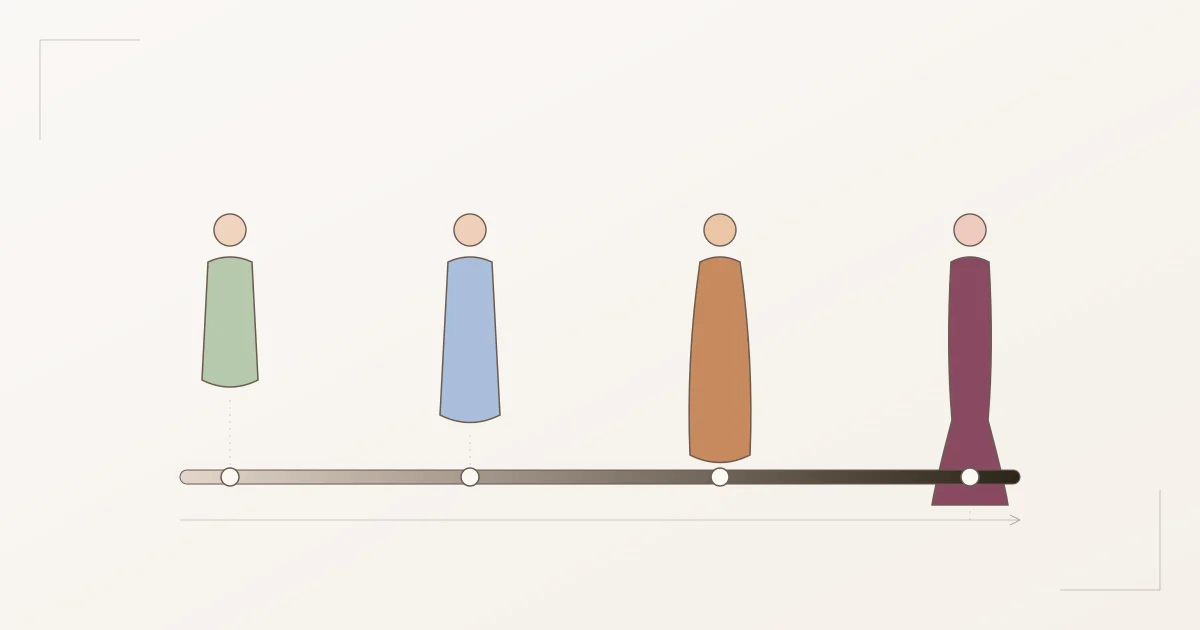
The dress code is the most important piece of information on the invitation — and the most often misunderstood. It tells you how formal the celebration will be and, with that, how long and dressy your outfit should be. This table translates the common codes into concrete clothing. For a detailed explanation of every level of formality, see our guide to the women's dress code.
| Dress code | Formality | Suitable outfit |
|---|---|---|
| Civil (registry office) ceremony | Elegant-casual | Chic midi dress, refined jumpsuit, tailored suit with a blouse |
| Outdoor celebrant ceremony / garden | Semi-formal, light | Flowing midi or maxi dress, airy fabric, block heel |
| Church ceremony | Modest-festive | Midi length, covered shoulders (bolero/wrap), a restrained neckline |
| Cocktail | Festive | Knee- to calf-length cocktail dress, finer fabrics, a heel |
| Black Tie / evening wedding | Very formal | Floor-length evening gown, quality materials, festive jewelry |
If there's no dress code on the invitation, take your cue from the place and time: an afternoon celebration in a garden is lighter and more relaxed, while an evening reception at a venue or a castle is decidedly more formal. When in doubt: better a touch too dressy than too casual — a wedding is a special occasion.
Dressing for the venue & occasion
The venue and time of day refine what the dress code prescribes. The same level of formality dresses differently at a winery than in a ballroom.
Civil & outdoor celebrant ceremonies
Both are usually the most relaxed part and leave the most room to play. An elegant midi dress or a well-cut jumpsuit is ideal. For outdoor celebrant ceremonies, practical comfort counts: heels sink into the lawn — a block heel or elegant sandals are a smarter bet than stilettos.
Church ceremony
Here, modest festiveness is the watchword. Covered shoulders are a sign of respect — keep a bolero, a fine cardigan or a wrap on hand. Plunging necklines and very short hems don't belong in the sacred setting.
Garden & summer wedding
Light, airy and full of color. Flowing fabrics like chiffon or linen, floral or pastel tones and comfortable shoes for uneven ground. Remember sun protection and a light layer for the cooler evening.
Evening wedding & venue
The most formal setting. Here the fabrics can be finer, the length longer and the jewelry dressier. A floor-length dress or a very elegant jumpsuit with statement jewelry hits exactly the right note.
Wedding guest outfits by figure
The most flattering silhouette depends on your body line — not your dress size. The Kibbe system describes that line precisely. Here are the broad tendencies of the five Kibbe families for festive dresses.
| Kibbe family | Flattering silhouette | Better to avoid |
|---|---|---|
| Dramatic | Long, clean column dresses; sharp, elegant lines | Fussy ruffles, small-scale prints |
| Natural | Flowing maxi dresses, refined jumpsuit, relaxed drape | Stiff, heavily fitted corsetry |
| Classic | Timelessly elegant, symmetrical midi or evening dresses | Extreme cuts, too much volume |
| Gamine | Short, structured cocktail dresses with contrast | Long, uniform column silhouettes |
| Romantic | Curve-emphasizing wrap dresses, soft draping | Straight, boxy, shapeless cuts |
If you don't know your Kibbe type yet, the Kibbe quiz gives you a first sense of direction. If you'd like to settle color and shape in one go, our guide to combining color type and Kibbe type lays out the full logic.
Choosing color by color type — and the off-limits shades
After the silhouette comes the color. The right color follows your color type — the combination of undertone, lightness and intensity in your complexion. And a few colors are simply off-limits for wedding guests.
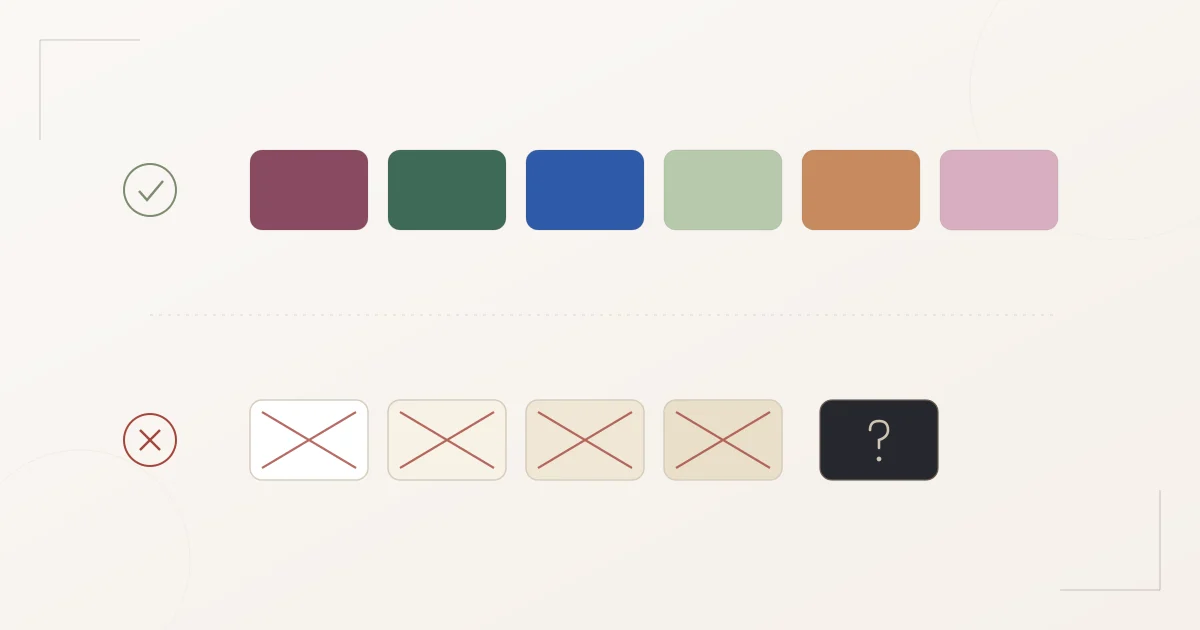
Flattering colors by seasonal type
- Spring type: warm, clear shades — coral, warm turquoise, golden yellow-green, peach.
- Summer type: cool, soft shades — dusty rose, smoky blue, lavender, sage, mauve.
- Autumn type: warm, deep shades — terracotta, rust, olive, teal, burgundy.
- Winter type: cool, clear shades — emerald, sapphire blue, berry, magenta, deep purple.
The off-limits colors for every guest
Whatever your color type, white, ivory, cream and champagne belong to the bride — they are strictly off-limits. You should also avoid very pale pastels that read as whitish in photos. Pure bright red is tricky because it draws the eye instantly; muted reds like burgundy are perfectly fine. Head-to-toe black is occasion-dependent — fine for elegant evening weddings, but often too severe for daytime and garden weddings.
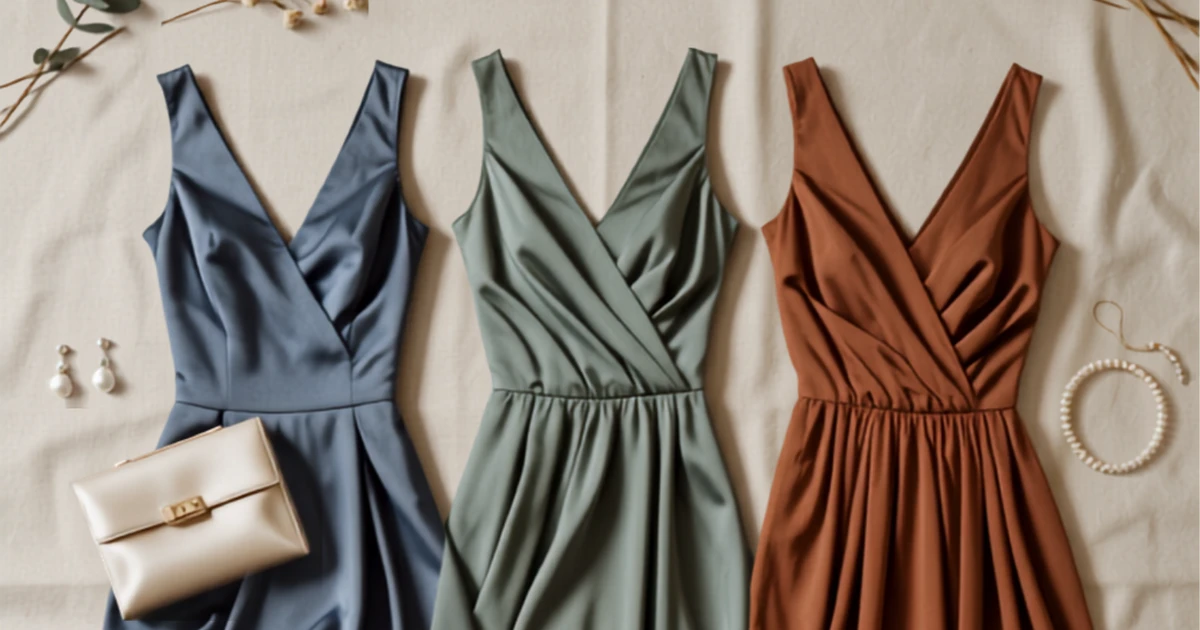
The most common color question isn't "Which color suits me?" but "Is navy allowed?" The answer: yes. Navy, berry, emerald and terracotta are the safest guest colors there are — festive, respectful and available to almost every color type.
Step by step: putting your outfit together
These six steps take you from an empty calendar entry to a finished outfit — in the right order, so no decision blocks the next.

- Clarify the dress code & occasion. Read the invitation closely: dress code, time, venue. No dress code given? Take your cue from the place and time of day, and if in doubt ask other guests or the couple.
- Choose the silhouette for your figure. Decide the dress shape by your body line — straight column, curve-hugging wrap dress, flowing maxi or structured cocktail dress. The dress code dictates the length.
- Set the color by your color type. Pick a shade from your color palette — and rule out white, cream and ivory without compromise. Navy, berry, emerald and terracotta are safe all-rounders.
- Coordinate the accessories. Add a clutch, jewelry and one or two accents. Keep the number of statement pieces small: one eye-catching element per outfit is plenty.
- Plan for weather & comfort. Check the forecast and the venue. Plan a light layer for the evening, weatherproof shoes for outdoors and a spare pair of flats for dancing.
- Check the whole look in a full-length mirror. Put everything on — shoes and bag included — and judge the look as a whole. Sit down, take a few steps: an outfit has to still work after hours.
Never "nothing to wear" before the next occasion again
Once you know your Kibbe type and your color type, you make every occasion decision in minutes instead of panic purchases. A professional analysis gives you both in a personal dossier — for the next wedding and every occasion after.
My Kibbe analysis with style dossier costs €150 — a colour analysis can be added (price on request). Free intro call via WhatsApp — 30 minutes, no obligation.
Accessories, shoes & bag
Accessories turn a dress into an outfit — and often decide comfort and how well you photograph. Three areas matter most.
Shoes: beautiful meets wearable
A wedding day often runs ten hours and more, with plenty of standing and dancing. Choose shoes you can genuinely last in: a block heel gives support and won't sink into the lawn, and elegant sandals suit summer. The pro trick: a second, flat pair (foldable ballet flats) in your bag for the late dancing hours.
Bag: small and festive
A clutch or small shoulder bag is all you need — room for phone, lipstick, tissues and a plaster. Large everyday bags look out of place. A shoulder-strap version leaves your hands free for the champagne glass and the congratulations.
Weather backup
Plan for a change in weather: a bolero, a fine stole or an elegant blazer for cooler evenings, and a foldable umbrella if the forecast is uncertain. At outdoor summer celebrations, sun protection and an emergency plaster for new shoes belong in the bag too.
Season & weather
The season shapes fabric, color and layering. An outfit that ignores the season quickly looks out of place — or is simply uncomfortable.
For a summer wedding, light, breathable fabrics like chiffon, linen and cotton blends matter, along with brighter, fresher colors. Mind the sun protection and a light layer for the evening. A winter wedding can carry heavier fabrics like velvet and crepe, deeper, richer colors and warming layers — an elegant coat or a stole is part of it. For the transitional seasons in spring and autumn, layering is ideal: a dress with a matching blazer or bolero you put on and take off as the temperature shifts.
The most common wedding guest mistakes
These are the mistakes I see most often — and every one of them is easy to avoid.
Mistake 1: Underestimating white or cream
The classic. Not only pure white dresses are off-limits, but cream, ivory and heavily white-dominant prints too. When in doubt, hold any pale piece next to a true white — if it reads "also white," leave it on the hanger.
Mistake 2: Ignoring the dress code
An outfit that's too casual comes across as disrespectful, one that's too formal is out of place. Take the dress code seriously and ask if you're unsure. The most common slip-up: a casual-style summer dress at a formal evening celebration.
Mistake 3: Uncomfortable shoes
New, unworn high heels over ten hours are a guaranteed recipe for blisters and an early exit from the dance floor. Break the shoes in beforehand and pack a flat spare pair.
Mistake 4: Too much of a good thing
A statement dress plus statement jewelry plus eye-catching shoes plus a big hat add up to clutter rather than elegance. One focal point per outfit is enough — the rest falls into supporting roles.
Mistake 5: Forgetting the weather
A strapless dress with no layer at an outdoor autumn wedding turns into a shivering ordeal. Always plan a weatherproof addition — it saves both the outfit and the evening.
Buy, rent or restyle?
A festive outfit doesn't have to be expensive. Three routes get you there, depending on your budget and how often the occasion comes around.
Buying pays off when you'll wear the piece often — a timeless cocktail dress in a color from your palette is an investment that carries many occasions. Renting is ideal for one-off, very formal occasions like a Black Tie wedding: rental services offer designer dresses for a fraction of the purchase price. Restyling is the underrated third route — often your own wardrobe already holds a suitable dress that, with new accessories, different shoes and a festive layer, looks like a brand-new outfit.
Once you know your palette and silhouette, you shop more deliberately and rarely go wrong. That's exactly why it pays to understand your color type and Kibbe type — it turns every occasion purchase from a guessing game into a confident decision.
FAQ — Common questions about wedding guest outfits
What do you wear as a wedding guest?
As a wedding guest, you wear a festive outfit that suits the dress code, frames your figure flatteringly and complements your color type — without upstaging the bride. The length follows the formality: midi for a civil ceremony and outdoor celebrant ceremony, knee- to calf-length for cocktail, floor-length for Black Tie.
Which colors are off-limits for wedding guests?
White, ivory, cream and champagne are strictly off-limits — they belong to the bride. You should also avoid very pale pastels that read as whitish in photos. Pure bright red is tricky, and head-to-toe black is only safe at formal evening weddings.
Can you wear black as a wedding guest?
Yes, but it depends on the occasion. For elegant evening and Black Tie weddings, a black dress is perfectly accepted. For daytime, garden and summer weddings, head-to-toe black often looks too severe — break it up with colorful accessories or choose a more festive color.
How long should the dress be?
The length follows the dress code. A civil ceremony and outdoor celebrant ceremony allow midi length, cocktail calls for knee- to calf-length, and Black Tie means floor-length. When in doubt, midi is the safest, most universally useful length for almost any wedding.
What do I wear to a civil ceremony wedding?
Civil ceremonies are usually elegant-casual. A chic midi dress, a well-cut jumpsuit or a tailored suit with a fine blouse are ideal. It doesn't have to be floor-length or extremely dressy — polished, festive and color-appropriate is enough.
Which outfit suits a garden wedding?
Light, airy fabrics like chiffon or linen, flowing midi or maxi dresses and fresh or pastel colors. Comfortable shoes with a block heel or sandals are especially important, because thin heels sink into the lawn. Plan a light layer for the cooler evening.
Can I wear a long dress as a guest?
Yes, as long as it suits the dress code. At evening and Black Tie weddings, a floor-length dress is exactly right. At very casual daytime weddings, a floor-length evening gown can look too formal — in which case midi is the better choice. Just make sure the dress isn't bridal-looking white.
Which shoes do I wear as a wedding guest?
Beautiful but wearable shoes. A block heel gives support over many hours and won't sink into the lawn; elegant sandals suit summer. Break new shoes in beforehand and pack a flat spare pair for the dancing hours — comfort decides how your evening goes.
How do I figure out which silhouette suits me?
The most flattering silhouette depends on your body line, which the Kibbe system describes precisely. Curve-emphasizing types wear wrap dresses to advantage, while straight lines look elegant in column dresses. The free Kibbe quiz gives you a first read on the cuts that suit you.
Which color suits me best?
That's determined by your color type — the combination of undertone, lightness and intensity in your complexion. Warm types glow in terracotta and teal, cool types in berry and emerald. Navy and muted berry tones are safe guest colors for nearly every color type.
Do I have to buy a new outfit for every wedding?
No. A timeless cocktail dress in a color from your palette can be restyled again and again with different accessories. For one-off, very formal occasions, renting is an affordable alternative. Once you know your palette and silhouette, you shop deliberately and wear every piece more often.
What do I do if no dress code is given?
Take your cue from the place and time: an afternoon in a garden is more relaxed, an evening at a venue more formal. When in doubt, ask other guests or the couple. As a rule of thumb: better a touch too dressy than too casual — a wedding justifies the dressier look.
Ready for any occasion
Know your colors and your line — once and for all
This guide gives you the rulebook for the next occasion. A professional analysis gives you your own personal result — color palette and Kibbe silhouette in one dossier that makes every outfit decision easy. A free intro call is always included.