
TL;DR — Autumn/winter 2026/27 fashion trends
- The season has eight trends: strong shoulders, a clear waist, velvet and lace, faux fur, suede, XXL knitwear, check and bows.
- The colours turn warmer: chocolate brown, toffee, burgundy, mahogany, violet, olive, petrol blue and soft rosé instead of plain black and grey.
- No trend suits everyone. A strong shoulder balances narrow shoulders and reinforces broad ones. XXL volume needs height, or a visible gap below the hem.
- Trend colours can be translated into every colour season: burgundy comes warm and muted for autumn types, cool and clear for winter types.
- Faux fur is usually made of acrylic. A wash test by the Austrian Environment Agency found 382,000 plastic fibres per kilo of laundry; a wash bag cut the number of particles by about 70 per cent.
The autumn/winter 2026/27 fashion trends come down to three movements: a clear shoulder line, a visible waist and soft, warm materials. Plus warmer colours, from chocolate brown to burgundy. What matters is not whether a trend is running, but whether its line suits your figure.
Trend lists sum up what was on the runways. They do not say why the same shoulder looks powerful on one woman and like a borrowed jacket on another. This guide assigns every trend of the season to a body shape, a body line and a colour season. And it says which ones you can safely skip.
Contents
- The 8 trends of the season at a glance
- Power dressing: the strong shoulder
- Waisted silhouettes instead of oversize
- Dark romance: velvet, lace, dark florals
- Faux fur, suede and XXL knitwear
- Modern heritage: check, blazer, boyfriend coat
- Bows, balloon hems and high collars
- The trend colours by colour season
- Shoes and accessories of the season
- Which trend suits which body shape?
- 5 steps to your trends
- FAQ — Frequently asked questions
- Next steps
The 8 trends of the season at a glance
The autumn/winter 2026/27 fashion trends follow one pattern: the body gets a recognisable shape again, and surfaces turn soft. A fashion trend is a shape, a material or a colour that appears in many collections in the same season. Only the part that supports your line matters for you. The table below assigns the eight trends directly.
| Trend | What it is | Suits especially | Careful with |
|---|---|---|---|
| Strong shoulder | structured blazers, a clear shoulder line | narrow shoulders, pear, rectangle | already broad shoulders (V shape) |
| Waisted silhouette | belts, fitted dresses, two-piece sets | hourglass, pear, rectangle | a short torso with a wide belt |
| Velvet | shimmering pile, soft drape | soft body lines, evening occasions | very small scale, stiff cuts |
| Lace | openwork fabric, fine pattern | fine scale, romantic lines | large areas at the office |
| Faux fur | woven pile fabric made of acrylic | large scale, natural and dramatic lines | fine bone structure, petite height |
| Suede | buffed leather, matte surface | almost everyone, natural above all | rain and road salt |
| XXL knitwear | chunky knit, wide coats, cocooning | tall height, long torso | petite height with no visible leg |
| Check and bows | heritage patterns, playful details | gamine, classic, clear lines | large checks on a petite figure |
It is striking how many of these trends form opposite pairs: a clear shoulder against soft material, a tight waist against a wide hem, crisp check against flowing velvet. That is what makes the season usable, because almost every figure has a side of the pair that works. None of it is compulsory. A trend is worth it when it does something your wardrobe cannot do yet. Everything else is a mistake with an expiry date, as the guide Avoiding shopping mistakes shows.
Power dressing: the strong shoulder
Power dressing is a way of dressing that signals authority: clear cuts, structured shoulders, calm colours. According to Wikipedia it emerged in the second half of the 1970s, popularised by John T. Molloy's guidebooks of 1975 and 1977. The shoulder pad became its signature in the 1980s; the designer Claude Montana was known as the "King of the Shoulder Pad". This season the shoulder returns, but narrower and softer than back then.
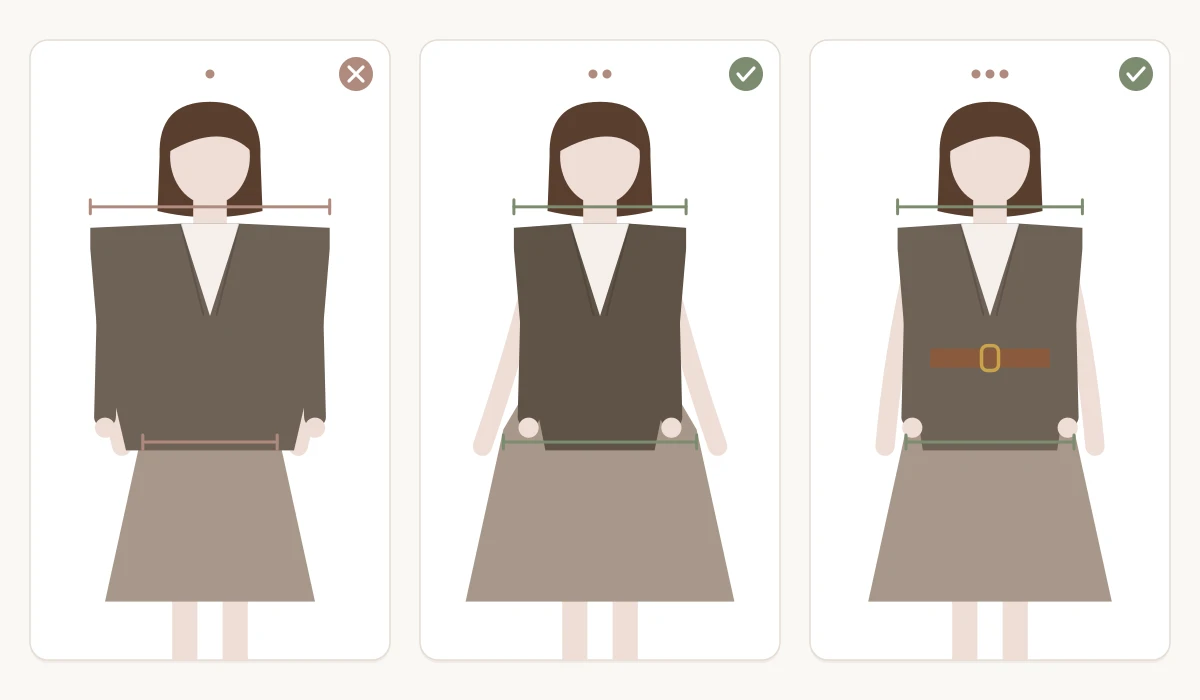
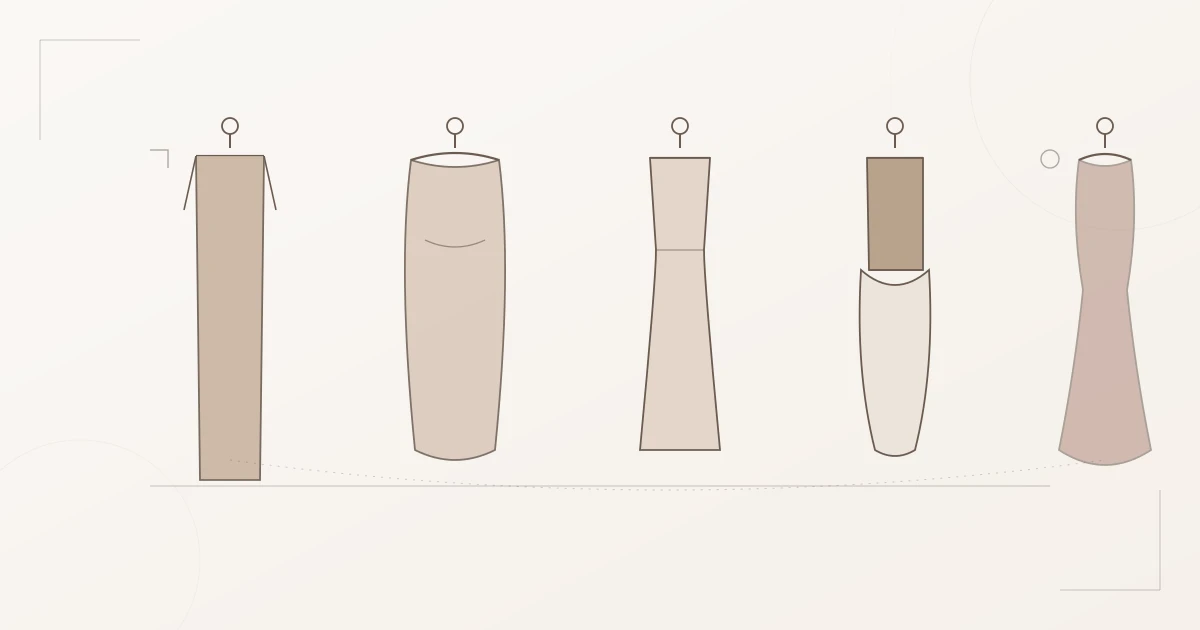
A shoulder is not an end in itself. It is the counterweight to the hip.
The rule behind it is simple: a strong shoulder makes the hip look narrower. With narrow shoulders and wider hips, the pear, this creates balance. On a straight figure it gives structure, especially together with a visible waist. On already broad shoulders it reinforces the weight at the top. A blazer with a soft, unpadded shoulder is enough then. Which blazer suits you otherwise is covered in the guide Which blazer suits my figure?.
Waisted silhouettes instead of oversize
The waisted silhouette is the counter-movement to the wide cuts of recent years: the upper body gets a centre again. You see it in fitted two-piece sets, belted coats and dresses with seams running to the waist.
There are three ways to wear it, depending on the garment: a cut that shapes the waist itself, a belt over a straight piece, or a shorter top that leaves the narrowest point visible. Which belt height and width suits your torso is in the guide Which belt suits me?.
A straight figure gains the most, because a waist appears where the body does not provide one. With a short torso the belt stays narrow, otherwise it fills the gap to the bust. With a tummy, a waist seam in a dress looks calmer than a tight belt.
Dark romance: velvet, lace, dark florals
Dark romance is the dark version of romantic fabrics: velvet, lace, jacquard and floral patterns in muted, deep tones. The appeal lies in the contrast between soft material and serious colour.
Using velvet well
Velvet has a pile that reflects light differently from smooth fabric. That makes it add visual volume, especially at wide points. A velvet skirt on narrow hips looks full in the best sense, a velvet top on a full bust quickly looks heavy. For smaller areas, velvet blazers, velvet shoes or a velvet ribbon at the neckline work well.
Lace without the costume effect
Lace looks most grown-up when it appears in one place only: as an insert at the neckline, as sleeves or as a hem under a knitted dress. The scale of the pattern follows your bone structure. Fine lace suits fine features, large patterns suit a strong bone structure. Which pattern scale suits you is explained in the guide Which pattern suits my figure?.
Jewellery with a calm surface works better with dark, soft fabrics than high shine. Pearls, matte gold and single coloured stones look coherent next to velvet and lace, while very shiny chains compete with the fabric. Which metal is yours is in the guide Jewellery by colour season.
Who can skip this trend
If your line is clear and geometric, dark romance quickly looks like a costume. Then take only the colour, burgundy or mahogany, and leave the fabrics out.
Faux fur, suede and XXL knitwear
Faux fur is, according to Wikipedia, a fur imitation with a high pile, woven from a base yarn and a synthetic acrylic pile yarn. It is warm, light and everywhere this season: as a collar, a gilet and a full coat.
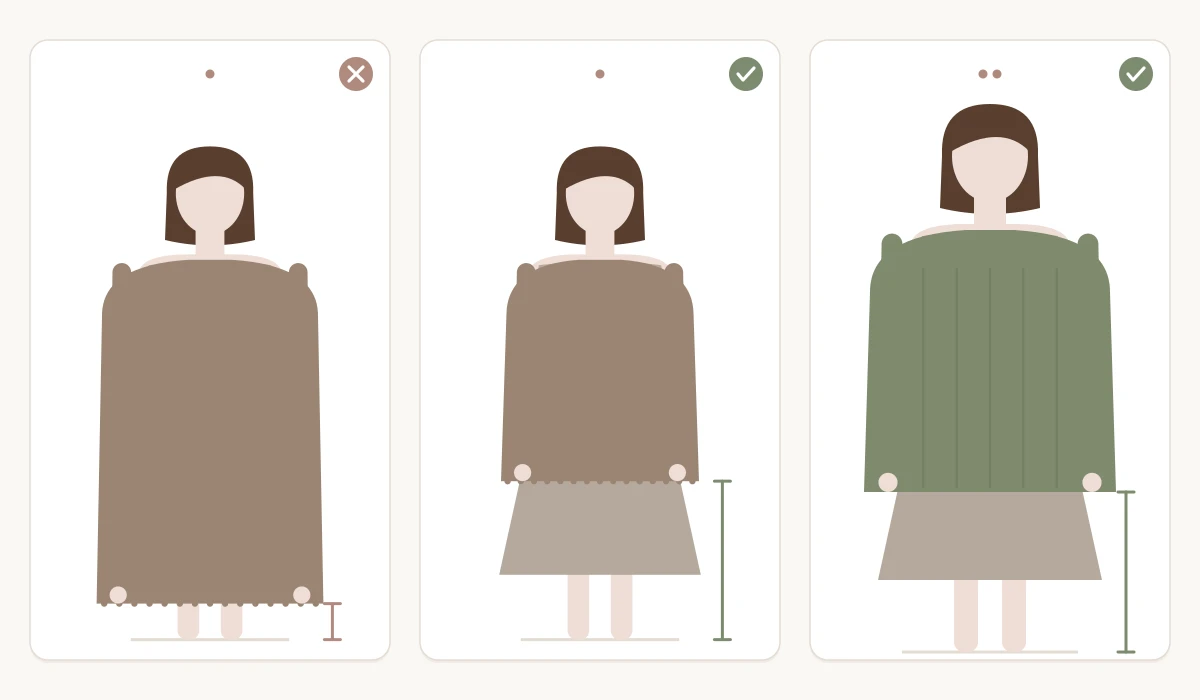
The volume rule
Volume works as long as a visible part of the leg remains below the hem. The shorter your height, the shorter the wide coat may be. A knee-length faux fur coat at 1.60 metres looks different from the same cut at 1.78 metres. The proportion rules are in the guides Styling for petite women and Fashion for tall women.
What acrylic means at the wash
Synthetic fibres shed microplastics in the wash. The Austrian Environment Agency tested ten polyester sports shirts in 2020: they lost 50 to 258 milligrams of abrasion per kilogram of textile, and on average 382,000 fibres between 0.05 and 0.5 millimetres per kilo of laundry ended up in the waste water. A wash bag reduced the weight of the fibres by about 60 per cent and the number of particles by about 70 per cent. For faux fur that means washing rarely and cool, and airing and brushing instead. More on care in the guide How to wash and care for clothes.
Suede
Suede is buffed leather with a matte, velvety surface. It looks softer than smooth leather and therefore suits organic body lines particularly well. In practice: suede does not like constant rain or road salt. A protective spray before the first wear and a soft brush afterwards keep it looking good for a long time.
Modern heritage: check, blazer, boyfriend coat
Modern heritage is the return of classic British fabrics and cuts: check, tweed, trench coat, boyfriend coat. The appeal is that these pieces stay wearable for decades, which makes them the opposite of a seasonal trend.
With check, the size of the pattern decides. A fine houndstooth or glen check reads as a calm surface from two metres away, a large block check stays a pattern even from a distance. A fine bone structure carries small checks better, a strong bone structure large ones. With coats the length matters too: which coat suits your line is shown in the guide Which coat suits me?.
In everyday life, heritage is easiest to wear when only one piece shows a pattern. A check blazer with plain trousers, a check skirt with simple knitwear, a check coat over a calm outfit. Two checks at once only work when they differ clearly in size. Because heritage pieces are expensive and last, this is where the biggest investment of the season pays off. They belong to the category the guide Timeless basics describes: pieces you still wear in five years.
Bows, balloon hems and high collars
The playful side of the season consists of details: bows at collars, sleeves and shoes, balloon hems on skirts and dresses, plus high collars and roll necks.
- Bows place a focal point exactly where they sit. At the neck they draw the eye to the face, at the hip to the hip. Choose the spot deliberately.
- Balloon hems add volume at the hem. That balances broad shoulders and looks fuller on narrow hips. On wide hips it adds.
- High collars visually shorten the neck. With a short neck the collar stays softer and wider, with a long neck it may be high and close.
A high collar also changes the face zone. Large earrings and a roll neck compete, as the guide Which earrings suit me? describes.
The trend colours by colour season
This season's trend colours are warmer than recently: chocolate brown, toffee and caramel, plus burgundy, mahogany and wine red, olive and khaki, petrol blue, violet and soft rosé. Plain black and grey step back.
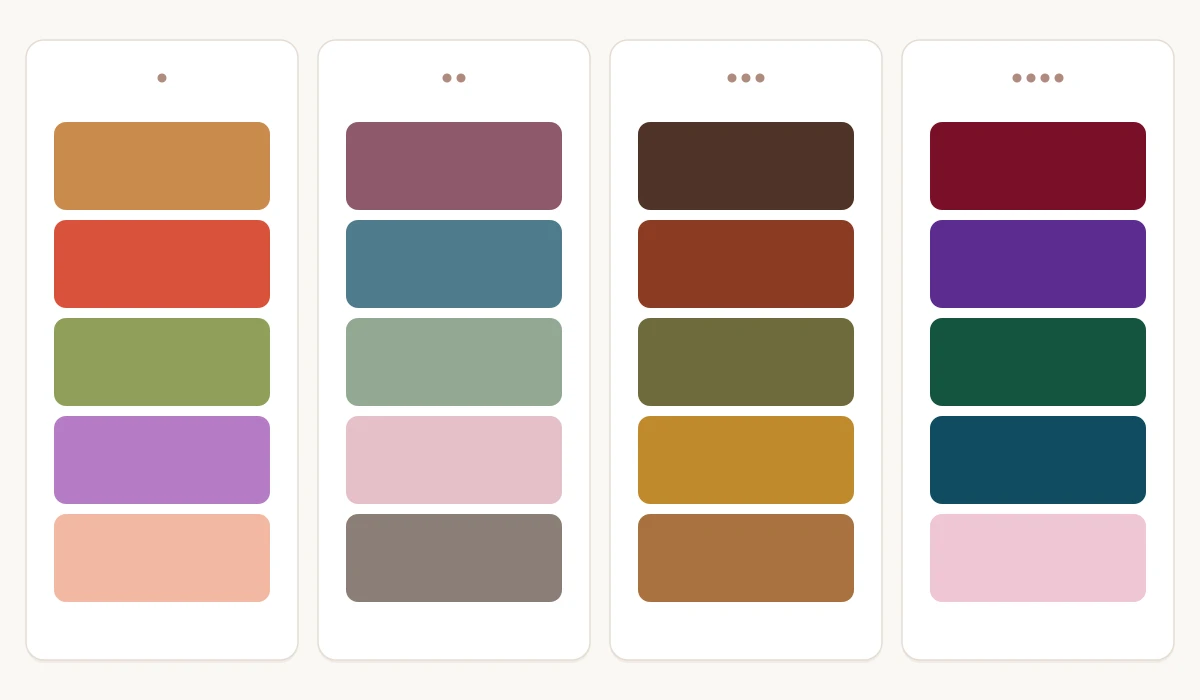
A trend colour is not a fixed colour value but a colour family. Burgundy comes warm and earthy, cool and blue-based, light and muted or deep and clear. That is the trick: you never have to skip a trend colour, you pick the version that matches your undertone.
| Colour season | Version of the season's colours | Especially good |
|---|---|---|
| Spring | warm and clear | caramel, warm red, light olive green, warm rosé |
| Summer | cool and muted | berry, petrol, sage green, cool rosé, taupe |
| Autumn | warm and muted | chocolate brown, rust red, olive, mustard, toffee |
| Winter | cool and clear | burgundy, clear violet, pine green, petrol blue |
Among the autumn/winter 2026 fashion trends, colour is the part that costs the least and changes the most. A jumper in your version of burgundy looks completely different next to your face than the same cut in a shade that makes you look pale. Which type you are is answered in the guide What colour season am I?. How to combine the season's colours is shown in the guide Combining colours. For the colours of a whole autumn outfit, see the guide Autumn outfits for women.
Trend colours come in four versions. You pick yours, not the one in the shop window.
Shoes and accessories of the season
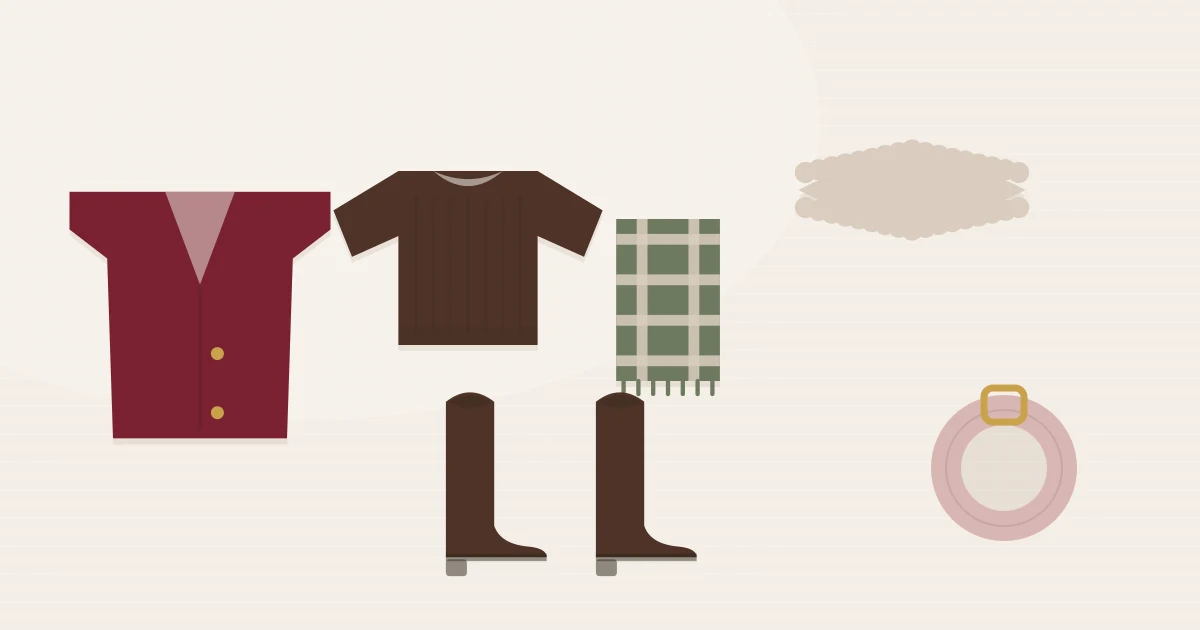
For shoes, the autumn/winter 2026/27 fashion trends show two directions: flat moccasins and loafers on one side, tall boots above the knee on the other. Both change the line of the leg considerably.
- Moccasins and loafers look calm and suit everyday life. They shorten the leg a little, which a higher rise balances out.
- Tall boots lengthen the leg when tights, boot and hemline sit in the same colour family. Otherwise horizontal lines appear that cut the leg.
- Long gloves are the accessory of the season. They draw the eye to forearm and hand and work well with short sleeves.
- Bags stay medium-sized and soft. The size follows your bone structure, as the guide Which bag suits my figure? shows.
One rule applies to all shoes this season: the more the shoe contrasts with the leg, the more it divides the line of the leg. Dark boots with dark tights lengthen, light loafers with dark trousers set a full stop. Both are right as long as they are intentional. How shoe shape and heel affect the figure is in the guide Which shoes suit my figure?.
Which trend suits which body shape?
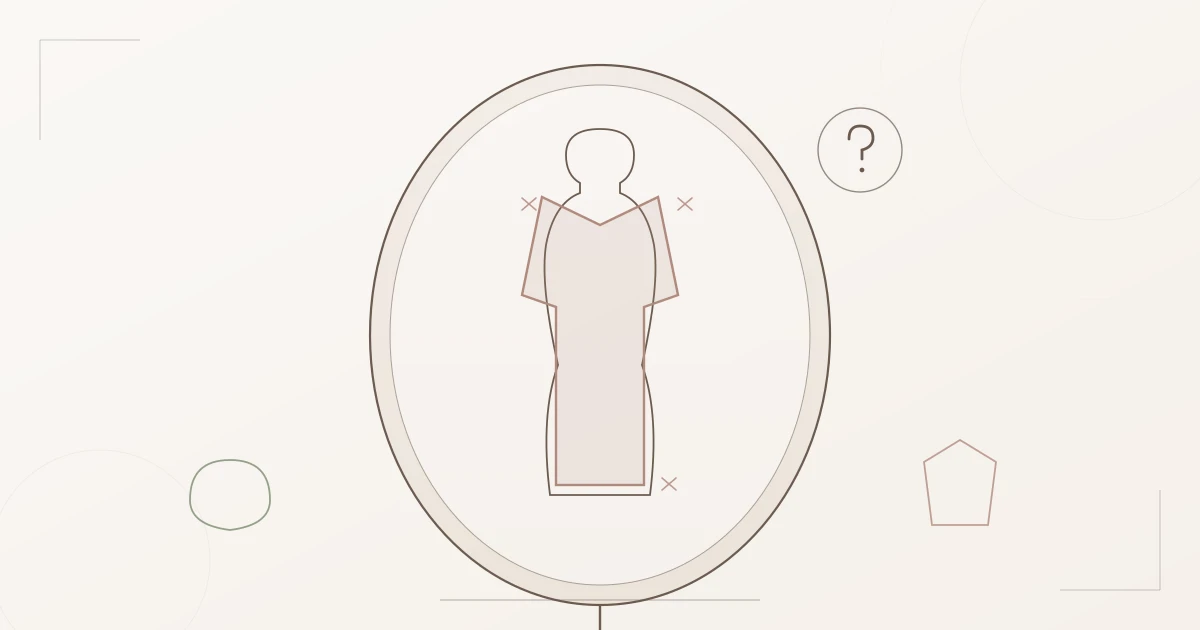
Body shape describes the ratio of shoulders, waist and hips. It decides whether a trend balances or reinforces. How to determine it is explained in the guide What body shape do I have?.
| Body shape | These trends help | These better in small doses |
|---|---|---|
| Hourglass (X) | waisted silhouette, velvet, suede | XXL volume without a belt |
| Pear (A) | strong shoulder, check on top, high collars | balloon hems, faux fur at the hip |
| Apple (O) | long lines, open XXL knitwear, tall boots | tight belts over the stomach |
| Rectangle (H) | strong shoulder plus waist, balloon hem | straight boxy cuts with no centre |
| V shape | balloon hem, check at the bottom, soft shoulder | shoulder pads, faux fur collars |
The table is a starting point, not a verdict. If you like a trend from the right-hand column, take it in a small dose: as a detail instead of a whole garment, in a muted colour instead of a contrast, or in a place you want to show. Beyond shape, the line matters: whether you are straight or curved, small or large in scale, clear or soft. Faux fur and XXL knitwear belong to large, organic lines, fine lace and small checks to fine ones. The classification is explained in the guide Understanding the Kibbe body type system.
5 steps to your trends
This is how you filter the autumn/winter 2026/27 fashion trends down to what really helps you:
- Check the gap: look in your wardrobe and find what is missing. A trend without a gap is a shopping mistake.
- Match the line: does the trend balance your proportion or reinforce it? Shoulder against hip, volume against height.
- Translate the colour: take the trend colour in the version of your colour season, not the one on display.
- Set the share: one eye-catching trend per outfit is enough. The rest stays calm.
- Limit the price: invest in heritage pieces, buy short-lived details cheaply or not at all.
If you buy only one piece this season, take a structured blazer or a coat in a trend colour of your type. Both carry the most in everyday life. How to build whole outfits from them is shown in the guide Layering in the transition season.
FAQ — Frequently asked questions
What are the autumn/winter 2026/27 fashion trends?
The autumn/winter 2026/27 fashion trends cover eight directions: strong shoulders, waisted silhouettes, velvet and lace, faux fur, suede, XXL knitwear, heritage check and playful details such as bows and balloon hems. Warm brown and red shades dominate the colours. Which trend helps you depends on body shape, body line and colour season.
Which colours are worn in winter 2026/27?
Chocolate brown, toffee and caramel lead, together with burgundy, mahogany and wine red, plus olive, petrol blue, violet and soft rosé. Plain black and grey step back. Each of these colours exists in a warm and a cool version, and you pick the one for your colour season.
Are shoulder pads back in fashion?
Yes, but narrower and softer than in the 1980s. A strong shoulder helps when your shoulders are narrower than your hips, because it balances the silhouette. With already broad shoulders, a blazer with a soft, unpadded shoulder is enough.
Is oversize still in?
Oversize stays but loses the lead role to waisted cuts. Wide pieces now work above all in combination with a visible centre, for example a wide coat over a slim dress or an XXL knit with a belt. Volume without a counterweight quickly looks shapeless.
Does faux fur suit petite women?
Yes, if the area stays limited. A faux fur collar, a short gilet or a hip-length coat works better than a floor-length coat. What matters is that a visible part of the leg remains below the hem.
How do I wear velvet in everyday life?
Velvet becomes everyday through small areas: a blazer, trousers with plain knitwear, a shoe or a hair ribbon. Combine it with matte fabrics such as wool or cotton so the shine gets a counterpoint. Full velvet outfits quickly look like evening wear.
Which shoes are current in autumn 2026?
Flat moccasins and loafers as well as tall boots above the knee are current. Flat styles look calmer and suit higher rises, tall boots lengthen the leg when tights, boot and hemline match in colour.
Do I have to follow trends at all?
No. Trends are an offer, not a programme. A trend makes sense when it fills a real gap in your wardrobe and suits your line. You can skip all the others without looking dated.
How many trend pieces do I need per season?
Two or three are enough for most wardrobes. One larger piece such as a coat or blazer, plus one or two small accents such as a scarf, a shoe or gloves. That keeps the wardrobe calm and lets the pieces combine with each other.
Next steps
Go through the autumn/winter 2026/27 fashion trends with two questions: does this piece fill a gap, and does its line balance my proportion? Whatever passes both goes into the wardrobe. The rest can stay in the shop.
Which colour versions of the season really suit you is explained step by step in the guide What colour season am I?. A personal colour and style consultation clarifies it together with your body line. And if you are unsure whether a trend piece suits you, send me a photo on WhatsApp. I reply personally, usually the same day.