
TL;DR — the essentials at a glance
- The shoulder line decides the coat, not the letter. Sharp shoulders need structured, architectural coats; broad, blunt shoulders need relaxed, slightly oversized cuts with texture; softly sloping shoulders need fluid coats with a narrow collar; balanced shoulders need moderate symmetry; a small contrast scale needs compact, clearly defined shapes.
- Detail size follows your bone structure. Lapel width, button size, collar and pockets all have to match your scale. Fine bones drown under wide lapels and plate-sized buttons; strong bones make dainty details disappear altogether.
- Coat length is governed by your vertical line, not by centimetres. What matters is where the hem cuts across the vertical — mid-calf breaks a short vertical, longline extends a long one.
- Fabric and texture are part of the line. Smooth gabardine and crisply woven wool for Yang sharpness, soft wool felt and draping cashmere for Yin softness, tweed and bouclé for the relaxed Natural character.
- Camel is not neutral. The coat is the most visible garment you own and it sits right next to your face — its colour comes from your colour type: warm camel and cognac for Spring, taupe and smoke blue for Summer, olive and rust for Autumn, black, navy and pure white for Winter.
Table of contents
- The short answer
- Why the letter-based body shape falls short for coats
- Determining your shoulder line
- Women's coat types at a glance
- Coat construction by Kibbe family
- Scaling the details: lapels, buttons, collars
- Coat length and the vertical line
- Fabric weight and texture by type
- Coat colour by colour type
- Typical coat-buying mistakes
- The 6-step fitting checklist
- Frequently asked questions (FAQ)
The short answer
Short answer
The right coat follows four levels: your shoulder line determines the construction — structured, relaxed or softly draping. Your bone structure determines the size of lapels, buttons and collar. Your vertical line determines the length. Your colour type determines the coat colour. The letter-based body shape only governs how much waist definition you need.
Almost every coat guide works with four letters: A, V, H, X. That explains where a coat needs volume — but not why the same wool coat looks completely different on two women with identical figures. The difference lies in the shoulder construction, in the detail size and in the fabric. Those three levels are exactly what is missing online, and they are exactly what we clarify here.

Why the letter-based body shape falls short for coats
The letter-based body shape is a ratio of three circumferences: shoulders, waist, hips. A stands for shoulders narrower than the hips, V for shoulders wider than the hips, H for a straight line, X for a defined waist with balanced shoulders and hips. That is a statement about volume distribution — nothing more.
A coat, however, is the most heavily constructed garment in your wardrobe. It has a built-in shoulder, a lapel, a collar construction, an interlining, a lining and a weight. The circumference of your hips says nothing about whether a padded, sharply drawn shoulder looks powerful on you or looks like a costume.
Three things remain unanswered if all you know is the letter:
- The shape of your shoulder. Two women with a V figure share the same letter — one with a sharp, angular shoulder edge, the other with a broad but bluntly rounded shoulder. The first wears an architecturally built coat; the second walks out of it looking stiff and armoured.
- The scale of your bones. An H figure at 1.58 m with fine wrists and an H figure at 1.79 m with a strong bone structure get the same recommendation — and the same 10 cm wide lapels look overwhelming on one and daintily lost on the other.
- The character of the surface. A coat is around 1.5 square metres of continuous fabric. Smooth gabardine, soft wool felt and coarse tweed create three completely different effects on the same figure — and the letter has nothing to say about it.
Body shape answers where a coat needs width. It never answers how the shoulder has to be built — and that is exactly where most coat purchases fail.
Why the letter system runs into its limits in principle, and what the Kibbe system measures instead, is compared in detail in the guide Kibbe type vs. body shape type. In short: the letter measures circumferences, the Kibbe system measures bone structure, flesh and facial features — precisely the things a coat makes visible.
Determining your shoulder line
The shoulder line is the shape of your shoulder edge from the base of the neck to the shoulder joint — its width, its angle and its edge. It is the decisive variable for a coat, because the coat rests exactly there and draws its entire silhouette from that point.
The test takes two minutes. Put on a close-fitting top, stand square in front of a mirror, let your arms hang loosely and look only at the stretch between neck and shoulder point. Not the width of your figure, not the arms — only that one line.
Sharp and angular (Dramatic family)
The shoulder edge is clearly visible, the bone stands out, the transition into the arm forms a recognisable angle. The line looks drawn, almost geometric — even without shoulder pads. This shoulder carries construction effortlessly and actually needs it: a softly draping coat looks, on her, like a garment that never made a decision.
Broad and blunt (Natural family)
The shoulder is horizontal and broad, but the edge is rounded rather than sharp. The line runs straight outwards and then curves softly into the arm. It is the most common reason behind the sentence "coats just don't suit me" — because an already broad shoulder turns massive the moment you add padding and hard edges.
Soft and sloping (Romantic family)
The shoulder line drops away at a visible angle, the edge is rounded and covered by flesh. The bone does not stand out. On this shoulder a stiff, constructed coat visually slides forward and looks empty across the chest.
Balanced and moderate (Classic family)
The shoulder is neither sharp nor strongly sloping, neither notably broad nor narrow. It is symmetrical and unremarkable. This line wears classic coat cuts with the least fuss — and loses out precisely when it reaches for extremes.
Narrow with contrast (Gamine family)
The shoulder is small and narrow, but the edge is straight and slightly angular — a small scale with a visible Yang edge. It needs defined shape in a compact format. Volume is its enemy, clarity its friend.
The control test: place both index fingers on your shoulder points and look in the mirror. If neck and shoulder form a T, the line is straight. If they form a V, it slopes. If the corner at your index finger is clearly visible, the edge is sharp; if it disappears into a curve, it is blunt.
Women's coat types at a glance
A coat type is a combination of cut, collar shape and degree of construction. Every type carries a character of its own — and that character has to suit your line before any question about your figure even becomes meaningful.
- Trenchcoat. Double-breasted, epaulettes, belt, storm flap, usually gabardine. The highest degree of construction, clear edges, plenty of detail at the shoulder. It belongs to straight, defined shoulder lines and to a medium-to-large scale.
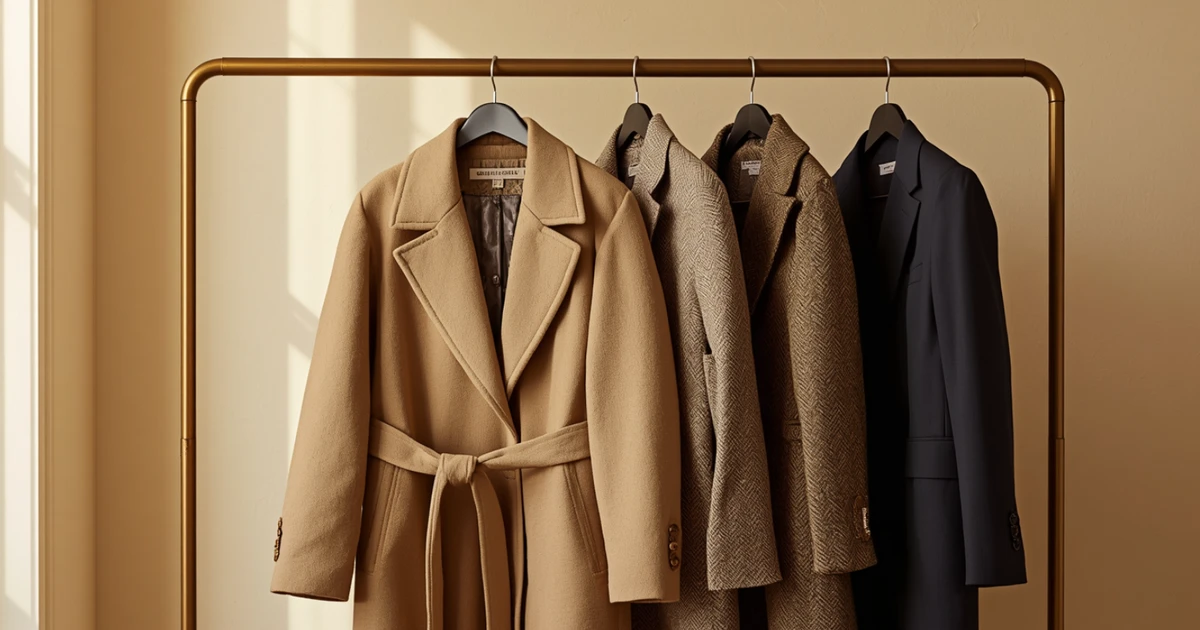
- Classic wool coat with lapels. Single- or double-breasted, can be waisted, built-in shoulder. The all-rounder — its character depends almost entirely on lapel width, shoulder construction and fabric.
- Cocoon coat. Rounded volume, no waist, soft shoulder, often cut raglan-style. It lives on fullness and curve and suits soft, fleshier lines — on a sharp shoulder it looks shapeless.
- Wrap coat. No buttons, a tie belt, overlapping front panels, soft drape. It draws a diagonal across the body and is the friendliest cut for soft shoulders and pronounced waists.
- Dufflecoat. Hood, toggle fastenings, sturdy wool cloth, straight cut. Robust and texture-led — a Natural garment at heart, and quickly overwhelming on a small scale.
- Quilted coat. Padded channels, soft or no shoulder construction, sporty character. Here the width of the quilting is the detail size: narrow channels for a small scale, wide channels for a large one.
- Blazer coat. A blazer cut in coat length, clean lapels, straight shoulder, minimalist. The sharpest, most modern cut — perfect for straight shoulders and purist lines.
- Short coat and pea coat. Hip- to thigh-length, strong buttons, wide collar. It divides the vertical and therefore needs either long legs or a deliberately high waist.
No type is inherently better. But every type carries a default setting: the trench is built, the cocoon is round, the duffle is robust, the blazer coat is sharp. A coat is infrastructure, not a seasonal item — so the default setting has to match your line, not the current season.
Coat construction by Kibbe family
Coat construction is the degree of internal structure: shoulder interlining, padding, armhole height, chest reinforcement and the crispness of the seams. It determines whether a coat looks architectural, relaxed or fluid — and it is the point at which the usual coat guides fall completely silent.
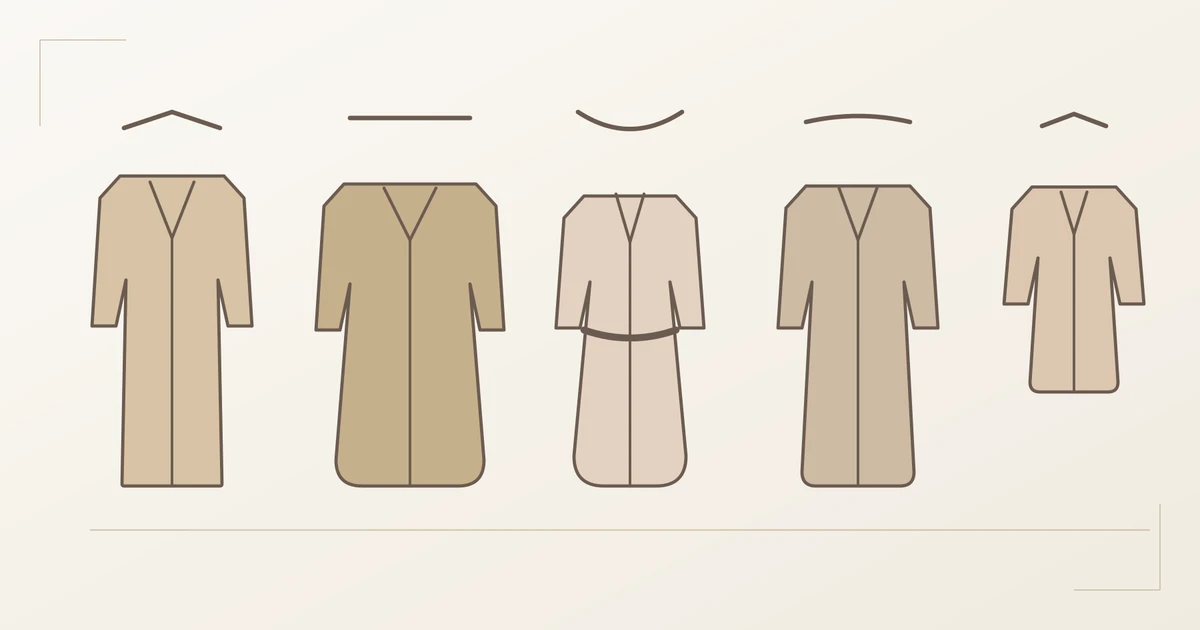
Dramatic: architectural and sharp
The Dramatic line is vertical, angular and long. Her coat is built like architecture: a clearly defined shoulder, a high narrow armhole, a narrow pointed lapel, a straight fall with no flare. Long, narrow silhouettes with clean vertical seams. Anything soft, flared or playful dissolves this line instead of carrying it.
Natural: relaxed, slightly oversized, textured
The Natural line is broad and slightly irregular. Her coat is deliberately loosely built: an unconstructed or minimally built shoulder, raglan or dropped shoulder, a soft armhole, rounded edges, visible texture. Tweed, bouclé, wool blends with structure. A stiffly constructed coat with padding turns this shoulder into armour on the spot.
Classic: moderate and symmetrical
The Classic line is balanced. Her coat is cleanly made but never extreme: a lightly built shoulder with no visible padding, a medium-width lapel, a calm silhouette, a straight or gently waisted line. Its strength is proportion, not effect.
Gamine: compact, short, defined
The Gamine line is small in scale and lives on the contrast between edge and curve. Her coat is compact and clearly bounded: shorter lengths, a close fit, a defined shoulder in a small format, graphic details, strong colour blocks. Large volumes and long fluid cuts swallow her whole.
Romantic: softly draping and draped
The Romantic line is full, soft and rounded. Her coat is softly built: an unpadded shoulder, fluid fabrics, a narrow collar and narrow lapel, a wrap shape or gentle waist definition, rounded hemlines. Hard edges and stiff interlinings cut against the soft shapes and come across as severe.
| Kibbe family | Shoulder line | Coat construction | Details & scaling | Typical coat types |
|---|---|---|---|---|
| Dramatic | Sharp, angular, visible edge | Architectural, defined shoulder, high narrow armhole, straight line | Narrow pointed lapel, small flat buttons, clean seam lines | Blazer coat, long slim wool coat, straight longline trench |
| Natural | Broad, horizontal, blunt edge | Unconstructed to light, dropped or raglan shoulder, wide armhole, slightly oversized | Wide soft lapel, strong matt buttons, patch pockets | Dufflecoat, tweed coat, boyfriend coat, long quilted coat |
| Classic | Balanced, moderate, symmetrical | Cleanly made, light interlining with no visible padding, calm silhouette | Medium-width lapel, medium buttons, welt pockets, nothing extreme | Classic wool coat, classic trench, pea coat |
| Gamine | Narrow, small, straight with a slight edge | Compact and defined, close fit, short to knee-length silhouette | Narrow short lapel, small buttons in a row, graphic contrasts | Short coat, waisted short trench, compact quilted coat |
| Romantic | Soft, sloping, rounded | Softly built, unpadded, fluid drape, gentle waist definition or tie belt | Narrow collar, narrow lapel, fine buttons, rounded edges | Wrap coat, soft cocoon coat, draped wool coat |
Which of the five families is yours is settled by the overview of the 13 Kibbe types. For choosing a coat, the family is entirely sufficient — the fine distinction between Soft Natural and Flamboyant Natural barely changes the construction, though it does change the detail size.
Scaling the details: lapels, buttons, collars
Scaling is the size relationship between a coat's details and your bone structure. It is the second big blind spot of the usual guides: two coats with an identical cut look completely different when the lapel is 6 cm wide instead of 11 cm.
The yardstick is your own body, not the size label. Check three places: your wrist, your ankle and the width of your hand. Fine, narrow joints mean a small scale; strong, broad joints mean a large scale. Your facial features confirm the result — small, fine features belong to the small scale, large, pronounced ones to the large.
- Lapel width. A small scale wears narrow lapels; a wide shawl lapel swallows the neck and collarbone. A large scale needs width — a narrow lapel on broad shoulders looks like a strip of tape and makes the upper body appear broader still.
- Button size and button count. Large matt buttons belong to a large scale and to the Natural character. Small, flat, colour-matched buttons belong to a small scale and to clean lines. Double-breasted styles visually double the button surface — on a narrow upper body that quickly becomes too much.
- Collar height and collar shape. A high stand collar shortens short necks; a flat, narrow collar leaves long necks free. Large, sweeping collars need facial features that can hold their own against them.
- Pockets. Patch pockets add bulk and suit texture and the Natural character. Welt and jetted pockets stay flat and keep the line clean — the choice of the clean-lined families.
- Belt width. The belt is the horizontal line across the middle. Narrow for a small scale, wide for a large one. An 8 cm wide belt on a petite upper body cuts the figure in half.
The cut decides whether a coat belongs to you. The detail size decides whether you wear it or it wears you.
Coat length and the vertical line
The vertical line is the uninterrupted upright impression you create — the ratio of leg length to torso, not your height in centimetres. That is exactly why the widespread rule "no long coats under 1.65 m" is wrong: it measures the wrong dimension.
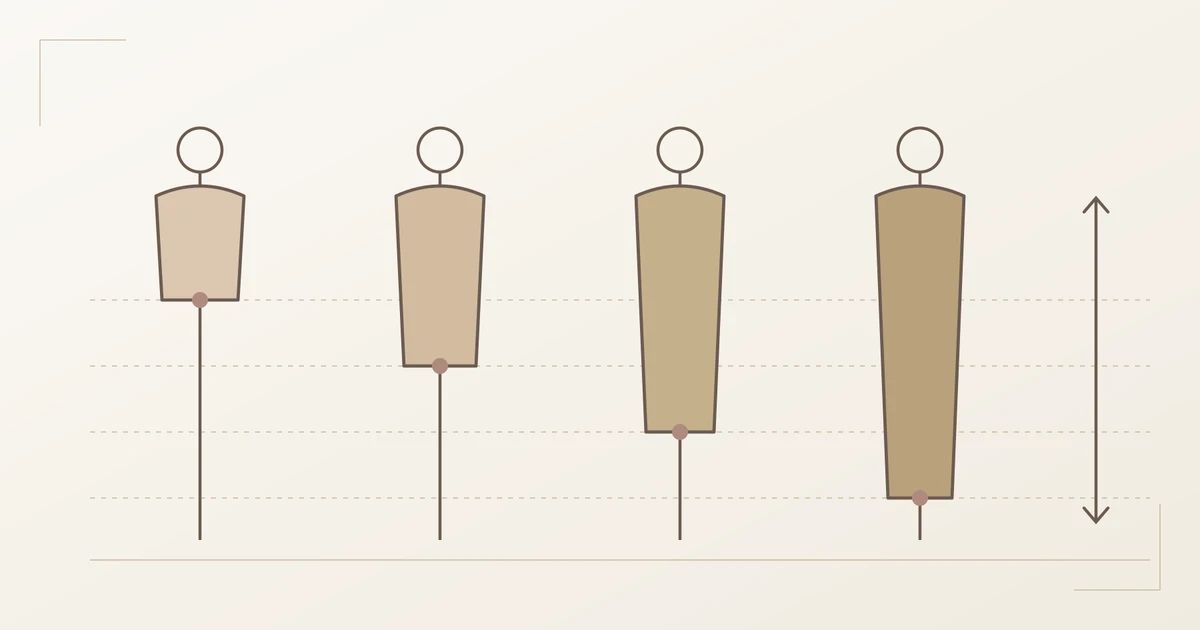
Every hem is a horizontal cut through the vertical. What matters is where it lands and what it divides as a result:
- Hip length (short coat, pea coat). The hem cuts across the widest point of the hip. It divides the figure early and works best with long legs and compact lines — the Gamine family thrives on it. With a short leg line, this length pulls the eye downwards.
- Knee length. The most reliable length, because the knee is a natural articulation point. It works on almost any proportion, as long as the hem ends just above or on the kneecap — never exactly on the widest part of the calf.
- Mid-calf (midi). The most difficult length. It cuts precisely where the leg is widest and breaks the vertical in the middle. On a long vertical line with slim calves it looks elegant; on a short vertical it shortens you every time.
- Ankle length (longline). The hem sits below the calf and lets the vertical run almost uninterrupted. That lengthens — even at a small height, as long as the silhouette stays narrow and the shoes match in colour. A wide longline coat on a small scale, by contrast, looks borrowed.
The rule of thumb for the hem
A coat hem should never end at the widest point of the leg — neither at mid-calf nor at the fullest part of the thigh. The target points are the narrow spots: just above the knee, just below the knee, or below the calf. And: the coat always has to be longer than the skirt or dress underneath, otherwise you create two competing hems.
Fabric weight and texture by type
Fabric weight is the density and stiffness of the coat cloth — it determines whether the coat holds a shape or drapes. Texture is the surface structure: smooth, brushed, crimped or fulled. Together the two create the coat's character before the cut even comes into play.
- Smooth and firm (gabardine, worsted, crisply woven virgin wool). The fabric keeps edges and seams visible. It supports sharp lines and clean construction — Dramatic and Classic. On soft facial features it comes across as cool and hard.
- Soft wool felt, cashmere blends, boiled wool. The fabric drapes rather than stands, edges soften. This is the fabric of the Romantic family and of all soft lines — it drapes around rounded shapes instead of building over them.
- Texture: tweed, bouclé, herringbone, mélange, teddy. Visible structure brings irregularity and grounding. It belongs to the Natural family and makes even plain cuts interesting. On very clean, sharp lines, coarse texture looks restless.
- Sheen and coating (quilted coat, coated cotton, satin nylon). Sheen visually enlarges and draws the eye to every curve. A small scale and soft shapes do better with matt surfaces.
When it comes to material, it pays to read the label: a high proportion of virgin wool determines drape, warmth and shape retention far more than the brand name does. Background on fibre, wool quality and processing is provided by the industry body Australian Wool Innovation; a factual overview of coat shapes and their history is given in the article Coat (clothing).
Coat colour by colour type
The coat colour is the colour that frames your face almost daily through the cold season. No other garment covers so much surface, stays in use so long, or sits so close to the face. That is precisely why the standard advice "take camel, it's timeless" is the most expensive piece of bad advice in retail.
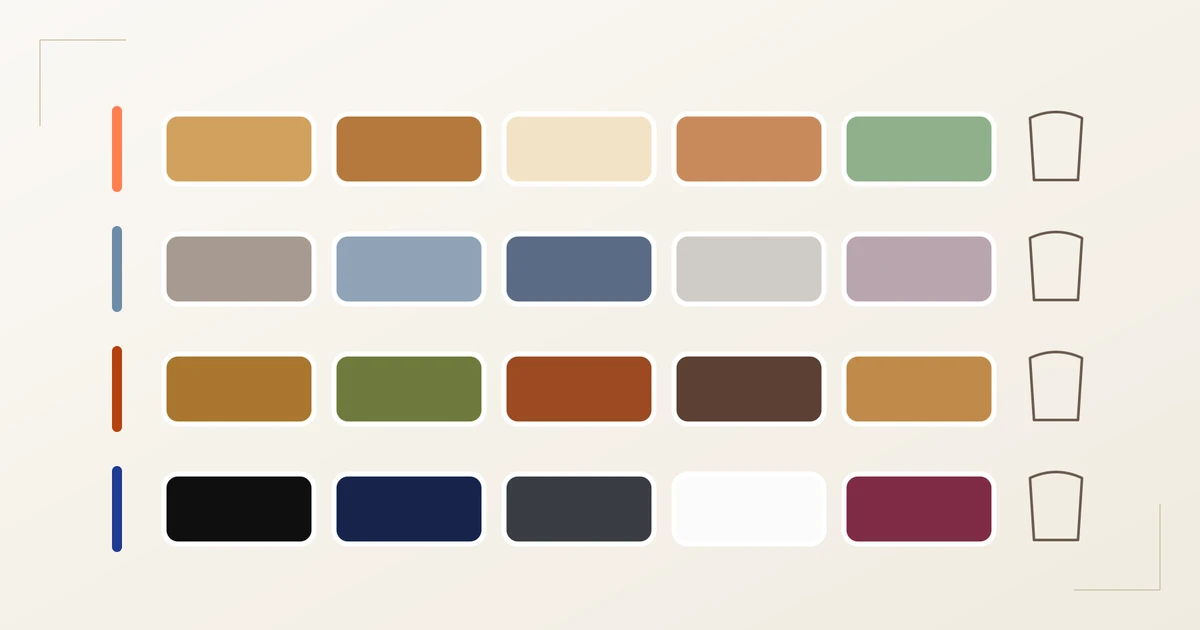
Camel is a warm shade with a golden cast. On a warm skin undertone it makes the face glow. On a cool undertone it lays a yellowish veil over the skin and makes it look tired. "Timeless" is a statement about fashion, not about your complexion.
Spring type: warm and clear
The best coat colours are warm camel, cognac, light caramel, warm beige and a soft navy with warmth in it. Pure black looks hard on a Spring type and takes the freshness out of the face. The palette is warm, but never heavy.
Summer type: cool and muted
The best coat colours are taupe, smoke blue, soft navy, muted grey and mauve. Camel and cognac make a Summer type look washed out, and harsh black overpowers her. The shade may be cool and slightly dusty, but never garish.
Autumn type: warm and deep
The best coat colours are olive, rust, dark camel, cognac brown, moss green and deep terracotta. Cool grey and clear navy look pale and lifeless on an Autumn type. Texture supports this palette particularly well — tweed and mélange play right into its hands. The full palette and the matching neutrals are set out in the guide to Autumn type colours.
Winter type: cool and high-contrast
The best coat colours are black, navy, charcoal, pure white and clear cold shades such as cobalt or wine red. The Winter type is the only type who wears heavy black effortlessly right next to the face. Camel and beige, by contrast, look dull and undecided on her.
The colour rule for investment pieces
The closer a garment sits to the face and the longer you wear it, the more strictly it has to follow your colour type. With a coat, therefore, there is no room for compromise. Which palette is yours is settled by the guide Which colour type am I — or, in five minutes, by the free colour type test.
Typical coat-buying mistakes
A bad coat purchase costs more than any other, because a coat is meant to last for years and is visible almost daily through the season. These seven patterns come up again and again in consultations:
- The shoulder is too wide. The shoulder seam sits three centimetres too low, out on the upper arm. The coat looks borrowed and can barely be altered — the shoulder is the one place a tailor can only correct at great expense.
- Construction that works against your own line. A stiff, padded coat on a softly sloping shoulder. It fits technically and still feels alien — this is the bad buy nobody can explain.
- Detail size chosen by trend instead of by scale. Oversized lapels and plate-sized buttons have dominated the shops for years. On a small scale they are still wrong.
- Camel as the supposedly safe choice. The most common colour mistake of all. Warm neutrals are only safe for warm undertones.
- The wrong length in the wrong place. The hem lands on the widest part of the calf. Five centimetres shorter or longer would have saved the coat.
- Tried on too tight over a jumper — or not tried on at all. A coat is worn over knitwear. If you try it on over a T-shirt, you buy a size that pulls in winter.
- No look at the workmanship. Lining, seam allowances, collar attachment and buttonholes decide whether the coat still holds its shape after two winters.
Which patterns of thinking sit behind these purchases, and how to spot them in the shop before the card goes into the terminal, is covered in the guide Avoiding bad buys.
The 6-step fitting checklist
This order is deliberate: it checks first what cannot be changed and last what is a matter of taste. Follow it and you will put three coats back on the rail before you even button up the fourth.
- Check the shoulders. The shoulder seam ends exactly on your shoulder bone — not before it, not on the upper arm. Only with a deliberately chosen dropped shoulder or raglan cut may it sit lower. This is the most expensive alteration and the most common reason to leave a coat in the shop.
- Test your arm movement. Put on a jumper, close the coat and lift both arms forward as if you were gripping a steering wheel. If it pulls across the back or strains in the armhole, the coat is cut too narrow — regardless of the size on the label.
- Assess the waist and the closure. Button the coat up and look at yourself from the side. If the closure gapes at bust or hip level, the width is distributed wrongly. In the same step, check whether the narrowest point of the coat sits where your narrowest point is.
- Check the length in the mirror — with the shoes you will wear it with. Step back three paces and look at where the hem cuts the leg. Never on the widest part of the calf. Switch once from flat to higher shoes and watch how the effect shifts.
- Hold the detail size against your body. Put your hand next to the lapel and next to a button. Do the details look coherent next to your hand and your face, or oversized? From three metres away, people should see the silhouette first and the buttons second.
- Check the colour against your face — in daylight. Turn the collar up, walk to the door or the shop window and look in the mirror. If your skin looks fresher and your eyes clearer, the colour is right. If shadows under the eyes, redness or a tired tone appear, the coat is wrong — even if the cut is perfect.
The short version of the order: shoulder → construction → scale → length → fabric → colour. Start with the colour and you will spend your time trying on coats that were never going to work at the shoulder anyway.
Conclusion: your coat in four decisions
A coat that genuinely fits comes out of four decisions in a fixed order. The shoulder line sets the construction. The bone structure sets the detail size. The vertical line sets the length. The colour type sets the colour. The letter-based body shape comes only afterwards, and governs nothing more than how much the coat may be waisted.
Once those four levels are right, you no longer need seasonal recommendations — the coat then becomes a piece that carries you for years, exactly as the guide to timeless basics describes for the wardrobe as a whole.
Not sure which line and which palette are yours — and which coat follows from them? The free colour type test settles the colour, the Kibbe test settles the line. In a personal colour and style consultation we translate both into concrete cut and colour recommendations for your next coat. The first conversation is free.
Frequently asked questions (FAQ)
Which coat suits my figure?
Don't start with your body shape, start with your shoulder line: sharp, angular shoulders carry structured, architecturally built coats; broad, bluntly rounded shoulders carry relaxed, slightly oversized cuts with texture; softly sloping shoulders carry fluid coats with a narrow collar. Your figure — that is, the ratio of shoulders, waist and hips — only comes in afterwards, to decide how much the coat may be waisted. Detail size, length and colour follow from bone structure, vertical line and colour type.
Which coat length suits me?
Length is governed by your vertical line, not by your height in centimetres. The hem must never end at the widest point of the leg — mid-calf is therefore the most difficult length, and just above or below the knee the safest. An ankle-length, narrow silhouette extends the vertical and works even at a small height, as long as the cut stays slim.
Which coat colour suits me?
Coat colour follows your colour type, because a coat covers a large area right next to the face. Spring types wear warm camel, cognac and warm beige; Summer types taupe, smoke blue and soft navy; Autumn types olive, rust and dark camel; Winter types black, navy, charcoal and pure white. The in-store test: collar up, step into daylight and see whether your skin looks fresher or more tired.
Is camel really for everyone?
No. Camel is a warm shade with a golden cast, and therefore anything but neutral. On warm undertones — Spring and Autumn — it makes the face glow. On cool undertones it lays a yellowish veil over the skin and makes it look tired; Summer types do far better with taupe, Winter types with navy or charcoal.
Which coat suits broad shoulders?
That depends on the edge, not on the width alone. If the shoulders are broad and sharply drawn, clean straight cuts with a defined shoulder and a narrow silhouette work. If they are broad but bluntly rounded, you need the opposite: unconstructed or raglan shoulders, soft edges and no padding. Padded shoulders on an already broad, soft shoulder look like armour straight away.
Which coat works at a small height?
What matters is the scaling, not giving up on length. Keep lapels, buttons, collar and belt narrow and small so they don't swallow the upper body. A slim, straight silhouette in one continuous colour lengthens — even in longline. What really shortens you is volume, wide horizontal belts and a hem on the widest part of the calf.
How much should a good wool coat cost?
Instead of looking at the price, check the quality markers: a high proportion of virgin wool or cashmere on the label, a cleanly stitched lining, tidy seam allowances, a collar attachment that lies flat and properly barred buttonholes. A shape-retaining coat has a built-in shoulder rather than merely a fused interlining. Work the price out per wear — a coat that lasts five winters costs less per season than three that last one each.
How do I recognise a well-fitting coat?
The shoulder seam ends exactly on the shoulder bone, the closure does not gape at bust and hip level, and you can lift both arms forward with a jumper underneath without it straining across the back. The sleeve ends at the wrist bone and the collar lies flat against the neck without standing away. If one of these things is off, a different size rarely helps — usually the cut is simply someone else's, not yours.
Which coat suits tall women?
Greater height often comes with a larger bone structure, and then the details need presence: wider lapels, stronger buttons, larger collars and longer cuts. Details that are too small look dainty and lost on a large scale, not understated. Short coats work if the legs are long — otherwise they shift the volume upwards and visually shorten the torso.
Further reading: Australian Wool Innovation — wool, fibre and processing · Coat (clothing) — shapes and history.