
TL;DR — Fashion for tall women
- Tall women do not need special rules, but three answers: where your length sits (long torso or long legs), how fine or strong your bone structure is and whether your line carries the vertical.
- Height is not scale. Guides recommend oversize and XXL accessories to tall women across the board. On a fine bone structure that is exactly what overwhelms — scale follows your bones, not your centimetres.
- Two women at 1.80 m often have opposite problems. With a long torso the opposite applies to what applies to long legs — including the rise.
- The vertical is yours. Horizontal stripes and breaks do “shorten” — but balancing out is a style decision, not an obligation. Clear, long body lines look more coherent in the continuous column.
- The real everyday problem is length: sleeves, inseam, torso length and hem land too high in standard sizes — and usually cannot be lengthened.
Fashion for tall women works when three things are right: the lengths match your actual limbs, the volume matches your bone structure and the colour distribution matches your body line. What decides is not your height, but where that height sits — in the torso or in the legs. Tall sizes solve the length problem, but not the proportion.
Almost every guide on this subject says the same thing: buy tall collections, wear horizontal stripes, visually shorten the silhouette. That is partly practical, partly questionable — and it leaves open why the same recommendation looks completely different on two women of the same height.
Contents
- Why “tall” is not a style category
- The three questions that actually count
- Where your length sits: torso or legs
- Height is not scale: the bone structure decides
- The length problem: where standard sizes fail
- The vertical: balance it out or own it?
- Tall women and the body line
- The key pieces in a length check
- Accessories by scale, not by height
- Step by step to the right outfit
- The most common mistakes
- FAQ — Frequently asked questions
Why “tall” is not a style category
Height is a number, not a style category. It says how many centimetres you measure — not how those centimetres are distributed, how strong your bone structure is or which shapes suit your contours. That is exactly why guides treating all tall women alike miss systematically.
Two women at 1.80 m can need completely opposite wardrobes. One has long legs and a short upper body, the other a long torso and legs of normal length. One has fine joints, the other broad shoulders and strong bones. A tip that serves both at once does not exist.
What does actually connect: standard clothing sizes map circumferences, not lengths. That is why you can be in the right size and still have sleeves that are too short. That is not a figure problem, it is a sizing-standard problem.
The same logic applies in the other direction: at a small height too it is not the number that decides but the proportion — the counterpart to this guide is in Styling for petite women.
The three questions that actually count
Instead of “what suits tall women?”, three more precise questions lead to the answer:
- Where does your length sit? In the torso or in the legs. That decides the rise, the top length and the belt position.
- What is your scale? Finely or strongly built. That decides volume, fabric weight, detail size and accessories.
- Which body line do you have? Sharp, soft, relaxed, balanced or compact. That decides the character of the cut and whether the continuous vertical carries you.
Height appears in none of these questions as a factor of its own — it only amplifies the answers. Let us take them in order.
Where your length sits: torso or legs
Proportion describes how your total length is distributed between upper body and legs. Two women of the same height can be built in opposite ways here — and therefore need opposite cuts. This is the point at which most guides become sweeping: they equate tall with long-legged.
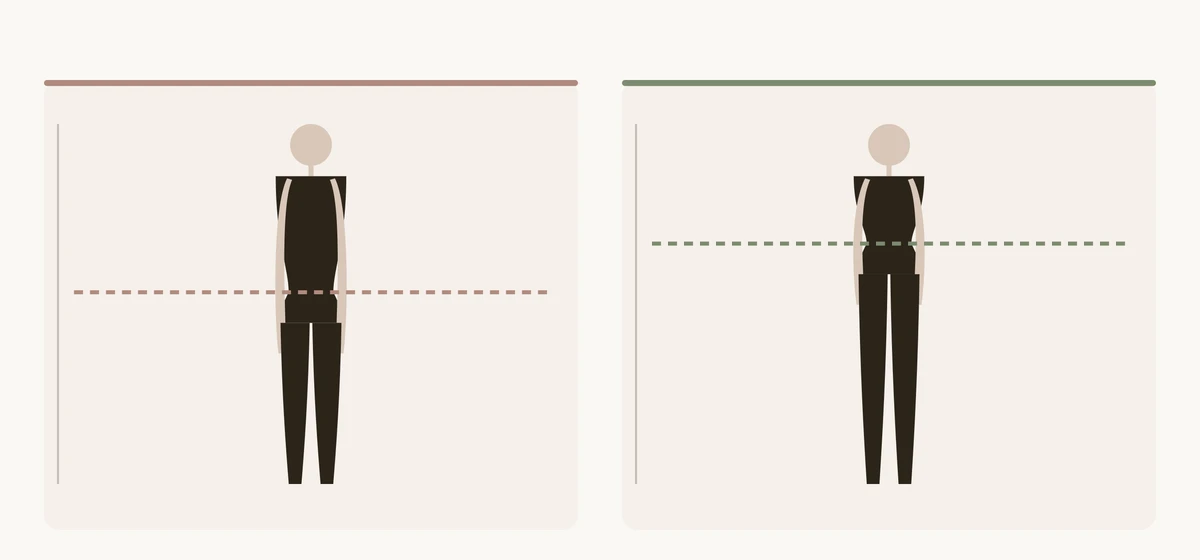
How to find out: stand straight in front of the mirror and find your natural waist — the narrowest point between the rib cage and the hip bone. If it sits above the middle of your body, the legs dominate. If it sits below or exactly on the middle, you have a long torso.
The rise follows directly from that. With a long torso, a high rise is right: it lets the leg line start higher and balances the torso length. With long legs and a short upper body, the widespread recommendation actually holds — a mid rise stops the upper body looking even shorter. The same logic governs which skirt suits your body.
Height is not scale: the bone structure decides
Scale is the strength of your bone structure, height is your body height — the two are independent of each other. There are tall women with very fine wrists and narrow shoulders, and there are petite women with strong bones. Because guides equate the two, they recommend oversize, chunky knits and XXL bags to tall women across the board.
Check your scale at the wrist: wrap the thumb and middle finger of one hand around the other wrist. If they clearly overlap, you have fine bones — even at 1.82 m. If they barely touch, you carry real volume.
In practice: a tall woman with fine bones wears narrow cuts, finer knits, delicate fastenings and medium-sized accessories — just in a longer execution. A tall woman with a strong bone structure really does carry the volume the guides recommend to everyone. It is not the centimetres that decide, but the frame.
The length problem: where standard sizes fail
The practical everyday life of tall women is rarely a style question, but a length question. Standard sizes scale circumferences far more than lengths — a larger number brings more width, but hardly any extra sleeve or inseam length. The result: pieces that fit and are still too short.
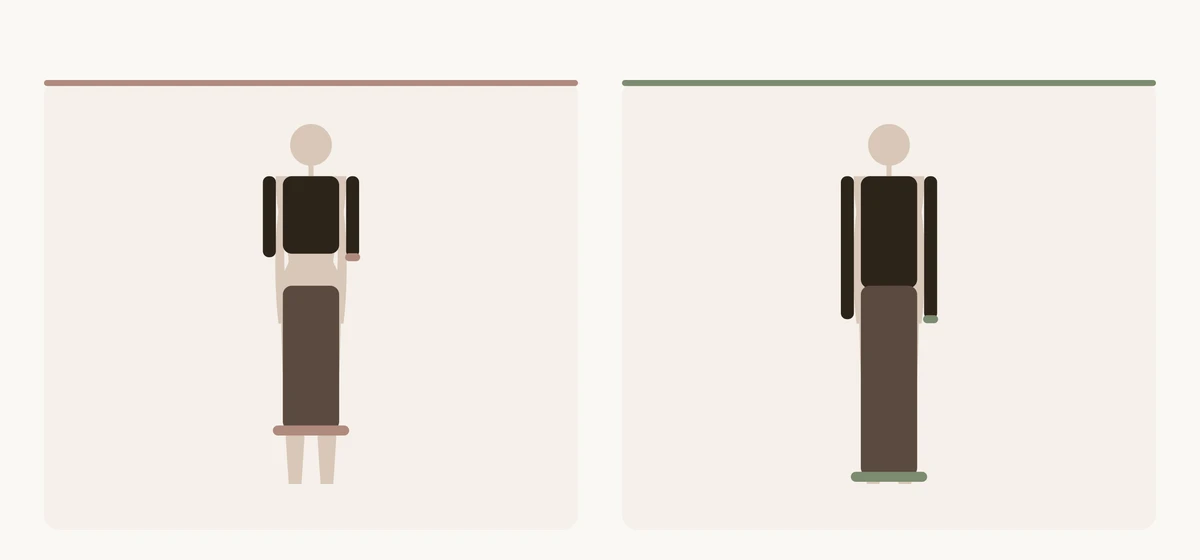
Four points fail regularly: the sleeve length (ending at mid-forearm instead of the wrist), the inseam (the trouser leg ending at the calf), the torso length in dresses and bodysuits (the waist seam sits too high) and the hem of tops, which rides up when you raise your arms.
Important: shortening is almost always possible, lengthening almost never — ready-to-wear rarely has more than two to three centimetres of seam allowance. For critical lengths you therefore buy tall cuts, or watch for inseams given in centimetres, rather than hoping for the alterations tailor.
The vertical: balance it out or own it?
Here this guide deliberately departs from the consensus. The standard recommendation is: horizontal stripes, colour blocking, contrasting belts — anything that interrupts the silhouette horizontally and therefore visually shortens it. That works. The question is whether you want it.
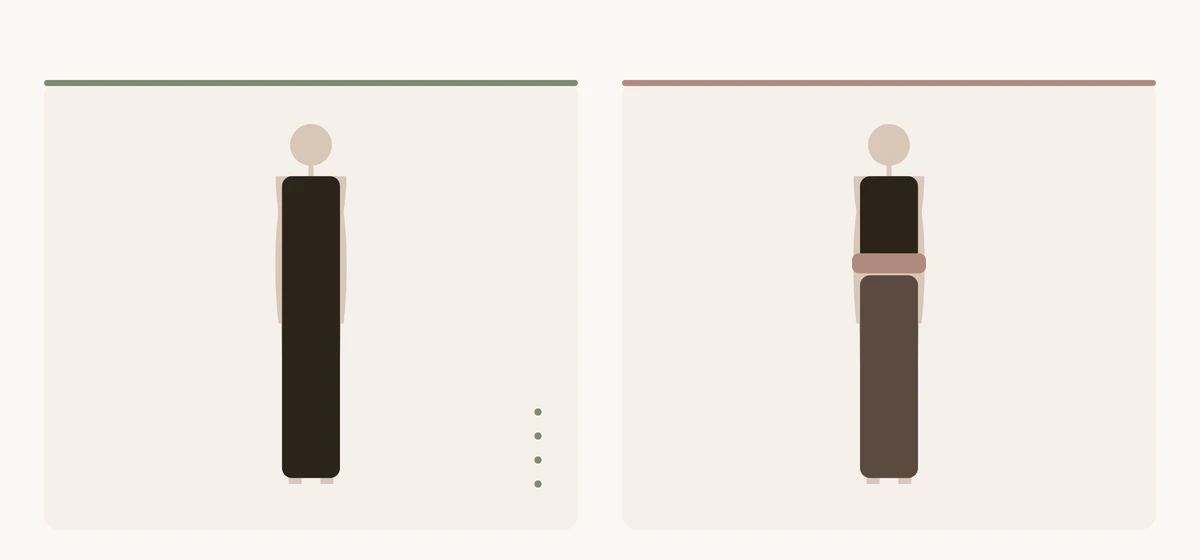
Balancing out is a style decision, not a rule. Your height is not a mistake that has to be corrected — it is a feature you can emphasise or calm down.
If you have long, clear lines, the continuous vertical works for you: one colour family from top to shoe, long coats, unbroken seams. A hard horizontal break cuts through exactly the line that makes up your structure. If, on the other hand, you have soft or compact lines, a deliberate break orders the silhouette and looks more coherent than the endless column. It is not your height that decides, but your line.
Tall women and the body line
Your body line describes whether your contours are sharp and straight, soft and round, or strong and relaxed. It is independent of height — but on tall women it reads more strongly, because there is more surface available. The Kibbe test gives the direction.
Sharp, long lines
This is where the classic “tall” effect sits. Long coats, straight column cuts, clean edges and monochrome outfits reinforce the structure. Volume and many small details dilute it. This is the type for which breaking the vertical makes the least sense.
Strong, relaxed lines
Tall women with broader bones carry substance: textured fabrics, unstructured cuts, denim, linen, robust knits. Overly strict, tight silhouettes look stiff here — coat construction shows the same principle.
Soft, round lines
Fluid fabrics, curved cuts and soft transitions. Here the gentle horizontal break — a wrap dress, a softly sitting belt — really is an advantage, because the line cannot carry a hard column anyway.
Balanced and compact lines
Neat, medium cuts without extremes. Neither the maximum column nor a strong break, but clear, clean proportions in sufficient length.
The key pieces in a length check
| Piece | Critical point | What to watch |
|---|---|---|
| Trousers | Inseam | Inseam in cm instead of dress size; hem at the ankle or above the widest calf |
| Blazer & coat | Sleeve and torso length | Sleeves to the wrist bone; waist seam on your own waist |
| Dress | Waist seam and hem | Seam on your waist, not above it; hem at a slim point of the calf |
| Top | Hem length | Covers the hip even with raised arms; otherwise the line slips |
| Skirt | Length relative to the leg line | A midi often ends too high at 1.80 m — check the position on the calf |
For trousers and jeans it pays to look at the inseam — more on that in the guide Which jeans suit your body.
Accessories by scale, not by height
“Tall women can carry big bags” is the standard line — and again a height-instead-of-scale confusion. Accessory size follows your bone structure, not your height. A tall woman with fine joints looks more harmonious with a medium-sized model than with an XXL shopper.
Two points matter more than the size: the landing point — a crossbody bag should not end exactly at the widest point of the hip — and the strap length, which you can adjust on adjustable models. Details are in the guide Which bag suits your body. Conversely: very small mini bags quickly look lost on tall women — here the scale really is too small.
Step by step to the right outfit
Here is how to proceed at your next purchase:
- Determine your proportion. Find the natural waist and compare it with the middle of your body — long torso or long legs?
- Check your scale at the wrist. Fine or strong bones? That sets volume and detail size.
- Determine your body line. Sharp, soft, relaxed, balanced or compact.
- Decide about the vertical. Do you want to emphasise the length (continuous colour column) or calm it (a deliberate horizontal break)?
- Choose the rise by the proportion. High rise with a long torso, mid rise with long legs.
- Check the four critical lengths. Sleeves, inseam, torso length, hem — in front of the mirror, with raised arms.
- Check the whole picture. Step two paces back: does the outfit read as one line or as a collection of pieces that are too short?
The most common mistakes
The most common mistake is not a wrong cut, but a wrong assumption: that height automatically carries volume and automatically has to be balanced out.
- Confusing height with scale. Oversize and XXL accessories suit a strong bone structure, not automatically a tall height.
- Buying a size up to gain length. That brings width, hardly any length — and the shoulders then sit wrong.
- Breaking the vertical reflexively. With clear, long lines the horizontal stripe cuts through exactly the structure that carries.
- Choosing the rise across the board. Mid rise is right only with long legs; with a long torso the opposite applies.
- Hoping for the alterations tailor. Lengthening is rarely possible — critical lengths have to be bought right.
- Checking only while standing. Only with raised arms and while seated does it show whether hem and sleeves really reach.
From height to the right line
Find the cuts that carry your length
This guide gives you the tools. A professional Kibbe and colour analysis gives you your personal result: which proportions, lengths and tones your structure really carries. A free initial consultation is always included.
FAQ — Frequently asked questions
What fashion suits tall women?
Fashion suits tall women when its lengths actually match their limbs and its volume matches their bone structure — not their height. Three things decide: where your length sits (long torso or long legs), how fine or strong your bone structure is, and whether your body line carries the continuous vertical or needs an interruption. Tall sizes solve only the length problem, not the proportion.
Should tall women visually balance out their height?
No, not automatically. Almost all guides recommend horizontal stripes, colour blocking and horizontal breaks to shorten the silhouette — but that is a style decision, not a rule. Anyone with long, clear body lines looks more coherent in the continuous vertical than in an artificially cut-up silhouette. Balancing out makes sense if you want it, not because you are tall.
What is the difference between tall and large scale?
Height is your body height, scale is the strength of your bone structure. The two are independent: there are tall women with very fine wrists and petite women with strong bones. Because guides confuse height with size, they recommend oversize and XXL accessories to tall women across the board — on a fine bone structure that is exactly what overwhelms.
How do I find out whether I have a long torso or long legs?
Sit upright on a chair and compare in the mirror: if your upper body looks strikingly long while seated and your legs look normal while standing, you have a long torso. If your waist while standing reaches clearly above the middle of your body, you have long legs. Practical test: where does your natural waist end relative to the middle of your body? If it sits above it, the legs dominate.
Does a high or mid rise suit tall women better?
That depends on where your length sits, not on your height. Many guides recommend a mid rise to tall women across the board, because a high rise supposedly shortens the upper body — that only holds with already long legs and a short torso. If you have a long torso, a high rise is exactly right, because it balances the torso length and lets the leg line start higher.
What trouser length do tall women need?
Trousers should end at a slim point: just at the ankle, on the instep, or clearly above the widest point of the calf. The most common problem is not the width but the inseam — standard sizes often end at mid-calf on tall women and make the trousers look bought a size too small. Tall sizes and inseams given in centimetres solve that more reliably than a size up.
Which pieces can be altered when the lengths are too short?
Sleeves and hems can only be lengthened if there is enough seam allowance — in ready-to-wear usually a few centimetres. Shortening is almost always possible, lengthening rarely. That is why, for critical lengths (trouser leg, sleeves, torso length in dresses), you buy tall cuts rather than hoping for the alterations tailor. Moving shoulder seams and armholes is expensive and rarely worth it.
Which bags suit tall women?
Not automatically the biggest. Bag size follows your overall scale of height and bone structure: a tall woman with fine bones carries medium-sized models more harmoniously than XXL shoppers. What also matters is the landing point — a crossbody bag should not end at the widest point of the hip. Mini bags, by contrast, quickly look lost on tall women.
Which dress length suits tall women?
Maxi and midi lengths suit tall women particularly well, because they have enough fabric to continue the line. The critical zone is where a dress lands in standard sizes: what is sold as a midi often ends just below the knee at 1.80 m and looks like a dress that came out too short. Do not check the label, check where the hem sits on your calf.