
TL;DR — Which skirt suits my body?
- Which skirt suits your body is decided not only by your classic body shape, but by three layers: the skirt shape relative to your body line, the waist placement and the length relative to your leg line.
- Guides sort almost only by body shape (an A-line balances the hips). That’s true — but only half the story. Whether the same A-line carries you depends on your body line.
- The waist placement is the most-overlooked point: a high waistband lengthens the leg, a low one shortens it — regardless of the skirt shape.
- The length is measured on your leg line, not in centimetres. The hem must not end at the widest point of the calf — whatever the label says.
- Five basic shapes are enough: pencil, A-line, pleated, wrap and circle skirt. Which one carries you follows from line, waist and length.
Which skirt suits your body is decided not only by your body shape, but by three things: the skirt shape relative to your body line, the height at which the waistband sits, and the length relative to your leg line. A skirt fits when its shape mirrors your line, its waistband starts your leg line at the right point, and its hem ends at a slim part of your leg. The classic body-shape rule is only one of these three layers.
Almost every skirt guide sorts by body shape: A-line for the pear, pencil for the hourglass. That’s right — and incomplete. It doesn’t explain why the same A-line skirt looks completely different on two women with the same figure. The reason is the body line.
Contents
- Why the “skirt by body type” rule is only half the story
- The three layers: shape, waist placement, length
- The five skirt shapes at a glance
- Skirt shape by body line
- The waist placement: high, mid, low
- Skirt length by leg line, not centimetres
- Fabric and drape decide too
- Skirt by classic body shape
- The conflict case: when body shape and line disagree
- Step by step to the right skirt
- The same skirt for day, office and evening
- The most common mistakes when buying skirts
- FAQ — Frequently asked questions
Why the “skirt by body type” rule is only half the story
“An A-line balances the hips, a pencil skirt emphasises the waist” — that’s the standard answer in almost every skirt guide. It isn’t wrong. It sorts skirts by classic body shape and balances proportions. But it only explains how a skirt balances your silhouette — not whether its form language belongs to you.
A skirt suits your body when three things come together: its shape mirrors your body line, its waistband sits at the right height for you, and its hem ends at a slim part of your leg. Body shape is only the first of these three levers — and the only one most guides address. That’s exactly why a skirt “in the right size for your figure” still often doesn’t sit right: because the waist placement and length are off.
This guide covers all three layers. It keeps the classic body-type logic — and adds the two factors that make the difference between “suits me” and “only hangs in the wardrobe”.
The three layers: shape, waist placement, length
Three levers decide whether a skirt suits your body:
- The shape (line). Straight, flared, pleated or wrapped — the silhouette of the skirt has a character that has to match your body line. This is the layer almost everyone skips.
- The waist placement. Where the waistband sits shifts the start of your leg line and therefore the whole proportion — regardless of the skirt shape.
- The length. Where the hem ends decides the apparent leg length. It follows your leg line, not a number in centimetres.
Classic body-shape advice covers part of the first layer. Waist placement and length almost never come up — yet they’re often the real reason a skirt doesn’t sit. Let’s take the layers in order.
The five skirt shapes at a glance
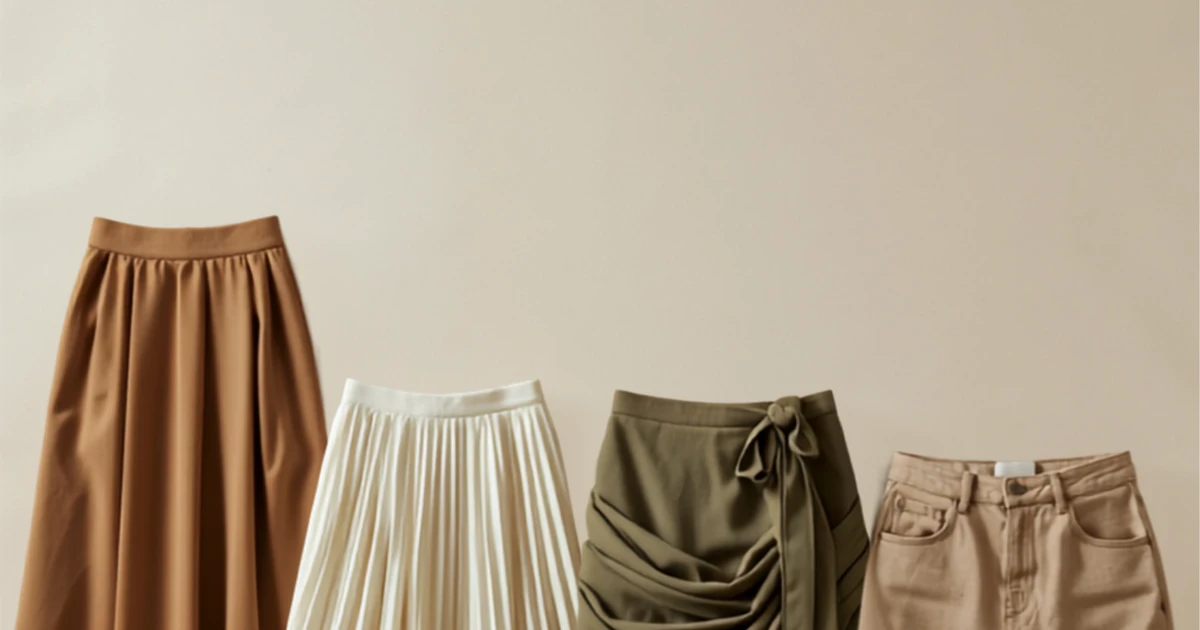
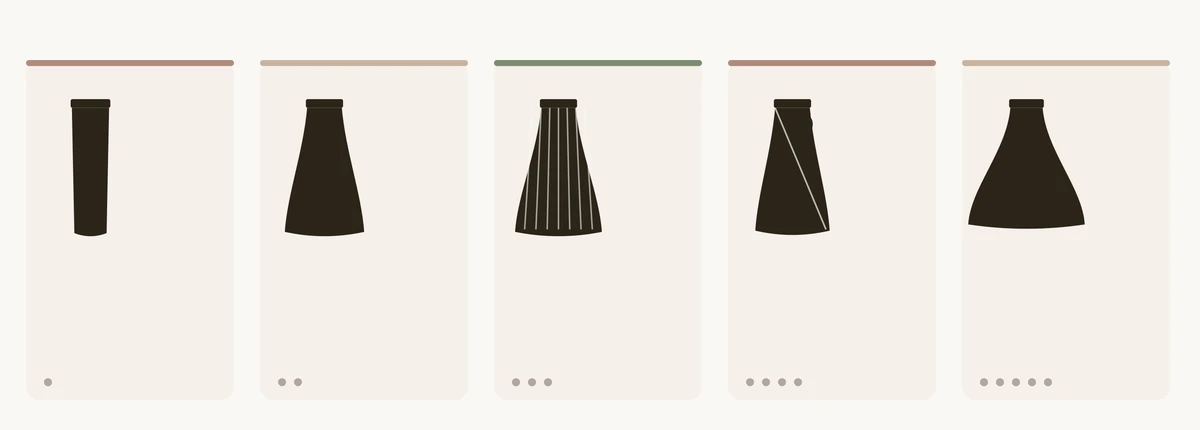
Five basic shapes cover almost every skirt. Each has its own character and its own effect on the silhouette:
| Skirt shape | Effect | Suits which line |
|---|---|---|
| Pencil (straight, narrow) | emphasises waist and leg line, reads strict | sharp, clean lines; hourglass |
| A-line (flared) | balances the hips, reads classic | balanced lines; pear |
| Pleated | adds movement, reads soft and light | soft lines; relaxed lines |
| Wrap | emphasises the waist diagonally, reads fluid | soft, round lines |
| Circle / full | lots of volume, reads romantic and playful | soft lines; larger scale |
The “line” column is a starting point, not a law — waist placement, length and fabric shift the effect of every shape.
Skirt shape by body line
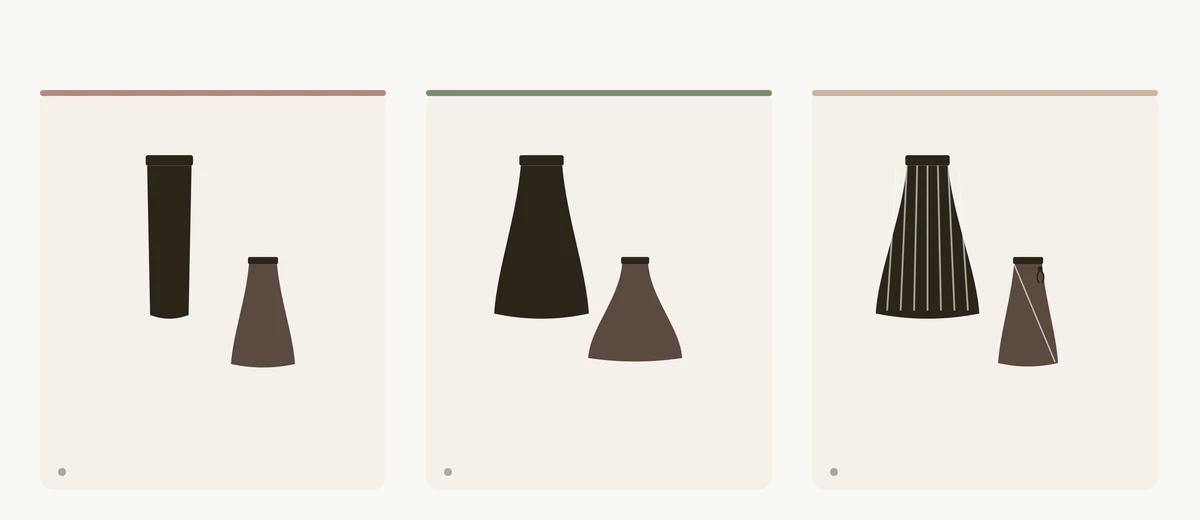
Your body line describes whether your contours are sharp and straight, soft and round, or strong and relaxed. It decides which form language carries you — and this is exactly where classic body-shape advice stops. Two women with a pear figure get the same A-line recommended; the one with a sharp line wears it stricter and knee-length, the one with a soft line fluid and pleated. The body line by Kibbe gives the direction.
Sharp, clean lines (Dramatic family)
Long, straight, angular body lines wear skirts with the same clarity: straight pencil skirts, strict A-lines, smooth fabrics, clean edges. Volume, many pleats and playful details dilute the effect. A narrow midi pencil in a firm fabric sits better here than a wide circle skirt.
Strong, relaxed lines (Natural family)
Broader bones and relaxed contours wear skirts with substance and texture: denim, corduroy and linen skirts, fuller A-lines, unstructured shapes. Too strict, glossy or tightly tailored styles look costumed here. A soft, slightly flared skirt with texture carries best.
Soft, round lines (Romantic family)
Curved, soft contours wear skirts with movement: fluid pleated skirts, wrap skirts, circle skirts in soft-draping fabric. Hard, strictly straight cuts in stiff material look foreign on soft lines. The fabric should follow the silhouette, not stiffen away from it.
Balanced and compact lines (Classic, Gamine)
Balanced lines (Classic) wear neat knee lengths with no extremes — the classic A-line, the clean pencil. Compact, small-scale lines (Gamine) wear shorter skirts with detail: pleats on a smaller scale, cheeky A-lines. For both: medium length, no single feature dominates.
The waist placement: high, mid, low
The waist placement is the height at which the waistband sits — and it shifts the start of your leg line. This is the most-overlooked factor when buying a skirt. Your leg line visually begins where the skirt begins, at the waistband. Sitting higher, the leg looks longer; sitting lower, it looks shorter.
It’s not the skirt length alone that makes long legs, but the interplay of waist height and hem. A high waistband with a knee-length hem lengthens more than a low waistband with a long midi.
A high waistband lengthens the leg and suits a long torso and short legs — petite women benefit most, as described in the guide Styling for petite women. A mid waistband is neutral and everyday-friendly. A low waistband shortens the leg and needs a short torso that can gain length in the middle. Always check the waist placement first — it decides half the effect.
Skirt length by leg line, not centimetres
The right skirt length is measured not in centimetres, but on your leg line. A label says “midi” — but whether that midi ends on the slimmest or widest point of your calf depends on your leg length. And that’s exactly what decides the effect.
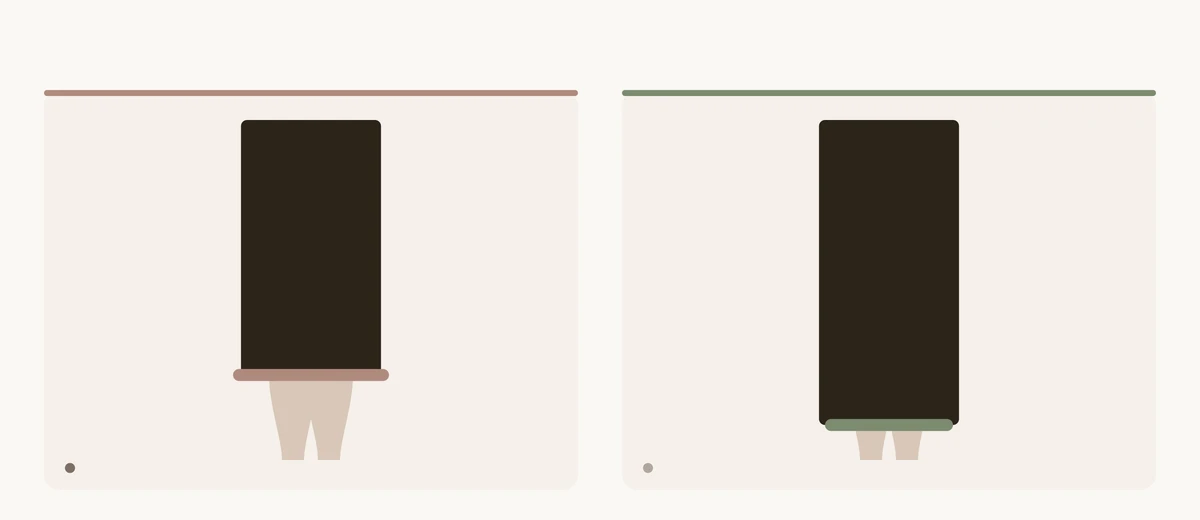
The rule is simple: the hem should end at a slim part of the leg — just below the knee, at mid-calf above the widest part, or at the slim ankle. If it ends exactly on the fullest part of the calf, it sets a horizontal cut on the widest point and shortens the leg. The same logic applies to dresses and to choosing the right shoes: transitions belong at slim points.
Fabric and drape decide too
The same skirt shape looks completely different in two fabrics. The drape of the fabric decides whether a shape flows along your silhouette or stands away from it. An A-line skirt in firm cotton poplin stands out and adds bulk; the same cut in viscose or Tencel falls soft and slim.
The rule of thumb follows the body line: soft lines wear fluid fabrics (viscose, silk, jersey, fine pleats) that follow the contour. Sharp, clean lines wear firm fabrics (twill, firm denim, wool blend) that hold a constructed shape. Strong, relaxed lines wear textured, substantial fabrics with visible texture. A stiff fabric on a soft line looks hard, a too-soft fabric on a sharp line loses the clarity.
Skirt by classic body shape
Classic body shape remains a useful layer — as one of three levers, not the sole rule. It describes where your body carries volume and helps balance proportions:
- Pear (hips wider than shoulders): A-line and slightly flared shapes balance the hips. The skirt sits at the waist and falls softly over the hip.
- Hourglass (waist clearly narrower): pencil and fitted skirts emphasise the waist. A firm fabric that smooths the curve rather than emphasising it matters here.
- Straight / rectangular (little waist): pleated and wrap skirts visually create a waist and bring movement to the straight line.
- Round middle: a skirt that sits above or below the fullest point, with soft-falling fabric from the waistband, leads slimly along the silhouette.
What matters is combining this layer with line and length — not taking it as the only rule. That’s exactly where the next section comes in.
The conflict case: when body shape and line disagree
The interesting case is the contradiction. What if your body shape asks for one thing and your body line for another? Example: you have a pear figure (body shape says: A-line to balance) and at the same time a sharp, clean line (line says: straight, strict, no volume). A soft, widely flared A-line does balance the hips — but looks too demure and sweet on a sharp line.
In a conflict, the line wins for harmony, the shape for balancing proportions. Translated: take the form language of your line — and solve the balance through cut, fabric and colour, not through a shape that works against your line.
In the example that means: not a romantic, widely swinging A-line, but a strict, only slightly flared A-line or a firm pencil skirt in a darker tone at the hip. The clean shape honours your line, the subtle flare and the colour balance the hips. You get both — harmony and balance — without one fighting the other. This order is the core: line first, balance as fine-tuning.
Step by step to the right skirt
Here’s how to proceed at your next purchase — in this order:
- Determine your body line. Sharp, soft, relaxed, balanced or compact? The Kibbe test gives the direction.
- Choose the skirt shape by the line. Straight and strict, fluid and soft, or textured and full.
- Check the waist placement. High waistband for long legs and a short torso, low for the reverse, mid as neutral everyday.
- Set the length on your leg line. The hem must end at a slim part, never on the widest calf.
- Choose the fabric by drape. Fluid for soft lines, firm for sharp ones, textured for relaxed ones.
- Balance the body shape. Only now: use flare, colour and cut to balance proportions.
- Check the skirt in the whole picture. With the planned top and shoe in front of the mirror — the line from waistband to hem to toe decides.
The same skirt for day, office and evening
An occasion rarely calls for a particular skirt shape — it calls for a particular level of formality. And that can be expressed in any shape. Take the A-line skirt: for everyday in denim with a sneaker, for the office in wool blend with a pencil-close drape and pumps, for the evening in fluid satin with a delicate shoe. The same base shape, three levels of formality — and at each you choose the variant that suits your line.
Three to four basic skirts in your character language — a pencil, an A-line, a fluid pleated or wrap skirt — cover most situations, as long as fabric and length match the formality. It’s the same capsule logic that works for jeans and dresses.
The most common mistakes when buying skirts
The most expensive skirt is not the pricey one, but the one that hangs in the wardrobe — because it was bought by body shape, while waist placement and length were never checked.
- Buying by body shape only. The body-type rule is one of three layers — line, waist placement and length are missing otherwise.
- Ignoring the waist placement. A low waistband can shorten the best cut; a high one often rescues a whole outfit.
- Thinking of length in centimetres. What matters is where the hem lands on your calf, not the label.
- Overlooking the fabric. The same shape sits completely differently in stiff and fluid material.
- Buying against your own line. A widely swinging skirt on a sharp line looks costumed, however lovely on its own.
- Checking only while standing. A skirt has to sit while seated and walking — that’s where the waistband and length prove themselves.
From rule to the right skirt
Find the skirts that carry your line
This guide gives you the tools. A professional Kibbe and colour analysis gives you your personal result: which shapes, lengths and tones your structure really carries — from the skirt to your whole silhouette. A free initial consultation is always included.
In winter the gap between hem and boot shaft decides as well — it determines whether the leg reads as one line or three sections. More on that in which boots suit my figure.
FAQ — Frequently asked questions
Which skirt suits my body?
The skirt that suits you is the one whose shape mirrors your body line and whose length ends at a slim part of your leg: clean, sharp lines wear straight pencil and strict A-line skirts, soft lines wear fluid pleated and wrap skirts, strong, relaxed lines wear fuller, textured shapes. The classic body-type rule (an A-line balances the hip) is only one of several layers. What also decides is where the waist sits and where the hem ends.
Which skirt looks slimming?
The most reliably slimming skirt is one whose hem doesn’t end at the widest point of the calf, that sits on or just above the natural waist, and whose fabric falls rather than stands away. A straight or slightly flared cut in a continuous colour lengthens. A stiff, widely standing fabric or a hem right at the fullest calf, by contrast, adds bulk.
Which skirt length suits me?
The right length is measured not in centimetres but on your leg line: the hem should end at a slim part — just below the knee, at mid-calf above the widest point, or at the slim ankle. If it ends exactly on the fullest calf, the leg looks shorter and wider. Petite women lengthen with knee lengths and high cuts, taller women can carry longer midi and maxi lengths.
Does a pencil skirt suit every figure?
A pencil skirt flatters many figures when waist placement and length are right — it emphasises the waist and the leg line. It especially suits clean, straight body lines and hourglass as well as straight figures. With very round hips, a firm, shape-holding fabric that smooths rather than adds bulk matters. Too-tight styles in thin fabric emphasise every contour, which is rarely intended.
Which skirt suits strong thighs?
A slightly flared A-line skirt that sits at the waist and falls softly over hip and thigh without pulling. The fabric should flow, not stiffen — viscose, twill or soft denim rather than stiff taffeta. It matters that the skirt only tapers again below the widest point or falls straight on. A tight pencil cut in thin fabric, by contrast, emphasises this area.
Which skirt suits my Kibbe type?
Sharp, long lines (Dramatic family) wear straight, narrow pencil skirts and clean, strict A-lines. Strong, relaxed lines (Natural family) wear fuller, textured skirts in denim, corduroy or coarse linen. Soft, round lines (Romantic family) wear fluid pleated, wrap and circle skirts with movement. Balanced and compact lines (Classic, Gamine) wear neat knee lengths without extremes.
High or low waistband — which is better?
That depends on your torso length and your desired leg line, not on the skirt shape. A high waistband visually lengthens the leg, because the leg line starts higher — ideal for short legs and a long torso. A mid waistband reads neutral and everyday. A low waistband shortens the leg and suits a short torso that needs length in the middle.
Which skirt goes with which shoe?
The shorter the skirt, the more leg shows — here a shoe in the skin tone lengthens the line. With midi skirts ending at the calf, a short piece of visible leg appears down to the shoe; a flat shoe or a heel in the leg or skirt tone holds the line together. Basic rule: skirt and shoe should speak the same character language — a fluid skirt with a delicate shoe, a structured skirt with a more robust one.
Which skirts are timeless and always wearable?
Three basic shapes in calm colours are timeless: a knee-length pencil skirt, an A-line skirt in midi length, and a fluid pleated or wrap skirt. Bought in your character language and your colour world, they last for years and vary for day, office and evening. Trend shapes add to this base but don’t replace it.